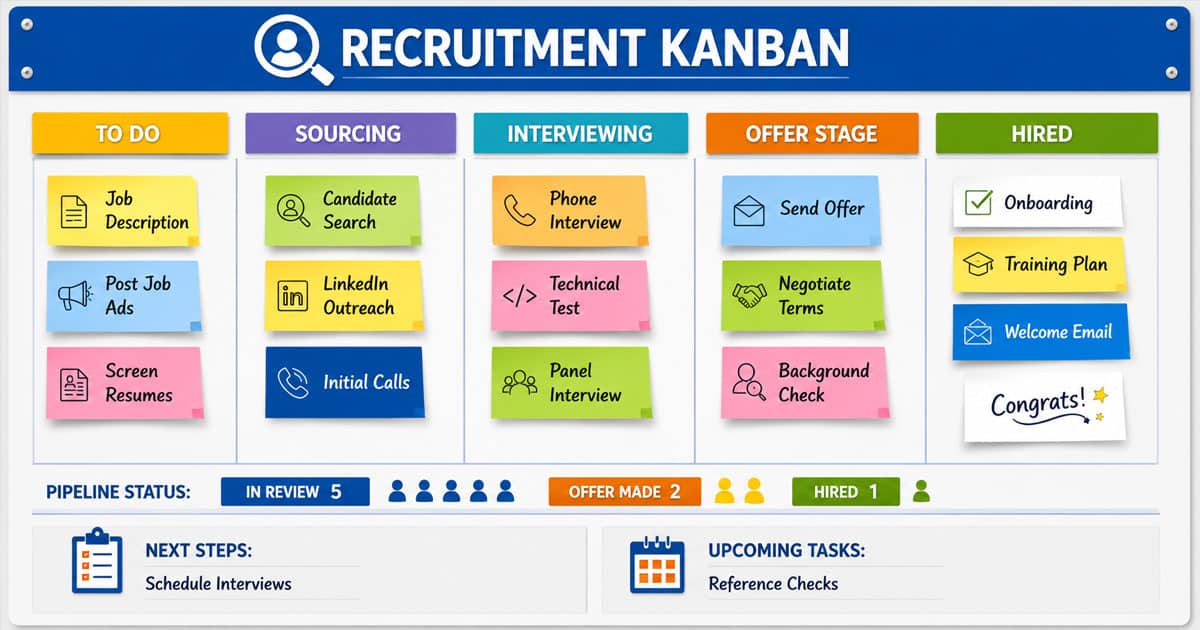
Recruitment kanban offers a clear alternative to a broken system that still defines traditional hiring. Many recruitment process models rely on volume-driven job posting across job boards, which creates bloated applicant pools, resume fraud, AI-generated applications, and unqualified applicants. Hiring deserves a better hiring process. A kanban board brings a visual approach to hiring progress, candidate progress, and various stages of open positions, so the entire team stays on the same page.
Inspired by the kanban method, Toyota introduced to revolutionize manufacturing and software development. Recruitment kanban board design helps HR team members identify bottlenecks, reduce wasted interviews, and make hiring decisions in an efficient manner. Performance-based job descriptions, skills-laden job descriptions, and performance objectives replace the wrong strategy that drives defective output.
High performers gain genuine engagement, clearer career opportunities, career growth, and stay longer, while businesses see higher quality new hires, lower cost, less waste, and reduced turnover.
What Is Recruitment Kanban
Recruitment kanban is a visual, structured approach to managing the recruitment process using a kanban board. The model organizes open positions into various stages, tracking candidate progress from job posting to interviews scheduled and final hiring decisions. Inspired by the kanban method Toyota introduced to revolutionize manufacturing and later adopted in software development and project management, recruitment kanban replaces a volume-driven, broken system with a clear and efficient manner of work processes.
A recruitment kanban board helps HR team members identify bottlenecks, reduce bloated applicant pools, and limit unqualified applicants early through a strong weeding out process built on performance-based criteria. Performance-based job descriptions and skills-laden job descriptions set clear performance objectives for each job class.
Recruitment kanban supports relationship-based sourcing, fewer wasted interviews, higher-quality job candidates, and better workforce planning. Hiring progress becomes visible, hiring decisions improve, and top talent finds a genuine career opportunity with long-term career growth.
How Recruitment Kanban Improves Hiring Workflow Visibility
Recruitment kanban introduces a visual approach that replaces guesswork with clarity across the hiring process. By structuring hiring progress inside a kanban system, HR teams gain immediate insights into candidate progress, internal processes, and workflow health, which supports better hiring decisions and workforce planning.
End-To-End Hiring Progress Visibility
Recruitment kanban presents the entire recruitment process on a single kanban board, where open positions move through clearly defined stages. Every job opens with visible performance objectives and advances step by step, which removes confusion caused by scattered tools and disconnected spreadsheets.
This visual nature allows the entire team to stay on the same page. Hiring progress becomes easy to track, interviews scheduled appear instantly, and delays stand out without reports or meetings. Human resources leaders can process thousands of job candidates while maintaining control and accountability across work processes.
Clear Candidate Progress At Every Stage
A recruitment kanban board shows candidate progress from job posting to final selection without relying on guesswork. Each candidate occupies a visible stage, which makes it easier to understand who advances to the next stage and who exits through the weeding out process.
This transparency limits bloated applicant pools and reduces resume fraud and ai generated applications. HR teams focus on the right candidates rather than on more volume. Clear visibility supports fewer wasted interviews and improves genuine engagement with ambitious people who match performance-based criteria.
Early Identification Of Hiring Bottlenecks
Recruitment kanban helps HR teams identify bottlenecks before hiring stalls. When candidates accumulate in one stage, the wrong process or wrong strategy becomes obvious. Immediate insights replace delayed reporting and reactive fixes.
This approach mirrors how Toyota introduced kanban to fix manufacturing defects and defective output. In hiring, the same logic applies. Clear approval workflow HR exposes broken system issues, improves internal processes, and ensures hiring deserves the same operational discipline as software development and project management.
Stronger Alignment With Performance-Based Hiring
Recruitment kanban aligns workflow visibility with performance-based job descriptions and skills-laden job descriptions. Each stage reflects performance objectives rather than vague qualifications, which improves the weeding out process built on real outcomes.
This structure filters unqualified applicants early and attracts high performers who value a genuine career opportunity. Clear expectations improve hiring decisions, support career growth, and reduce regrettable turnover drops. Hiring progress reflects quality movement, not volume-driven activity.
Better Collaboration Across The Entire Team
Recruitment kanban places human resources, hiring managers, and leadership on the same visual system. The entire team shares real-time visibility into open positions, lateral transfers, and candidate status across various stages.
Shared visibility reduces miscommunication and supports relationship-based sourcing. Decisions happen in an efficient manner, interviews scheduled stay consistent, and hiring progress aligns with workforce planning. Collaboration improves without extra meetings, which lowers cost and reduces waste.
Data-Driven Decisions With Immediate Insights
Recruitment kanban supports better hiring decisions through immediate insights rather than delayed metrics. Visual signals show where hiring slows, where candidate quality drops, and where job boards produce lower quality results.
This clarity strengthens the business case for recruitment kanban. HR teams adjust job class definitions, refine job posting strategy, and avoid the wrong strategy that drives poor outcomes. Fewer mistakes, higher quality new hires, and better long-term career opportunity stay longer become measurable results.
Scalable Visibility For Growing Hiring Needs
Recruitment kanban scales easily as companies post hundreds of roles or manage more volume across departments. The kanban method supports growth without sacrificing visibility or control over candidate progress.
As circumstances align, HR teams increase efficiency, reduce screening, and maintain focus on top talent. Recruitment kanban ensures hiring workflow visibility stays intact, even as organizations expand, attract people at scale, and build a workforce that delivers higher quality outcomes with less waste.
Key Stages Of A Recruitment Kanban Board
A recruitment kanban board breaks the hiring process into clear, visual stages that reflect real hiring progress. Each stage supports better workflow visibility, reduces bloated applicant pools, and helps HR teams move the right candidates forward in an efficient manner.
Job Intake And Role Clarity
Every recruitment kanban board begins with job intake, where open positions enter the system with a clear structure. This stage defines job class, performance objectives, and performance-based criteria before any job posting appears on job boards. Strong foundations prevent a broken system from forming later.
Performance-based job descriptions and skills-laden job descriptions replace vague requirements. This clarity attracts ambitious people seeking a genuine career opportunity and discourages unqualified applicants. A clear role permission definition supports better workforce planning and reduces defective output caused by the wrong process.
Sourcing And Candidate Entry
This stage captures job candidates from job boards, relationship-based sourcing, referrals, and lateral transfers. The recruitment kanban board tracks candidate progress from the moment applications arrive, which limits more volume without purpose.
Early visibility reduces resume fraud, AI-generated applications, and bloated applicant pools. HR teams focus on higher quality rather than volume-driven sourcing. Clear entry criteria ensure hiring deserves disciplined internal processes that support top talent selection and lower cost outcomes.
Screening And Weeding Out
Screening functions as a structured weeding-out process built on performance-based criteria. Candidates advance or exit based on skills alignment and performance objectives rather than subjective impressions.
This stage reduces less screening later in the hiring process and prevents more wasted interviews. Clear visual signals help HR teams identify bottlenecks and correct wrong strategy early. Candidate progress stays aligned with job requirements, which improves hiring decisions and increases efficiency across work processes.
Interviews And Evaluation
Interview stages on a recruitment kanban board track interviews scheduled, feedback cycles, and evaluation outcomes in one visual system. Hiring teams stay on the same page, which supports consistent decision-making.
Structured evaluation limits bias, improves genuine engagement, and ensures the right candidates reach the next stage. Fewer mistakes occur because hiring progress remains visible. Clear evaluation also supports career growth discussions and strengthens the career opportunity presented to high performers.
Offer, Hire, And Onboarding Readiness
The final stage reflects hiring decisions, offers extended, and readiness for new hires. Recruitment kanban keeps visibility on acceptance status, incremental pay bumps, slightly more pay adjustments, and start dates.
Clear closure reduces regrettable turnover drops by HR management setting, accurate expectations. HR teams transition candidates into internal processes smoothly, which improves retention and long-term career opportunity stay longer outcomes. This stage confirms recruitment kanban as a system that delivers higher quality hires with less waste.
Benefits Of Recruitment Kanban For HR And Talent Teams
Recruitment kanban delivers clear operational advantages for hr and talent teams by replacing volume-driven hiring with a visual, performance-based system. The kanban method improves hiring decisions, workflow visibility, and workforce planning while reducing waste across the recruitment process.
Clear Visibility Across Hiring Progress
Recruitment kanban gives hr teams immediate visibility into hiring progress across all open positions. Each stage on the kanban board reflects real candidate progress, which removes reliance on status meetings and delayed reports.
The visual nature of the kanban system helps teams stay on the same page. Bottlenecks appear early, interviews scheduled stay visible, and internal processes become easier to manage. Clear visibility improves accountability and supports higher quality outcomes with fewer mistakes.
Higher Quality Candidate Selection
Recruitment kanban supports performance-based hiring through skills-laden job descriptions and performance objectives. Candidates advance based on measurable criteria rather than subjective impressions.
This structure reduces unqualified applicants, resume fraud, and ai generated applications. Hr teams focus on the right candidates and high performers instead of more volume. Higher quality selection leads to stronger career growth, better job fit, and new hires who deliver value faster.
Fewer Wasted Interviews And Lower Cost
Recruitment kanban reduces wasted interviews by strengthening the weeding out process early in the recruitment process. Clear screening stages filter candidates before interviews consume time and budget.
Lower interview volume reduces cost, limits recruiter burnout, and improves genuine engagement with serious job candidates. Hr teams avoid the wrong strategy that drives bloated applicant pools and focus resources on top talent who align with performance-based criteria.
Improved Team Collaboration And Alignment
Recruitment kanban keeps human resources, hiring managers, and leadership aligned through a shared visual system. The entire team tracks candidate progress, open positions, and decision points in one place.
Shared visibility supports relationship-based sourcing, consistent feedback, and faster hiring decisions. Collaboration improves without excessive meetings, which increases efficiency and strengthens trust across teams responsible for workforce planning. It can be easily done with a workforce calendar.
Better Long-Term Hiring Outcomes
Recruitment kanban improves long-term outcomes by addressing the broken system common in traditional hiring. Clear processes reduce regrettable turnover drops and improve retention.
Candidates experience a genuine career opportunity rather than volume driven job posting. Businesses gain higher quality hires, lower cost, and less waste. Over time, recruitment kanban builds a repeatable hiring system that supports growth, attracts ambitious people, and delivers sustainable talent results.
Recruitment Kanban Vs Traditional Hiring Process
Recruitment kanban replaces the broken system of traditional hiring with a visual, performance-based approach. By structuring hiring progress through a kanban board, hr teams gain clarity, reduce waste, and make better hiring decisions with fewer mistakes and lower cost.
| Recruitment Kanban | Traditional Hiring Process |
|---|---|
| Uses a kanban board to show candidate progress across various stages | Relies on emails, spreadsheets, and disconnected tools |
| Focuses on performance-based job descriptions and performance objectives | Emphasizes generic requirements and volume-driven job posting |
| Reduces bloated applicant pools and unqualified applicants | Encourages more volume from job boards and mass applications |
| Builds a structured weeding-out process early | Pushes screening late, which creates fewer wasted interviews |
| Supports relationship-based sourcing and targeted outreach | Depends heavily on job boards and reactive sourcing |
| Improves hiring progress visibility for the entire team | Limits visibility to recruiters or hiring managers only |
| Lowers cost, less waste, and fewer mistakes | Increases cost through repeated interviews and rework |
| Attracts high performers seeking a genuine career opportunity | Attracts mixed-quality applicants seeking slightly more pay |
| Reduces regrettable turnover drops over time | Produces higher turnover and defective output |
| Enables workforce planning with immediate insights | Reacts late to job opens and hiring delays |
How Recruitment Kanban Supports Faster Candidate Decisions
Recruitment kanban accelerates hiring decisions by replacing fragmented internal processes with a visual, performance-based system. Clear hiring progress, defined stages, and immediate insights help HR teams move the right candidates forward without delay or unnecessary rework.
Clear Decision Points At Every Stage
Recruitment kanban defines explicit decision points across the recruitment management process. Each stage on the kanban board represents a clear outcome, which removes ambiguity and hesitation during evaluation.
Clear structure prevents candidates from stalling between steps. HR teams see exactly when a candidate meets performance objectives and qualifies for the next stage. This clarity supports faster decisions, reduces the wrong process, and keeps hiring progress aligned with workforce planning goals.
Reduced Delays From Hidden Bottlenecks
Recruitment kanban exposes bottlenecks through its visual nature. When candidate progress slows at a specific stage, the issue becomes immediately visible to the entire team.
This transparency allows quick correction of wrong strategy before delays compound. HR teams adjust internal processes, redistribute workload, or refine screening criteria. Faster problem resolution prevents backlog buildup, supports fewer mistakes, and keeps open positions moving toward closure.
Stronger Screening Through Performance Criteria
Recruitment kanban accelerates decisions by enforcing performance-based criteria early. Skills-laden job descriptions and performance objectives guide screening, which strengthens the weeding out process.
Unqualified applicants exit the system earlier, which limits resume fraud and ai generated applications from advancing. Hr teams spend less time debating marginal candidates and more time selecting high performers who match job class expectations.
Aligned Feedback Across The Entire Team
Recruitment kanban keeps hiring management system and human resources aligned through shared visibility. Feedback appears directly within the kanban system, which removes delays caused by email chains and fragmented tools.
Shared context supports faster consensus and consistent hiring decisions. The entire team evaluates candidates against the same performance-based standards, which improves decision confidence and reduces rework caused by misalignment.
Confidence To Act Without Over-Interviewing
Recruitment kanban builds decision confidence by replacing volume-driven evaluation with clear evidence. Structured stages reduce the urge to schedule unnecessary interviews.
Fewer wasted interviews lead to faster offers and improved candidate experience. High performers see genuine engagement and a clear career opportunity, while HR teams close roles in an efficient manner with lower cost and less waste.
Best Practices To Implement Recruitment Kanban Successfully
Recruitment kanban succeeds when HR teams apply disciplined structure, clear performance criteria, and consistent visual control. The right practices transform hiring from a volume-driven, broken system into a repeatable process that delivers higher quality candidates, faster decisions, and lower cost outcomes. The wrong strategy drives the wrong process.
Start With Performance-Based Role Design
Recruitment kanban works best when every job opens with performance-based job descriptions and skills-laden job descriptions. Clear performance objectives define success before any job posting appears on job boards.
This approach attracts ambitious people who value genuine career opportunities and filters unqualified applicants early. Role clarity strengthens workforce planning, reduces resume fraud, and prevents the wrong process from entering the kanban system.
Limit Work In Progress Across Stages
Recruitment kanban requires strict limits on candidate volume at each stage. Controlled flow prevents bloated applicant pools and keeps candidate progress moving at a sustainable pace.
Clear limits expose bottlenecks quickly and reduce defective output caused by overloading recruiters. HR teams gain immediate insights into hiring progress and maintain focus on the right candidates rather than on more volume.
Design Clear And Consistent Stages
Each recruitment kanban board needs clearly defined stages that reflect real hiring decisions. Vague stages create confusion and slow progress.
Consistent stages improve visibility across open positions and ensure the entire team stays on the same page. Clear structure supports fewer mistakes, smoother internal processes, and better hiring decisions across job classes.
Build A Strong Early Weeding Out Process
A structured weeding-out process built on performance-based criteria protects later stages from overload. Early screening removes unqualified applicants before interviews are scheduled consume time and cost.
This practice reduces wasted interviews and improves genuine engagement with top talent. HR teams spend more time with high performers and less time fixing downstream issues caused by the wrong strategy.
Align Hiring Managers And HR Teams
Recruitment kanban succeeds when human resources and hiring managers share ownership of the board. Shared visibility improves collaboration and accountability.
Aligned teams evaluate candidates using the same performance objectives, which speeds decisions and reduces conflict. Relationship-based sourcing improves, and hiring progress stays aligned with business needs rather than personal preferences.
Use Data To Adjust The System
Recruitment kanban depends on continuous review of flow, stage timing, and outcomes. Visual signals reveal where delays, drop-offs, or quality issues appear.
HR teams refine job posting strategy, sourcing channels, and screening criteria based on real results. Data-driven adjustments replace assumptions and strengthen the business case for recruitment kanban. You can do this with a job posting software.
Treat Hiring As An Ongoing System
Recruitment kanban delivers results when hiring operates as a continuous system rather than a reactive task. The kanban method, first used to revolutionize manufacturing, applies equally to talent flow.
Consistent use reduces regrettable turnover drops, improves career opportunities, and builds a scalable hiring engine. Over time, organizations attract people who perform, grow, and deliver lasting value with less waste.
How Recruitment Kanban Works Seamlessly With Payrun
Recruitment kanban aligns naturally with Payrun by connecting hiring progress with workforce planning and payroll readiness. A visual kanban board tracks open positions, candidate progress, and hiring decisions, while Payrun ensures new hires enter internal processes with accurate job class, compensation structure, and compliance data. Clear visibility helps hr teams move the right candidates forward without delays or rework.
Payrun supports recruitment kanban by reducing handoffs between hiring and payroll. Performance-based criteria, incremental pay bumps, and slightly more pay adjustments stay consistent from offer to onboarding. This connection limits errors, improves efficiency, and ensures new hires experience a smooth transition into a genuine career opportunity that supports long-term career growth. Payrun has several features that can improve your HR activities. You can enjoy these features at a suitable price.
FAQs
Does Recruitment Kanban Replace An ATS Or HR Software?
Yes. Recruitment kanban does not replace an or HR software but works alongside them. It adds visual hiring progress, clearer workflow control, and better decision clarity that most systems lack.
Recruitment Kanban Suitable For Small HR Teams?
Yes. Recruitment kanban fits small hr teams especially well because it reduces manual, limits wasted interviews, and improves hiring decisions without complex tools or added headcount.
Can Recruitment Kanban Reduce Resume Fraud And AI Generated Applications?
Yes. Recruitment kanban reduces resume fraud and ai generated applications by enforcing early performance-based screening and a strong weeding out process built on real performance objectives.
Does Recruitment Kanban Help With Workforce Planning?
Yes. Recruitment kanban supports workforce planning by showing open positions, candidate progress, and hiring clearly, which helps HR teams align hiring with business priorities.
What Metrics Work Best With A Recruitment Kanban System?
Recruitment kanban works best with flow metrics such as stage time, drop-off points, candidate quality by source, and time to decision. These metrics support immediate insights and better hiring progress control.
How Does Recruitment Kanban Impact Candidate Experience?
Recruitment kanban improves candidate experience through transparency, faster decisions, fewer unnecessary interviews, and genuine engagement. The right candidates gain clarity around career opportunities and hiring expectations.
Can Recruitment Kanban Support Remote Or Distributed Hiring Teams?
Recruitment kanban supports remote teams by keeping the entire team on the same page through a shared visual system. Hiring progress, feedback, and decisions stay aligned without constant meetings.