Employee Turnover Causes In Fast Growing Companies
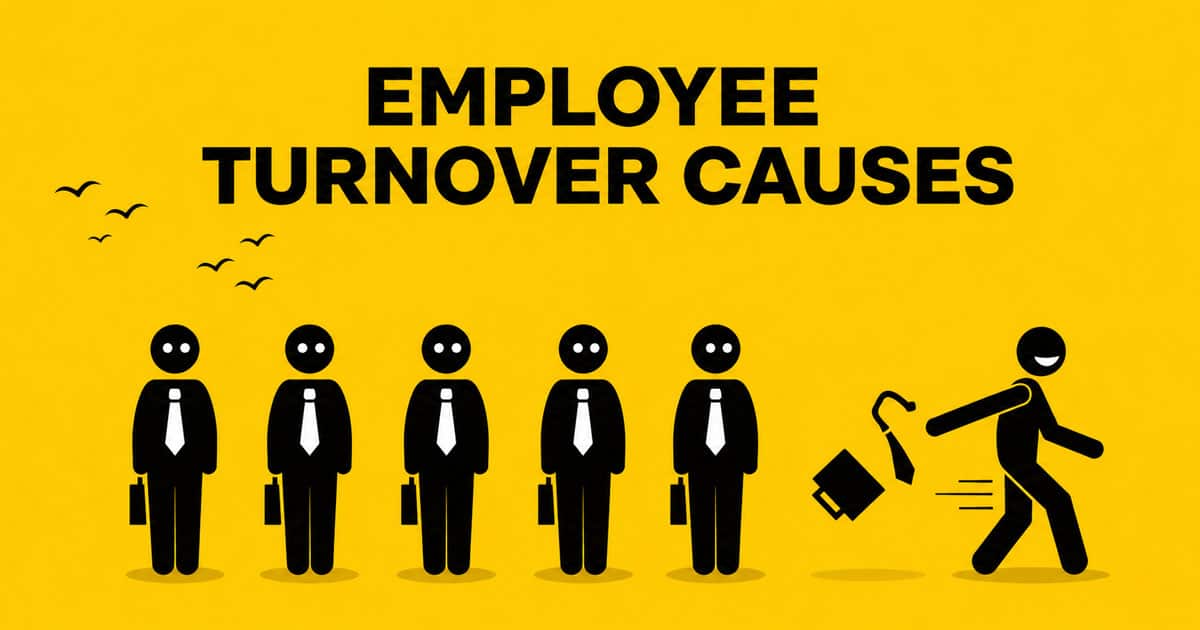
Table of Contents
Employee turnover creates a serious challenge for growing companies. Voluntary departures cost businesses billions each year, increase recruitment and training expenses, and slow hiring cycles. When employees leave, remaining team members face added pressure, which lowers morale, engagement, and job satisfaction. High turnover also affects customer experience and long-term business stability.
Common causes include inadequate compensation, poor management, limited career growth, and weak leadership. Lack of professional development, flexible work options, and work-life balance often drives employees to seek better opportunities. External factors and personal reasons also influence both voluntary and involuntary turnover. Understanding these causes helps HR teams design stronger retention strategies and protect top talent.

What Is Employee Turnover
Employee turnover refers to the rate at which employees leave an organization during a set period. It measures workforce movement and helps track employee attrition and staff turnover. A rising turnover rate signals deeper employee turnover causes such as poor management, low job satisfaction, or weak employee engagement. High employee turnover increases hiring process costs and affects employee morale. Both voluntary employee turnover and involuntary employee turnover shape overall workforce stability.
Voluntary turnover happens when employees leave for a new job, career growth, or personal reasons. Involuntary turnover results from layoffs or poor performance. To calculate turnover rate, divide total separations by the average number of employees and multiply by 100. Monitoring employee turnover rates helps HR teams improve employee retention and reduce employee turnover over the same period.
Why High Employee Turnover Hurts Fast-Growing Companies
Fast-growing companies face unique vulnerabilities when employees leave. The pace of expansion creates dependencies on essential individuals while making knowledge transfer more difficult at the same time.
Loss Of Institutional Knowledge During Rapid Expansion
Team members take critical expertise with them when they leave. Research shows that 42% of the knowledge required to perform a job exists only in the mind of the person in that position. This tribal knowledge includes client priorities, historical context on company strategy and operational nuances that never get documented.
Harvard Business Review calls this experience-based expertise "deep smarts". These insights prove very difficult to replace. A new hire may handle simple job duties, but they cannot replicate their predecessor's relationships, ideas or approaches to work without personal mentoring.
Fast-growing companies feel the consequences hard. New hires spend an average of 200 hours working inefficiently as they chase down lost information or reinvent processes from scratch. They ask colleagues for help, wait for responses and figure things out through trial and error.
Effect On Remaining Employees And Team Morale
High employee turnover damages the people who stay. Studies of clinical staff found that counselors in high turnover programs reported higher job stress and inadequate staffing compared to those in low turnover environments. These perceptions remained significant even after accounting for budget cuts and increasing workloads.
The same research revealed that remaining employees also experienced lower communication and collaboration in high turnover settings. The supportive relationships that buffer against stress deteriorate when coworkers depart. This creates a dangerous cycle where stress increases and support decreases at the same time.
Hidden Costs Beyond Hiring Expenses
The financial effect extends way beyond recruitment management fees. Organizations spend between 50% and 200% of an employee's annual salary to replace them. Replacement costs range from $30,000 to $180,000 for someone earning $60,000 a year.
Lost productivity represents the largest hidden expense. U.S. businesses lose $1.8 trillion every year due to decreased productivity. Companies can lose more than $50,000 per month in productivity for every 100 remaining employees when positions remain unfilled. You need to have proper expense tracking for your business.
Why Proper Infrastructure Is Important For Rapid Scaling
Growth without proper infrastructure creates the conditions for high employee turnover. Companies that scale faster often skip the foundational systems that retain talent. Three infrastructure gaps stand out as the main reasons employees leave during expansion phases.
Inadequate Onboarding Processes For New Hires
Poor onboarding directly affects employee turnover rates. Research shows that 88% of organizations don't onboard new hires well. Even more concerning, only 12% of employees think their organization has a strong onboarding process.
The numbers tell a clear story. Organizations with strong onboarding improve new hire retention by 82%. On the other hand, 28% of people leave their new jobs within 90 days of starting due to inadequate onboarding. Almost 40% of employees who have been with a company for less than six months plan to leave within a year.
Lack Of Clear Role Definitions
Uncertainty due to unclear role descriptions decreases job satisfaction and increases voluntary employee turnover. Frustration builds among team members when job roles shift constantly or expectations go unspoken.
Role permission ambiguity boosts turnover intentions substantially. Employees experiencing unclear expectations feel a breach of trust, especially when actual tasks differ from what was agreed upon during hiring. This mismatched expectation creates immediate dissatisfaction.
Not Enough Management Support Systems
Management support gaps create another challenge for employee retention. Nearly 38% of people believe that lack of employee management support hinders successful project completion. Middle managers struggle to meet performance expectations without adequate backing.
Recent research of over 800 managers found that not enough staffing resources, constant change, and inefficient processes are the top three inhibitors to manager productivity. Middle managers feel this strain particularly. Their workload and stress levels have increased as they strive to meet raising performance expectations with less help.
How Employee Turnover Causes Limited Career Advancement Opportunities
Career advancement opportunities rank as the leading employee turnover cause in organizations experiencing faster growth. A McKinsey study identified lack of career development and advancement as the most common reason employees quit their jobs. Pew Research found that 63% of respondents who left positions in 2021 cited insufficient advancement opportunities as a main factor.
Unclear Career Progression Paths
Most organizations fail to provide employees with clear pathways for growth. Research reveals that 44% of HR leaders believe their organizations lack compelling career paths. This absence of direction leaves employees uncertain about their futures within the company.
The numbers paint a concerning picture. Only 15% of employees say their organization encouraged them to move to a new role. Just 14% report being encouraged to build a career development plan. Staff turnover accelerates when organizations neglect to guide employees toward advancement.
Quick Promotions Creating Skill Gaps
Faster-growing companies promote employees based on past performance rather than future potential. This practice creates serious problems. The skill set required to manage and lead is very different from technical execution abilities.
Organizations suffer multiple losses when promotions fail. First, they lose a high-performing individual contributor and productivity drops. Second, they gain a manager lacking effective leadership skills and this creates friction about expectations.
These situations trigger employee disengagement. Team members grow frustrated with inconsistent management practices. Communication weakens and deadlines slip. Performance issues go unaddressed. Top talent leaves the organization altogether in some cases.
Competition For Limited Leadership Positions
Faster-growing companies often create bottlenecks at leadership levels. While organizations expand, the number of senior positions grows more slowly than the overall workforce. You need to maintain a proper workforce calendar for that.
One in four American employees reports lacking opportunities for career advancement. Furthermore, 23% of workers express dissatisfaction with their growth and development opportunities. Access to advancement remains uneven across organizations. Employees at larger companies report better opportunities than those at smaller firms.
Poor Work-Life Balance From Growth Demands Due To Employee Turnover
Aggressive growth targets force employees into unsustainable work patterns that accelerate employee turnover directly. Work-life balance stands as a major factor for nearly three-quarters of employees when they look for new job opportunities. Yet only 48% of employees strongly agree their companies care about employee well-being. This disconnect between expectations and reality drives voluntary employee turnover in fast-growing organizations.
Extended Hours To Meet Aggressive Targets
Team members get pushed beyond normal working hours when expansion demands pile up. Research shows 40% of workers work after hours regularly, and half feel pressured to do so. They extend their days not by choice, but because they have insufficient time to complete tasks or too many competing priorities.
The pressure to meet aggressive targets backfires. Employees who log off at the end of the workday register 20% higher productivity scores than those who feel obligated to work after hours. Working longer doesn't equal working better. Half of workers don't take breaks, and these individuals face 1.7 times higher likelihood of suffering employee burnout.
Resource Constraints Leading To Employee Burnout
Fast-growing companies often expand revenue targets without adding proportional headcount. This creates crushing workloads for remaining employees. Research confirms that 25% of employees experience burnout symptoms currently. More alarming, 77% report they've experienced burnout at their workplace.
Existing staff face intensified pressure during growth phases when resource constraints hit. Employees must deliver products and services at the same pace with leaner teams and tighter budgets after hiring slowdowns or freezes. Staff shortages lead 41.1% of employees to cite understaffing as their burnout source. Women report burnout from understaffing at 69%, while younger workers report it at 66%.
Lack Of Flexible Work Arrangements
Schedule quality matters by a lot for employee retention. Research reveals 62% of employees lack high-quality work schedules. High-quality schedules require predictability, stability and employee control over hours. Team members struggle to balance professional demands with personal life responsibilities without these elements.
Parents face especially severe effects. Studies show 50% of male and 46% of female parents have thought about leaving the workforce entirely due to difficulty balancing childcare needs with inflexible work schedules. This represents massive talent loss from preventable causes of employee turnover.
Inadequate Compensation And Benefits Packages
Compensation remains the fundamental driver behind why employees leave organizations. Departing employees cite low pay as their main reason for leaving, and 56% fall into this category. Fast-growing companies focused on expansion face a problem: inadequate compensation packages accelerate voluntary employee turnover and damage employee retention efforts.
Salary Not Keeping Pace With Market Rates
Market competitiveness determines whether team members stay or explore other opportunities. Research shows 96% of workers were looking for new positions to get higher pay. The message proves clear: when salaries fall behind market rates, employees leave.
Monster's Cost-of-Living Report reveals that 95% of U.S. workers report their wages have not kept up with the rising cost of living. Only 9% received a raise or salary adjustment to offset higher costs. Job seekers believe salaries are not keeping pace with inflation, and 63% hold this view. This gap between earnings and expenses forces employees to seek better-paying roles elsewhere.
Limited Health Benefits During Growth Phase
Health benefits rank second only to wages in employee priorities. Surveyed workers said quality health benefits are important to them, and 88% hold this view. U.S. adults with employer-sponsored health benefits see coverage quality as a major factor in staying at their job, and 56% report this.
The retention impact proves substantial. Businesses offering health insurance see turnover rates 27% lower than companies with no health plan or minimal offerings. Dissatisfaction with health benefits causes workers to think about other employment opportunities. Health insurance helps attract employees who anticipate establishing long-term employment relationships.
Delayed Reviews And Raises
Postponing salary increases triggers departures. Research from Robert Walters reveals nearly half of employers experienced increased employee turnover after delaying pay rises. Team disengagement resulted from postponing or reducing salary reviews, and 36% reported this outcome.
The data shows employee response patterns. Among those who did not receive a pay rise, 67% said they are job hunting. Even employees who received increases reported dissatisfaction, with 61% saying it was lower than expected. Unmet expectations push people to reconsider their options, especially as AI tools streamline job applications and create more opportunities.
Weak Company Culture During Transition Periods
Culture deterioration during rapid expansion ranks among the most destructive employee turnover causes. Toxic culture is 10.4 times more powerful than compensation in predicting turnover, research confirms.
Loss Of Early Startup Culture
The energy and alignment of early teams gets diluted as organizations grow. Culture drift emerges as the biggest risk during scaling phases. What starts as efficiency becomes a blind race toward scaling a team at the cost of clarity and values. Employees who joined for the startup culture find themselves in a different organization. This disconnect between expectations and reality drives voluntary employee turnover upward.
Inconsistent Values Across New Teams
Cultural misalignment guides to confusion, cynicism, and lack of alignment among employees. Decisions become inconsistent and based on personal interests rather than organizational principles when leaders and team members fail to live core values. This inconsistency creates chaos and instability. Misalignment between stated company values and actual practices creates cognitive dissonance that high-integrity employees resolve by leaving.
Poor Management Practices From Rapid Hiring
Managers account for at least 70% of the variance in employee engagement scores. Only one in ten people have the skills to make effective managers. Companies that grow fast promote based on past performance rather than management capability and create ineffective leadership throughout the organization. First-time managers struggle without proper training. This results in disengaged staff and decreased productivity.
Lack Of Employee Recognition Programs
Organizations with formal employee recognition programs have 31% less voluntary turnover. Yet 83% of organizational leaders believe employee recognition is not a strategic priority. Only 35% of employees receive recognition monthly or weekly. Employees who receive high-quality recognition are 45% less likely to have turned over after two years. Employee morale decreases and turnover skyrockets without meaningful appreciation.
Communication Breakdowns Across Growing Teams
Communication failures emerge as one of the biggest employee turnover causes during expansion. Research shows 70% of customer experience professionals see silo mentality as the biggest obstacle, while 67% of collaboration failures stem from departmental silos. More concerning, 83% of executives recognize silos in their companies, with 97% reporting negative business impact.
Siloed Departments Reducing Collaboration
Departments working in isolation develop their own processes and tools. This creates inconsistencies that hinder performance. Poor communication between teams leads to misalignment and duplicated efforts. Teams work on similar projects without knowledge of each other's activities and waste time and resources. Lack of transparency causes employees to reinvent solutions rather than leverage existing work. Furthermore, 58% of respondents identified organizational structure and red tape as contributors to siloing.
Leadership Failing To Cascade Information
Leadership plays a critical role in information flow. Weak interdepartmental leadership leads to isolated decision-making where teams operate independently. Two-thirds of senior managers say their organizations explain major decisions well, but that percentage drops by a lot as messages move down the organization. Only one-third of front-line employees say the company explains major decisions well. This disconnect creates confusion when clarity is needed most.
Employees Feel Unheard In Decision Making
Poor internal communication impacts employee retention. Research shows 58% of employees thinking about leaving their jobs cite poor internal communications as a factor, with 30% calling it a major factor. Another study confirms 61% of employees considering departures name poor internal communication as a cause. Correspondingly, 86% of employees feel different voices aren't heard fairly, while 63% feel their employer has ignored their voice.
Effective Strategies To Reduce Employee Turnover
High employee turnover creates a significant challenge for growing companies. Clear action reduces voluntary turnover and protects employee morale. Strong employee retention strategies address key employee turnover causes and improve employee satisfaction, engagement, and long-term stability.
Structured Career Development
Career growth drives employee retention. LinkedIn reports that 94% of employees would stay longer if companies invested in career development. Lack of career advancement opportunities remains one of the top reasons for employee turnover. Clear promotion tracks and internal mobility programs help retain talent.
Employees stay where growth and development opportunities exist. Mentorship and professional development improve employee engagement and job satisfaction. Clear career progression also strengthens employee retention rate and reduces high turnover.
Strong Middle Manager Support
Gallup shows managers account for 70% of employee engagement variance. Poor management often leads to voluntary employee turnover. Exit data frequently highlights leadership practices as key causes of employee turnover.
Middle managers need training in communication and coaching. Clear expectations improve employee satisfaction and reduce employee burnout. When employees feel heard and supported, employee morale rises and turnover rate drops.
Transparent Communication Culture
Clear communication builds trust and a positive work environment. Research shows 86% of employees blame lack of communication for workplace failures. Weak company culture increases employee attrition and high employee turnover rate.
Open forums and regular updates improve employee engagement. Honest dialogue helps HR professionals detect employee turnover causes early. Transparent leadership also strengthens employee retention strategy and minimizes turnover over the same period.
Competitive Compensation And Benefits
Inadequate compensation remains a major reason employees leave. SHRM data shows compensation ranks among the top reasons for voluntary turnover. Competitive compensation reduces staff turnover and improves employee satisfaction.
Strong packages include health benefits, bonuses, and flexible work arrangements. Fair pay supports retaining employees and attracting top talent. Regular salary reviews help reduce employee turnover and protect long term success.
Healthy Work Life Balance
Work-life balance directly impacts job satisfaction. Employees with flexible hours and remote options report a lower turnover rate. Hybrid employees show up to 33% lower turnover, according to recent workforce studies.
A healthy work-life balance reduces employee burnout and protects well-being. Flexible work arrangements support personal life needs. Supportive policies boost employee morale and improve employee retention over time.
Effective Hiring And Onboarding
Strong hiring process decisions prevent early employee departs. Poor talent management increases involuntary turnover and high turnover. Structured onboarding makes employees 58% more likely to remain after three years.
Clear job duties and realistic expectations improve employee engagement. Early support builds employee satisfaction and reduces turnover rate. Effective strategies during onboarding protect the employee retention rate and reduce costly training costs.
How Payrun Helps Reduce Employee Turnover
Payrun gives businesses a central system to manage HR, payroll, and employee records in one place. They have several features in their platform to simplify your HR management. This reduces manual tasks that drain HR time and helps improve employee satisfaction through clarity and consistency. Payrun’s tools support structured workflows that keep employees informed and engaged.
Payrun makes leave tracking, attendance tracking, and payroll transparent and accessible. Employees can view payslips, submit leave requests, and update personal details easily. This boosts employee morale and job satisfaction by reducing confusion and delays.
Payrun also speeds up hiring and onboarding processes with its integrated tools. Faster onboarding improves early employee experience and helps new team members feel connected. By automating routine HR tasks, Payrun allows HR teams to focus on employee engagement, career development, and a strong employee retention strategy. You can enjoy Payrun at a suitable price.
FAQs
How Many Employees Leaving In A Year Is Considered A High Turnover Rate?
A high employee turnover rate depends on industry benchmarks. Yes, an annual turnover rate above 20% is often considered high for many sectors. HR professionals compare the number of employees who leave during the same period against industry averages to assess risk.
Does Employee Burnout Directly Increase Voluntary Employee Turnover?
Yes, employee burnout strongly increases voluntary turnover. Employees facing long hours, poor work life balance, and weak leadership practices often seek a new job. Burnout lowers employee engagement and job satisfaction, which raises overall employee turnover rates.
Can Poor Company Culture Cause High Employee Turnover?
Yes, weak company culture ranks among the top causes of employee turnover. Toxic environments reduce employee morale and employee satisfaction. When employees feel unheard or undervalued, staff turnover rises and retaining employees becomes difficult.
Is Involuntary Turnover Bad For Employee Retention Rate?
No, involuntary turnover is not always negative. Removing poor performance can protect team morale and customer satisfaction. However, frequent involuntary employee turnover may signal deeper talent management or leadership issues.
What Role Do External Factors Play In Employee Attrition?
External factors such as economic shifts, competitive compensation offers, and personal reasons influence employees leave decisions. Job seekers often move for better career growth opportunities or improved health benefits, even when internal conditions are stable.
Do Flexible Work Arrangements Help Reduce Employee Turnover?
Yes, flexible work arrangements help reduce employee turnover. Flexible hours support personal life balance and improve well being. Organizations that offer remote or hybrid models often report stronger employee retention and lower high turnover.
Can Data-Driven Insights Improve Employee Retention Strategy?
Yes, data-driven insights strengthen any employee retention strategy. Tracking employee turnover causes, engagement levels, and employee satisfaction helps minimize turnover. Clear metrics allow leaders to protect top talent and improve long-term success.