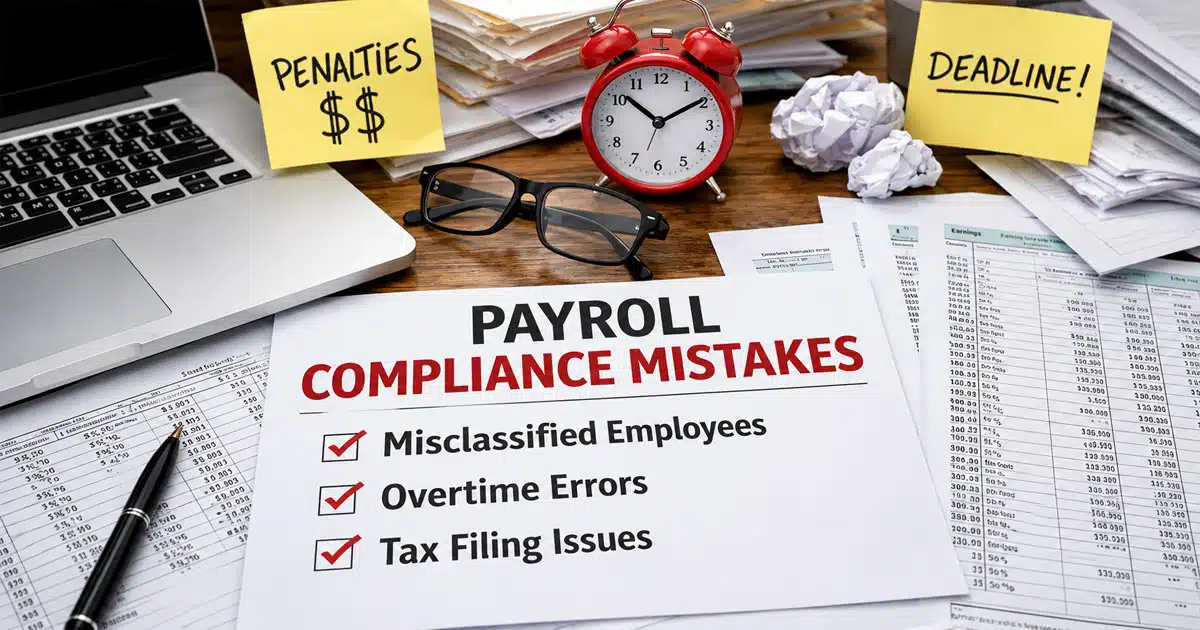
A single missed tax code update. One late RTI submission. A pension contribution was calculated from the wrong earnings figure. These might sound like minor slips, but in payroll, small mistakes rarely stay small.
Payroll compliance is one of those business areas where getting things mostly right still means getting things wrong. HMRC does not grade on effort. Employees do not shrug off being underpaid. And once errors compound across multiple pay periods or tax years, the time-consuming work of untangling them can consume your finance team for weeks.
This guide walks through ten common payroll compliance mistakes UK employers make, from everyday oversights to costly mistakes that attract serious HMRC attention. More importantly, it shows you how to fix problems when they happen and how to build processes that prevent them from recurring.
Whether you manage payroll yourself, rely on a small HR team, or are considering your first dedicated payroll software, understanding these compliance risks is the first step toward avoiding them.
Why Payroll Compliance Mistakes Hurt So Much
Picture a small UK company with fifteen employees. They run payroll monthly using spreadsheets and manual HMRC submissions. One year, a new starter joins with an emergency tax code, and nobody notices the P6 notification from HMRC updating it. For twelve months, that employee is under-withheld. Then HMRC sends a letter. The business now owes back PAYE, plus interest, plus penalties for late payment. The employee is confused and frustrated. The finance manager spends three weeks reconstructing records and explaining the situation to everyone involved.
This is how payroll errors work. They start as data entry mistakes or missed deadlines and end as people problems.
Payroll compliance in the UK covers several interconnected legal requirements: PAYE (Pay As You Earn) for income tax, National Insurance contributions for both employees and employers, pension auto-enrolment under The Pensions Regulator, statutory payments like SSP and SMP, National Minimum Wage and National Living Wage adherence, and proper record keeping for at least three years after each tax year ends.
Each of these areas has its own tax regulations, relevant deadlines, and penalties for non-compliance. Miss your RTI submission deadline, and HMRC can charge late filing fines. Underpay the National Minimum Wage, even by a few pence, and you risk being named publicly alongside paying arrears and penalties. Fail to auto-enrol eligible workers into a pension scheme, and The Pensions Regulator can escalate from warnings to daily fines remarkably quickly.
What makes payroll compliance particularly unforgiving is that mistakes often stay hidden until something triggers a review. An employee checks their payslip more closely than usual. HMRC runs a routine enquiry. Your accountant asks for documentation you cannot find. By the time the issue surfaces, it may have been compounding for months or years.
Common Payroll Compliance Mistakes
Before diving into the costlier and more complex errors, it helps to understand the everyday mistakes that trip up most UK employers at some point. These common payroll mistakes often surface during HMRC reviews, when employees question their payslips, or when businesses migrate to a new payroll system and realise their data does not quite add up.
Many of these errors stem from the same root causes: manual processes, disconnected systems, and the assumption that “it’s always been done this way” means it’s being done correctly.
1. Misclassifying Employees and Contractors
Worker classification sits at the heart of many payroll compliance problems. Treating someone as self-employed when they should be on PAYE creates a cascade of issues: unpaid income tax forms, missing National Insurance contributions, no holiday pay accrual, and zero pension contributions. If HMRC decides those independent contractors were employees all along, you could face back-dated employer NIC plus penalties stretching back several years.
The UK uses employment status tests focused on control (do you dictate how, when, and where work is done?), substitution (can the worker send someone else in their place?), and financial risk (do they invest their own money and risk losses?). HMRC provides the Check Employment Status for Tax (CEST) tool, though it has limitations and does not cover every scenario.
Consider a SaaS company that pays long-term “freelance” support agents. If the company controls their shift patterns, provides their equipment, and expects them to work exclusively on company tasks, those workers likely meet the definition of employees. The correct classification matters for tax liability, benefits entitlements, and potential redundancy rights.
To reduce risk, maintain written contracts that reflect genuine working arrangements, review status periodically as roles evolve, and take professional advice when project-based work becomes ongoing.
2. Getting PAYE and National Insurance Wrong
PAYE and NIC miscalculations represent the classic payroll compliance failure. Using the wrong tax code, ignoring P6 or P9 notifications from HMRC, or failing to apply updated thresholds when the tax year changes in April all lead to incorrect payroll.
Tax rules change annually. Rates, bands, and thresholds shift, and employers must update their payroll processes before running the first pay cycle of the new tax year. Failing to do so means underpaying or overpaying tax from day one.
Common scenarios include:
- New starters left on emergency tax codes for months
- Student loan and postgraduate loan deductions are ignored or applied to the wrong threshold
- Employer NIC miscalculated on bonuses or irregular payments
Underpayments can trigger HMRC penalties and employee tax bills. Overpayments damage trust and create cash-flow headaches when corrections are needed. Either way, employees end up questioning whether they can rely on their payslips.
Using HMRC-recognised payroll software, checking tax code notices as soon as they arrive, and reconciling year-to-date PAYE before each month closes all help mitigate compliance risks.
3. Incorrect Overtime, Holiday Pay, and Variable Pay
Variable earnings create fertile ground for payroll mistakes. Mis-tracking overtime, failing to include regular commission in holiday pay calculations, and ignoring rules around average earnings all lead to underpayments that can accumulate over years.
UK case law has established that holiday pay should reflect “normal remuneration” rather than basic pay alone. If an employee regularly works overtime or receives consistent shift enhancements, their holiday pay should typically include those elements.
Imagine a support agent who regularly works weekend shifts with enhanced pay. If their holiday pay is calculated only on their basic hourly rate, the business is likely underpaying. Extend that pattern across multiple employees over several years, and you have a significant exposure to back-dated claims.
Integrated time tracking paperwork within your payroll software helps here. When hours, rates, and allowances pull directly into pay runs without manual retyping, the risk of transcription errors drops considerably.
4. Missing National Minimum Wage and National Living Wage Breaches
Underpaying even a few pence below the legal minimum is a strict liability issue. HMRC can require you to pay arrears, impose penalties, and publicly name businesses that breach minimum wage rules. There are no good explanations once you fall below the threshold.
The National Living Wage and National Minimum Wage rates change every April, with different bands for different age groups and apprentices. Employers need to check these figures annually and update their payroll processes accordingly.
Typical pitfalls include:
- Salary sacrifice schemes that push net pay below minimum wage
- Unpaid team meetings, training sessions, or travel time that should count as working hours
- Uniform costs or other deductions that reduce effective hourly pay below the legal floor
Regular minimum wage checks across all staff categories, especially after rate changes, help catch the most common payroll problems before HMRC does.

Costly Payroll Compliance Mistakes
The next set of mistakes tend to attract more serious HMRC attention, larger back-payments, and the kind of long email chains with accountants that nobody enjoys. These are the expensive payroll mistakes that can consume budgets and management time for months.
5. Late or Incorrect RTI Submissions (FPS and EPS)
Real Time Information (RTI) requires UK employers to send a Full Payment Submission (FPS) to HMRC on or before each payday. This is not optional. It is a legal requirement with penalties for non-compliance.
Common RTI compliance mistakes include submitting late, sending figures that do not match payments, or forgetting to file an Employer Payment Summary (EPS) for statutory payments or months with no payments. HMRC can charge late filing penalties and issue queries through your PAYE account when data looks inconsistent.
Consider a small business that runs payroll on the last working day of each month but consistently uploads the FPS a week later. Each late submission can incur fines, and the pattern signals to HMRC that controls may be weak across the board.
Aligning payroll cut-off dates and approval workflows to RTI deadlines helps. Many businesses find that automation in payroll software eliminates the risk of missed deadlines entirely.
6. Mishandling Pension Auto-Enrolment and Re-Enrolment
UK auto-enrolment duties require employers to assess workers each pay period, enrol eligible staff into a qualifying workplace pension scheme, pay minimum contributions on time, and handle opt-outs correctly. Every three years, employers must also re-enrol eligible staff who previously opted out.
Mistakes in this area include never setting up a pension scheme in the first place, failing to complete the Declaration of Compliance with The Pensions Regulator, underpaying contributions, and missing re-enrolment deadlines.
A company that hired its first employee in 2021 but never established a qualifying pension scheme is already non-compliant. The Pensions Regulator can escalate enforcement from warning letters to daily fines, and underpaid contributions may need to be back-dated across multiple tax years.
Payroll software that automates worker assessments, tracks re-enrolment dates, and generates the correct file formats for pension providers takes much of the manual burden away.
7. Poor Record-Keeping and Document Retention
Incomplete records make it nearly impossible to defend against HMRC queries or resolve employee disputes. When you cannot produce payslips, time records, or RTI confirmations, you lose the ability to demonstrate compliance.
UK employers must retain PAYE and payroll records for at least three years after the end of each tax year. In practice, other legislation often drives longer retention periods, and keeping records for six years provides a safer margin.
Imagine trying to reconstruct 2021-22 pay records from scattered spreadsheets and email attachments during a 2024 HMRC check. The time spent searching, reconciling, and explaining gaps could be enormous, and the outcome uncertain.
Moving away from paper and ad-hoc spreadsheets to a single, secure, cloud-based payroll system where all pay data, reports, and adjustments are stored and searchable reduces this risk considerably. Good record keeping is not glamorous, but it is often what separates a quick HMRC query from a prolonged investigation.
8. Ignoring Statutory Payments and Leave Rules
Underpaying or failing to pay Statutory Sick Pay (SSP), Statutory Maternity Pay (SMP), Statutory Paternity Pay (SPP), or Statutory Adoption Pay is a common compliance trap. The rules around eligibility, waiting days, and average earnings calculations are not intuitive, and mistakes happen frequently.
Consider an employee on maternity leave in 2023-24 whose Average Weekly Earnings are miscalculated because bonuses paid during the reference period were excluded. The resulting SMP payments are too low, creating an underpayment that may not surface until the employee reviews their records months later.
Payroll teams also sometimes forget to reflect statutory payments accurately in RTI submissions and EPS claims, missing opportunities for reimbursement and creating data inconsistencies.
Regularly checking current HMRC guidance and using in-product statutory calculators helps avoid these problems. The tax rules around statutory payments change, and assumptions from previous years may no longer be correct.
Time-Consuming Payroll Compliance Problems
Not every error leads directly to fines. Some mistakes simply eat into your payroll team’s time, distract leaders from running the business, and create ongoing frustration. These operational problems often connect back to compliance risk because rushed, manual processes are where human error thrives.
9. Manual Data Entry and Disconnected Systems
The real-world full picture looks like this: copying hours from paper timesheets or a rota app into spreadsheets, then manually entering those figures into payroll software each month. Every rekeyed number is another chance to mis-type hours, omit overtime, or apply the wrong rate.
Research shows that organisations fix an average of 149 payroll errors related to variable pay and leave accruals each year. That is 149 opportunities for underpayments, retrospective corrections, and awkward conversations with employees.
A business running HR data in one tool, timesheets in another, and payroll in a third spends hours each pay period reconciling differences. When systems do not talk to each other, the gaps between them fill with errors.
Integrating time tracking, employee data, and payroll into a single system creates one source of truth. When data flows automatically from timesheets to pay calculations, reducing errors becomes the default rather than the exception.
10. Rushed Approvals and Last-Minute Changes
Waiting on managers to approve timesheets or bonuses the day before payday creates pressure, rushed calculations, and missed checks. Compliance risks spike when payroll is processed under time pressure.
Here is a familiar scenario: a manager emails updated overtime figures at 5pm on payroll day. An exhausted payroll admin edits one person’s hours but overlooks another. The mistake gets spotted when an employee reviews their payslip, and trust in both payroll and leadership takes a hit.
These patterns erode confidence over time. Employees start double-checking every payslip, human resources fields more queries, and the payroll complex process becomes a source of anxiety rather than a routine operation.
Clear cut-off dates, standardised approval workflows, and a culture where payroll sign-off is non-negotiable help prevent these scenarios. When managers understand that late approvals lead to late or incorrect pay, most will adjust their behaviour.

How to Fix Payroll Compliance Mistakes Without Losing Trust
Even careful employers occasionally get something wrong. A missed update, an overlooked notification, a calculation error that slipped through review. What matters is how you respond. Quick corrections, honest communication, and process improvements can preserve trust even when common mistakes happen.
Step 1: Confirm What Went Wrong and Who Is Affected
Before making any changes, pause and clearly identify the scope of the problem. Which pay runs are affected? Which employees? Which tax years? Which elements of pay are involved?
Use payroll reports, RTI submissions, and pension schedules to quantify underpayments or overpayments rather than guessing. A clear picture of the legal issues prevents overcorrection and helps you communicate accurately with affected staff.
Keep a short internal log for each issue with dates, decisions, and evidence. If HMRC or auditors ask questions later, having a documented trail of how you identified and resolved the problem demonstrates due diligence.
Step 2: Communicate Early and Honestly with Employees
Tell affected staff as soon as you understand the basics, even if you do not have every detail finalised. Silence breeds speculation, and employees who discover payroll problems through their own investigation tend to trust the process less going forward.
Use plain English: what happened, how it affects their pay, and when they can expect a correction. For underpayments, consider off-cycle payments as soon as possible rather than waiting for the next regular payroll. For overpayments, propose reasonable repayment plans that respect employment law and treat employees fairly.
Step 3: Correct Payroll, Pensions, and Tax Filings
Fixing net pay alone is not enough. You must also adjust PAYE, NIC, and pension contributions where relevant and update RTI data. For prior tax years, this may require amended submissions or professional advice.
Document every adjustment and keep revised payslips and schedules together. When tax authorities or pension providers have questions, having complete records in one place makes responses faster and more accurate.
Step 4: Fix the Process, Not Just the Payslip
After each incident, conduct a brief internal review. Which control failed? Which step relied on memory rather than a checklist? What could be automated or simplified?
Practical changes might include earlier timesheet deadlines, additional checks for new starters, or standardised pay elements in your payroll system. If the same “one-off” mistake keeps happening, it is a sign that the process is broken, not that individual people are careless.
How to Avoid Payroll Compliance Mistakes in the First Place
Building a robust payroll process does not require enterprise-scale resources. It requires consistency, simplicity, and regular check-ins. Here is a practical playbook for businesses of any size.
Build a Simple, Documented Payroll Checklist
Create a monthly checklist covering each step: data collection, approvals, running payroll, reviewing exception reports, submitting RTI, paying staff, and remitting payments to HMRC and pension providers.
Include key tax-year dates such as April rate changes, P60 deadlines, and pension re-enrolment cycles. Keep the checklist visible and shared so payroll is not a black box owned by one person.
| Payroll Step | Deadline | Owner |
|---|---|---|
| Collect timesheets | 5 days before pay date | Line managers |
| Approve hours and expenses | 3 days before pay date | Finance |
| Run payroll calculations | 2 days before pay date | Payroll admin |
| Review exception report | 1 day before pay date | Finance manager |
| Submit FPS to HMRC | On or before pay date | Payroll admin |
| Pay employees | Pay date | Finance |
| Pay HMRC and pension | By relevant deadlines | Finance |
Train the People Who Touch Payroll Data
Line managers and administrators who approve hours or expenses need basic payroll awareness, not just the payroll specialist. When everyone understands how their data flows into pay calculations, errors get caught earlier.
Short refreshers each year help, especially when tax requirements change. Give managers clear written guidelines for overtime, shifts, and allowances so they enter data consistently.
Let Software Take Care of the Repetitive Work
Dedicated UK payroll software handles PAYE calculations, RTI submissions, pension auto-enrolment, and digital payslips in one place. Automation is not about removing control. It is about reducing human error in tasks like tax code updates, threshold changes, and contribution percentages.
When software stays current with UK payroll compliance legislation, you do not have to manually apply each new rule. Updates happen in the background, and your next pay run reflects the latest requirements.
Regular audits of your payroll data, even quarterly reviews of a sample of payslips and submissions, help catch issues before they become severe consequences.
How Payrun Helps You Stay Payroll-Compliant
Payrun is designed for UK employers who want compliant payroll without spreadsheets, guesswork, or last-minute panic.
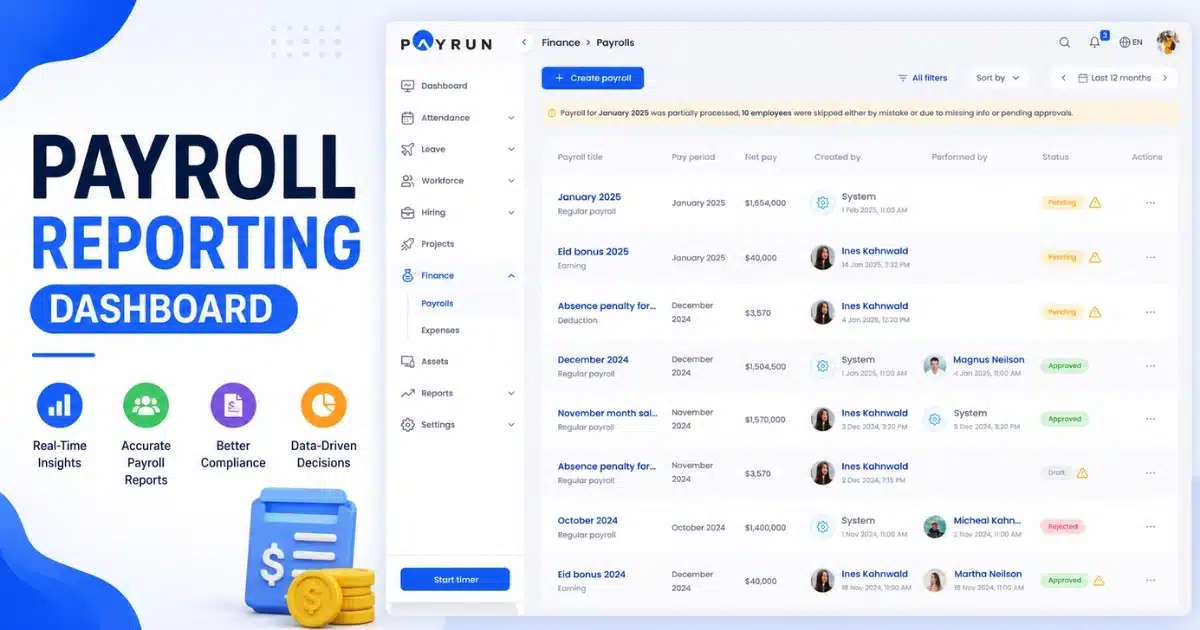
The platform calculates PAYE and NIC in line with current HMRC rules and submits RTI (FPS and EPS) electronically on time. This reduces the risk of filing penalties and ensures your tax filings match your payments.
For pension auto-enrolment, Payrun assesses workers, applies the correct contributions, and generates the files your pension scheme needs. This helps avoid under-funding or over-funding and keeps you on the right side of The Pensions Regulator.
Payrun maintains clear, searchable records of pay runs, adjustments, and reports. When employees have questions or HMRC sends a query, you can respond quickly with accurate data. No more digging through email archives or reconstructing figures from memory.
By centralising employees, pay elements, and schedules in one system, Payrun cuts down on manual data entry and the compliance errors that come with it. Timely deposits, accurate calculations, and proper documentation become the default rather than the exception.
If you are tired of payroll feeling like a compliance minefield, explore Payrun’s features or try it on an upcoming pay period. See how much easier compliant payroll can feel in practice.
FAQs
How far back can HMRC go if they find payroll compliance mistakes?
HMRC can typically look back four years for careless errors and up to twenty years for deliberate or fraudulent behaviour. Even for honest mistakes, interest and penalties can accumulate significantly over four years.
Beyond HMRC, employees themselves may raise underpayment concerns going back several years, particularly for issues like holiday pay or minimum wage breaches. Keeping full payroll records longer than the bare three-year legal minimum makes any retrospective corrections much easier to manage.
What should I do if I discover I have underpaid an employee?
Calculate the shortfall as accurately as possible using your payroll records. Pay the difference promptly, ideally as an off-cycle payment rather than waiting for the next regular payroll. Explain clearly on their next payslip what has changed and why.
If the underpayment affects PAYE, NIC, or pensions, you must also correct those elements and update HMRC and your pension provider where necessary. Then review the underlying process to prevent the same issue from recurring.
Can I fix payroll compliance issues myself or do I need an accountant?
Small, recent errors in the current tax year can often be corrected within your payroll software by following HMRC guidance. Most payroll platforms allow you to make adjustments and submit corrected RTI data.
For issues spanning multiple tax years, involving large sums, or relating to worker classification or minimum wage breaches, professional advice is worth the investment. Even when using an accountant, you remain legally responsible for PAYE and payroll compliance, so understanding the basics matters.
How often should I audit my payroll for compliance?
A light internal review each quarter works well for most businesses. Check a sample of payslips, RTI submissions, and pension file against your source data for consistency. Flag anything that looks off and investigate before it compounds.
A more thorough annual audit after the tax year ends catches issues that quarterly reviews might miss, especially when rates have changed or the business has grown quickly. Document each audit and any fixes made, as this shows reasonable care if HMRC ever asks how you manage payroll.
When is it time to move from spreadsheets to payroll software?
Clear warning signs include frequent manual corrections, staff being paid late, difficulty tracking tax code changes, or anxiety every time HMRC rules change in April. If you dread payroll day rather than treating it as routine, your current approach is not working.
Once a business has multiple employees, variable hours, or pension duties, dedicated payroll software usually saves time and reduces compliance risk. Consider trialling a cloud payroll system like Payrun alongside your current process for a month to compare accuracy and effort.