More than half of HR departments are drowning in work, with 57% of professionals already working beyond capacity. Employee lifecycle management software has become necessary for teams that struggle to keep up with manual tasks and administrative burden.
Employee lifecycle management software brings structure to managing employees from recruitment through offboarding. It supports engagement and productivity throughout your organization.
In this article, we'll walk you through what employee management software does, the six critical stages it covers, and how to choose the best employee management system that fits your needs. You'll also learn key features to look for in hr employee management software and how employee data management software can transform your hr processes.
What Is Employee Lifecycle Management Software
Employee lifecycle management software helps HR teams manage the entire employee lifecycle in one centralized system. The platform covers key HR processes such as the hiring process, employee onboarding, performance management, and benefits administration. HR professionals use the software to store employee data, manage employee records, and track employee information without manual processes. A central hub also supports document management, task management, time tracking, and compensation management. HR teams save valuable time and reduce manual tasks.
Employee lifecycle management software also improves employee experience and employee engagement. Automated workflows handle HR tasks such as applicant tracking, background checks, e-signatures, and employee updates for new hires. Workforce analytics and actionable insights help HR teams make data-driven decisions. The platform supports workforce management, benefits management, succession planning, goal setting, and feedback cycles. Organizations improve operational efficiency, maintain compliance support, and drive business success across small teams, mid-sized organizations, and large enterprises.
The Six Critical Stages Of The Employee Lifecycle
Your employee lifecycle unfolds across six distinct stages that shape every aspect of the employee experience. Understanding these phases helps you see where employee lifecycle management software creates the most effect.
Attraction And Recruitment Stage
Attraction starts before anyone applies to your organization. You're building an employer brand that makes talented professionals want to work for you. The numbers tell the story: 3 in 4 job seekers apply only if you manage your employer brand actively.
Your recruitment phase needs clarity and speed. Job applications longer than 15 minutes cause over 70% of applicants to lose interest. Meanwhile, 83% of Fortune 500 companies require candidate registration before they can even apply. The hiring process becomes a balancing act between gathering data you need and respecting candidate time.
Onboarding And Integration Phase
Onboarding shapes whether new employees stay or leave. The process should last at least one year according to staffing experts. Nearly 90% of employees decide whether to stay within the first six months.
Onboarding that works has four phases:
- Preboarding: Send paperwork electronically, provide benefits selection, and share welcome messages before day one
- Orientation: Tour the facility, introduce team members, and explain company culture during the first week
- Training: Deliver job-specific skills through progressive schedules over weeks or months
- Integration: Provide continuous feedback and clear expectations as employees settle into roles
Three-fourths of new hires say training during the first week matters most to them. Just as important, 56% want a buddy or mentor when getting started. Your employee onboarding workflows through lifecycle management software ensure these touchpoints happen for every new hire consistently.
Development And Performance Growth
Organizations with structured training programs generate 218% more income per employee than those without. Companies investing in employee development report 11% greater profitability and retain employees at twice the rate.
Development isn't just about promotions. Employees who know and use their strengths are nearly six times more engaged. Your performance management systems enable goal setting, continuous feedback cycles, and skill development that keeps top talent growing.
Engagement And Retention Efforts
Employees who feel cared for at work are 92% more likely to be engaged, 65% more likely to be loyal, and 56% more likely to be productive. Recognition matters a lot here. Organizations recognizing employees well are 12 times more likely to have strong business results.
Lack of appreciation drives 79% of people who quit. Employees are five times more likely to stay when you acknowledge their good work regularly. Your employee engagement tools track recognition, gather feedback, and identify retention risks before people leave.
Compensation And Benefits Management
Compensation managers earned a median annual wage of $140,360 in May 2024. Their role has monitoring market conditions, analyzing wage data, and ensuring pay structures stay competitive and compliant.
Benefits administration covers retirement plans, leave policies, wellness programs, and insurance. Health insurance plays a major role in the United States. Compensation and benefits can account for up to 70% of business costs, making accurate benefits management vital for operational efficiency.
Offboarding And Alumni Relations
Companies lose an average of $15,000 per departed employee when they fail to maintain alumni relationships. Yet 40% of former employees would return to a previous employer.
Organizations adding resources to their exit process through career transition see upwards of 20% boomerang employees. Alumni referrals convert at twice the rate of cold applicants. Your offboarding workflows capture exit interview feedback, welcome departing employees to alumni networks, and maintain connections that drive business success long after employees leave.
Why Your HR Team Needs Employee Lifecycle Management Software
Your hr teams face a crushing workload. They waste up to 40% of their time on repetitive administrative tasks. Data entry, approvals and paperwork processing consume hours that could drive real value. Companies perform these repetitive, time-consuming tasks daily, 94% of them.
This goes deeper than just busy work. Manual processes create risk, inconsistency and burnout across your hr operations.
Reducing Manual Administrative Tasks
Manual data reconciliation alone eats up to 25% of your hr team's time. Your hr professionals chase signatures, hunt down spreadsheets and update employee information across disconnected systems. This administrative burden keeps them trapped in reactive work rather than focusing on HR workflow automation and talent management initiatives that move your business forward.
Employee lifecycle management software eliminates this drain on valuable time. Automated workflows handle document management, approval routing and employee updates without manual intervention. The numbers speak: organizations reclaim 30-50% of hr time previously lost to administrative work.
Your hr teams move from data entry roles into strategic business partners. They focus on culture building and employee engagement programs. The software handles the repetitive core hr tasks.
Improving Data Accuracy And Compliance
Manual processes invite mistakes that get pricey. A mistyped employee number or incorrect tax code cascades into compensation disputes and compliance problems. These errors erode trust between employees and your organization.
Workflow automation boosts data accuracy by as much as 88%. The software executes hr tasks exactly as programmed every time, and HR dashboard software consolidates these metrics into real-time insights. No human error in calculations. No forgotten steps in your hiring process or employee onboarding workflows.
Creating Consistent Employee Experiences
Employee experience affects your bottom line. Research shows employees with positive experiences have 16 times the engagement level of those with negative experiences. They're eight times more likely to stay at your company, but many organizations still struggle with common HR challenges like disengagement and turnover.
Inconsistent hr processes damage that experience. Some new hires get thorough employee onboarding while others fall through cracks. Some managers provide continuous feedback while others ignore performance reviews. These gaps create frustration and disengagement.
Enabling Strategic HR Decision Making
Most organizations struggle to employ their employee data. Fewer than 25% of companies can employ collected data to produce even basic workforce management insights. As many as 92% of organizations cannot total data from their hr systems to generate meaningful workforce analytics.
This creates a massive chance. Organizations making use of information see a 15% increase in productivity. HR analytics can reduce employee turnover by up to 25%. Companies using analytics are 3.1 times more likely to report talent management improvements.
65% of hr professionals say big data is essential for strategic decision making. Organizations with advanced analytics capabilities outperform their peers 70% of the time.
Essential Features Of An Employee Lifecycle Management Systems
Choosing the right employee lifecycle management software depends on understanding which features actually matter to your hr operations. Platforms don't all offer the same capabilities. Some features deliver far more value than others to your daily hr tasks.
Centralized Employee Database And Records
Your employee data needs one secure home. A centralized employee record management system combines personal details, job history, payroll data, attendance records, performance reviews and documents into a single system. This becomes your single source of truth where updating information once reflects everywhere.
The database fuels your entire employee lifecycle. Custom fields, tabs and tables give you complete control over organizing employee information the way your business needs it. Your hr teams access data from anywhere without digging through disconnected systems or outdated spreadsheets.
Automated Workflow Capabilities
Automation transforms how your hr processes function. Mark a new hire as hired in the system. That single action triggers payroll setup, creates attendance records, assigns onboarding tasks and notifies relevant departments. No manual work required.
Your automated workflows handle onboarding, offboarding, payroll processing and performance reviews by drawing from the same centralized database. This reduces delays and manual intervention across all hr operations, much like a modern employee management system that centralizes HR tasks. The software executes actions based on specific triggers. Human error can't creep into repetitive tasks.
Integration With Existing Tools
Your employee lifecycle management software must connect with tools you already use. Integration capabilities allow data to flow between your HRMS, payroll systems, time tracking platforms, benefits administration tools and identity management systems, helping you replace disconnected HR tools with a unified platform.
These connections work properly when updating employee information in one system updates all connected platforms instantly. To name just one example, an address change in the self service portal flows to payroll and benefits systems. Your support teams stop duplicating efforts while employees get consistent, accurate information.
Up-To-The-Minute Reporting And Analytics
Real time reporting capabilities turn raw employee data into practical insights your hr teams actually use. You analyze headcount trends, turnover rates, compensation distribution and performance data without reconciling multiple sources.
A manager notices high turnover in a specific department. They generate reports comparing performance ratings and compensation levels right away. The analytics help you identify retention risks, forecast hiring needs based on workforce trends and make informed decisions about compensation management.
Mobile Access And Self-Service Portals
Your employees need access to hr information wherever they work. Mobile-friendly employee self-service portals let them update personal details, check pay stubs, request time off and access policy documents from their phones without contacting hr teams.
This enables employees while reducing your team's administrative workload. Employees save approximately 300 labor hours per month through automation and faster workflows that self service features enable. Mobile HR apps with push notifications keep everyone informed when requests get approved. This creates transparency that builds trust across your organization.
How To Choose The Best Employee Lifecycle Management Software
Selecting the best employee management software requires careful planning. You're making a decision that affects your entire employee lifecycle and HR operations for years. The wrong choice results in wasted resources, frustrated HR teams, and systems that can't keep pace with your organization's growth.
Assess Your Current HR Challenges
Document your specific HR challenges before you review any vendors. Are you spending excessive time entering employee data into disconnected systems? Do time off approvals consume hours each week? Understanding these pain points helps you prioritize which core HR functions matter most.
Build a clear business case that outlines your software acquisition goals. Setting realistic objectives prevents over-promising and under-delivering later. Consider how an all-in-one HR management system supports your long-term strategy. Get input from employees handling HR tasks daily since they understand your HR operations better than anyone. Rank your requirements by importance and include security as a vital item.
Review Scalability And Growth Potential
Your employee management system must grow with your business. Can it handle major increases in employee count or expansion into new markets without performance issues? Given that many organizations select tools based on current needs alone, you risk needing another system change when your team expands.
Look for cloud-based infrastructure that makes flexible scaling possible. Cloud solutions now account for 74% of the market and offer superior scalability with continuous updates. Evaluate whether employee management software designed for modern HR teams supports unlimited user licenses or uses tiered pricing that accommodates growth.
Compare Pricing Models And Total Cost
Pricing for HR employee management software ranges from $2 to $100 per user monthly. Standard packages excluding payroll and dedicated support cost $12 to $30 per employee each month. Common models include per employee monthly fees, tiered pricing based on user counts, and custom quotes for complex needs.
Calculate total cost of ownership beyond subscription fees. Implementation costs include configuration, data migration, and training. Data migration presents particular challenges and often requires manual staff hours for cleaning and formatting employee information. On top of that, factor in ongoing maintenance, storage, support fees, and potential customization costs when evaluating HR software for small and medium businesses.
Review Vendor Support And Training Options
Strong vendor support proves significant during implementation and ongoing operation. Review their standard implementation timeline and training programs. Ask about support availability through phone, email, or dedicated account managers. Request references from customers similar to your size and industry. While vendor references share positive feedback, they offer valuable insight into actual product performance.
How To Implement Your Employee Lifecycle Management Software
Implementation determines whether your employee lifecycle management software delivers value or becomes shelfware. You need a structured approach that gets your hr teams and employees to use the system.
Plan Your Rollout Strategy
Skip the "big bang" approach where everything launches at once. That creates chaos. Start with a pilot group of tech-savvy users or one department instead. This lets you catch bugs and refine workflows before full deployment.
Implementation takes 4-14 weeks. Six weeks is practical for most organizations. Your plan should include data cleanup before migration. You just automate existing errors when you move messy employee data into new systems, especially when rolling out workforce management software for growing teams.
Train Your Team And Employees
Training makes or breaks adoption. Role-specific sessions work best for hr professionals, managers and employees. Each group needs different knowledge about the employee lifecycle management software.
A sandbox environment gives hands-on practice before going live. Support should be available during initial days through FAQs, step-by-step guides and dedicated help teams. Some groups need extra support, like those with limited tech skills. Create targeted training for them.
Measure Success And ROI
You calculate ROI by dividing net benefits by total costs and multiplying by 100. To name just one example, if your system costs $60,000 annually but delivers $100,000 in savings, your ROI is 66.7%.
Time saved on manual tasks, reduced errors and improved operational efficiency are key metrics. Clear goals upfront give you something to measure against.
How Payrun Supports Employee Lifecycle Management
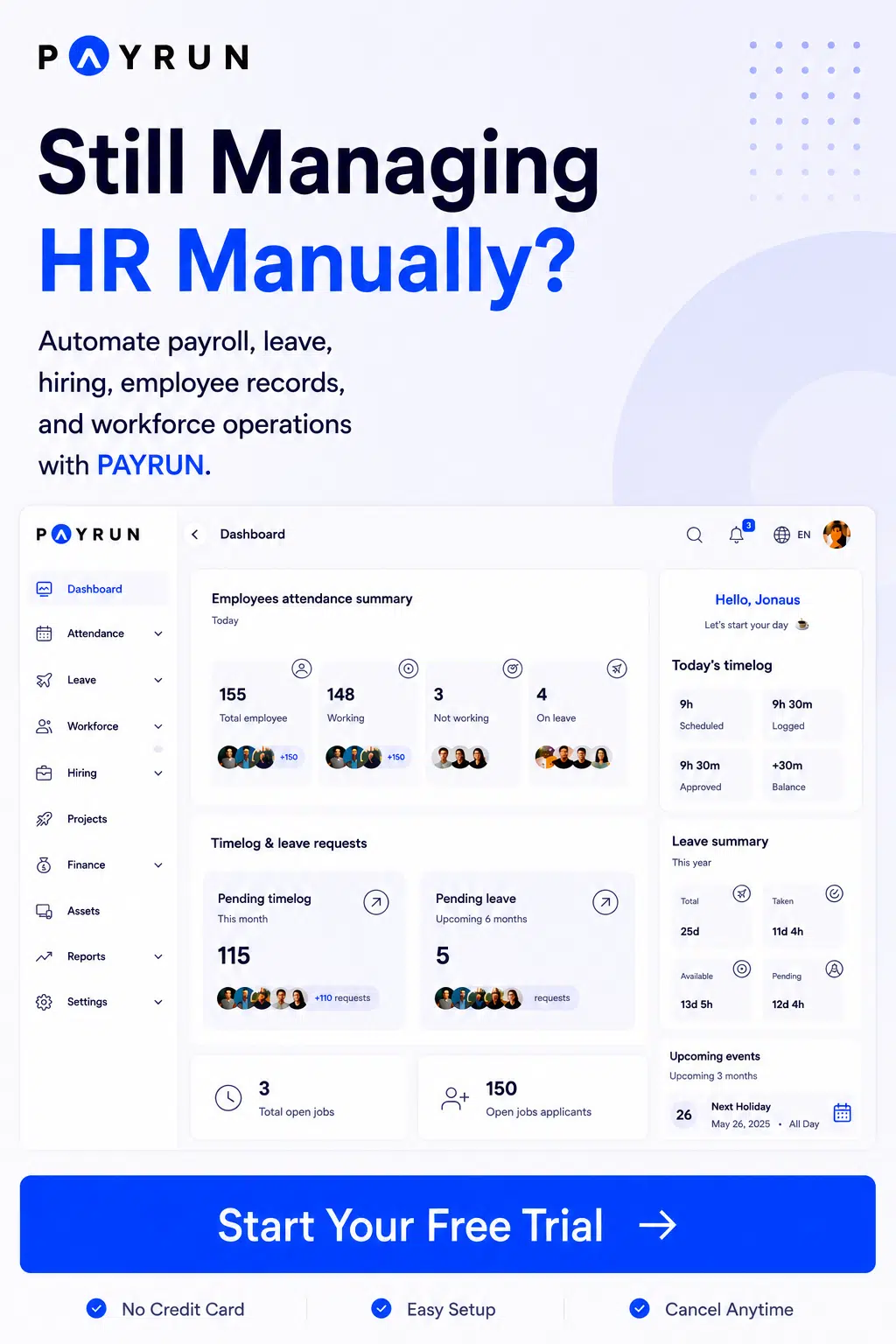
Payrun supports employee lifecycle management with a centralized system that simplifies core HR functions. As a trustworthy partner in HR management, HR teams manage employee data, employee records, and employee information in one central hub. The platform supports the hiring process, applicant tracking, background checks, and employee onboarding for new hires. HR professionals also handle document management, e-signatures, and employee updates without manual processes. A structured system helps organizations maintain data accurate records and improve HR operations.
Payrun also supports workforce management through time tracking, benefits administration, and compensation management. HR teams manage performance reviews, goal setting, and continuous feedback across the entire employee lifecycle. Its innovative HR features and automated workflows reduce manual tasks and save valuable time for HR professionals. Workforce analytics provide actionable insights that help organizations make data-driven decisions. With better lifecycle management, organizations improve employee experience, support employee engagement, and drive business success across small teams and mid-sized organizations.
FAQs
Can Small Teams Benefit From Employee Lifecycle Management Software?
Yes. Employee lifecycle management software helps small teams manage employee data, employee onboarding, and HR tasks in a centralized system. Automated workflows reduce manual work and improve operational efficiency. HR software designed for small businesses also helps HR teams gain better workforce analytics and employee engagement insights without complex HR systems.
Does Employee Lifecycle Management Software Help With Compliance And Employee Records?
Yes. A centralized system stores employee records, employee payroll records, employee information, and document management files in one secure place. Automated workflows support compliance, background checks, and e-signatures. HR professionals maintain data accurate records and reduce errors in HR operations.
What Role Does Workforce Analytics Play In Employee Lifecycle Management Software?
Workforce analytics turns employee data into actionable insights. HR teams track workforce trends, employee engagement, and performance reviews through real-time reporting. These insights support informed decisions, improve talent management, and help organizations drive business success.
Can Employee Lifecycle Management Software Integrate With Payroll And Time Tracking Tools?
Yes. Many HR solutions integrate with payroll platforms, time tracking tools, and benefits administration systems. Integration connects core HR functions and keeps employee updates synchronized, which is critical for accurate payroll processing for growing businesses. HR teams manage workforce operations from a central hub without duplicating HR tasks.
How Does Employee Lifecycle Management Software Support Global HR Teams?
Global HR teams manage employee information, compliance requirements, and workforce management across different locations, often including a distributed or remote workforce supported by HRM software. Lifecycle management software centralizes employee data and HR processes. HR professionals maintain consistent HR operations while adapting to workforce changes in different regions by following a structured employee lifecycle management guide across all stages.