Running payroll for small business in 2026 is about more than just cutting checks on time. You need software that keeps up with changing tax rules, remote teams, growing headcount, and the everyday HR tasks that come with it. Running payroll manually can be time-consuming and increases the risk of errors, making it difficult to stay accurate and compliant. Modern payroll software automates wage calculations, tax filings, and compliance checks, saving you hours each week, reducing costly mistakes, and giving your team a smoother experience from payday to onboarding.
That’s why we’ve put together this list of the 10 best payroll software for small businesses in 2026. The best payroll software integrates with other business tools like accounting and time tracking systems, and uses built-in audits to catch payroll errors before they reach employees or tax agencies. From all-in-one platforms to simple, budget-friendly tools, these options are built to help small teams stay compliant, organized, and focused on what really matters, growing the business with confidence.
What To Look For In Payroll Software
Choosing payroll software is not just about paying people on time. For small businesses, the right tool should reduce stress, save hours every month, and grow with your team as things get busier.
Payroll software should provide compliance alerts and legal resources to help businesses stay compliant with ever-changing tax laws. Quality payroll software also tracks where each employee lives, works, and travels to ensure the correct tax rules are applied. For businesses operating in different locations, multi-state payroll support is essential to handle complex tax filings, compliance, and diverse pay structures across state lines.
1. Simple Setup And Easy Everyday Use
Payroll should not feel like a weekly headache. Look for software that is quick to set up and easy to understand, even if you are not a payroll expert. A clean dashboard, guided steps, and clear labels can make a big difference when you are running payroll late in the evening or between meetings. The best tools let you add employees, set pay schedules, and run your first payroll without digging through long manuals. Referencing a complete guide to payroll software features and automation can also help you know which capabilities matter most. If your team can start using it confidently within a day or two, that is a strong sign you are on the right track.

2. Built In Tax Calculations And Compliance
Taxes are where most small businesses worry the most, and for good reason. A solid payroll system should automatically handle payroll tax calculations, tax payments, and tax filings—including federal, state, and local requirements. The best payroll software can file taxes on your behalf and provide automated tax filings to ensure regulatory compliance. Automated taxes and support for state payroll taxes are important for compliance, as they help you keep up with changing regulations and avoid costly mistakes. Look for features like automatic tax filing, year end forms, and reminders for deadlines. Automated payroll systems help ensure compliance with tax regulations and reduce the risk of penalties for small businesses.
3. Accurate And Flexible Pay Options
Every business pays people a little differently. Some employees are hourly, some are salaried, and others may earn overtime, bonuses, or commissions. Good payroll software should handle all of these without complicated workarounds. You should be able to adjust pay easily, run off cycle payroll when needed, and correct mistakes without starting over. Accuracy matters because even small errors can damage trust with your team. The right system makes sure everyone gets paid correctly, every time.
4. Employee Self Service That Saves Time
Payroll should not mean answering the same questions again and again. Tools with employee self service portals let your team view payslips, download tax forms, update personal details, and check leave balances on their own. This reduces emails and messages coming your way and gives employees more control. When staff can log in from their phone or laptop to find what they need, it creates a smoother experience for everyone and frees you up to focus on running the business.
5. Integration With HR And Time Tracking
Payroll does not work in isolation. It connects closely with attendance, leave, and basic HR records. Seamless accounting integration and accounting integration are important for connecting payroll with financial systems, ensuring data flows accurately between payroll and accounting software. Quality payroll software integrates with other business systems, providing a unified platform that enhances visibility into labor costs and simplifies payroll management. Look for software that integrates smoothly with time tracking software or includes them built in. Payroll software can also streamline payroll processes by consolidating payroll, time tracking, and benefits administration into a single solution. This way, approved hours, overtime, and leaves flow directly into payroll without manual entry. It cuts down on mistakes and saves you from juggling spreadsheets. If the system also stores employee profiles and documents, you get a more complete view of your team in one place.
6. Clear Pricing That Fits Small Business Budgets
Small businesses need predictable costs. The best payroll software is transparent about pricing, whether it charges per employee, per month, or offers fixed plans. However, some features may come at an additional cost or as paid add-ons—such as time tracking, benefits, or HR management tools—so it's important to review what is included in each plan. The cost of small business payroll software will vary by provider and the exact features included in the plan you choose. Tools that offer straightforward per-employee pricing and unlimited runs can be a strong fit for small businesses. Watch out for hidden fees for tax filing, support, or reports. It helps to choose a tool that lets you start small and upgrade only when your team grows. A free trial or low-cost entry plan can also be useful to test if the software truly fits your needs before committing long term.
7. Helpful Support When Things Go Wrong
Even with great software, questions will come up. You might face an unusual payroll case, a tax notice, or a setup issue. That is when responsive customer support matters. Look for providers that offer chat, email, or phone support with real people who understand payroll. Helpful guides, tutorials, and a knowledge base are also valuable when you need quick answers. Knowing support is there gives peace of mind, especially during busy pay periods.
10 Best Payroll Software for Small Businesses In 2026
Choosing the right payroll software can save small businesses time, reduce costly errors, and keep everything compliant as teams grow. These tools offer reliable payroll, smart automation, and helpful HR features to make paying employees easier in 2026.
- Rippling
- BambooHR
- Payrun
- HiPeople
- Gusto
- Sage
- Paycom
- Deel
- Zoho People
- HR Cloud
Pricing Comparison Of The Best Payroll Software For Small Businesses (2026)
| Tool | Starting Price (US) | Pricing Model | Notes |
| Rippling | Custom quote | Base fee + per employee | Pricing depends on modules like Payroll, HR, IT. No fixed public rates; unlimited payroll runs included. |
| BambooHR | Custom quote (small teams often start around $250/mo) | Flat or per employee | Exact pricing depends on company size and plan; payroll is an add-on. Unlimited pay runs available. |
| Payrun | Free; paid from $29/mo | Flat monthly tiers | Starter $29, Pro $49, Enterprise $99 when billed yearly; add-ons for users. Unlimited payroll runs. Free trial available. |
| HiPeople | Custom quote | Subscription by module | Pricing varies by features like reference checks and analytics. No public pricing; custom quote required. |
| Gusto | $49/mo + $6/person | Base + per employee | Plus: $80 + $12/person, Premium: $180 + $22/person. Unlimited pay runs. Free demo available. |
| Sage (Sage 50) | $124.42/mo | Flat monthly license | Premium $169.33/mo, Quantum $253.42/mo; payroll is an add-on. |
| Paycom | Custom quote | Per employee, modules | No public pricing; tailored based on company size and features. Unlimited payroll runs. |
| Deel | $49/contractor/mo | Per worker | PEO $95/employee, Global Payroll $29/employee, EOR $599/employee. Free demo available. |
| Zoho People | $1.25/user/mo | Per user | Professional $2, Premium $3, Enterprise $4.50 billed annually. |
| HR Cloud | Custom quote | Tiered plans | Pricing depends on HR modules; payroll via integrations may add cost. Custom quote required. |
1. Rippling - All-In-One Workforce Management

Rippling is a unified workforce management platform that brings payroll and HR together in one system. It lets small businesses handle employee data, time tracking, benefits, onboarding, and payroll processing from a single dashboard rather than juggling multiple tools.
Payroll & HR Features: Rippling’s payroll solutions integrate payroll data with other HR and business functions, providing real-time visibility and streamlining workflows. A robust assortment of automations and integrations can streamline payroll, tax filing, project management, benefits administration, and HR capabilities into a single solution. Rippling’s payroll includes automatic tax calculations and filings, direct deposit, federal, state, and local compliance, and support for international employees and contractors all within the same system. Its HR suite covers employee records, onboarding, benefits administration, time tracking, and analytics, giving a broader set of capabilities than tools that focus only on payroll.
Ease of Use: Because Rippling combines many functions, the learning curve can be steeper compared with simpler payroll-only tools. However, once set up, many users appreciate having one platform for payroll and HR data, eliminating duplicate entry and improving accuracy. The interface is modern and integrates well with third-party apps, making navigation and automation smoother over time.
Price: Rippling’s core platform pricing starts from roughly $40/month base + ~$8 per employee per month in the US. Costs vary significantly with add-ons like payroll, time tracking, benefits, and compliance, and require a custom quote for full details.
Best For:
- Small businesses looking for an all-in-one platform instead of separate payroll and HR tools
- Teams that need more than basic payroll, including HR, benefits, and compliance management
- Companies managing both local and global employees or contractors
- Growing businesses that want payroll tightly connected with onboarding and employee data
- Owners who prefer to handle most people operations from a single system
2. BambooHR - HR-First Payroll Solution

BambooHR is a people-focused HR platform with built-in payroll that helps small businesses manage employee records, time off, hiring, and pay from one central place. It is known for its clean interface and strong HR foundation, making it a popular choice for growing teams that want better organization without complexity.
Payroll & HR Features: BambooHR offers a comprehensive suite of payroll features, including automatic tax calculations and filings, direct deposit, multi-state payroll support, benefits administration, and employee self-service tools, mainly for U.S.-based teams. Key features also include employee records, time-off tracking, performance management, applicant tracking, onboarding, and detailed reports. Compared to more IT-heavy platforms, BambooHR focuses more on core HR workflows tied closely with payroll.
Ease of Use: BambooHR is widely appreciated for being easy to navigate, even for non-HR users. Setup is straightforward, and everyday tasks like approving time off or running payroll feel simple. The interface is clean and intuitive, which makes it less intimidating than larger all-in-one systems.
Price: In the US, BambooHR pricing depends on company size and plan. For teams with 25 or fewer employees, it starts at a flat rate from about $250 per month. Larger companies pay per employee, per month, with volume discounts as headcount grows; exact pricing requires a quote.
Best For:
- Small businesses that want strong HR tools with reliable payroll built in
- Teams that value simplicity and a clean user experience
- Companies focused on employee records, time off, and onboarding
- U.S.-based businesses needing straightforward payroll compliance
- Growing teams without a dedicated HR department
Smaller companies with fewer than 50 employees often prioritize ease of use, transparent pricing, and core features.
3. Payrun – Best For Small And Growing Businesses

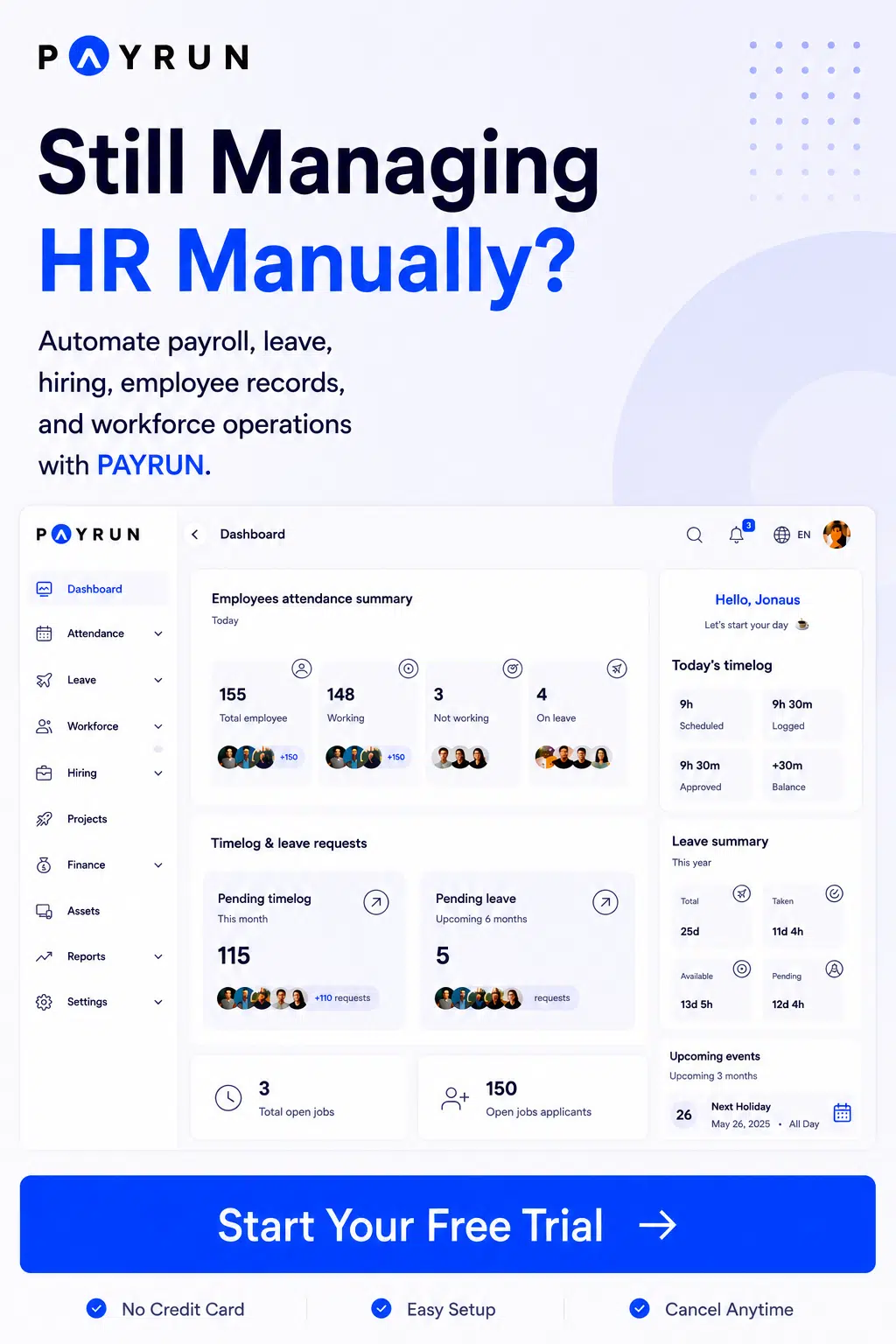
Payrun is a cloud-based HR and payroll management company tailored for small and growing businesses. As a trustworthy partner in HR management, it combines essential HR functions like employee management, attendance tracking, leave management, and hiring workflows in one place, helping teams stay organized and reduce manual work.
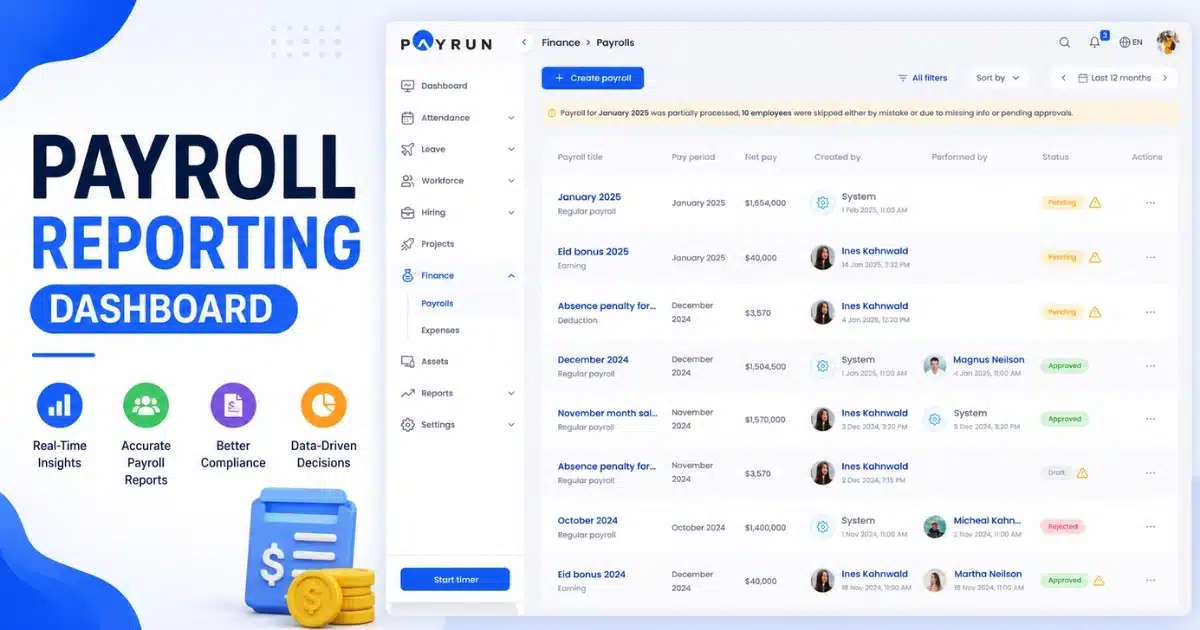
Payroll & HR Features: Payrun includes tools to centralize employee records, track attendance and time, manage leave requests, and streamline recruitment. Its automated HR workflows reduce repetitive administrative tasks and keep workforce data up to date. This aligns with the kind of game-changing HR software features small businesses need. Payrun helps streamline payroll by reducing manual data entry and automating repetitive tasks such as tax calculations and payroll runs, saving small business owners valuable time. While payroll capabilities are integrated, Payrun’s strength lies in connecting core HR functions with pay-related data so that teams can run payroll with better context and fewer errors.
Ease of Use: Designed with simplicity in mind, Payrun offers an intuitive interface that small business users find approachable without extensive training. Its dashboard and workflow automation help teams navigate leave, attendance, and basic payroll tasks smoothly. Some users note a slight learning curve for advanced customization, but overall the platform prioritizes usability for non-technical teams.
Price: Payrun offers a free plan, with paid tiers starting at $29/month for Starter, $49/month for Pro, and $99/month for Enterprise when billed yearly. Yearly billing saves 40%, with scalable add-ons for extra users and job listings.
Best For:
- Small and growing businesses that want HR and payroll together in one place
- Teams that need basic payroll linked with attendance and employee data
- Startups and SMBs that prefer intuitive, easy-to-navigate tools
- Organizations that want affordable, scalable plans as they expand
- Businesses looking for automated HR workflows alongside pay features
4. HiPeople – Best For Hiring And People Insights

HiPeople is a people and hiring platform that focuses on helping small businesses make better recruitment decisions and manage employee data more effectively. While it is not a traditional payroll-first tool, it supports payroll processes by strengthening onboarding, records, and people insights that feed into accurate pay management.
Payroll & HR Features: HiPeople is best known for its reference checks, surveys, and people analytics that help teams evaluate candidates and understand employees. On the HR side, it supports onboarding workflows, employee data collection, and feedback systems. Unlike full payroll suites, HiPeople does not run payroll directly, but it complements payroll software by ensuring clean employee data and smoother transitions from hiring to pay.
Ease of Use: The platform is designed to be straightforward, with guided workflows for setting up checks and collecting feedback. Most small teams can start using it quickly without much training. Since it focuses on fewer core functions, it feels lighter and simpler than large all-in-one HR systems.
Price: HiPeople pricing in the US is subscription-based and tiered by module or seat count, with costs varying by features like reference checks or analytics. Exact pricing requires direct contact or a sales quote. (Vendor pricing not publicly listed)
Best For:
- Small businesses that want to improve hiring quality and onboarding
- Teams that already use payroll software but need better people data
- Companies focused on reference checks and employee feedback
- Growing startups building structured HR processes
- Businesses that prefer a simple, focused people platform over complex systems
5. Gusto – Best For Simple Payroll And Benefits

Gusto is a popular payroll and HR platform built specifically for small businesses that want an easy way to pay employees and manage basic people operations. It brings payroll, benefits, and simple HR tools together in one system, making it a go-to choice for startups and small teams. Gusto is considered the best overall payroll software for small businesses in 2026 due to its intuitive interface and multiple HR features.
Payroll & HR Features: Gusto offers full-service payroll with automatic tax calculations and filings, direct deposit, year-end forms, and support for hourly and salaried workers. On the HR side, it includes employee profiles, onboarding, offer letters, time-off tracking, and access to health benefits in many regions. Gusto is widely known for being an affordable payroll and benefits management software for startups and small businesses. Compared to broader platforms, Gusto focuses more on payroll and core HR rather than advanced analytics or complex workflows.
Ease of Use: Gusto is known for its friendly interface and guided setup. Running payroll usually takes just a few clicks, and most tasks feel straightforward even for first-time users. The platform is less complex than enterprise tools, which makes it approachable for small business owners without HR experience.
Price: Gusto offers three US plans: Simple at $49/month + $6 per person, Plus at $80/month + $12 per person, and Premium at $180/month + $22 per person, with transparent monthly billing and no long-term contracts.
Best For:
- Small businesses that want simple, reliable payroll with minimal setup
- Startups and first-time employers running payroll for the first time
- Teams that need built-in tax filing and compliance support
- Companies looking for basic HR and benefits in one tool
- Owners who value ease of use over deep customization
- Small business payroll needs, as Gusto is a strong choice for affordable payroll and compliance
6. Sage – Suits Accounting-Driven Businesses

Designed for businesses that value accuracy and compliance, Sage brings long-standing accounting expertise into its payroll and HR solutions. It supports small teams that want dependable payroll backed by strong financial controls and reporting.
Payroll & HR Features: Sage payroll handles automatic tax calculations, filings, payslips, and direct deposits, with strong support for local compliance in many regions. It integrates closely with Sage accounting products, offering seamless accounting integration that consolidates payroll and financial data for real-time visibility and efficiency. On the HR side, features often include employee records, leave tracking, and basic reporting. Compared to modern all-in-one HR suites, Sage is more payroll and finance-focused than people experience-focused, whereas many HR software solutions for small and medium businesses emphasize broader people management alongside payroll. QuickBooks Payroll, by comparison, integrates directly with QuickBooks Online, making it especially useful for accounting professionals who want unified payroll and accounting management.
Ease of Use: The interface is practical and structured, especially for users familiar with accounting software. While it may feel less modern than newer tools, it offers clear workflows and reliable processing. Setup can take a bit more time, but once configured, day-to-day payroll runs are straightforward.
Price: Sage 50 Accounting starts at $124.42/month for Pro, $169.33/month for Premium, and $253.42/month for Quantum, billed monthly. Payroll is available as an add-on, making total costs higher depending on users and payroll needs.
Best For:
- Small businesses that already use Sage accounting products
- Teams that prioritize payroll accuracy and compliance
- Companies with basic HR needs tied closely to finance
- Owners comfortable with accounting-style software
- Businesses operating in regions where Sage has strong local support
7. Paycom – Best For Advanced Payroll Automation

Focused on automation, Paycom offers a single platform where employees and employers manage payroll and HR data together. It is built to reduce manual work by letting information flow directly from employee actions into payroll and compliance.
Payroll & HR Features: Paycom provides full-service payroll with automatic tax calculations, filings, direct deposit, and year-end reporting. Its HR tools cover employee records, time and attendance, talent management, onboarding, and performance tracking. Paycom automatically tracks employee hours to ensure accurate payroll calculations and streamline workforce management. The right payroll management system should improve accuracy, simplify tax handling, and cut manual work across HR and finance. A key difference is its employee-driven model, where staff update their own data, which feeds directly into payroll, reducing admin effort.
Ease of Use: The system is feature-rich, so it can feel more complex than simpler payroll tools. Once users are trained, workflows become efficient, especially for larger teams. The interface is modern, but setup often requires guidance.
Price: Paycom does not publicly list standard US pricing online. Costs are custom quoted based on company size, modules, and payroll needs, often positioned above basic payroll tools due to its comprehensive HR/payroll suite.
Best For:
- Small to mid-sized businesses planning to scale quickly
- Teams that want strong payroll automation tied to HR data
- Companies that value employee self-service for accuracy
- Businesses needing a wide range of HR features in one system
- Owners willing to invest time in setup for long-term efficiency
8. Deel – Best For Global Teams And Contractors

Built with global teams in mind, Deel helps small businesses pay and manage employees and contractors across different countries while staying compliant with local laws.
Payroll & HR Features: Deel supports global payroll, contractor payments, tax compliance, and localized contracts in many countries. It also helps businesses process payroll for international employees and contractors, streamlining payments, automating tax filings, and ensuring compliance and data security. It also offers HR features like onboarding, document management, time off tracking, and employee records. Compared to traditional payroll tools, Deel stands out for international compliance rather than domestic payroll depth.
Ease of Use: Deel is designed to be intuitive, especially for managing international workers. Setting up new hires and payments is guided step by step, which makes global payroll less intimidating. For local-only teams, it may feel more than what is needed.
Price: Deel’s US pricing starts at $49 per contractor per month, $95 per employee per month for PEO, $29 per employee per month for Global Payroll, and $599 per employee per month for Employer of Record services, depending on hiring and payroll needs.
Best For:
- Small businesses hiring internationally or remotely
- Teams working with global contractors and employees
- Companies needing built-in international compliance
- Startups expanding into new countries
- Owners who want simple global payroll without local entities
- Businesses in niche industries like farming and nonprofits—OnPay is especially good here, handling tax compliance with impressive accuracy
9. Zoho People – Best For Zoho Based Workflows

Part of the wider Zoho ecosystem, Zoho People focuses on helping small businesses manage employee information and HR processes while connecting smoothly with payroll through Zoho’s finance tools.
Payroll & HR Features: Zoho People offers strong HR features like employee records, leave and attendance tracking, onboarding, performance management, and workflows. It integrates with time tracking software and can sync with other products for accounting, HR management, and other business needs, either from Zoho or third-party providers. Payroll is handled through integration with Zoho Payroll in supported regions, allowing tax calculations, direct deposits, and compliance within the same ecosystem. Compared to payroll-first tools, Zoho People leans more toward HR management with payroll as a connected module.
Ease of Use: The interface is clean and flexible, especially for teams already using Zoho apps. There are many customization options, which is great for tailored workflows but can take time to set up. Once configured, daily tasks are smooth and consistent.
Price: Zoho People starts at $1.25 per user per month for Essential HR, $2 for Professional, $3 for Premium, and $4.50 for Enterprise when billed annually, making it one of the most affordable HR options for small teams.
Best For:
- Small businesses already using Zoho products
- Teams that want customizable HR workflows
- Companies needing HR-first tools with payroll integration
- Budget-conscious businesses looking for scalable software
- Growing teams that want everything in one ecosystem
10. HR Cloud – Suits Employee Experience Focus

With a strong focus on employee experience, HR Cloud helps small businesses bring together onboarding, engagement, HR management, and payroll connections in one people-centered platform.
Payroll & HR Features: HR Cloud provides tools for onboarding, employee directories, document management, time off tracking, and engagement features. It also includes expense management features to help track and control employee expenses, simplifying reporting and cost control. Payroll is supported through integrations with popular payroll providers rather than being fully native. This makes it different from payroll-first systems, as it emphasizes HR experience while still fitting into existing payroll setups.
Ease of Use: HR Cloud is designed to be user-friendly, especially for employees. Navigation is simple, and onboarding workflows are easy to follow. Admin setup is manageable, though integrations may require some initial configuration.
Price: HR Cloud offers tiered plans with transparent monthly rates for HR essentials, onboarding, and employee management. Exact pricing varies by chosen package and features, and payroll integrations may add costs, with detailed quotes available upon request from HR Cloud’s website.
Best For:
- Small businesses focused on onboarding and engagement
- Teams that already use a payroll system and want better HR tools
- Companies that value employee experience and communication
- Growing teams building structured HR processes
- Owners who want HR flexibility with payroll integrations
- Businesses looking for scalable solutions like ADP RUN, which is designed to accommodate growth and offers not just payroll but also HR support, benefits administration, and compliance assistance
Quick Comparison Of The Best Payroll Software For Small Businesses
Tool | Payroll Strength | HR Features | Ease of Use | Best Fit |
|---|---|---|---|---|
Rippling | Excellent full payroll with compliance & global support | Strong HR + benefits + onboarding | Moderate (feature-rich) | All-in-one payroll + HR |
BambooHR | Reliable payroll with tax filing (mainly US) | Excellent core HR & time-off | Easy | HR-centric small teams |
Payrun | Basic payroll linked with HR | Good HR, attendance & hiring | Very easy | Small/ growing businesses |
HiPeople | No native payroll (complements payroll) | Strong hiring & people insights | Very easy | Hiring/ people data focus |
Gusto | Full-service payroll + taxes | Good core HR & benefits | Very easy | Simple payroll needs |
Sage | Strong payroll + accounting ties | Basic HR | Moderate | Payroll + finance focus |
Paycom | Strong automated payroll | Comprehensive HR | Moderate-advanced | Scaling teams |
Deel | Global payroll & compliance | HR basics | Easy | Remote/ international teams |
Zoho People | Payroll via Zoho Payroll integration | Flexible HR workflows | Moderate | Zoho ecosystem users |
HR Cloud | Payroll via integrations | Good onboarding & engagement | Easy | HR experience-oriented |
Note: Payroll platforms and payroll providers offer a range of features for small businesses, including payroll processing, tax filing, HR support, and integrations. Some of the less expensive payroll plans may not include every feature you need, such as tax filing, so it's important to review each provider’s options carefully.
Which Payroll Software Matches Your Business Needs Best
The right payroll software depends on team structure, operational complexity, and how payroll connects with daily workflows. A clear comparison framework helps identify the most suitable option without confusion. The tables and scoring chart below highlight practical fit, scalability, and overall value so you can make a confident and informed decision.
Business Type-Based Recommendation
| Business Type | Recommended Tool | Why It Fits |
| Startups And Small Teams | Payrun | Combines payroll, attendance, and HR in one system with simple setup and fast adoption |
| Global Or Remote Teams | Deel | Built for cross-border payroll, compliance, and contractor management |
| Growing SMBs | Payrun | Scales with team growth while keeping payroll and HR workflows connected |
| HR-Structured Organizations | BambooHR | Strong HR processes with payroll integration for structured environments |
| Automation-Focused Companies | Paycom | Advanced automation and employee-driven workflows for larger teams |
| Finance-Driven Businesses | Sage | Deep accounting integration with reliable payroll processing |
Payroll Complexity-Based Selection
| Payroll Complexity | Recommended Tool | Why It Fits |
| Standard Payroll With HR Integration | Payrun | Keeps payroll aligned with attendance, leave, and employee data in one workflow |
| Multi-location Or Multi-state Payroll | Rippling | Handles compliance and payroll across regions with strong system control |
| Global Payroll And Contractor Payments | Deel | Designed for cross-border payroll, taxes, and compliance requirements |
| Variable Pay Structures And Adjustments | Payrun | Manages bonuses, overtime, and flexible pay without breaking workflow consistency |
| Advanced Compliance And Automation Needs | Paycom | Supports complex rules, automation, and large-scale payroll operations |
Payroll Software Scoring Comparison

Hidden Costs Most Businesses Miss
Payroll software pricing often looks simple, but real costs appear after setup. Many businesses overlook add-ons, scaling fees, and compliance-related expenses that increase over time.
- Tax filing and compliance add-ons
- Per-employee cost increases
- Integration or API access fees
- Customer support or priority service charges
- Year-end reporting and form fees
Finally, Which Payroll Software Company Is Better Overall
The best payroll software depends on how well it balances automation, compliance, and workflow integration. Modern solutions focus on reducing errors, saving time, and connecting payroll with HR systems for accuracy and scalability. Payrun stands out as a strong overall choice because it combines payroll and core HR in one system, keeping processes simple while scaling with business needs. For most small and growing teams, it delivers the most practical and balanced solution.

Payroll Trends Driving Smarter Business Operations 2026
Payroll has become a strategic function that connects finance, HR, and employee experience. Businesses no longer treat payroll as a routine task, but as a system that drives accuracy, compliance, and operational efficiency across growing teams.
AI Powered Payroll Accuracy Improvement
AI is transforming payroll by reducing manual errors and improving processing speed. Modern systems detect anomalies during calculations and flag issues before payroll runs. This proactive approach reduces rework and builds trust in payroll accuracy. Automation also removes repetitive tasks, allowing teams to focus on higher-value work.
Real Time Payroll And Flexible Pay Models
Traditional payroll cycles are shifting toward more flexible models. Real-time payroll enables faster processing based on live data, making salary adjustments more efficient. Many businesses now support flexible pay options, which improve employee financial stability and satisfaction while reducing dependency on fixed pay cycles.
Integrated Payroll And HR Systems Adoption
Payroll is no longer a standalone system. Businesses are adopting unified platforms where employee data, attendance, and payroll work together. This integration eliminates duplicate entries and ensures payroll reflects actual work activity. It also creates better visibility into workforce costs and operational performance.
Rising Focus On Payroll Compliance Automation
Compliance requirements are becoming more complex due to changing tax laws and workforce structures. Businesses rely on payroll systems that automatically update regulations and apply correct calculations. Automated compliance reduces legal risks and prevents costly penalties, especially for growing organizations.
Employee Experience Driven Payroll Systems
Payroll now plays a direct role in employee experience. Accurate and timely payments build trust, while self-service access gives employees control over their data. Modern payroll systems focus on transparency, quick issue resolution, and easy access to payslips and tax information, improving overall satisfaction and retention.
When Payrun Makes The Most Sense For Your Small Business
Choosing payroll software is about finding the right fit for how your team works today and how it will grow tomorrow. In the competitive payroll space, Payrun stands out for small businesses that want simple payroll tied closely with everyday HR without adding complexity by replacing disconnected HR tools with one platform.
Ideal For Small And Growing Teams That Need Simplicity
Payrun works best for businesses that are just starting to build structured people operations. If you have a small team and want to move away from spreadsheets or manual tracking, Payrun gives you an easy way to centralize employee records, attendance, and payroll-related data. You do not need a dedicated HR person to use it. The system is designed so owners and managers can handle core tasks themselves without feeling overwhelmed by features they may never use.
Great If Attendance And Leave Drive Your Payroll
For many small businesses, payroll accuracy depends on hours worked, shifts, and leave. Payrun shines when smart attendance and time tracking are part of daily operations. Since attendance and employee data live in the same system, it becomes easier to prepare payroll with fewer mistakes. This is especially useful for teams with hourly staff, rotating shifts, or frequent leave requests, where manual calculations can quickly turn into errors.
A Good Fit For Budget Conscious Businesses
Cost matters a lot when you are running a small business. Payrun's flexible pricing makes it attractive for teams that want predictable monthly costs and the option to start small. With plans that scale as you add users or job listings, you only pay more when your business grows. This makes Payrun a practical choice for startups and SMBs that need solid HR and payroll support without investing in expensive enterprise tools.
Helpful When You Want HR And Payroll In One Place
If you prefer not to juggle separate tools for employee records, hiring, leave, and payroll, Payrun offers a more unified experience. It helps you simplify HR by replacing disconnected tools, bringing together core HR workflows with payroll-related processes so information flows smoothly between them. This reduces duplicate data entry and helps keep everything consistent. For small teams, having one system for people management can save time and make everyday admin feel more organized.
Right For Teams That Value Ease Of Use Over Heavy Features
Payrun is a strong option when ease of use matters more than having every advanced feature available. It focuses on doing the basics well, with a clean interface and straightforward workflows. If your business does not need complex benefits administration, deep analytics, or global payroll, but instead wants a tool that is quick to learn and simple to run, Payrun fits that mindset well. It lets you stay focused on running your business rather than managing software.
FAQs
What Is Payroll Software And Why Do Small Businesses Need It
Payroll software helps businesses calculate wages, apply payroll deductions, manage payroll tax services, and pay employees accurately. For small businesses, it saves time, reduces errors, ensures timely payments, and helps maintain compliance without needing a full-time payroll service team.
How Much Does Payroll Software Usually Cost For Small Businesses
Pricing varies by provider and features. Many tools charge a monthly base fee plus a per-employee cost, while others offer flat plans. Small businesses can start with affordable options like Square Payroll and scale as they grow, depending on payroll complexity and advanced HR features required.
Can Payroll Software Handle Taxes Automatically
Most modern payroll systems calculate payroll taxes automatically, including local payroll taxes, and many also file them with tax authorities. Built-in payroll tax services help reduce tax penalties and ensure businesses maintain compliance with changing regulations.
Is Payroll Software Secure For Employee Data
Yes, reputable providers use encryption, secure servers, and access controls to protect sensitive employee data. Information such as salaries, pay statements, and personal records remains secure when using trusted payroll service providers.
Can Payroll Software Support Both Hourly And Salaried Employees
Most payroll tools support hourly, salaried, and contract workers, including overtime, bonuses, and payroll deductions. Many systems also manage benefits like health insurance and retirement plans, which is useful for small teams with mixed pay structures.
Do I Still Need An Accountant If I Use Payroll Software
Payroll software simplifies payroll tasks and automation, but many small businesses still rely on accountants for financial strategy, reporting, and compliance. Some companies also work with a Professional Employer Organization for broader HR and payroll support.
How Do I Choose The Right Payroll Software For My Business
Start with your team size, budget, and payroll complexity. Look for features like same day direct deposit, advanced HR features, and integrated payroll tax services. Choose a solution that supports your workflow, keeps operations simple, and helps you maintain compliance as your business grows.