Cloud HRMS Vs Traditional HR Software: The Best Choice For Businesses
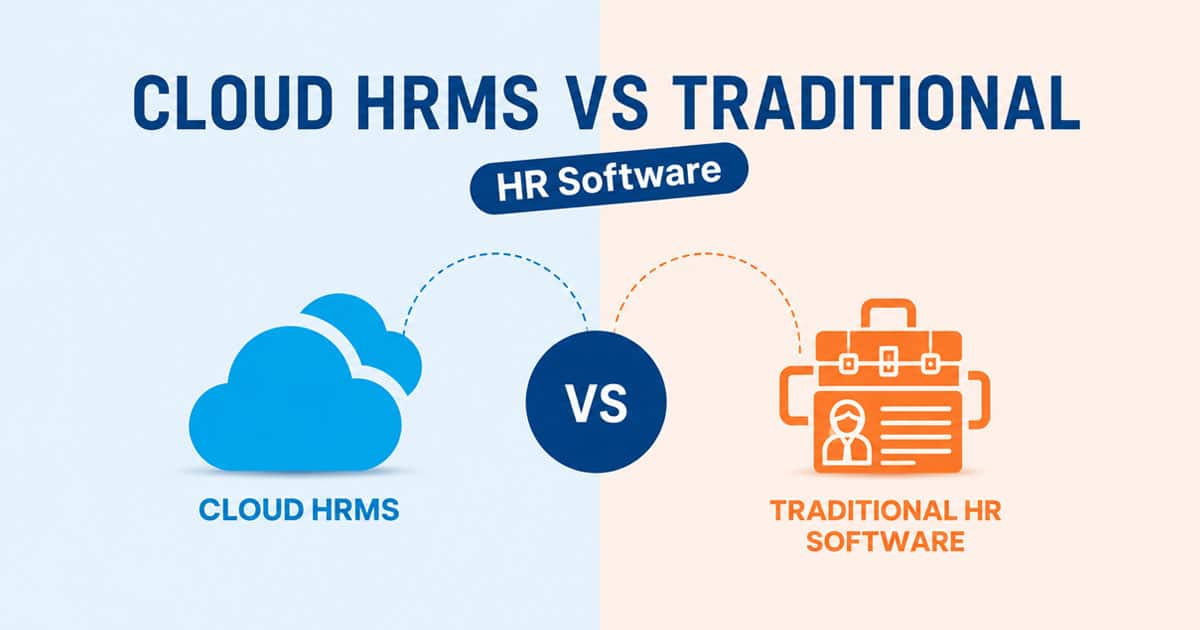
Table of Contents
Modern businesses face constant pressure to manage people more efficiently while adapting to remote work, global teams, and rising compliance demands. This shift has made the debate around cloud HRMS vs traditional HR more relevant than ever. Organizations now evaluate whether legacy systems can still support modern HR operations or whether cloud-based HR software offers a stronger foundation.
HR systems no longer handle only payroll and attendance. They support employee engagement, performance management, workforce analytics, and long-term talent management. As digital transformation accelerates, the choice between traditional HR solutions and cloud-based HRMS directly affects productivity, cost efficiency, and employee experience.

What Is Traditional HR Software?
Traditional HR software typically operates through on-premises systems installed on physical servers within office locations. These systems rely on local deployment, manual configuration, and internal maintenance handled by HR personnel or IT teams. Access often remains restricted to office networks, which limits flexibility for HR teams and employees.
Traditional human resource management supports essential HR functions such as payroll processing, employee attendance tracking, performance management, talent management, and workforce management. Many of these tasks depend on manual processes, spreadsheets, and periodic data updates rather than real-time analytics.
Traditional HR solutions place a heavy burden on manual HR tasks. Operational costs increase due to hardware maintenance, security patches, and system upgrades. Limited workforce analytics restrict data-driven decision making, while scalability and integration challenges slow business growth. Remote work support also remains limited in most traditional HR systems.
What Is Cloud-Based HR Software?
Cloud HRMS refers to cloud-based HRMS software hosted on remote servers and accessed through an internet connection. These systems operate on a subscription-based service provider model and remove the need for physical infrastructure. HR teams gain secure access to HR systems from anywhere.
Cloud-based HR solutions support comprehensive employee data management, payroll and compliance automation, performance tracking, workforce analytics, and employee self-service portals. These capabilities streamline HR operations and reduce repetitive tasks across human resources.
Cloud HRMS delivers real-time analytics that support data-driven decision-making. Automatic updates and security patches reduce IT dependency. Distributed HR teams gain full support for remote work, while operational efficiency improves through automation. Cost efficiency also improves due to lower infrastructure and maintenance expenses.
Cloud HRMS Vs Traditional HR: Key Difference
Cloud HRMS and traditional HR software differ across different factors like infrastructure, accessibility, cost, security, daily HR operations, etc. Understanding these differences helps HR leaders choose the right HR system for scalability, efficiency, and long-term workforce management.
Deployment And Infrastructure
Cloud HRMS operates on cloud platforms that use remote servers maintained by a service provider. This model removes dependency on physical servers and on-premises locations. Businesses avoid hardware procurement, routine maintenance, and system downtime caused by local infrastructure failures.
Traditional HR software relies on physical servers installed within office environments. These on-premises systems require internal IT support, regular upgrades, and manual security patches. Infrastructure expansion often demands additional capital expenditure, which limits scalability and slows HR operations as organizations grow.
Accessibility And Flexibility
Cloud-based HR systems allow HR teams and employees to access HR tools through an internet connection from any location. This flexibility supports remote work, hybrid teams, and distributed HR personnel without disrupting HR processes or employee management.
Traditional HR software restricts access to office networks and specific devices. Employees often depend on HR intervention for simple tasks, which slows workflows. Limited accessibility creates friction for modern workforces that expect self-service portals and real-time access to employee data.
Cost Structure And Operational Costs
Cloud HRMS follows a subscription-based pricing model that spreads costs over time. This structure improves cost efficiency and helps organizations reduce costs associated with infrastructure, upgrades, and long-term maintenance. Operational costs remain predictable and easier to manage.
Traditional HR software demands upfront investment for hardware, licenses, and system configuration. Ongoing expenses include server maintenance, IT staffing, and software updates. These costs increase as the workforce grows, which affects operational efficiency and budget planning.
Automation And Hr Operations
Cloud HRMS platforms automate core HR tasks such as payroll processing, employee attendance, performance tracking, and compliance reporting. Automation reduces repetitive tasks and minimizes payroll errors. HR teams gain time to focus on employee engagement and strategic workforce planning.
Traditional HR practices rely heavily on manual processes and spreadsheets. HR personnel often handle repetitive data entry and approvals, which increases HR intervention and operational delays. Manual workflows also raise the risk of data inconsistencies across HR systems.
Data Security And Data Integrity
Cloud-based HRMS software protects sensitive employee data through encryption, access controls, regular backups, and compliance frameworks. Cloud platforms maintain high data integrity while supporting business continuity during system failures or security incidents.
Traditional HR systems place full responsibility for data security on internal teams. Physical servers face risks from hardware damage, unauthorized access, and delayed security patches. Protecting employee data becomes more complex without a dedicated security infrastructure.
Scalability And System Performance
Cloud HRMS scales easily as the workforce size and HR functions expand. Additional users, features, and HR tools become available without system redesign. System performance remains stable due to distributed cloud-based systems.
Traditional HR software struggles with scalability. Workforce growth often requires server upgrades and manual configuration. Performance issues appear as data volume increases, which affects HR operations and employee experience.
Employee Experience And Self-Service
Cloud HRMS improves employee experience through self-service portals that support leave requests, payroll access, and personal data updates. Employees complete routine HR tasks independently, which increases employee satisfaction and engagement.
Traditional HR systems offer limited self-service capabilities. Employees depend on HR teams for basic information and approvals. This dependency slows response times and reduces transparency across human resources operations.
Pros And Cons Of Cloud HRMS And Traditional HR Software
Every HR system comes with strengths and limitations that affect HR operations, employee experience, and long-term cost efficiency. A clear view of the pros and cons of cloud HRMS and traditional HR software helps businesses align HR solutions with workforce needs and operational priorities.
Advantages Of Cloud HRMS
Cloud HRMS delivers strong scalability that supports growing HR teams and expanding workforces. Organizations add users, features, and HR tools without changes to physical infrastructure. Cloud-based HRMS software centralizes HR processes such as payroll processing, employee attendance, and performance management within a single platform.
Automation improves operational efficiency by reducing repetitive tasks and HR intervention. Real-time analytics and workforce analytics help HR leaders make data-driven decision-making across talent management and workforce planning. Employee self-service portals improve employee experience and employee satisfaction by offering transparent access to HR functions.
Disadvantages Of Cloud HRMS
Cloud HRMS depends on a reliable internet connection to maintain system performance. Limited connectivity can disrupt HR operations, employee self-service access, and payroll workflows. Businesses operating in regions with unstable networks must plan carefully for continuity.
Data migration from traditional HR systems requires structured planning and accurate employee data management. HR teams also need time to adapt to modern HRMS platforms. Training HR personnel becomes necessary to ensure smooth adoption and consistent use of cloud-based systems across human resources.
Cloud pricing also deserves a closer look before signing a contract. Base subscription fees often run between $7 and $25 per employee per month depending on feature depth, but implementation fees, premium support tiers, and module-based upcharges can push real spending well past the initial quote as a business grows. Reviewing the full contract, not just the headline price, avoids budget surprises later.
Summary Table: Advantages Vs Disadvantages of Cloud HRMS
| Aspect | Advantages | Disadvantages |
| Scalability | Supports growing HR teams and expanding workforces without physical infrastructure changes | Requires planning when workforce growth increases system usage |
| HR Operations | Automates payroll processing, employee attendance, and performance management | Workflow disruptions are possible during internet outages |
| Cost Efficiency | Reduces long-term operational costs through subscription-based pricing | Recurring subscription costs may affect short-term budgeting |
| Accessibility | Enables remote access for HR teams and employees from any location | Dependence on a stable internet connection |
| Analytics | Provides real-time analytics and workforce analytics for data-driven decision making | Requires HR teams to learn analytics dashboards |
| Employee Experience | Improves employee experience through self-service portals | Change management is needed during initial adoption |
| Maintenance | Automatic updates and security patches managed by the service provider | Limited control over update schedules |
Advantages Of Traditional HR Software
Traditional HR software offers direct control over on-premises systems and employee data. Organizations manage physical servers internally, which may suit industries with strict internal governance requirements. Some HR teams prefer familiar workflows and manual oversight across HR processes.
Traditional HR systems often operate without dependence on internet connectivity. This setup allows uninterrupted access within office environments. For small businesses with limited HR tasks and a stable workforce size, traditional HR solutions can meet basic payroll and employee management needs.
Disadvantages Of Traditional HR Software
Traditional HR software relies heavily on manual processes that increase HR intervention and repetitive tasks. Payroll errors and data inconsistencies appear more frequently without automation. Limited workforce analytics restrict visibility into performance management and strategic workforce planning.
Operational costs increase due to hardware maintenance, security patches, and IT staffing. Traditional HR systems also struggle to support remote work and modern workforce expectations. Lack of employee self-service reduces employee engagement and slows HR operations across departments.
Summary Table: Advantages Vs Disadvantages Of Traditional HR Software
| Aspect | Advantages | Disadvantages |
| Data Control | Full control over employee data stored on physical servers | High responsibility for data security and data integrity |
| Internet Dependency | Operates without reliance on internet connectivity | Limited remote access and flexibility |
| Familiarity | Uses familiar workflows and manual oversight | Heavy reliance on manual processes |
| Cost Structure | One-time investment for hardware and licenses | High operational costs for maintenance and upgrades |
| HR Operations | Suitable for basic payroll and employee management needs | Increased HR intervention and repetitive tasks |
| Scalability | Stable for small, fixed workforce sizes | Difficult and costly to scale |
| Employee Access | Controlled access within office networks | Limited employee self service and engagement |
When To Choose Traditional HR Software
Traditional HR software still fits certain business environments where simplicity, direct control, and limited digital dependency matter more than scalability or advanced automation. In specific scenarios, traditional HR solutions support stable HR operations without the complexity of cloud-based systems or modern HRMS platforms.
Very Small Workforce Size
Traditional HR software works well for very small organizations with a limited number of employees. HR tasks such as payroll processing, employee attendance, and basic employee data management remain manageable without advanced automation or workforce analytics.
Manual HR processes do not create major operational strain at this scale. HR personnel often handle multiple roles, and traditional HR systems provide sufficient structure for routine HR functions without introducing additional cost or technical overhead.
Limited HR Processes And Scope
Businesses with narrow HR requirements may find traditional HR solutions adequate. Core HR tasks such as salary calculation, leave tracking, and basic compliance can function without cloud-based HR software or modern HRMS platforms.
HR operations remain predictable in such environments. Employee engagement initiatives, talent management programs, and performance tracking often follow informal or manual approaches, which align with traditional HR practices and existing workflows.
Strict On-Premises Data Control
Some organizations require full ownership of employee data due to internal policies or regulatory expectations. Traditional HR software stores employee data on physical servers within on-premises locations, which offers perceived control over sensitive employee data.
Industries with conservative data governance models may prefer internal management of data security and access rights. Traditional HR systems allow businesses to define security protocols without reliance on third-party service providers or cloud platforms.
Minimal Remote Work Requirements
Traditional HR systems fit organizations where remote work plays a limited role. Office-based teams that operate within fixed schedules benefit less from cloud-based HR access or employee self-service portals.
HR teams manage attendance, payroll, and documentation within controlled office environments. Dependence on local networks does not disrupt HR operations when employees and HR personnel remain on site.
Stable Business Growth And Workforce
Companies with stable headcounts and slow expansion cycles may not require scalable HRMS platforms. Traditional HR software supports consistent HR operations without frequent system changes or data migration.
Workforce management remains predictable, and operational efficiency stays consistent. HR leaders in such organizations often prioritize familiarity and reliability over real-time analytics or advanced HR tools.
Limited Technology Adoption Readiness
Some organizations lack readiness for cloud-based systems due to skill gaps or resistance to digital change. Traditional HR software offers familiar interfaces and workflows that reduce training requirements for HR teams.
HR intervention remains higher, yet this approach suits environments where automation and data-driven decision-making are not immediate priorities. Traditional HR practices continue to align with organizational culture and operational comfort.
Short-Term HR System Use
Traditional HR solutions may serve businesses that require a temporary HR system. Short-term projects, early-stage operations, or transitional phases benefit from simple HR software without long-term subscription commitments.
Operational costs remain predictable in the short run. Businesses often choose traditional HR systems when a long-term HR strategy remains undefined or when future system upgrades are planned later.
When To Choose Cloud HRMS
Cloud HRMS suits organizations that prioritize scalability, automation, and data-driven HR operations. Businesses with evolving workforce needs, remote teams, and growing compliance requirements often rely on cloud-based HRMS software to streamline HR processes and improve overall operational efficiency.
Growing Workforce And Expansion
Cloud HRMS supports businesses with expanding teams and frequent workforce changes. HR systems scale easily without physical infrastructure upgrades or system redesign. New employees, locations, and HR functions integrate smoothly within cloud-based systems.
Workforce growth often increases complexity in employee data management and payroll processing. Cloud-based HR software manages this complexity through centralized data, real-time updates, and consistent HR operations across departments and regions.
Distributed And Remote Teams
Organizations with remote work or hybrid models benefit from cloud-based HR access. HR teams and employees reach HR tools through an internet connection, regardless of location. Employee self-service portals support leave requests, payroll access, and attendance records without HR intervention.
Traditional HR systems struggle to support distributed workforces. Cloud HRMS improves employee experience by providing transparent and consistent access to HR functions for all employees, including global and mobile teams.
Need For Automation And Efficiency
Cloud HRMS reduces reliance on manual processes by automating repetitive tasks such as payroll calculations, compliance reporting, and employee attendance tracking. Automation improves operational efficiency and reduces payroll errors.
HR personnel spend less time on routine HR tasks and more time on strategic workforce planning and employee engagement. Automated workflows also improve consistency across HR operations and reduce dependency on manual approvals.
Focus On Data-Driven Decision-Making
Cloud HRMS platforms deliver real-time analytics and workforce analytics that support informed HR decisions. HR leaders track performance management, talent management, and workforce trends through centralized dashboards.
Traditional HR software lacks advanced reporting capabilities. Cloud-based HRMS software transforms employee data into actionable insights that support long-term HR management and organizational planning.
Priority On Employee Experience
Cloud HRMS improves employee experience through self-service portals and transparent HR processes. Employees access personal data, payslips, attendance records, and performance feedback without delays.
Improved accessibility increases employee satisfaction and engagement. HR teams benefit from fewer routine queries, which helps streamline HR operations and improve overall service quality within human resources.
Cost Efficiency And Predictable Spending
Cloud HRMS follows a subscription-based pricing model that aligns costs with actual usage. Businesses avoid large capital expenditure on physical servers and reduce long-term operational costs.
Predictable pricing helps HR leaders plan budgets more effectively. Cloud-based HR solutions also eliminate expenses related to maintenance, security patches, and system upgrades.
Compliance And Business Continuity Needs
Cloud HRMS supports compliance with international labor laws through automated updates and standardized processes. Cloud platforms maintain backups and disaster recovery mechanisms that protect employee data.
Business continuity improves through secure remote servers and redundancy. HR operations remain uninterrupted during system failures or local disruptions, which strengthens organizational resilience.
How To Migrate From Traditional HR To Cloud HRMS
Moving off a legacy system works best as a planned project rather than a single cutover. These five steps cover the core of a typical migration.
Assess Current Systems And Data
Start by listing every system currently holding employee data, from payroll to spreadsheets used for tracking leave. Flag what is outdated, what is mission critical, and what can be retired outright. This inventory becomes the checklist the rest of the migration follows.
Set Clear Migration Goals
Define what success looks like before choosing a platform, whether that is fewer manual payroll corrections, faster onboarding, or self-service access for a distributed team. Assign one person, usually an HR or operations lead, to own sign-off at each stage so decisions do not stall.
Choose A Phased Migration Strategy
Moving every process at once raises the chance something breaks unnoticed. A phased approach, migrating one department or one function like payroll first, lets a team catch data issues early and adjust before the rest of the organization moves over.
Test Before Full Cutover
Run the new system alongside the old one for at least one full payroll cycle. Comparing outputs side by side catches mapping errors or missing fields before employees ever see a problem in their pay or records.
Communicate Change Before Go Live
Adoption depends on employees knowing what is changing and why. A short heads up on new login steps, self-service features, and where to get help reduces confused tickets in the first week and builds confidence in the new system faster.
How Payrun Helps Businesses Succeed In Cloud HRMS Vs Traditional HR
Payrun serves as a modern cloud-based HRMS software that addresses the core limitations of traditional HR while supporting the evolving needs of modern organizations. It centralizes HR management and employee management within a single, secure platform that simplifies day-to-day HR operations and reduces dependency on manual processes. That’s why Payrun is one of the best hr software for business
Payroll processing, employee attendance tracking, and performance management operate through automated workflows that reduce payroll errors and repetitive HR tasks. Secure employee data management protects sensitive employee data while maintaining data integrity, regulatory compliance, and business continuity. Employee self-service portals allow teams to access payslips, attendance records, and personal information independently, which improves employee experience and employee satisfaction.
Real-time analytics and workforce analytics provide HR leaders with clear visibility into workforce trends, performance tracking, and strategic workforce planning. Payrun delivers a cost-efficient HRMS platform that scales with business growth and supports the modern workforce without the complexity and operational burden of traditional HR systems.
FAQs
What Is The Main Difference Between Cloud HRMS And Traditional HR?
Cloud HRMS operates on cloud platforms with remote access, automation, and centralized data management. Traditional HR relies on on-premises systems, physical servers, and manual processes that limit scalability and flexibility.
Is Cloud-Based HRMS Software Secure For Employee Data?
Cloud-based HRMS software protects employee data through encryption, regular backups, access controls, and compliance standards managed by the service provider. These measures help maintain data integrity and reduce risks associated with internal system failures.
Can Traditional HR Systems Support Remote Work?
Traditional HR systems offer limited support for remote work due to restricted access and reliance on office networks. Employees often require HR intervention for routine tasks, which slows HR operations in distributed work environments.
How Does Cloud HRMS Improve HR Operations And Efficiency?
Cloud HRMS improves HR operations through automation, real-time reporting, and streamlined employee data management. Workforce analytics also support data-driven decision-making across HR functions.
Does Cloud HRMS Reduce HR Operational Costs?
Cloud HRMS reduces operational costs by removing the need for physical servers, frequent maintenance, and manual upgrades. Subscription-based pricing helps businesses manage HR expenses more predictably while improving cost efficiency.
Is Data Migration From Traditional HR To Cloud HRMS Difficult?
Data migration requires proper planning, validation, and structured employee data management. With the right approach, businesses can migrate employee data securely without disrupting HR operations or data integrity.
Which Businesses Benefit Most From Cloud-Based HRMS Software?
Growing businesses, remote teams, and organizations with complex HR processes benefit most from cloud-based HRMS software. These businesses gain scalable HR solutions, automation, and workforce analytics that support long-term human resource management goals.