Growing companies face increasing challenges when it comes to maintaining accurate attendance records across expanding teams. Remote workers, field employees, and multiple job sites make traditional tracking methods unreliable. The American Payroll Association reports that U.S. businesses lose $50 billion annually to time theft and buddy punching.
A GPS attendance system addresses this problem by using smartphone location data to verify employee presence within geofenced zones. Studies show these systems improve data accuracy by up to 99% compared to manual data entry. For scaling businesses, this means accurate payroll calculations without expensive hardware investments.
What Is A GPS Attendance System
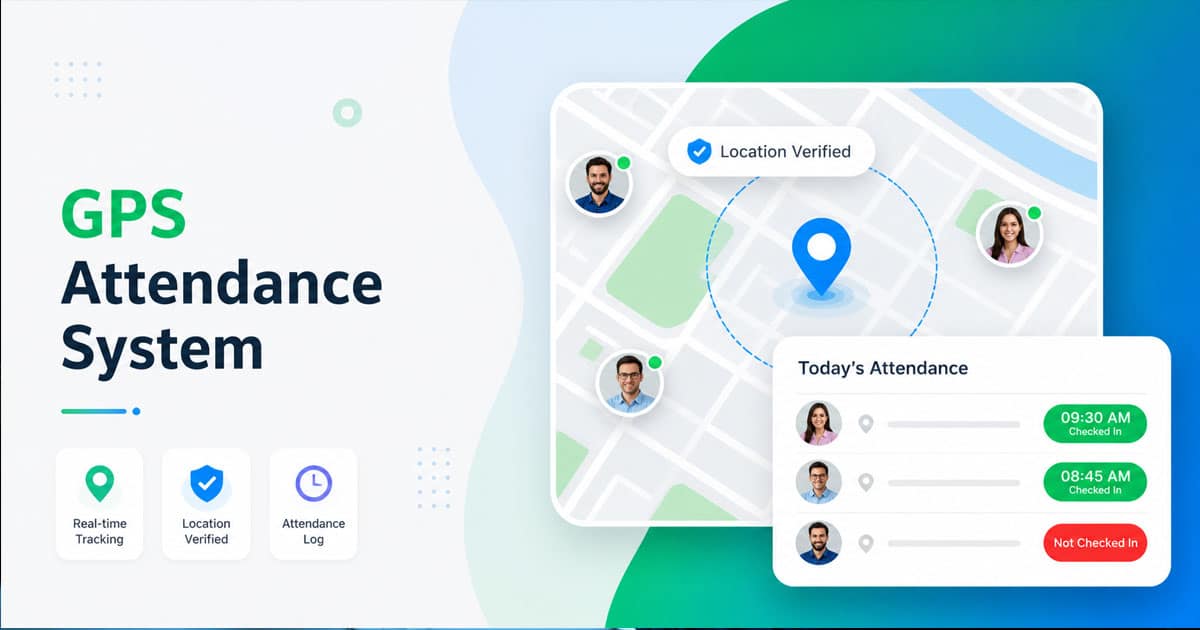
A GPS attendance system records employee clock-ins and clock-outs using the global positioning system built into smartphones. When employees tap to start or end their shift, the system captures latitude and longitude coordinates to confirm their physical presence at designated locations. Unlike biometric scanners that require hardware installation, GPS attendance tracking works through mobile apps on devices employees already own.
The technology creates virtual boundaries called geofences around offices, construction sites, or client locations. Research from industry sources shows 40% adoption in field-heavy sectors like construction and logistics. Accuracy rates exceed 98% in urban areas, making this approach reliable for workforce management.
How GPS Attendance Systems Work
GPS based attendance tracking relies on satellite positioning through employee smartphones to log attendance with precision. The core mechanism uses trilateration from multiple satellites to determine location within 5 to 10 meters outdoors.
Geo-Fencing Technology
Geofencing creates virtual perimeters around approved locations using GPS coordinates. You define a radius around each job site or office, typically between 50 and 200 meters. Employees must enter this zone before the system accepts their clock-in. Reports indicate geofencing cuts proxy attendance by 95% since the system rejects punches outside the designated area. This prevents employees from clocking in while still at home or traveling to work.
Real Time Data Synchronization
When an employee clocks in, the app captures a timestamp along with real time location data. This information uploads instantly to a central server through cellular or Wi-Fi connections. Managers see attendance data appear on dashboards within seconds. This process runs 80% faster than manual entry methods where HR staff collect paper timesheets.
Mobile App Integration
Employees download the attendance tracking software on Android or iOS devices. They authenticate using a PIN or biometric verification before accessing clock functions. Modern apps use background GPS efficiently to minimize battery drain, with improvements of up to 20% in recent versions.
Clock-In And Clock-Out Verification
The system cross-checks employee location against predefined sites during each punch. Any anomalies get flagged for manager review. This verification achieves 99% success rates in preventing buddy punching, where one person clocks in for an absent coworker.
Reporting And Analytics
GPS attendance systems generate comprehensive reporting on attendance patterns, late arrivals, and overtime hours. Advanced analytics can identify trends and predict absenteeism using historical data. Companies report 60% reduction in administrative time spent compiling attendance records.
Core Features Of A Modern GPS Attendance System
Modern GPS tracking software packs advanced tools that go beyond basic location logs, similar to broader attendance management systems for flexible, hybrid, and remote teams. These features help growing businesses scale their attendance solutions without adding infrastructure costs.
Geofencing With Custom Zones
You can define multiple site-specific geofences with adjustable radii for different locations. Set a smaller zone for your main office and larger boundaries for sprawling construction sites. Multi-location support saves 50% setup time compared to installing hardware at each site. Employees can only track attendance when physically present within these approved locations.
Real Time Tracking And Notifications
Live maps show employee location during clock events, giving managers real time visibility into field operations. Automatic alerts notify supervisors about late arrivals or missed clock-ins. Research shows managers respond 70% faster to attendance issues when they receive instant notifications rather than discovering problems at month-end.
Integration With Payroll And HR Systems
Seamless integration with payroll systems eliminates manual data entry between platforms. Attendance data flows directly into payroll automation software that calculates wages, overtime pay, and allowances. Companies using integrated systems report 90% fewer disputes over hours worked and process payroll 10 times faster.
Anti-Fraud Measures Like Photo Capture
Some systems require a selfie with GPS stamp during clock events. Facial recognition verifies the employee identity matches the account. This feature reduces attendance fraud by 85% according to case studies. Photos provide visual proof that the right person clocked in at the right location.
Offline Mode And Data Sync
Field employees often work in areas with poor connectivity. Offline mode records punches locally on the device and syncs when connection returns. This ensures 95% reliability even in remote areas. No attendance data gets lost due to network issues, and HR receives complete labor data once sync completes.
Business Benefits Of GPS Attendance Systems
GPS attendance delivers measurable returns for growing companies through fraud prevention, better visibility, and operational efficiency gains.
Stops Time Theft And Buddy Punching
Time theft occurs when employees claim hours they did not work. Buddy punching happens when one colleague clocks in for another who is absent. GPS verification makes both practices nearly impossible since the system confirms physical presence at the job site. The American Payroll Association estimates buddy punching costs businesses $5.8 billion yearly. Companies implementing GPS attendance tracking reduce these losses by 90 to 95%. A worker claiming to arrive at 9:00 AM gets recorded only when their phone enters the geofence, ensuring fair pay for hours worked.
Improves Payroll Accuracy And Reduces Disputes
Precise clock times with location verification remove guesswork from payroll processing. When an employee questions their hours, HR pulls exact logs showing clock events with timestamps and coordinates. This evidence-based approach cuts disputes by 85% and speeds up payroll processing time by 20%. Fewer corrections mean less administrative burden and more trust between staff and finance teams.
Gives Managers Real Time Visibility
Supervisors can open a dashboard and see who has clocked in at which location right now. This real time monitoring helps with decisions like reassigning a nearby technician to an urgent job or confirming a night shift arrived on schedule. Productivity improves by 60% when managers have this visibility. Alerts flag late arrivals immediately rather than after the pay period closes.
Supports Remote And Field Teams
Remote employees, sales representatives, delivery drivers, and field workers rarely visit a central office. GPS attendance tracking lets them clock in at approved client locations or route checkpoints. HR gets a consistent view of hours worked without collecting spreadsheets. This approach also provides verified work logs when clients request proof of service visits.
Helps With Compliance And Audit Readiness
Accurate records with timestamps and location stamps help companies demonstrate compliance with labor laws. Stored logs support internal audits and inspections around overtime, night shifts, or maximum daily work hours, and form the backbone of well-organized employee payroll records for compliance and accurate payment processing. Compliance reports generate automatically, saving 50% of preparation time. Businesses operating across regions can configure local rules for work weeks and holidays.
Saves Admin Time For HR And Payroll
Removing manual timesheets and Excel uploads frees HR teams from chasing signatures each pay cycle. Automated exports eliminate double entry and the small errors that come with copying times by hand. Companies report 70 to 80% reduction in administrative time spent on attendance. This allows HR to focus on resource allocation, hiring, and employee engagement instead of data entry.
Use Cases Across Different Industries
GPS attendance solutions support industries that manage distributed teams, field employees, and multiple work locations. Organizations must use reliable tracking systems to maintain employee attendance records, improve workforce management, and reduce payroll errors.
Construction And Field Services
Construction companies manage teams across multiple job sites, which makes tracking employee attendance difficult. A gps attendance tracking system helps the construction workforce automatically clock in when workers arrive at approved locations. Using accurate location data from the global positioning system, managers verify presence without relying on manual attendance sheets.
Automating attendance tracking also reduces manual errors that often occur with paper records. The system collects gps data to maintain accurate time tracking for workers across different project sites. Accurate attendance data improves payroll accuracy and prevents payroll errors when calculating wages and overtime pay. Companies also use these systems to ensure compliance with labor laws while improving overall labor management across construction sites.
Sales And Delivery
Sales representatives and delivery drivers travel across wide territories every day. A gps based attendance system helps organizations track employees while they work outside traditional office locations. Managers receive real time visibility into employee location and work activity through gps attendance tracking.
These systems help verify client visits and route completion while supporting accurate time tracking for mobile workers. Businesses also use attendance data to optimize resource allocation and reduce unnecessary travel costs. When companies manage attendance effectively, they improve time management, reduce wasted work hours, and increase employee productivity across distributed sales teams.
Healthcare And Hospitality
Healthcare facilities and hospitality businesses often manage employees across multiple branches and shift schedules. A time and attendance system supported by gps attendance tracking ensures employees clock in only from approved locations.
Automating attendance tracking helps HR teams manage attendance across departments without relying on manual processes. Accurate attendance records help organizations maintain accurate payroll calculations while reducing payroll errors. These systems also help ensure compliance with labor regulations that require accurate documentation of working hours.
Retail And Warehousing
Retail stores and warehouses manage large teams that work across different zones and locations. GPS attendance tracking systems help managers manage attendance and monitor workforce activity throughout the facility.
Accurate attendance data allows businesses to analyze attendance trends and track labor costs across locations, especially when supported by smart attendance tracking software with real-time timeline views of employee activity. Integrating attendance tracking software with HR systems improves operational efficiency and supports better workforce planning.
Manufacturing And Logistics
Manufacturing plants and logistics companies rely on accurate time tracking to manage complex operations. GPS attendance systems provide accurate records of employee attendance across facility zones and distribution centers.
Organizations use these systems to analyze attendance trends, support labor management decisions, and ensure accurate payroll processing, often relying on detailed employee time log reports for smarter attendance and productivity tracking. Reliable attendance data also helps companies optimize resource allocation and maintain efficient operations across large production and logistics environments.
Practical Tips To Implement A GPS Attendance System
Technology alone does not guarantee success. Proper rollout and clear communication drive adoption rates.
Employee Training And Buy-In
Transparency matters more than anything during implementation. Conduct training sessions explaining what data gets captured, who sees it, and how long records stay stored. Address privacy concerns directly with clear policies. Companies achieve 80% acceptance rates when employees understand the system protects accurate records rather than invading privacy.
Define Geofences Precisely
Conduct site surveys before setting boundaries. Urban locations may need 50 to 100 meter radii while large construction sites require 200 meters or more. Test configurations to avoid false rejections that frustrate employees. Expect around 5% error rate initially in dense urban areas and adjust accordingly.
Integrate With Existing HR Tools
Choose attendance solutions compatible with your current payroll system and hr systems. Following structured steps on how to implement an attendance management system in your business helps ensure API connections allow attendance data to flow automatically without manual exports. Proper integration delivers 90% smoother transitions and ensures accurate payroll calculations from day one.
Address Connectivity Challenges
Enable offline mode and communicate how it works to field employees. Hybrid GPS and Wi-Fi positioning improves reliability to 95% even in low-coverage areas. Make sure staff know to clock in through the app regardless of signal strength.
Monitor And Optimize Post-Launch
Review analytics weekly during the first month. Expect 20 to 30% discrepancies initially as you fine-tune geofence sizes and shift rules. Regular optimization, supported by employee timeline tracking that shows detailed work patterns in real time, ensures the system works for your specific operational needs. Future updates may include AI that auto-adjusts fences based on usage patterns.
How An HRM Helps Businesses With GPS Attendance
An HRM streamlines GPS attendance for growing companies through a mobile app with built-in geofencing and real-time time tracking as part of a unified employee management platform. Employees clock in and out within approved locations, and attendance data syncs automatically to remove manual entry.
The system includes photo verification to reduce time fraud and produces compliance-ready reports for audits. Payroll integration uses verified attendance records to calculate wages, overtime, and allowances accurately. HR teams notice fewer payroll disputes and major reductions in administrative workload.
Companies with field teams, remote staff, or construction crews benefit from offline clock-ins and detailed workforce analytics. Managers review attendance trends, verify job site presence, and maintain accurate records through automated workflows. Compared with manual or hardware-based systems, an HRM reduces operational costs while maintaining reliable attendance accuracy.
FAQs
Does A GPS Attendance System Track Employees All The Time
No. Most systems record location only during clock events like clock-in, clock-out, or break changes. Continuous monitoring raises privacy issues and violates many data protection regulations. An HRM captures location data at specific moments, complying with local laws and reflecting its role as a trustworthy HR management partner focused on secure, transparent workforce solutions. Transparency about tracking policies leads to 90% employee trust, according to surveys.
What Happens If An Employee Has No Internet Connection
Offline mode stores clock events locally on the device. Data syncs automatically once connection returns. Testing shows less than 1% data loss in field conditions. Communicate this feature to staff so they continue using the app in low-coverage areas, especially when combined with HRM software designed to manage and support remote workforces effectively.
Can GPS Attendance Work For Night Shifts And 24x7 Operations
Yes. GPS time tracking handles shift rules that span midnight and supports round-the-clock operations in security, hospitals, and manufacturing. Configure shift windows so employees clock in only during correct time ranges within the right geofence. Accuracy remains at 98% for shift workers.
How Accurate Is Smartphone GPS For Attendance
Modern smartphones achieve 5 to 10 meter accuracy outdoors and 20 to 50 meters indoors with Wi-Fi assistance. This precision works well for verifying presence at a job site or office. In dense urban areas with tall buildings, businesses may choose slightly larger geofence radii to avoid false rejections. Overall accuracy exceeds 98% for attendance purposes.
What If Employees Forget To Clock In Or Out
Supervisors can review GPS logs and adjust records with manager approval and a documented reason. Push notifications around shift start and end times reduce forgetfulness by 70%. Employee self service portals, combined with tools like smart attendance tracking software offering real-time visual timelines and detailed employee time log reports for accurate attendance and productivity insights, let staff view past attendance records and flag missed punches for review.