Federal Vs State Payroll Tax-Which Tax System Creates More Compliance Complexity?
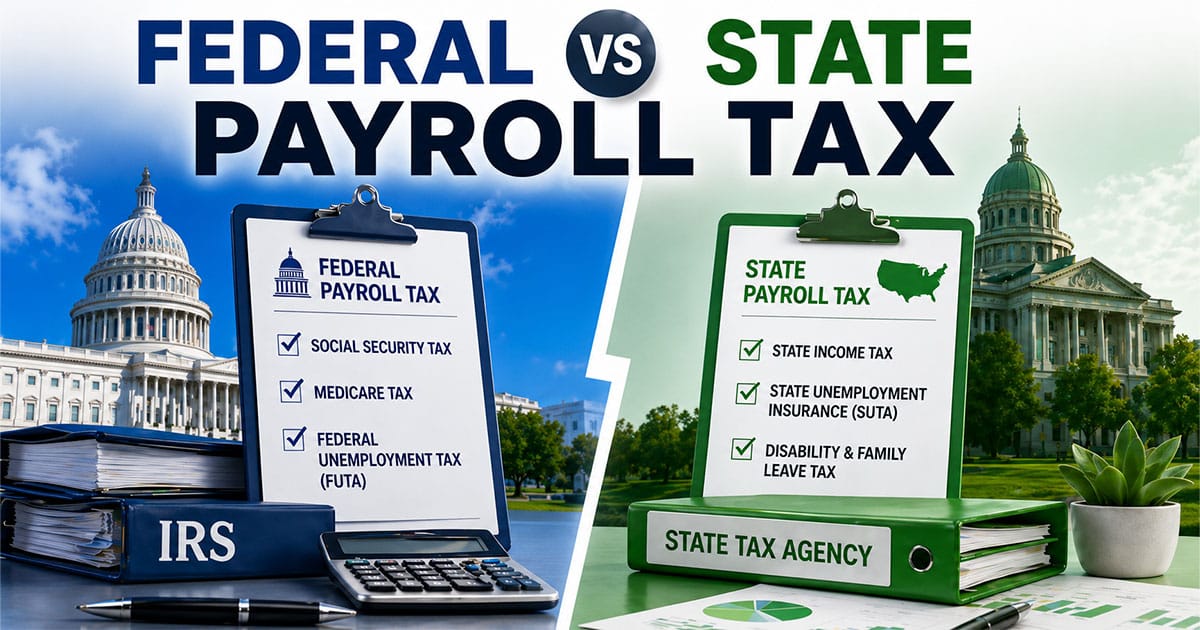
Table of Contents
Payroll taxes represent a fundamental obligation for every employer in the United States, encompassing both federal and state tax systems that fund critical programs like Social Security and Medicare. Federal payroll taxes apply uniformly across all 50 states, creating predictable rates and filing schedules that remain consistent regardless of where your business operates. State payroll taxes, however, introduce significant variation through differing unemployment tax rates, disability insurance mandates, and paid leave programs that change from one jurisdiction to another.
For businesses expanding across state lines or managing remote workers, understanding which system creates greater compliance complexity becomes essential for accurate payroll processing. This comparison examines the specific requirements, filing obligations, and administrative burdens of federal versus state payroll tax systems to help you determine where your compliance resources should focus.

Federal Vs State Payroll Tax: Key Differences
The fundamental distinction between federal and state payroll tax systems centers on uniformity versus variation. Federal taxes are established by Congress and implemented by the IRS, Social Security Administration, and Department of Labor, applying identical rules, rates, and wage base limits to every employer nationwide. State payroll taxes are enacted by individual state legislatures, with each jurisdiction designing unique systems for unemployment insurance, disability coverage, and leave mandates.
Aspect | Federal Payroll Taxes | State Payroll Taxes |
|---|---|---|
Governing Authority | IRS, SSA, Department of Labor | Individual state agencies and legislatures |
Tax Types | Social Security, Medicare, FUTA, federal income tax withholding | State Unemployment Insurance, State Disability Insurance, Workers Compensation, Paid Leave |
Rate Consistency | Fixed percentages applied uniformly across all states | Rates vary by state, employer history, and industry classification |
Wage Base Limits | National limits: Social Security at $184,500 (2026), FUTA at $7,000 | State limits range from $7,000 to over $70,000 depending on jurisdiction |
Filing Schedules | Standardized quarterly and annual deadlines | Varies by state with different forms, portals, and submission timelines |
Penalty Structure | Uniform federal penalties for late deposits or filings | Diverse penalty systems with varying interest rates and escalation procedures |
The compliance complexity comparison reveals that federal taxes offer predictability through consistent rules, while state systems create administrative burden through variation. Multi-state employers must track approximately 50 different tax systems, each with distinct wage bases, experience rating formulas, filing portals, and deposit deadlines. Implementing dedicated payroll compliance software to automate these obligations can significantly reduce manual tracking and error risk. This jurisdictional complexity often drives the overall compliance cost for businesses operating beyond a single state.
Federal and state systems work together in payroll processing through coordinated mechanisms. For example, employers receive FUTA tax credits for paying state unemployment taxes on time. Payroll systems must simultaneously calculate federal income tax withholding, security and medicare taxes, and multiple state obligations while ensuring correct taxable wage bases are applied per program and jurisdiction.
Tax Types And Program Funding
Payroll taxes include federal and state taxes taken from an employee’s taxable compensation, which help fund programs like Social Security and Medicare. Understanding which taxes apply, who bears the cost, and what programs they support provides the foundation for managing tax obligations effectively, especially when you map them to a structured payroll processing workflow for growing businesses.
Program | Level | Responsible Party | Wage Base/Limit | Program Funded |
|---|---|---|---|---|
Social Security (OASDI) | Federal | Employee and Employer (6.2% each) | $184,500 (2026) | Retirement, survivors, disability benefits |
Medicare | Federal | Employee and Employer (1.45% each) | No cap | Healthcare for seniors and disabled |
Additional Medicare Tax | Federal | Employee only (0.9%) | Income over $200,000 | Medicare expansion |
FUTA | Federal | Employer only | First $7,000 per employee | Federal unemployment trust fund |
State Unemployment (SUTA) | State | Employer (most states) | Varies by state ($7,000 to $70,000+) | State unemployment benefits |
State Disability Insurance | State | Employee, sometimes shared | Varies by state | Short-term disability benefits |
Paid Family/Medical Leave | State | Shared or employee/employer | Varies by state | Wage replacement during leave |
Workers Compensation | State | Employer | Based on wages and industry risk | On-the-job injury compensation |
Federal Payroll Tax Programs
The Federal Insurance Contributions Act establishes the framework for Social Security and Medicare taxes. The federal payroll tax rate for Social Security is 6.2% on wages up to a certain limit, while the Medicare tax rate is 1.45% on all earnings. FICA taxes are split between employers and employees at a total rate of 15.3%, with each contributing 7.65%.
The Social Security tax applies to income up to a specific limit ($184,500 for 2026), while Medicare has no upper cap. The additional Medicare tax of 0.9% applies only to employees earning over $200,000 annually, with employers required to begin withholding once that threshold is reached during the calendar year.
The federal unemployment tax (FUTA) is usually 6% on the first $7,000 of an employee’s wages but can drop to 0.6% with state credits. This significant reduction applies when employers pay state unemployment taxes on time and their state maintains compliance with federal guidelines. These employment taxes collectively fund federal social insurance programs that provide retirement income, healthcare coverage, and unemployment assistance.
State Payroll Tax Programs
State payroll taxes are influenced by local government priorities and economic conditions, making them more dynamic than federal taxes. State Unemployment Insurance rates vary significantly based on employer claims history, with experience rating systems rewarding employers who maintain stable workforces with lower rates.
Several states operate mandatory disability insurance programs. California, New Jersey, New York, Hawaii, Rhode Island, and Puerto Rico require State Disability Insurance contributions that provide wage replacement for non-work-related illness or pregnancy. California combines SDI with paid family leave, requiring employee contributions at approximately 1.3% of wages.
Workers compensation requirements differ by state in terms of rate structure, industry classification, and coverage mandates. States like Washington and California have also implemented mandatory paid family and medical leave programs that impose additional payroll tax obligations. These state-specific programs create layered compliance requirements beyond traditional unemployment insurance, and poor tracking of time off or entitlements can easily lead to leave management mistakes that create compliance risk.
Tax Rates And Calculation Methods
To calculate payroll taxes, employers must withhold federal income tax, Social Security tax, and Medicare tax from employees’ paychecks, as well as any applicable state and local taxes. The calculation methods and rate structures differ substantially between federal and state systems, which is why many employers rely on payroll automation software to handle complex calculations accurately.
Feature | Federal | State |
|---|---|---|
Rate Uniformity | Fixed percentages regardless of location | Highly variable by state, employer, and industry |
Wage Base Limits | Social Security: $184,500 (2026), FUTA: $7,000, Medicare: none | UI wage bases from $7,000 to over $70,000; some programs have no cap |
Additional Taxes | Additional Medicare Tax 0.9% above threshold | Disability, leave, workers compensation, training fund surcharges |
Cost Sharing | Social Security and Medicare shared equally; FUTA employer only | Mostly employer for unemployment; disability and leave often shared |
Federal Tax Rate Structure
Federal payroll taxes maintain fixed percentage rates that apply uniformly across all states. The federal payroll tax rate for Social Security is 6.2% on earnings up to a certain limit, while the Medicare tax rate is 1.45% on all earnings, with an additional 0.9% for high earners. Employers are responsible for calculating the correct amounts of payroll taxes based on employee earnings and the information provided on their Form W-4, which includes details like marital status and number of exemptions.
The wage base limit for Social Security increased from $176,100 in 2025 to $184,500 in 2026, reflecting adjustments based on the national average wage index. Medicare taxes continue without any income cap, creating unlimited liability on all wages. The FUTA tax applies only to the first $7,000 of each employee’s wages annually, with employers receiving credits that typically reduce the effective rate from 6.0% to 0.6%.
Payroll taxes are split between employers and employees, while income taxes are solely the responsibility of employees. As new rules around transparency, minimum wage, and worker classification emerge, understanding how payroll regulations are evolving for growing companies in 2026 becomes critical for long‑term compliance. This cost-sharing arrangement for FICA taxes means both parties contribute equally to Social Security and Medicare funding, though FUTA remains entirely an employer obligation.
State Tax Rate Variations
Unemployment tax rates vary by state and are often based on an employer’s claims history. SUTA rates can range from under 1% to nearly 9% depending on the jurisdiction and employer experience rating. Minnesota employers, for example, face minimum base rates of 0.40% and maximum experience rates up to 8.90% on a taxable wage base of $44,000 in 2026.
New employer rates are typically set between 2.7% and 3.4%, though this varies by state and industry classification. Texas defaults new employers to 2.70% for most industry codes, with experience eventually adjusting rates upward or downward based on unemployment claims filed against the employer.
State income tax rates can vary significantly, with some states implementing a flat tax rate while others use a progressive tax system where rates increase with income levels, making a robust payroll compliance guide for small businesses especially valuable for employers without in‑house tax expertise. As of 2023, there are nine states in the U.S. that do not levy an income tax on wages: Alaska, Florida, Nevada, New Hampshire, South Dakota, Tennessee, Texas, Washington, and Wyoming. States with no income tax may still impose taxes on other sources of income, such as New Hampshire’s tax on dividends and interest income, which is set to phase out completely by 2025.
Filing Requirements And Deadlines
Meeting filing deadlines represents a substantial administrative burden for employers, which is why regular payroll audit strategies to check filings and calculations are essential to catch issues before they trigger penalties. Federal filings follow standardized schedules, while state requirements introduce variation in forms, deposit frequency, and submission portals that complicate compliance for multi-state operations.
Aspect | Federal | State |
|---|---|---|
Filing Frequency | Quarterly (Form 941), Annual (Form 940) | Usually quarterly for SUTA; monthly for some disability or leave programs |
Deposit Schedule | Monthly or semi-weekly based on lookback period liability | Varies by state; some require weekly deposits for larger employers |
Required Forms | Forms 941, 940, 944, 945 through IRS/SSA systems | State-specific forms through individual state portals |
Electronic Filing | Required above certain thresholds through EFTPS | Many states mandate electronic funds transfer above volume thresholds |
Penalty Structure | Uniform federal penalties with defined grace periods | Varied penalties, interest rates, and escalation procedures by state |
Federal Filing Obligations
Employers must file various payroll tax forms according to specific schedules, such as Form 941 for federal income and FICA taxes, which is due quarterly, and Form 940 for FUTA tax, which is due annually. Form 941 deadlines fall on the last day of the month following each quarter: April 30, July 31, October 31, and January 31.
If all federal tax deposits for a quarter were made on time, employers receive an automatic 10-day extension for filing the corresponding Form 941. Form 940 is generally due by January 31, though adjustments apply when deadlines fall on weekends or holidays.
Federal deposit schedules depend on a lookback period that determines whether employers must deposit monthly or semi-weekly. Larger tax liabilities require more frequent deposits. Federal law requires electronic funds transfer for federal tax deposits when certain thresholds are met, with penalties escalating based on duration and amount of any violation.
State Filing Requirements
State unemployment tax returns are typically filed quarterly, though due dates vary by jurisdiction and do not always align with federal deadlines. Each state maintains its own forms, employer portals, and submission requirements, often mandating electronic filing for employers exceeding specific volume or dollar thresholds.
Different deposit schedules ranging from monthly to quarterly create additional tracking requirements. Some states with robust disability insurance or paid leave programs require monthly contributions separate from quarterly unemployment filings. Wage reporting requirements often differ from federal timelines, with states sometimes requiring additional data about hours worked or multi-state wage allocation.
Missing state filing deadlines can trigger consequences beyond state penalties. Late payment of state unemployment taxes can result in loss of FUTA tax credits, effectively increasing federal tax liability from 0.6% back toward the statutory 6.0% rate. This interaction between federal and state systems makes timely state compliance essential for managing overall tax obligations.
Compliance Complexity And Administrative Burden
Federal payroll taxes are uniform across the United States, while state payroll taxes vary significantly by jurisdiction. This fundamental difference shapes the compliance experience for employers of all sizes.
Aspect | Federal Payroll Tax | State Payroll Tax |
|---|---|---|
System Structure | Uniform system with standardized rules across all states | Varies by jurisdiction with different laws and requirements |
Rates And Wage Bases | Consistent rates and wage bases nationwide | Different rates and wage limits per state |
Filing Requirements | Standard forms, schedules, and processes | Multiple portals, formats, and deadlines by state |
Multi-State Complexity | No added burden across locations | High complexity managing multiple state obligations |
Penalty Structure | Clear and predictable escalation model | Varies widely in fines, interest, and enforcement |
Administrative Effort | Easier setup and maintenance | Requires ongoing tracking, tools, and specialized resources |
State systems create multi-jurisdictional compliance challenges for multi-state employers. Managing 10 or 20 state registrations, tracking different experience rating formulas, ensuring correct wage base caps per state, and navigating distinct filing portals requires substantial administrative infrastructure. Remote work has intensified these challenges, with employees working from home potentially creating nexus in states where the employer has no physical presence, amplifying the impact of new employment policies on growing businesses.
Penalty structures differ between systems. Federal penalties for late deposits follow a clear escalation schedule based on how late the deposit is made and the amount involved. State penalties vary widely in severity, interest rate calculations, and enforcement practices. Some states impose steep fines, while others may affect future tax rates or program eligibility.
Technology solutions have become essential for managing varying state requirements, with a modern payroll management system that centralizes calculations and record‑keeping often forming the backbone of a compliant payroll operation. Payroll software that automatically updates rate tables, tracks state-specific wage bases, and supports electronic filing across multiple jurisdictions reduces error risk. Larger employers often engage specialized payroll compliance providers or maintain dedicated internal teams to monitor state legislative changes and ensure accurate payroll processing.
Geographic Considerations For Multi-State Employers
Employers operating across multiple states face layered compliance requirements that multiply administrative burden. Understanding how geographic factors affect tax obligations helps businesses allocate compliance resources effectively.
Geographic Factor | Federal Relevance | State Relevance |
|---|---|---|
Work Location vs. Residence | Federal taxes apply to all wages regardless of state | State unemployment, income withholding, and leave obligations depend on work location |
Remote Work/Nexus | No impact on federal payroll tax obligations | Remote presence can trigger state tax obligations even for occasional work |
Reciprocity Agreements | Generally irrelevant for federal payroll taxes | Some states reduce withholding burden for cross-border workers |
Interstate Commerce | Federal definitions are standard | States may conflict on wage allocation, requiring careful tracking |
Remote work has created significant nexus complications. An employee working from home in a different state than company headquarters may trigger state income tax withholding obligations, state unemployment insurance registration, and compliance with that state’s paid leave mandates. In states with a progressive income tax system, employers must update withholding tables to align with various tax brackets and rates, which can change annually.
Some states maintain reciprocity agreements that reduce state income tax withholding complexity for workers living in one state and working in another, but employers must still maintain detailed employee payroll records that document work locations and withholdings. These agreements are more common in border regions and primarily affect state withholding tax rather than unemployment or disability obligations. Understanding which agreements apply to your workforce helps minimize unnecessary withholding and filing.
Interstate commerce considerations affect how wages are allocated when employees perform work in multiple states. States differ in their methods for determining which jurisdiction’s unemployment insurance applies, sometimes creating risk of double contributions or gaps in coverage without careful wage tracking.
Federal Vs State Payroll Tax: Which Creates Greater Business Impact?
For businesses operating in single states with straightforward compliance needs, federal payroll tax requirements represent the primary administrative focus. The federal government sets consistent rules that apply across every pay period, shaping how employers handle federal tax obligations. These include calculating federal withholding tax, managing taxable income, and ensuring accurate reporting of personal income taxes. Employers must also withhold income taxes correctly to avoid errors in the final tax bill. State unemployment insurance and suta taxes add one additional layer but generally follow predictable patterns within a single jurisdiction.
Employers operating across multiple states face a different calculation. State payroll tax management becomes the more significant driver of systems investment, staff time, and compliance risk. Requirements to withhold state income tax, coordinate with local tax agencies, and manage local payroll taxes increase operational complexity. Tracking different wage bases, experience ratings, and handling diverse filing portals makes it harder to stay compliant with evolving tax obligations, increasing the likelihood of payroll mistakes businesses must avoid in 2026. In some cases, additional considerations like self employment tax and region-specific programs further complicate payroll processing and reporting.
Professional payroll services or comprehensive payroll software become essential for complex state tax environments, and many employers evaluate a broad payroll software feature set covering automation, compliance, and reporting before selecting a platform. These solutions help automate calculations, apply accurate tax deductions, and ensure all taxes paid align with regulatory requirements. Using a reliable system also simplifies processes like federal withholding, improves accuracy in reporting, and reduces errors that often arise in a typical payroll tax example scenario involving multiple jurisdictions.
Final Discussion
Federal and state payroll tax systems each contribute to compliance burden through different mechanisms. The federal system’s uniformity provides stability and predictability, with consistent rates, wage bases, and filing schedules that simplify administration. This structure ensures steady federal revenues and reduces variability in handling wage income across organizations. However, the multiplicity of state systems creates the complexity that typically challenges payroll professionals most significantly, especially when coordinating with each state tax agency.
Employers are responsible for withholding federal income tax, Social Security, and Medicare taxes from employees’ paychecks and remitting these amounts to the IRS and state authorities. Accurate handling of employee's filing status directly impacts calculations, ensuring proper withholding money and avoiding scenarios where employees later owe taxes or expect a tax refund. This dual obligation requires integrated systems capable of managing both federal consistency and state variation simultaneously, making automated payroll software with built‑in compliance features especially valuable.
Annual updates, state legislative changes, and nexus considerations demand ongoing attention, making simple payroll software for small businesses that automates tax updates a practical way to stay current without constant manual monitoring. Remote work has expanded state tax footprints beyond traditional geographic boundaries, creating obligations tied to each state's unemployment fund and other regional programs, which can be managed more effectively with payroll software tailored for startups and growing teams. Maintaining compliance requires investing in integrated payroll software, leveraging tax professional expertise, centralizing payroll functions, and conducting annual compliance audits for state obligations, often supported by dedicated payroll processing software designed for business payroll needs.
FAQs
What Are The Wage Base Limits For Federal Social Security And Medicare?
The Social Security wage base limit for 2026 is $184,500, an increase from $176,100 in 2025. This annual adjustment reflects changes in the national average wage index. Once an employee’s wages exceed this threshold, no additional Social Security tax applies for that calendar year.
How Does State Experience Rating Affect Unemployment Insurance Rates?
Experience rating calculates an employer’s state unemployment insurance rate based on their history of unemployment benefit charges relative to taxable wages paid over a specific period, typically four years. Employers with fewer unemployment claims against their accounts receive lower rates, while those with more claims pay higher rates.
What Is The Additional Medicare Tax And When Is It Triggered?
The additional Medicare tax is a 0.9% tax applied only to employee wages exceeding $200,000 in a calendar year. Unlike standard Medicare taxes that employers pay at 1.45% each, this additional tax is solely an employee obligation with no employer matching requirement.
What Are Some State Specific Mandated Payroll Taxes Beyond Unemployment Insurance?
State Disability Insurance programs operate in California, Hawaii, New Jersey, New York, Rhode Island, and Puerto Rico. These programs provide wage replacement for employees unable to work due to non-work-related illness, injury, or pregnancy. In California, the employee contribution rate for combined SDI and Paid Family Leave is approximately 1.3% of wages.
What Are Common Mistakes Businesses Make With State Payroll Tax Compliance, And How Can They Mitigate Risk?
Common errors include failing to register in states where employees work remotely, using incorrect wage bases when experience rating changes, missing state-specific disability or paid leave obligations, and allowing filing deadlines to pass unnoticed. Employers that still rely on spreadsheets instead of software are particularly exposed, making it important to move payroll from Excel to dedicated software using a structured migration plan.