FSA vs HSA: Which Should Your Small Business Offer
Table of Contents
Health coverage decisions hit small business owners harder than most people expect. You want to support your team without drowning in paperwork or blowing your benefits budget. Two options usually come up first: a flexible spending account and a health savings account. Both let employees set aside pre-tax money for medical expenses, but they work in very different ways.
An FSA fits any health plan and covers everyday costs like prescriptions, dental work, and vision care. An HSA only pairs with a high-deductible health plan, but it rewards employees with long-term savings and full ownership of their balance. Picking the right one (FSA Vs HSA) shapes your payroll setup, your costs, and how happy your team feels at open enrollment.

FSA Vs HSA: At A Glance
Feature | FSA | HSA |
|---|---|---|
Health Plan Required | Any health plan | High deductible health plan only |
Who Owns The Account | Employer | Employee, for life |
2026 Contribution Limit | $3,400 | $4,400 individual / $8,750 family |
Rollover | Up to $680 carries over, rest is lost | Full balance rolls over every year |
Portability | Stays with the job | Moves with the employee |
Investment Option | Not available | Can be invested like a retirement account |
Tax Treatment | Pre-tax payroll deduction | Pre-tax in, tax-free growth, tax-free withdrawals |
Employer Contributions | Optional, less common | Optional, common as a hiring perk |
Best Fit | Employees with predictable, planned expenses | Employees who want long-term savings and flexibility |
What Is An FSA
A Flexible Spending Account, or FSA, is an employer-owned account that lets employees set aside pre-tax money for qualified medical expenses. Workers pick a contribution amount during open enrollment, and the funds come out of each paycheck before taxes are applied. Any health plan qualifies, so employees don't need a high deductible health plan to open one.
Money in an FSA covers a wide range of eligible medical expenses, including medical and dental expenses, prescriptions, and copays. Unlike a health savings account, unused funds mostly don't carry over, so employees need to plan their contributions carefully each year.
What Is An HSA
A Health Savings Account, or HSA, is an employee-owned account built for people enrolled in a high deductible health plan (HDHP). Employees, employers, or both can contribute pre-tax dollars, and the balance stays with the worker even if they change jobs or leave the company. That's a key difference from flexible spending accounts, which the employer owns.
HSAs cover a broad range of health care expenses, including vision expenses, dental work, and prescriptions. Unlike a dependent care FSA, an HSA can't be used for childcare costs, but it doubles as a long-term savings account since unused funds roll over and can even be invested year after year.
FSA Vs HSA: Full Side-By-Side Comparison
Small business owners weighing these two accounts need clear answers on eligibility, ownership, contributions, and tax treatment. The breakdown below covers each factor side by side.
Eligibility And Health Plans
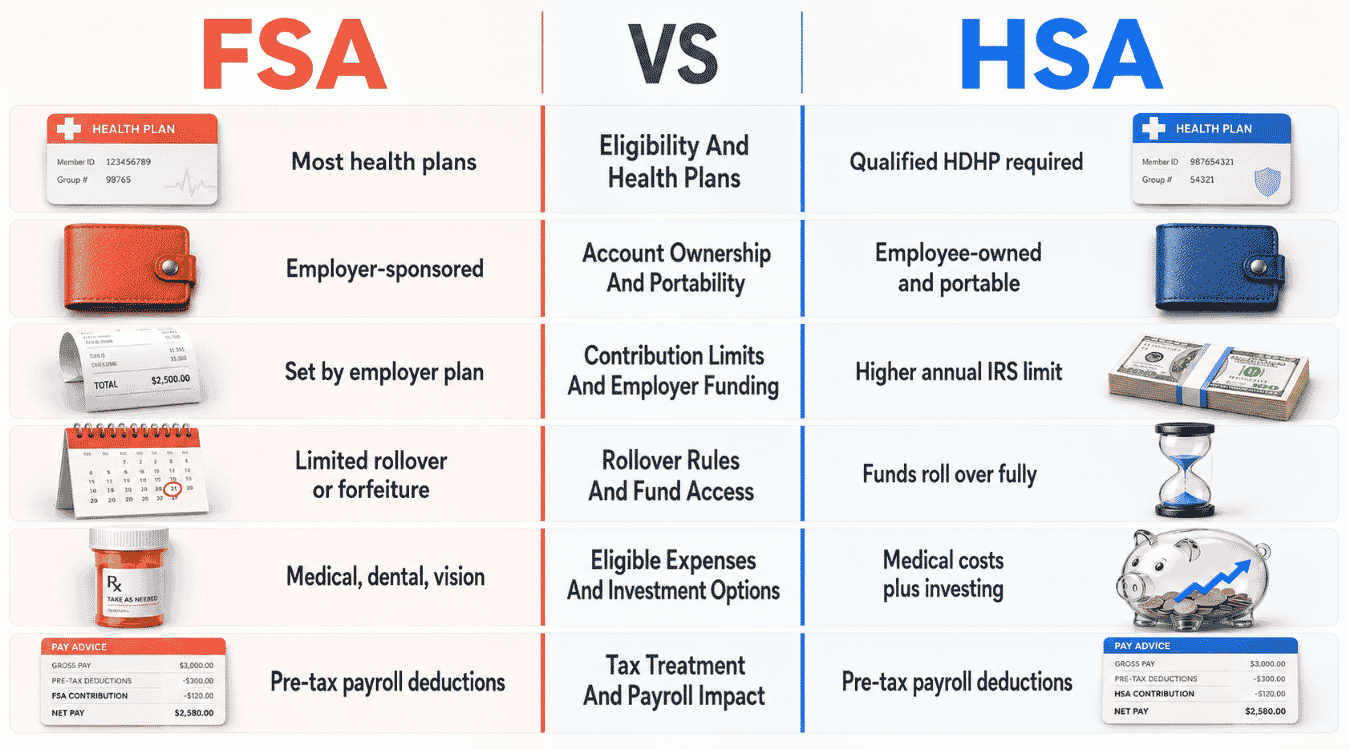
Employee health coverage determines which account actually works for your team. A flexible spending account (FSA) pairs with any health plan your business offers, so nearly every employee on payroll can use one right away. No special enrollment requirements stand in the way of setting aside money for health expenses.
A health savings account (HSA) works differently. Employees need an HSA-eligible health plan, usually a high-deductible option, before they can open one. Employers should confirm current health plan enrollment before rolling out HSA access, since offering the account without matching coverage creates confusion once open enrollment begins.
Account Ownership And Portability
Ownership sets these two accounts apart in a big way. Employers own the FSA, so unused funds generally stay behind if an employee leaves mid-year. That structure catches many workers off guard during a job change, since the balance rarely follows them out the door.
Employees own their HSA outright from day one. The account travels with them across jobs, and the balance keeps growing no matter where they work next. This portability makes the HSA a stronger fit for employees focused on long-term savings tied to future medical costs rather than funds that disappear at year-end.
Contribution Limits And Employer Funding
Contribution limits shift annually, and employers can add funds to either account if they choose. A health care FSA usually caps contributions at a lower amount than an HSA, with the IRS adjusting both limits each year for inflation.
HSA contribution limits sit higher, and both employee and employer contributions reduce taxable income, which lowers income tax owed at filing time. Some employers match part of an employee's HSA contribution as an added perk, while FSA employer contributions happen less often. Comparing both options helps small businesses plan benefits costs with more accuracy each year.
Rollover Rules And Fund Access
Fund access works on very different timelines for these two accounts. An FSA typically follows a use-it-or-lose-it rule tied to the plan year, though some employers allow a small carryover or grace period. Employees need to spend their balance before that window closes, or they risk losing what's left.
An HSA carries no such deadline. Balances roll forward every plan year without limit, giving employees more flexibility to pay for qualified medical needs whenever they come up. This structure suits workers who prefer building a cushion for future health care coverage rather than spending down funds on a fixed schedule.
Eligible Expenses And Investment Options
Both accounts cover a wide range of qualified medical costs, including prescriptions, copays, and dental or vision care. Employees can use either account for everyday health needs, though FSA funds must generally be spent within the plan year they're allocated.
HSAs go a step further by doubling as investment accounts. Once a balance reaches a certain threshold, employees can invest unused funds much like a retirement account, letting the money grow over time. This feature, paired with higher contribution limits, makes HSAs appealing to employees planning for long-term medical costs rather than short-term spending.
Tax Treatment And Payroll Impact
Both accounts fall under tax favored health plans, meaning contributions reduce taxable income before payroll taxes apply. Employees see the benefit directly in each paycheck, since FSA and HSA deductions lower the income subject to tax withholding.
Employers benefit too, since payroll tax obligations shrink slightly with every pre-tax contribution processed. Setting up either account correctly in automated payroll software keeps deductions accurate and compliant, so employees can pay for qualified medical expenses without payroll errors disrupting their coverage throughout the year.
Can Employees Have Both An FSA And HSA
Generally, no. Enrolling in a standard FSA while also contributing to an HSA counts as disqualifying health coverage under IRS rules, since a regular FSA covers the same health care costs an HSA is meant to handle. Having both at once puts employees at risk of losing HSA eligibility entirely.
There's one common workaround: a Limited Purpose FSA. This version only covers dental and vision expenses, so it doesn't overlap with HSA-eligible health coverage or count as other disqualifying health coverage. Employees can pair a Limited Purpose FSA with an HSA and still stay within HSA contribution limits without penalty.
A Dependent Care FSA works the same way, since it covers childcare rather than medical costs. Employers should explain these distinctions clearly during enrollment, so employees don't accidentally jeopardize their HSA by picking the wrong FSA type alongside it.
Should Your Small Business Offer An FSA, An HSA, Or Both
Small businesses often benefit from offering both accounts rather than picking just one. An FSA works well for employees who want predictable health benefits with lower upfront costs, since contributions stay within set FSA contribution limits and reduce taxable income right away. It's a good fit for teams with steady, expected medical expenses like prescriptions or routine checkups.
An HSA appeals more to employees who want to cover healthcare costs long-term while building tax-free savings. Contributions are tax-deductible, funds roll over every year, and unused money can even be invested. This makes HSAs attractive to employees planning for bigger expenses down the road.
Offering both gives your team flexibility to choose what fits their situation best. Smaller businesses with tighter budgets might start with just one account and expand later, based on employee demand and how much administrative support they can realistically manage each plan year.
Which Account Fits Your Employees Best
Every employee has different health needs and financial goals. Understanding who benefits most from an HSA or FSA helps you guide your team toward the right choice during open enrollment.
Employees With Predictable Care Costs
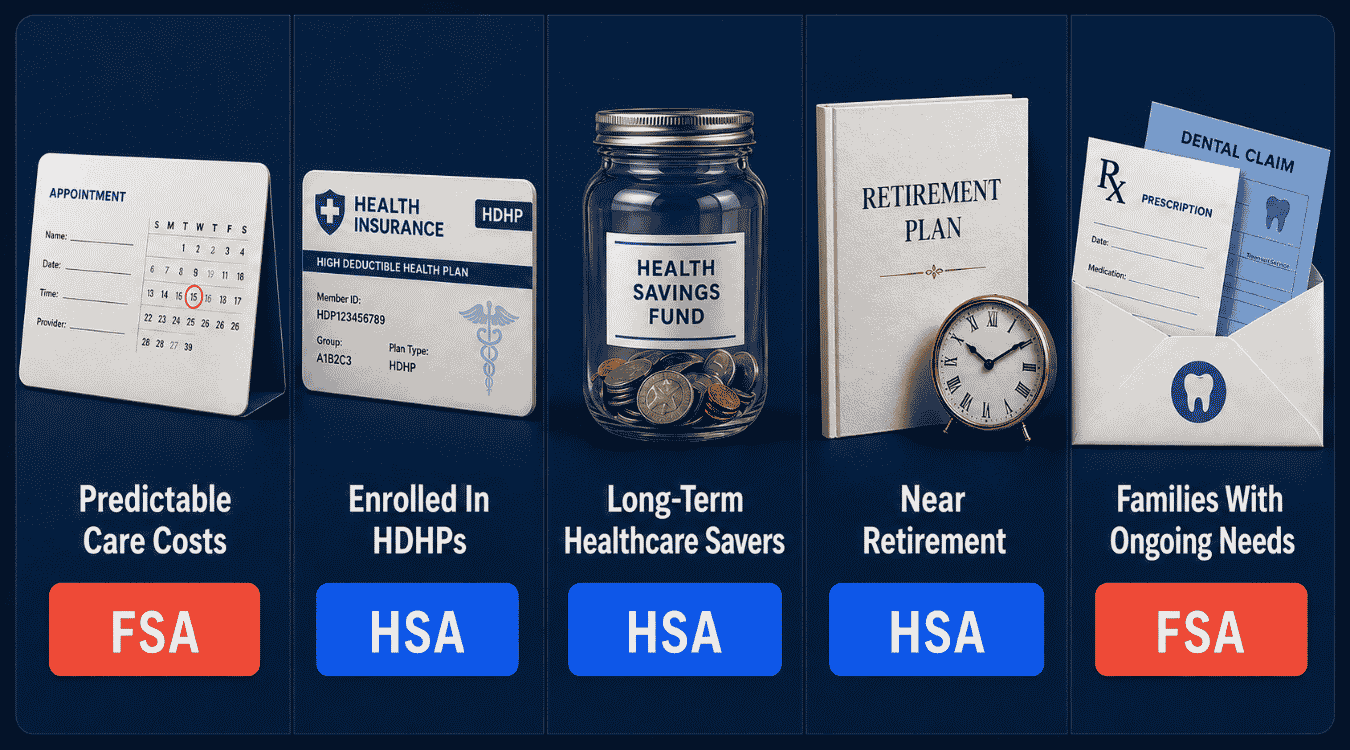
Employees who know roughly what they'll spend on health care each year often do better with an FSA. Regular prescriptions, routine dental visits, or ongoing vision needs make it easier to estimate a contribution amount without guessing too high or too low.
Since FSA funds follow a use it or lose it rule, predictable spending removes most of the risk. Employees get the tax benefits of pre-tax contributions without worrying about leftover money at year-end, making this account a practical fit for steady, expected costs.
Employees Enrolled In HDHPs
Only employees with a high deductible health plan qualify for an HSA, so this group has a clear starting point when choosing between HSA or FSA. Their health insurance structure already meets the requirement, making the HSA an easy add-on to existing coverage.
For these employees, an HSA pairs naturally with their plan and adds a way to save money on qualified expenses. Since contributions reduce taxable income immediately, employees see the benefit in their paycheck without needing to change how they use their health insurance.
Long-Term Healthcare Savers
Employees focused on building savings for future medical needs benefit most from how HSA funds roll over year after year. Nothing expires, so contributions can sit and grow untouched for years if employees don't need to spend right away.
This makes the HSA appealing to workers who want flexibility rather than a use-it-by-deadline account. Combined with potential investment growth, it functions as a secondary savings vehicle alongside retirement accounts, appealing to employees thinking well beyond the current plan year.
Employees Nearing Retirement
Workers approaching retirement often lean toward HSAs because unused balances continue growing tax-free and can cover medical costs well into retirement years. Since HSA funds roll over indefinitely, there's no pressure to spend before leaving the workforce.
After age 65, employees can also withdraw HSA funds for non-medical expenses without penalty, though regular income tax still applies. This flexibility gives near-retirees another way to save money for whatever comes after their working years end.
Families With Ongoing Medical Needs
Families managing frequent doctor visits, prescriptions, or chronic conditions often need more available funds upfront. An FSA can work well here since the full annual election is available starting day one, rather than building up gradually through payroll deductions.
Families with family coverage under an HDHP might still prefer an HSA for its higher contribution limits and long-term flexibility. The right choice often depends on how predictable their medical spending is and whether they'd rather access funds immediately or build savings steadily.
How FSA And HSA Contributions Flow Through Payroll
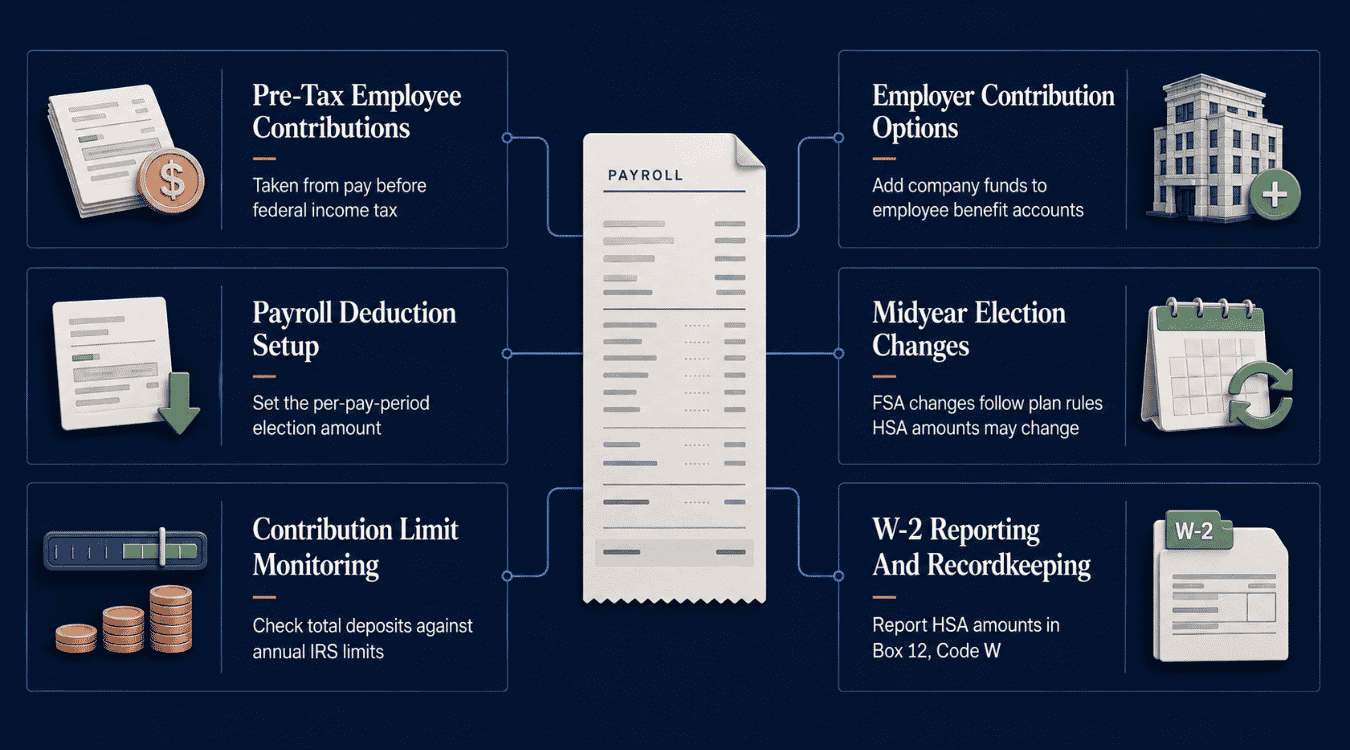
Payroll handles FSA and HSA contributions differently, and understanding those key differences helps small businesses avoid setup errors. For many employers, clarifying what payroll processing includes makes it easier to see where these accounts fit. Here's how each account moves through a standard pay cycle.
Pre-Tax Employee Contributions
Both accounts pull employee contributions from each paycheck using pre tax dollars, which lowers taxable income before withholding calculations happen. Employees choose an annual amount during enrollment, and payroll divides that total across each pay period automatically.
This is where HSA vs FSA differences start showing up in practice. FSA elections stay fixed for the year in most cases, while HSA contributions often allow more flexibility to adjust as needed. Either way, the pre-tax structure benefits employees right away through smaller tax bills each pay period.
Employer Contribution Options
Employers can add money to either account, though the process looks different for each. FSA employer contributions typically come as a flat amount or partial match, deposited directly without affecting employee payroll deductions.
HSA employer contributions often work similarly, but since funds roll over and can be invested in mutual funds down the line, some employers use HSA contributions as a stronger recruiting perk. Deciding how much to contribute usually depends on budget and how competitive the benefits package needs to be.
Payroll Deduction Setup
Setting up payroll deductions correctly from day one prevents contribution errors later. Most payroll software allows employers to input annual election amounts, which then get divided evenly across remaining pay periods automatically, especially when paired with smart attendance tracking software that keeps working hours and absences accurate.
Small mistakes, like entering the wrong start date or missing a pay period, can throw off annual totals fast. Double-checking each employee's deduction schedule against their enrollment paperwork and using a centralized payroll management system helps catch errors before they affect W-2 reporting at year-end.
Midyear Election Changes
FSA elections generally stay locked in unless an employee experiences a qualifying life event, like marriage or the birth of a child. HSA contributions offer more flexibility, letting employees adjust their amount throughout the year without needing a special circumstance.
Payroll teams should update deduction amounts promptly whenever a change gets approved, since delays can cause employees to over-contribute or under-contribute against their annual limit. Building clear internal processes and regular payroll audit strategies for handling these requests keep payroll accurate all year.
Contribution Limit Monitoring
Tracking contributions against annual limits protects both the employer and employee from tax penalties. Payroll compliance software and other payroll systems should flag accounts approaching their cap, especially for HSAs where potential tax free growth makes overcontributing an easy mistake if limits aren't monitored closely.
Employees switching jobs mid-year need extra attention, since contributions from a previous employer count toward the same annual limit. Payroll teams should ask new hires about prior contributions during onboarding to avoid accidental overages later in the year, and integrated workforce management software can help keep this information organized.
W-2 Reporting And Recordkeeping
Both FSA and HSA contributions need accurate reporting on year-end tax documents. HSA contributions show up in Box 12 of the W-2, while FSA amounts typically reduce Box 1 wages without a separate line item in most cases.
Keeping clean employee payroll records throughout the year makes W-2 preparation far smoother. Payroll software that tracks contributions in real time reduces manual reconciliation work and helps avoid reporting errors that could trigger employee questions or IRS scrutiny later.
FSA Vs HSA: A Real Tax-Savings Example
Consider an employee earning $50,000 a year. If they contribute $2,000 to an FSA, that amount comes out pre-tax, dropping their taxable income to $48,000. At a combined federal and state tax rate of roughly 22%, that saves about $440 in taxes for the year, money they'd otherwise lose to withholding.
Now compare that to an HSA. The same $2,000 contribution lowers taxable income the same way, saving that same $440 upfront. But the HSA doesn't stop there. If the employee doesn't spend the full amount, it rolls over and can be invested. Over ten years, even modest investment growth could turn that unused balance into $3,000 or more, completely tax-free when used for qualified expenses.
The FSA saves money now. The HSA can save money now and keep growing later, which is why long-term savers often lean toward the HSA once they qualify.
What Happens When An Employee Leaves?
When an employee leaves, FSA funds usually stay behind since the employer owns the account. Any remaining balance typically can't follow the employee out the door, though COBRA sometimes allows limited continuation for a short period after departure.
An HSA works differently. Since the account belongs to the employee, it travels with them regardless of job status. They can keep using the tax-advantaged balance to pay medical bills and other qualified expenses long after leaving the company, with no time limit attached, and modern digital payslip software makes it easier to document those payments accurately for employees.
Departing employees should review their specific situation, since rules around continuation and eligibility can vary. Checking with a tax advisor helps clarify how to handle remaining funds and avoid surprises when managing future healthcare costs.
Special Rules For Small Business Owners
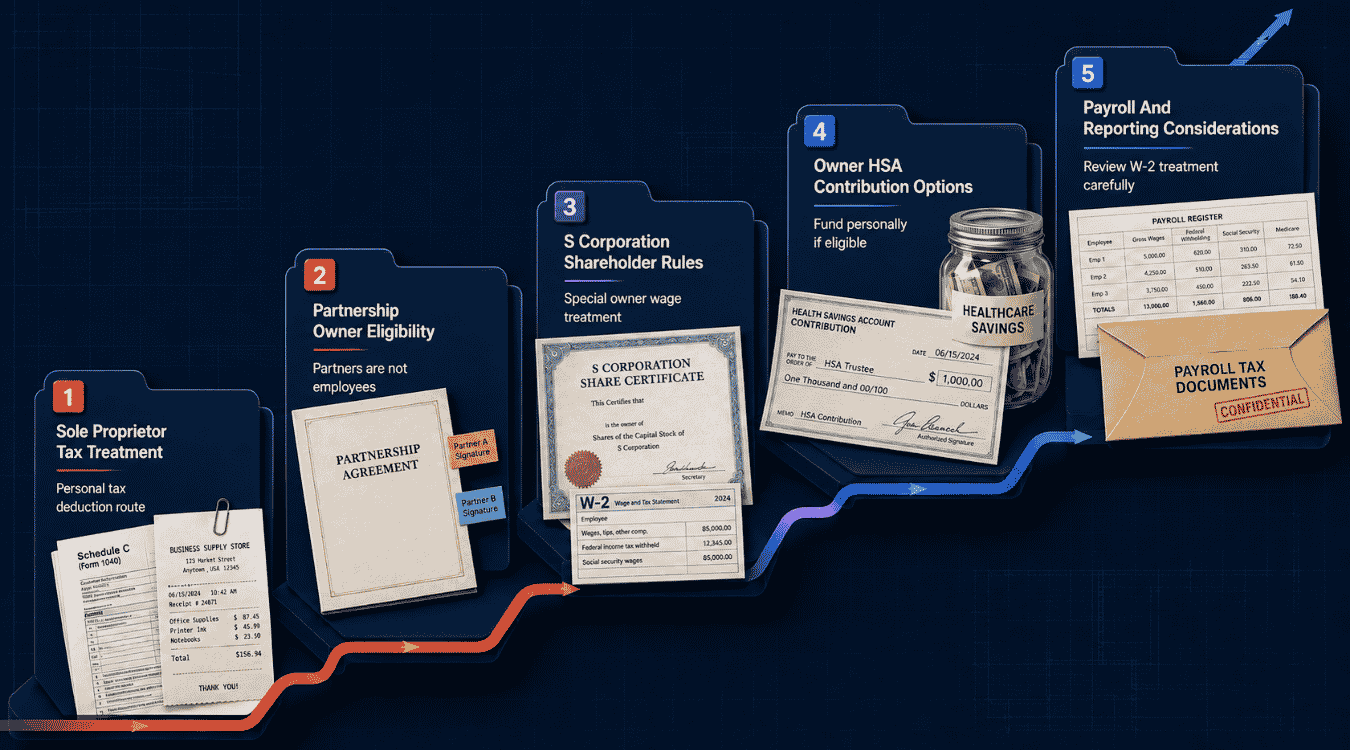
Business owners often face different rules than regular employees when it comes to FSAs and HSAs. Here's how eligibility and tax treatment shift depending on business structure.
Sole Proprietor Tax Treatment
Sole proprietors generally can't participate in a healthcare FSA the same way employees do, since IRS rules treat self employed individuals differently for this benefit. Without employee status, contributing to an FSA through payroll simply isn't an option, but small business owners still need to follow core payroll compliance guidelines when setting up benefits for staff.
An HSA works differently for sole proprietors. As long as they're enrolled in a qualifying high deductible health plan, they can open and contribute to an HSA directly, deducting contributions from ordinary income when filing taxes rather than through payroll deductions.
Partnership Owner Eligibility
Partners in a business face similar restrictions to sole proprietors. Partnership owners typically can't use a healthcare FSA either, since they're not classified as employees for benefits purposes under IRS guidelines.
HSAs remain available to partners, though contributions usually happen outside of payroll. Partners can still deduct HSA contributions on their personal tax return, provided they meet HDHP requirements, giving them a practical way to save even without standard employee benefits access.
S Corporation Shareholder Rules
Shareholders owning more than two percent of an S corporation follow special rules that differ from regular W-2 employees. These owners generally can't participate in a healthcare FSA on a pre-tax basis, even if the company offers one to staff.
HSA contributions for these shareholders often get added to wages first, then deducted on their personal return instead of running pre-tax through payroll. Reviewing these rules with a tax advisor helps avoid reporting mistakes tied to ownership percentage.
Owner HSA Contribution Options
Business owners across different structures can still fund an HSA, just through slightly different channels than regular employees. Some contribute personally throughout the year, while others coordinate contributions with their accountant during tax season.
Owners can't typically combine both an HSA and a standard FSA without triggering eligibility issues, the same rule that applies to employees. Sticking to HSA-compatible benefits keeps their tax treatment clean and avoids accidental disqualification.
Payroll And Reporting Considerations
Payroll systems need clear settings to reflect how owners differ from employees for benefits purposes. Misclassifying an owner's contribution as a standard payroll deduction or misunderstanding employee vs contractor classification rules can create reporting errors that affect both business and personal tax filings.
Working closely with a payroll provider or tax advisor ensures contributions get recorded correctly based on business structure. Getting this right from the start prevents complications during year-end reporting, helps avoid common payroll mistakes businesses face, and keeps owner benefits compliant with IRS rules.
State Tax Exceptions To Know
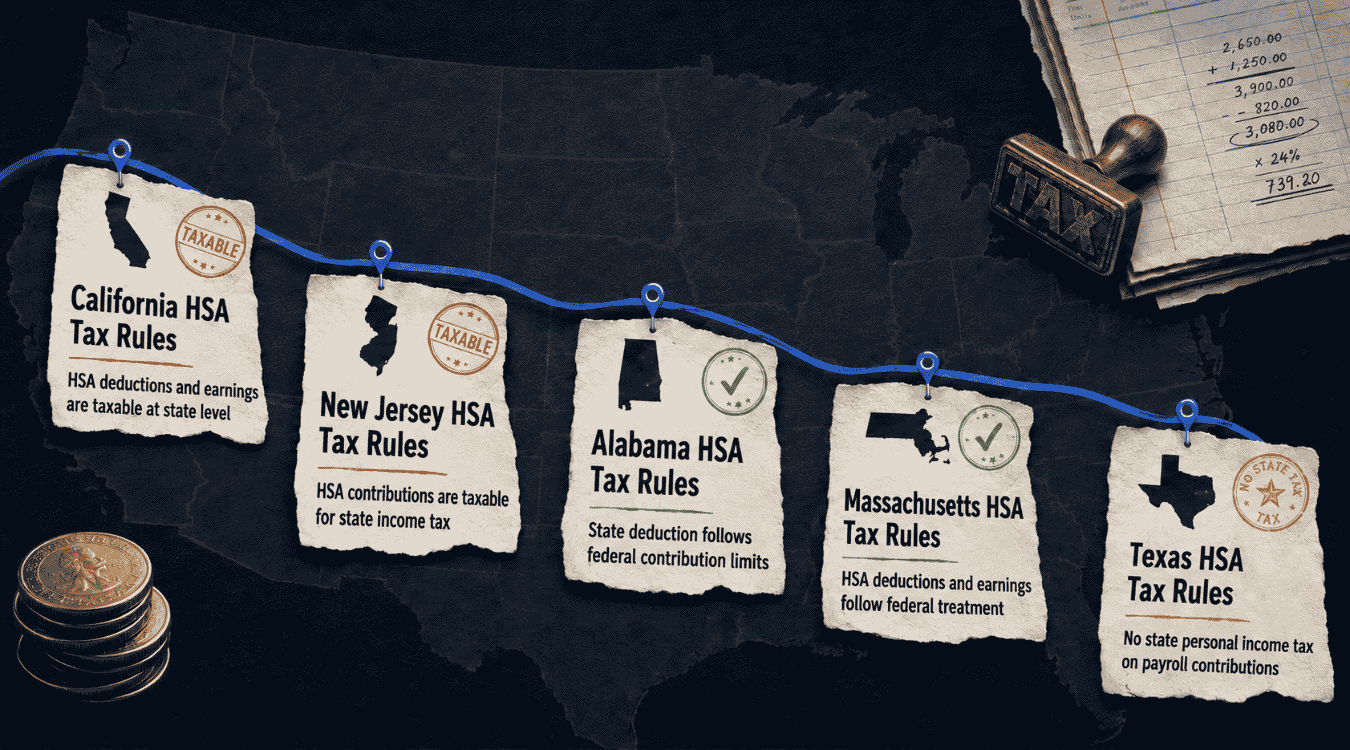
Most states follow federal tax rules for HSAs, but a couple of exceptions can catch employers and employees off guard. Knowing which states differ helps avoid payroll surprises and keeps long-term savings on track.
California HSA Tax Rules
California doesn't conform to federal HSA tax treatment, one of only two states that don't. Contributions to an HSA balance get taxed as regular income at the state level, even though they stay tax-free federally.
Investment growth inside the account also gets taxed annually by California, unlike the federal treatment where growth stays untouched until withdrawal. Employers with California employees should flag this during enrollment, since take-home pay calculations differ from what federal IRS limits alone would suggest.
New Jersey HSA Tax Rules
New Jersey follows the same non-conforming approach as California. HSA contributions aren't deductible on state returns, so employees still owe state income tax on money set aside for medical expenses.
Earnings inside the account face state taxation too, reducing the long term savings advantage New Jersey residents would otherwise get. Payroll systems typically handle this automatically, but employers should confirm W-2 reporting reflects the correct taxable wages for state purposes.
Alabama HSA Tax Rules
Alabama used to tax HSA contributions similarly to California and New Jersey, but that changed back in 2018. The state now fully conforms to federal HSA tax treatment, so contributions, growth, and qualified withdrawals all follow the same rules employees see on their federal return.
Employees in Alabama don't need to plan around any state-level exception. Their HSA balance grows the same way it would federally, without the extra tax adjustments required in California or New Jersey.
Massachusetts HSA Tax Rules
Massachusetts also conforms fully to federal HSA rules. Contributions stay deductible, growth inside the account stays untouched by state tax, and withdrawals for qualified expenses remain tax-free at both the state and federal level.
This puts Massachusetts in line with most of the country rather than the handful of non-conforming states. Employers don't need special payroll adjustments here beyond staying within standard IRS limits each year.
Texas HSA Tax Rules
Texas doesn't complicate things at all, mainly because the state has no personal income tax to begin with. Without a state income tax return to file, there's no separate HSA tax treatment to worry about one way or the other.
Employees in Texas get the full federal tax advantage without any state-level offset. This makes payroll setup simpler for Texas-based teams compared to employers managing employees in California or New Jersey.
FSA And HSA Rollout Checklist For Employers
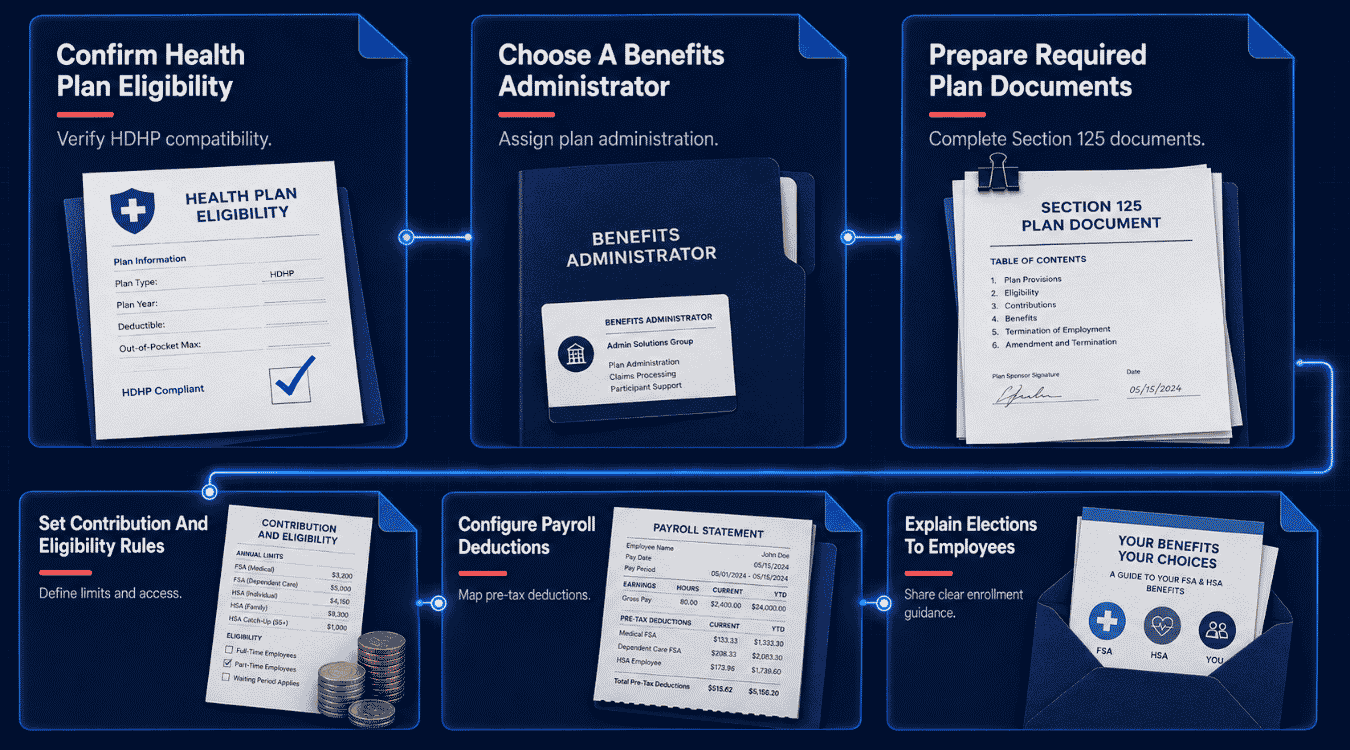
Rolling out an FSA or HSA takes more than picking an account type. Following a clear checklist helps small businesses avoid setup mistakes and confusion during open enrollment, especially for startups adopting payroll software for growing teams.
Confirm Health Plan Eligibility
Before offering either account, check what health plans your business currently provides. HSA eligibility depends on employees being enrolled in a plan that meets the IRS minimum deductible requirement, so confirm your current plan qualifies before promoting the account.
FSAs don't carry this restriction, so eligibility is simpler to confirm across the board. Reviewing plan documents with your broker or benefits administrator early prevents promising an account employees can't actually use once enrollment opens.
Choose A Benefits Administrator
Both accounts need someone managing enrollment, contributions, and compliance behind the scenes. A benefits administrator handles the paperwork, tracks eligibility, and makes sure contributions follow IRS rules throughout the year.
Smaller businesses sometimes handle this through their payroll provider directly, while larger teams bring in a third-party administrator. Either way, choosing someone experienced with both FSA and HSA rules and with payroll automation software keeps rollout smooth from the start.
Prepare Required Plan Documents
Plan documents outline how each account works, including eligibility rules, contribution limits, and what counts as an eligible expense. Employers need these documents in place before employees can start putting money into either account.
Missing or incomplete documentation creates compliance risk down the road, especially during an audit. Working with your benefits administrator to draft accurate, current plan documents protects the business and gives employees clear expectations upfront.
Set Contribution And Eligibility Rules
Decide how much employees can contribute and who qualifies before rollout begins. This includes confirming whether eligible dependents can be covered under an FSA and setting any employer contribution amounts you plan to offer.
Clear rules prevent confusion later, especially around family coverage or dependent care elections. Employers should also decide whether they'll match contributions or offer a flat amount, since this affects total benefits cost planning for the year.
Configure Payroll Deductions
Once rules are set, payroll needs accurate deduction schedules for every enrolled employee. Using robust payroll processing software, each employee's annual election gets divided across remaining pay periods, so setup errors here can throw off contributions fast.
Double-check start dates and confirm deductions align with each employee's enrollment paperwork. Businesses moving from spreadsheets to dedicated tools should follow a clear plan to move payroll from Excel to software. This step matters even more for employees with a spouse who might be contributing through someone else's tax return, since household contribution limits still apply.
Explain Elections To Employees
Employees need clear, simple explanations before choosing an account. Walk them through how contributions work, what counts as an eligible expense, and how HSA eligibility ties directly to their current health plan.
Answering questions upfront, especially around dependents and contribution limits, reduces confusion after enrollment closes. A short info session, written guide, or overview of your chosen payroll software features during open enrollment helps employees feel confident about the choice they're making.
Final Discussion
Choosing between an FSA and an HSA comes down to your team's health plans, budget, and how much flexibility employees need. An FSA works well for predictable expenses and simple setup, while an HSA rewards long-term savers with rollover funds and investment growth. Many small businesses find offering both, where eligibility allows, gives employees the most flexibility to fit their own situation.
Getting payroll deductions right from day one matters just as much as picking the right account. Clear plan documents, accurate contribution tracking, and simple employee communication, supported by simple payroll software for small businesses, make rollout smoother and keep both accounts running without compliance headaches down the road.