PEO Vs EOR: Which Is Better For Global Business Expansion?
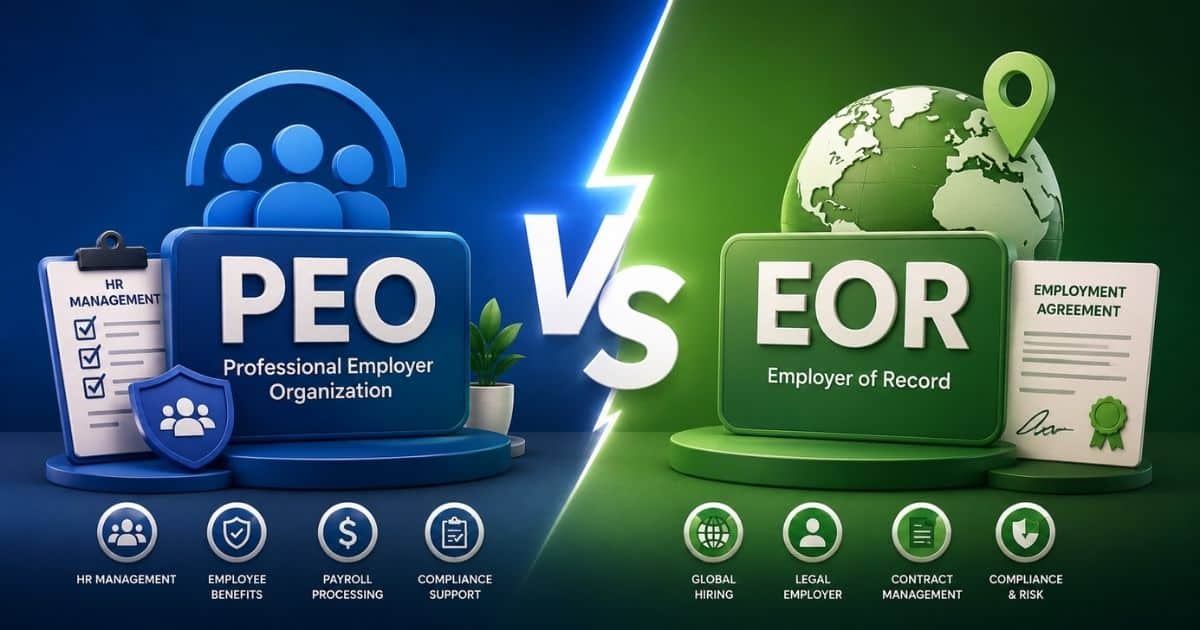
Table of Contents
Hiring across borders sounds simple until payroll, tax, and labor law get in the way. A PEO shares employer duties with you in a country where you already have an entity. An EOR becomes the legal employer on your behalf, so you can hire without setting one up.
Grand View Research pegs the global PEO market at above $7 billion, while EOR adoption keeps climbing as remote hiring grows. Founders often confuse the two, then pick the wrong one and pay for it in cost or compliance risk. This guide breaks down what each model actually does, when to use one over the other, and how the right choice speeds up global expansion without adding legal exposure.

What Is A PEO?
A professional employer organization is a company that co-employs your staff through a shared employment structure. It becomes the legal employer for tax and compliance purposes, while you keep control over daily work and performance. Businesses use PEO services to outsource payroll, benefits, and HR services without building an internal HR team. This model works best when you already have a legal entity in the country. It saves time on admin, but it does not replace the need for local registration.
What Is An EOR?
An employer of record is a company that legally hires workers on behalf of your client business in a country where you have no entity. It handles employment contracts, payroll, tax filings, and employee benefits under its own legal name, while you direct the actual work. Many companies also use it alongside independent contractor compliance services when hiring mixed teams abroad. This model lets you enter a new market fast, without registering a local entity or navigating unfamiliar labor law yourself.
PEO Vs EOR: Key Differences At A Glance
Both models handle employment, but the legal setup, cost, and hiring speed differ sharply. Knowing where each one fits saves you from picking the wrong structure for your expansion plans.
Factor | PEO | EOR |
|---|---|---|
Legal Employer | Co-employer shares responsibility with you | Sole legal employer on record |
Entity Requirement | You need your own legal entity | No local entity needed |
Payroll And Benefits | Managed jointly through shared systems | Fully managed by the EOR |
Compliance Risk | Shared compliance responsibilities | EOR carries most of the risk |
Hiring Flexibility | Best for domestic, multi-state teams | Best for fast international hiring |
Legal Employer Responsibility
A PEO acts as a co-employer. It shares legal responsibility with your business, splitting duties between the two of you. You keep control over hiring decisions and daily management, while the PEO handles tax filings and paperwork tied to employment.
An EOR takes on full legal responsibility instead. It becomes the sole employer of record for your workers, which means it carries the compliance risk that would otherwise sit with you. This setup works well when you want to hire employees fast without holding that liability yourself.
Local Entity Requirements
PEOs require you to already have your own legal entity in the country where you're hiring. Without one, a PEO simply cannot step in, since its whole model depends on co-employment inside an entity you already own.
EORs remove that requirement entirely. You can hire employees in a new country without setting up your own entity there. This is why EORs work so well for contingent workforce solutions and short-term market testing, where building a full legal presence doesn't make sense yet.
Payroll And Benefits Management
With a PEO, payroll and employee benefits are handled through shared systems built around your entity. The PEO manages the mechanics, but final decisions on pay structure and benefit plans usually stay with you, backed by ongoing HR and compliance support.
An EOR runs payroll and benefits entirely under its own systems and local employment laws. It structures compensation and benefits to match what's legally required in that country, much like automated payroll software for accuracy and compliance, offering innovative employee solutions that adapt to each market without extra setup on your end.
Compliance And Employment Risk
PEOs provide compliant employment solutions, but the compliance responsibilities remain split. If something goes wrong with labor law, both you and the PEO can be held accountable, since the co-employer relationship ties you together legally.
EORs absorb almost all of that exposure. Because they act as the sole legal employer, they carry the weight of local employment laws and reduce your compliance risk significantly, particularly around maintaining accurate employee payroll records for compliance and audits. This makes EORs a common choice for businesses that want record services without touching local legal complexity themselves.
Global Hiring Flexibility
PEOs work best for steady, domestic growth, especially across multiple states where you already meet the minimum employee count and have HR functions in place. They're less useful once you look beyond borders where you hold no entity.
EORs offer far more global reach. They let you test new markets, hire single employees, or scale a distributed team without opening new entities everywhere. For businesses chasing fast, flexible international growth, EORs simply move more quickly than a PEO ever can.
PEO Vs EOR: Which Expansion Strategy Fits Your Business?

The right choice depends on where you're headed, not just what each model does. Match your expansion goal to the structure that supports it, and the decision gets much simpler.
Expanding Into One Country
If you're moving into a single new market, the choice often comes down to whether you already have a business entity there. With one in place, a PEO fits well, since its co-employment relationship lets you share HR administration without building out a full internal HR team from scratch.
Without a local entity, an EOR makes more sense. It skips business registration entirely and lets you hire international employees right away. Both PEOs and EORs can work for single-country expansion, but the deciding factor is almost always whether you already hold that legal footing.
Hiring Remote Global Talent
Remote hiring across scattered locations rarely lines up with owning entities everywhere. This is where EOR services shine, since they let you bring on talent in dozens of countries without opening a local entity in each one, especially when combined with HRM software for managing a remote workforce.
A PEO can't stretch that far, since the co-employment model only works where you already operate. For a distributed, remote-first global workforce, EORs give you the reach a PEO structurally cannot, handling everything from contracts to benefits administration on your behalf, while cloud HR tools simplify remote team management.
Testing New International Markets
Market testing means you need speed and low commitment, not a permanent legal footprint. An EOR lets you hire a handful of workers in a new country without business registration, so you can validate demand before committing further.
If the test succeeds and you decide to stay, you can later set up your own entity and shift into a PEO relationship for ongoing HR administration. This staged approach, EOR first and PEO later, is common among client companies expanding step by step rather than all at once.
Building A Long-Term Global Presence
Long-term plans usually justify the investment in a local entity, and that's where a PEO earns its place. Once you're committed to a country for years, the co-employment relationship gives you more control over hiring, culture, and workers' compensation policies than an outside employer of record typically allows.
A PEO also integrates more closely with your internal HR team over time, building institutional knowledge about local employment laws. For businesses planning to stay put, this deeper co-employment setup tends to outperform an EOR arrangement built for short-term flexibility.
Managing Multi-Country Teams
Running teams across several countries at once often means mixing models. Some locations might already have a business entity and an established PEO relationship, while newer markets rely on EOR services until the business case for an entity becomes clear.
This blended approach lets a client company scale a global workforce without forcing every country into the same structure. Whichever mix you choose, keeping benefits administration and compliance consistent across both PEOs and EORs matters more than picking just one model for every market.
How To Choose Between PEO And EOR

Picking between a professional employer organization PEO and an employer of record EOR comes down to five practical checks. Walk through these before hiring managers commit to either path.
Define Your Expansion Goals
Start with what you actually need from expansion, not just which model sounds more established. If you're chasing a long-term presence with steady headcount, the co-employment structure of a PEO supports deeper HR compliance and local relationship building over time.
If speed and flexibility matter more, an EOR provider gets international employees hired without the wait tied to business registration. Hiring managers should map the goal first, since the right structure follows from the outcome you're targeting, not the other way around.
Check Your Legal Entity Status
Your legal entity status decides half of this choice on its own. A PEO only works where you already hold an entity, since its entire model depends on sharing employer duties within that existing legal structure.
Without an entity, a PEO simply isn't available to you, and an employer of record EOR becomes the practical option instead. This applies whether you're a woman-owned business entering a first overseas market or an established SaaS company using HR and payroll software built for software businesses and adding one more country to the list.
Evaluate Compliance Responsibilities
Compliance liability splits differently between the two models, and that split matters more than most founders expect. A PEO shares HR compliance and local compliance duties with you, meaning both parties carry some exposure if employee contracts or payroll taxes get handled incorrectly.
An EOR takes on nearly all compliance liability itself, since it acts as the sole employer of record. For businesses without a dedicated legal or HR compliance function, that transfer of responsibility to a leading provider often outweighs the added cost of using an EOR.
Compare Long-Term Costs
Cost comparisons need to look past the monthly fee. PEOs typically charge less per employee over time, since payroll processing and benefits management get folded into shared systems tied to your own entity.
EORs charge more per head, but that price includes full compliance liability transfer, payroll tax handling, and complete HR process management. Once you weigh in the cost of building internal HR compliance capacity, the key differences in total cost narrow considerably, especially at smaller headcounts.
Consider Future Growth Plans
Growth plans should shape this decision as much as your current headcount does. If you expect to scale significantly in a country, starting with an EOR provider and later transitioning to a PEO once you register a local entity keeps early costs down without blocking future scale.
If growth in that market looks uncertain, staying with an EOR provider for benefits management and payroll processing avoids sinking resources into a legal entity you might not need long term.
Make The Right Choice
There's no universal answer between a professional employer organization PEO and an employer of record EOR, only the one that fits your entity status, compliance appetite, and growth timeline. Review these five factors together rather than in isolation.
Once hiring managers align entity status, compliance liability, and cost against real expansion goals, partnering with a trustworthy HR management provider like Payrun makes choosing between the two models usually straightforward rather than a guessing game.
Common Business Scenarios And The Best Choice

Real hiring decisions rarely match a textbook case. These five scenarios show which model actually fits, based on entity status, headcount, and how long the hiring need is expected to last.
Startup Hiring Its First Global Employee
A startup hiring its first person abroad usually has no local entity and no dedicated human resources function yet. An EOR fits best here, since it handles employee contracts, statutory benefits, and payroll without requiring business registration in that country.
This setup also keeps legal risk off the founder's plate at a stage when building internal HR management capacity isn't realistic. For small teams, using HR software tailored to small businesses alongside an EOR can further simplify processes. Once the startup grows past a handful of hires, revisiting the structure makes sense, but for that first employee, an EOR removes friction fast.
Growing Company Entering A New Market
A growing company testing a new market sits in a similar spot, minus the startup uncertainty. It needs to hire workers quickly without waiting months for a local entity to clear registration, so an EOR again makes the practical choice, especially when paired with streamlined payroll processing for growing businesses.
As hiring volume grows and the company hits a minimum number of employees that justifies its own presence, PEO solutions become worth exploring. At that point, shifting toward a co-employment model supported by robust payroll software with automation and compliance features can lower per-head costs while keeping compliance management intact.
Established Business With Local Entities
A business that already holds local entities in its target countries is in the best position to use PEO solutions. Since the legal groundwork already exists, a PEO can absorb administrative functions like payroll processing and statutory benefits, much like integrated HR and payroll software for SMBs, without adding new legal risk.
This path also strengthens internal HR management over time, since the co-employment relationship builds local compliance knowledge inside the company itself and benefits from a centralized employee record management system. For businesses planning to stay in a market long term, this option usually costs less than an EOR once headcount climbs.
Seasonal International Hiring
Seasonal hiring creates a different problem entirely, since headcount needs shift sharply across the year. An EOR handles this well, letting a business hire workers for short stretches without carrying the fixed overhead of an entity or a permanent HR management setup.
Because seasonal roles often fall below any minimum number needed to justify a PEO relationship, an EOR's flexibility matters more than its per-employee cost. Businesses can scale hiring up or down each season without touching payroll compliance structures for small businesses at all.
Enterprise Expanding Across Multiple Countries
Large enterprises expanding across several countries at once rarely rely on a single model. Established markets with full-time employees and existing entities usually run through PEO solutions, while newer or smaller markets lean on an EOR until volume justifies more investment.
This blended approach lets enterprises manage legal risk differently by market, matching administrative functions and compliance management to what each location actually needs, often supported by HR workflow automation for modern HR teams. It's less about picking one winner and more about deploying the right structure, market by market, as the footprint grows.
Mistakes To Avoid Before Choosing

Picking the wrong model rarely shows up immediately. It surfaces months later as tax problems, unhappy remote workers, or a compliance gap nobody caught in time. These five mistakes explain why.
Confusing A PEO With An EOR
The most common mistake is treating PEO and EOR as interchangeable terms. A PEO shares compliance risk with you inside your own entity, while an EOR takes on that risk entirely as the legal employer. Mixing these up leads businesses to pick a model that doesn't match their entity status at all.
This confusion often surfaces during tax filings, when a company assumes an EOR relationship but has actually signed on for a co-employment structure. Getting this distinction right up front saves a lot of cleanup later.
Weak Understanding Of Local Employment Laws
Every international market runs on its own labor rules, and assuming they resemble your home country's laws is a costly guess. Tax compliance, termination rules, and health insurance requirements vary widely, and neither PEO pros nor EOR solutions can fix a company's blind spot on local law before signing a contract, especially as new employment policies impact growing businesses.
Businesses that skip this research often discover gaps only after hiring remote workers, when fixing a contract retroactively becomes far harder than getting it right from the start, particularly around basics like a streamlined leave management system for HR teams.
Cost As The Only Decision Factor
Choosing based purely on which option looks cheaper on paper ignores what that price actually covers. A lower-cost EOR solution might still leave gaps in tax filings or health insurance support that create bigger expenses down the line, just as picking HR software without comparing options like Payrun vs alternative platforms such as Homerun can lead to higher long-term costs.
Cost matters, but it should sit alongside compliance risk and entity status, not replace them. Businesses that treat price as the only factor often end up switching providers within a year once the real gaps in service surface.
Lack Of A Long-Term Expansion Plan
Choosing PEO versus EOR without a growth plan behind it tends to backfire once headcount changes. A company that plans to hire seasonal workers one year and full-time staff the next needs a structure flexible enough to handle both, or a plan to transition between them.
Without that roadmap, businesses often lock into a model built for a stage they've already outgrown, forcing a messy switch mid-project during active project management cycles.
Compliance Risks You Can't Ignore
Some compliance risks simply can't be waved off, no matter which model looks more convenient. Skipping proper tax compliance or misclassifying international market hires as contractors instead of employees creates legal exposure that outlasts whichever provider you pick.
Whether you share compliance risk through a PEO or hand it off entirely through EOR solutions, someone still has to verify that the details are handled correctly. Assuming the provider has it covered without checking is where most compliance failures start, which is why many teams adopt unified HR platforms that replace disconnected tools and invest in innovative HR features for centralized management.
How Payrun Helps Businesses Scale With Confidence
Choosing between a PEO and an EOR gets easier once payroll and compliance stop feeling like separate battles. Payrun brings HR management, payroll processing, and compliance tracking into one system, so businesses can hire across borders without juggling scattered tools or guessing at local rules.
Whether you're running a co-employment setup or working with an EOR provider, Payrun keeps employee data, tax filings, and benefits administration organized in one place as an all-in-one HR platform and a modern HR management system. It doesn't replace legal expertise, but it removes the administrative weight that slows down global hiring decisions.
For businesses building a global workforce, that clarity turns expansion from a compliance headache into a manageable, well-tracked process.
FAQs
Can A Business Use Both A PEO And An EOR?
Yes, many businesses use both at once. A company might run PEO services in a country where it holds a legal entity, while relying on an EOR for newer markets where no entity exists yet. This blended approach lets a business match each country to the right structure instead of forcing one model everywhere.
Is An EOR Better Than Setting Up A Local Entity?
It depends on the timeline. An EOR is faster and skips business registration entirely, making it a strong fit for testing a market or hiring a small team quickly. A local entity costs more upfront and takes longer to set up, but it gives a business full control over HR processes and often lowers costs once headcount grows. Neither option is universally better, since the right one depends on hiring volume and how long the company plans to stay.
Does A PEO Reduce Employer Liability?
A PEO shares employer liability rather than removing it completely. Since a PEO operates through a co-employment relationship, both the business and the PEO carry some compliance responsibility. This differs from an EOR, which takes on employer liability almost entirely as the sole legal employer.
Which Option Is More Cost-Effective For Small Businesses?
For very small teams or single hires, an EOR is usually more cost-effective, since it avoids the cost of setting up a local entity. As headcount grows and a business already holds an entity, a PEO often becomes cheaper per employee over time.
Can A Business Switch From An EOR To A PEO Later?
Yes, this is a common transition. Once a business grows enough in a country to justify its own legal entity, it can move from an EOR to a PEO relationship, gaining more control over HR management while lowering long-term costs.