How To Build A Skills Based Hiring Process In 2026
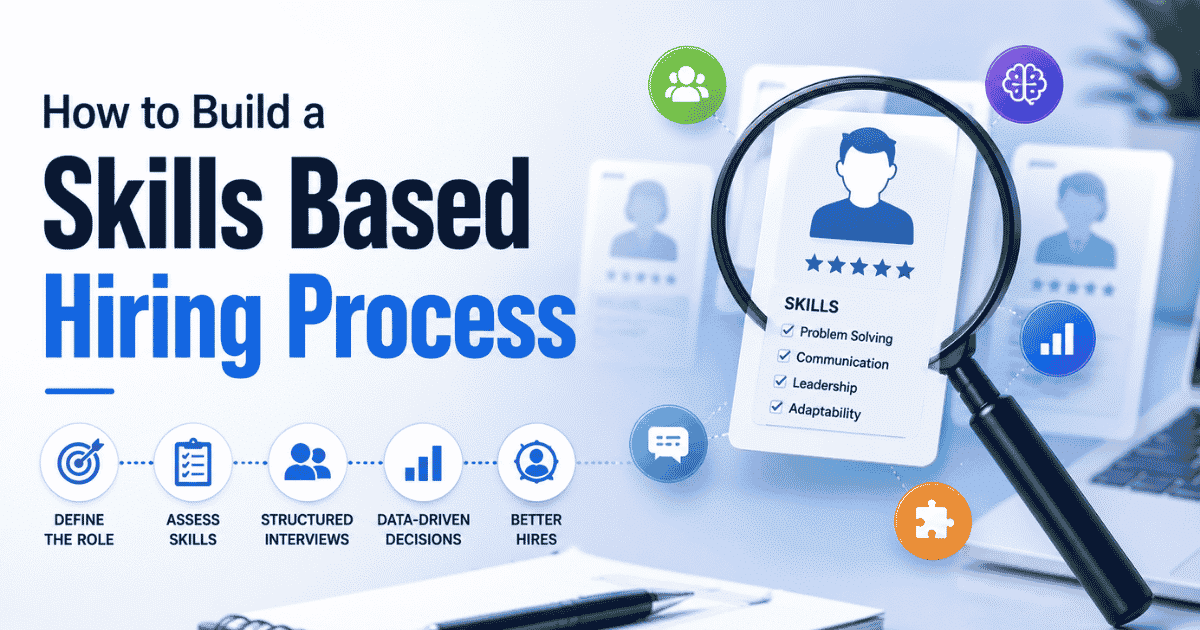
Table of Contents
Most job descriptions still ask for a degree before they ask what someone can actually do. Skills based hiring flips that order. Instead of screening candidates on where they went to school, hiring managers evaluate real, job-relevant abilities first, then everything else follows. It sounds simple, but the shift changes how companies write job postings, run interviews, and decide who's truly a fit. Businesses that adopt skills based hiring practices consistently uncover qualified candidates hiding behind resumes that rigid degree requirements would've filtered out. Rebuilding your job descriptions around skills isn't complicated, but doing it well takes more than swapping a few keywords, and that's exactly where most companies get it wrong.

What Is Skills Based Hiring
Skills based hiring is a hiring process that evaluates candidates by the key skills a role requires, rather than a college degree or years of experience. Talent acquisition teams identify the skills required for future performance, then test for them directly through assessments, work samples, or structured interviews. In a skills based hiring process, credentials take a back seat to proof of ability. Traditional hiring methods often reward polished resumes over real capability; this approach corrects that gap, judging candidates on what they can demonstrate, not what they claim on paper.
Real Benefits of Skills Based Hiring

Companies that adopt skills based hiring see measurable gains beyond just filling roles faster. For talent acquisition teams, this hiring approach reshapes how candidates are found, tested, and retained, changing outcomes across the entire hiring funnel.
Wider Access to Talent
Skills based hiring widens your talent pool by removing degree filters that block strong applicants. Instead of screening resumes for pedigree, hiring managers evaluate what candidates can actually do, opening the door to career changers, self-taught professionals, and workers without a four-year degree. Your talent pipeline also grows stronger over time, since roles stay open to a broader mix of backgrounds instead of the same narrow set of applicants. In competitive industries, a wider pool alone can be the difference between filling a role in weeks versus months, particularly when combined with job posting software for faster, smarter hiring.
Faster & Cheaper Hiring
Teams that adopt skills based hiring often cut both time-to-hire and cost-per-hire significantly, especially when they layer in recruitment management software. Job postings built around specific skills attract fewer irrelevant applicants, so recruiters spend less time sorting through resumes that were never a fit. Structured skills assessments replace multiple rounds of vague interviews, shortening the process without lowering quality, and work even better when embedded in an applicant tracking system. Recruiting budgets stretch further when fewer interviews go to waste, and candidates who move through hiring quickly are far less likely to accept a competing offer first, especially when your team is supported by recruitment software.
Higher Retention Rates
A skills based hiring approach tends to produce hires who stay longer. When someone is chosen for proven ability rather than a polished resume, they're more likely to succeed in the actual day-to-day work, which reduces early turnover. Job satisfaction climbs too, since employees feel matched to a role based on real competence rather than credentials on paper. Fewer resignations in the first year mean lower replacement costs and far less disruption from constantly refilling the same positions, especially when paired with strong employee retention strategies.
Less Bias in Decisions
Skills based hiring reduces unconscious bias by shifting focus away from names, schools, and backgrounds. Structured assessments score both soft skills and technical skills using consistent criteria, so every candidate is judged against the same bar. Applicants from non-traditional paths, who may lack a recognizable university name but have strong, provable ability, finally compete on level ground. Employer reputation tends to benefit as a result, particularly among candidates from underrepresented or non-traditional backgrounds who notice which companies actually hire on merit.
Stronger Day-One Performance
Candidates hired through a skills based hiring guide built on real assessments tend to perform better from day one. Because they're tested on tasks that mirror actual job responsibilities, there are fewer surprises once they start the role. Managers spend less time on remedial training and more time on genuine onboarding, since new hires already have the exact skills the position needs. Teams scale more smoothly when new hires hit the ground running instead of needing weeks to catch up.
Where Skills Based Hiring Works Best and Where It Doesn’t

Not every role suits skills based evaluation. Talent professionals get the best results when they know exactly where this approach shines, and where traditional credentials still matter more.
Ideal for Entry-Level Roles
Entry-level positions rarely demand years of proven history, which makes them a natural starting point for based hiring. Candidates fresh out of school or switching industries often lack a long resume, but skills tests let them show what they can actually do. Companies that evaluate candidates based on real ability, rather than work history, spot strong performers whom a resume filter would have missed entirely.
Great Fit for Career Changers
Someone moving from teaching into project management, or from retail into sales, carries demonstrated skills that a degree-first screen would overlook. Testing directly for the key skills needed in a role lets these candidates compete on merit instead of job titles. This one shift in hiring practices opens doors for talent that traditional screening routinely shuts out, often surfacing people with sharper motivation since they chose the new path deliberately, including career changers building their path in a remote workforce managed through modern HRM software.
Works Well in Tech Roles
Coding, data analysis, and technical support are some of the easiest jobs to test objectively. A live coding challenge or a real troubleshooting scenario reveals essential skills far better than a resume ever could. Many tech companies already lean on take-home projects and technical interviews, so building a full skills based hiring process here is less of a leap and more of a formality, particularly for SaaS teams already using HR and payroll software built for software businesses.
Struggles With Licensed Professions
Doctors, lawyers, and electricians need government-issued licenses before they can legally practice, no matter how strong their demonstrated skills are. No test replaces a required credential in these fields. Skills tests can still help differentiate between equally licensed candidates, but they can't substitute for legal certification that exists independently of what any employer prefers.
Riskier for Senior Leadership
Executive and senior leadership roles depend on judgment, strategic thinking, and a track record, qualities that are hard to capture through standardized testing. A skills assessment might confirm technical ability, but it won't show how someone leads through a crisis or handles ambiguity. Most companies still weigh experience and leadership history more heavily than any test at this level.
Caution in Regulated Industries
Finance, healthcare, and aviation operate under strict compliance rules that often require specific certifications or degrees. Dropping those requirements outright could create legal or safety risks that outweigh the benefits of a wider talent pool. Smart hiring practices in regulated sectors layer skills evaluation on top of mandatory credentials rather than replacing them, enabling talent professionals to improve candidate quality without compromising compliance, especially when supported by structured HR approval workflows. Many teams also rewrite job descriptions in these industries to separate what's legally required from what's simply preferred, giving candidates a clearer picture of the bar they need to meet.
How to Write a Skills-Based Job Description (With Template)

A skills-based job description looks different from what most candidates are used to. Here's how to build one that reflects real business priorities instead of outdated hiring habits.
Start With Core Tasks
Before listing requirements, map out what the role actually involves day to day. List the specific skills needed to handle those tasks well, not a generic wishlist copied from an old posting. This keeps the description tied to real job performance instead of assumptions about what a "qualified" candidate should look like on paper.
Drop Unnecessary Degree Requirements
Traditional hiring often defaults to degree requirements even when the job doesn't need one. Unless formal education is legally required, consider whether the role truly needs a degree or just the skills a degree happens to signal. Dropping blanket formal education requirements widens your applicant pool immediately, especially useful during talent shortages when college graduates alone can't fill every open seat.
Define Proficiency Levels Clearly
Vague terms like "strong communication skills" mean little without context. Specify what proficiency actually looks like, whether that's writing clear reports, resolving customer conflicts, or coding to a certain standard. This clarity helps you evaluate a candidate's skills against a defined bar, not a subjective gut feeling, and makes evaluating candidates far more consistent across your hiring team.
Use Inclusive, Plain Language
Corporate jargon and inflated requirements discourage strong applicants who don't come from the same background as your typical hire. Write in plain language that describes real tasks and outcomes, not buzzwords. Emphasize problem-solving ability and practical competence over polished terminology, since the goal is attracting people who can do the work, not people who are good at decoding job ads; job descriptions built this way also plug directly into job posting software for faster, smarter hiring or a broader HR software feature.
[Banner: Job Title | Employment Type | Location Type | Years of Experience]
(e.g., "Content Writer | Full-time | Onsite | 3 years")
[Job Title]
[1-2 line summary of the role and what the person will actually do]
- Employment type: [Full time / Part time / Contract]
- Vacancies: [Number]
- Location: [City, area]
- Deadline: [Date]
[Apply Now button]
Job Description:
[Company name] is a [industry] company dedicated to [what they do]. We're seeking a talented and [adjective] [Job Title] to join our [team name]. If you have a passion for [core skill/trait], we'd love to hear from you!
Job Nature:
- Job Nature: [Full Time / Part Time]
- Working Hours: [start time to end time]
- Working Days: [days, X days a week]
Job Location:
[Full address, floor, area, city]
[Google Map link]
Position Overview:
[2-3 sentences describing what the person will be responsible for day-to-day, written in plain language, not jargon]
Key Responsibilities:
- [Responsibility 1]: [Short explanation]
- [Responsibility 2]: [Short explanation]
- [Responsibility 3]: [Short explanation]
- [Continue as needed, bolding the responsibility name, then explaining it]
Skills and Experience Requirements:
- [X-Y years] of proven experience in [field], preferably within [industry/niche]
- Strong command of [core skill]
- Excellent [skill] abilities with [specific quality, e.g., "a keen eye for detail"]
- Familiarity with [specific tools/platforms]
- Ability to [soft skill, e.g., adapt style across platforms]
- Understanding of [analytical/strategic skill]
Educational Requirements:
- [Degree] in [field], or a related field
- [Optional line welcoming candidates without the formal degree if they have equivalent experience]
Nice to Have Skills:
- [Bonus skill 1]
- [Bonus skill 2]
- [Bonus skill 3]
Experience Requirement:
- [X-Y years] of experience in relevant fields
Salary:
- [Amount or "Negotiable"]
Job Benefits:
- [Benefit 1]
- [Benefit 2]
- [Benefit 3]
- [Continue as needed]
Ad Reference Number:
- [Internal tracking code]
Who should not apply:
- Do not apply if [disqualifying condition 1]
- Do not apply if [disqualifying condition 2]
How to Implement Skills Based Hiring

Rolling out a skills based approach takes more than swapping a few lines in a job post. It touches your interview process, your assessments, and how hiring managers evaluate every candidate who applies, which is why it helps to follow a structured HR software rollout guide.
Audit Your Current Process
Start by pulling up your last ten job postings and checking how many list a bachelor's degree as a baseline requirement, even for roles where it's never actually mattered. More than half of companies still default to academic degrees out of habit rather than genuine need. Flag every requirement that isn't tied to a task the person will actually perform, then ask whether it reflects necessary skills or just tradition, and consider whether your current tools support a more modern, recruitment software system optimized for 2026.
Redefine Roles Around Skills
For each open role, list the required skills the job truly demands, separating hard skills like coding or financial modeling from softer traits like communication. This step forces clarity on what "qualified" actually means for that position. Many teams discover during this exercise that career paths within their company were built around credentials rather than capability, which limits internal mobility as much as external hiring, and highlights the value of HR by replacing disconnected tools.
Pick the Right Assessments
Match the assessment method to the specific skills you're testing for. A writing sample works for content roles; a live technical challenge fits engineering. Avoid generic personality tests that measure nothing job-relevant. The goal is evidence of ability, not a proxy that just feels rigorous, and assessments run far smoother when they sit inside broader HR workflow automation.
Train Hiring Managers First
Hiring managers who've spent years screening resumes by degree and job title need real training before they can evaluate candidates on skills alone. Walk them through sample resumes, show what a strong skills based candidate looks like without a traditional background, and give them a scoring rubric. Without this step, old habits creep back into the interview process regardless of what the job posting says.
Pilot Before Full Rollout
Test the new approach on two or three roles, ideally a mix of entry level hires and a more experienced position, before rolling it out company-wide. Track how candidates perform after hiring, not just how they did in interviews. If the pilot shows stronger on-the-job results, you have real data to bring skeptical stakeholders on board, rather than asking them to take the shift on faith.
How To Choose Skills Assessments That Fit Your Budget

Assessment costs range from free to enterprise-level, and picking the wrong tier wastes money either way. The right choice depends on the job, your business needs, and how many candidates you're actually screening, as well as whether your broader HR stack, such as HR software for small businesses, already covers part of the workflow.
Free and DIY Options
For early-stage teams or a single open role, free tools go a long way. Work samples, take-home tasks, and structured skills-based interview questions cost nothing beyond staff time, and they still reveal real ability. A simple writing sample, a spreadsheet exercise, or a 30-minute practical task can surface the right skills just as clearly as a paid platform for entry-level roles where the skill requirements are straightforward. This route works best when hiring volume is low; once you're evaluating dozens of applicants per opening, manual grading stops scaling.
Mid-Tier Assessment Platforms
Once hiring volume grows, mid-tier platforms earn their cost by standardizing how skills get scored across more candidates. These tools typically cover technical tests, cognitive assessments, and role-specific simulations, all with dashboards that let hiring teams compare results side by side. For most small and mid-sized companies, this tier hits the sweet spot: affordable enough to justify company-wide, thorough enough to catch real skill gaps before an offer goes out.
When Enterprise Tools Make Sense
Enterprise-grade platforms make sense once you're hiring at scale, filling dozens of roles across departments, or trying to attract top talent in a competitive market where speed and candidate experience both matter. These tools often add features smaller platforms skip: bias auditing, integration with your ATS, and analytics tied directly to business needs like retention and internal movement, especially when bundled into innovative HR management features. If you're a five-person team hiring one role a quarter, this tier is overkill, and the cost isn't justified by the volume.
Match Cost to Role Level
Not every job needs the same assessment budget. A cashier role and a senior engineering job carry very different stakes, and spending enterprise money testing an entry level position rarely pays off. Reserve premium tools for roles where a bad hire is expensive or where specific skills are hard to verify any other way. Lower-stakes roles can lean on free or mid-tier options without sacrificing hiring quality.
Watch for Hidden Fees
Per-candidate pricing, seat limits, and "premium" question banks can quietly triple your actual spend beyond the advertised rate. Some platforms also charge extra for features that should be standard, like candidate feedback reports or integration with your existing systems. Before signing up, ask vendors for a full cost breakdown at your expected hiring volume, not just the entry-level pricing shown on their homepage.
How AI Resume Screening Makes Skills-Based Hiring Easier

AI resume screening reads applications against specific skill requirements instead of job titles or years listed on a page. For many organizations shifting toward skills-based hiring, this technology turns a manual, subjective process into something faster and more consistent, particularly when embedded in a broader recruitment system.
Matches Resumes To Skills
Traditional screening often filters candidates by keywords like "four year degree" or a specific former employer, missing people with the right skill sets but a different résumé format. AI tools instead scan for evidence of actual ability, matching what a candidate has done against what the role truly requires. Many employers use this matching to hire people who would've been screened out under older, credential-first systems, simply because the software looks past titles and degrees to the substance underneath.
Cuts Manual Screening Time
Reviewing hundreds of applications by hand takes hours a recruiter rarely has to spare. AI screening compresses that into minutes, surfacing the strongest matches first so hiring teams spend their time on candidates worth a real conversation. This speed matters most when business goals depend on filling roles quickly, since a slow hiring process often means losing top talent to a faster-moving competitor. Recruiters get their week back, and candidates get a decision sooner instead of waiting weeks to hear anything at all.
Reduces Unconscious Bias
Names, schools, and even formatting choices can quietly sway a human reviewer, even one who's trying to be fair. A properly configured AI tool scores every resume against the same criteria, judging skill sets on evidence rather than familiarity or pedigree. This doesn't eliminate bias; a model trained on biased historical hiring data can repeat old patterns. But when built and audited well, it gives candidates from non-traditional backgrounds a fairer shot at reaching the interview stage, which supports the organizational goals behind adopting skills-based hiring in the first place.
Flags Skill Gaps Early
Beyond just ranking resumes, good screening tools highlight exactly where a candidate falls short of specific skill requirements before an interview ever happens. That insight lets hiring managers prepare sharper, more targeted behavioral questions instead of generic ones that reveal little. It also helps candidates whose career goals don't perfectly match the role today but show clear potential to grow into it, since the gap becomes visible and discussable rather than a silent reason for rejection.
Humans Still Make the Call
No algorithm should make a final hiring decision alone. AI resume screening narrows the pool and highlights what's worth a closer look, but judgment about culture fit, communication, and genuine potential still belongs to people. The candidates who make it through screening deserve a real conversation, not just a score. Hiring teams that treat these tools as a first filter, not a final verdict, get the speed benefits without losing the human read that actually predicts whether someone will thrive on the job.
How Payrun Helps HR Teams Implement Skills-Based Hiring
Payrun's AI resume screening software lets HR teams define specific acceptance and rejection criteria for each role, then scores every resume against those exact rules instead of filtering by keywords or degrees. Each candidate profile shows a criteria match breakdown with clear strengths and gaps, so teams compare applicants on ability, not guesswork.
Payrun's Hiring and Recruitment module adds customizable application forms for collecting skills-based information upfront, plus configurable pipelines that keep every reviewer evaluating candidates against the same standard. Feedback stays centralized instead of scattered across emails.
Resume screening time can drop by up to 90% with this workflow, and hiring cycles move roughly 2x faster. The tools narrow the pool; people still make the final call, with Payrun positioning itself as a HR management partner rather than a replacement for human judgment.
FAQs
What Is the Difference Between Skills-Based Hiring and Competency-Based Hiring?
Skills-based hiring focuses on whether a candidate can perform specific, often technical tasks tied directly to the role, like coding, writing, or data analysis. Competency-based hiring looks at broader behavioral traits, such as leadership, adaptability, or problem-solving, that apply across many roles.
Does Skills-Based Hiring Work for Entry-Level Roles?
Yes, and it often works better than traditional methods for entry-level hiring. Candidates fresh out of school or switching careers rarely have long work histories to lean on, so testing for actual ability gives a clearer signal than a thin resume ever could.
Do I Need Expensive Software to Start Skills-Based Hiring?
No. Free options like work samples, structured interview questions, and short take-home tasks work well for small teams. Paid assessment platforms become worthwhile once hiring volume grows or roles need more specialized technical testing.
Can Skills-Based Hiring Hurt Diversity Efforts Instead of Helping Them?
It can, if assessments are poorly designed or biased toward a specific communication style, cultural reference, or test format. Well-built skills tests, reviewed regularly for fairness, tend to widen the pool and reduce bias rather than narrow it.
How Long Does It Take to Switch to a Skills-Based Hiring Process?
Most companies see meaningful results within one hiring cycle if they start with a single role as a pilot. Full rollout across every position typically takes a few months, since job descriptions, assessments, and manager training all need updating along the way.