Employer Branding Strategy: How To Attract And Retain Top Talent
Table of Contents
Job seekers do their homework now. Before anyone applies, they check reviews, scroll LinkedIn, and ask around. Your employer brand is already talking, whether you're managing it or not.
A strong employer branding strategy changes that story. It's not a logo or a tagline. It's the honest gap between what you promise candidates and what current employees actually experience every day. Get that gap small enough, and word spreads on its own.
Small businesses often skip this work, thinking employer branding is for big corporations with big budgets. Wrong move. A clear employee value proposition and a real focus on company culture can help you attract and retain top talent without outspending anyone, especially when you pair it with HR software designed specifically for small and medium-sized businesses. This guide shows you exactly how to build that strategy from scratch.

What Is An Employer Branding Strategy?
An employer branding strategy is the deliberate plan a company uses to shape how job seekers, current employees, and former employees see it as a place to work. It combines your employer value proposition, your company culture, and real employee stories into one consistent message. Done well, it makes recruitment easier and cheaper.
Recruitment marketing and a few nice job descriptions aren't the whole picture. Employer branding goes deeper, touching the entire employee life cycle, from the hiring process to how you treat people on their way out. Your employer brand reflects what actually happens inside the company, not just what you post on social media platforms.
The takeaway is simple. A strong employer branding strategy aligns what you say with what employees live every day, and that alignment is what actually helps you attract and retain top talent.
Employer Brand Vs EVP Vs Employee Experience
People often mix up these three terms, but they play different roles. Employer brand is the reputation itself. Employee value proposition is the promise behind it. Employee experience is proof the promise holds up. Together, they explain why some companies attract and retain top talent while others struggle.
Concept | What It Means | Main Purpose | Example |
|---|---|---|---|
Employer Brand | How job seekers and the public perceive a company as an employer | Shapes external reputation and attracts qualified candidates | A company known for genuine work life balance |
Employee Value Proposition | The specific benefits and experiences a company promises in exchange for someone's work | Defines what makes the company different from competitors | Fast career growth plus flexible remote options |
Employee Experience | What employees actually feel and encounter day to day | Determines whether the EVP holds up in real life | Managers who follow through on promised mentorship |
Here's the connection. Your employee value proposition sets the promise. Employee experience delivers on it, or breaks it. Employer brand is simply what people notice once enough of that experience adds up. Weak alignment between these three is usually why employer branding efforts stall, even with a great careers page or solid recruitment marketing tools behind them.
How To Build An Employer Branding Strategy
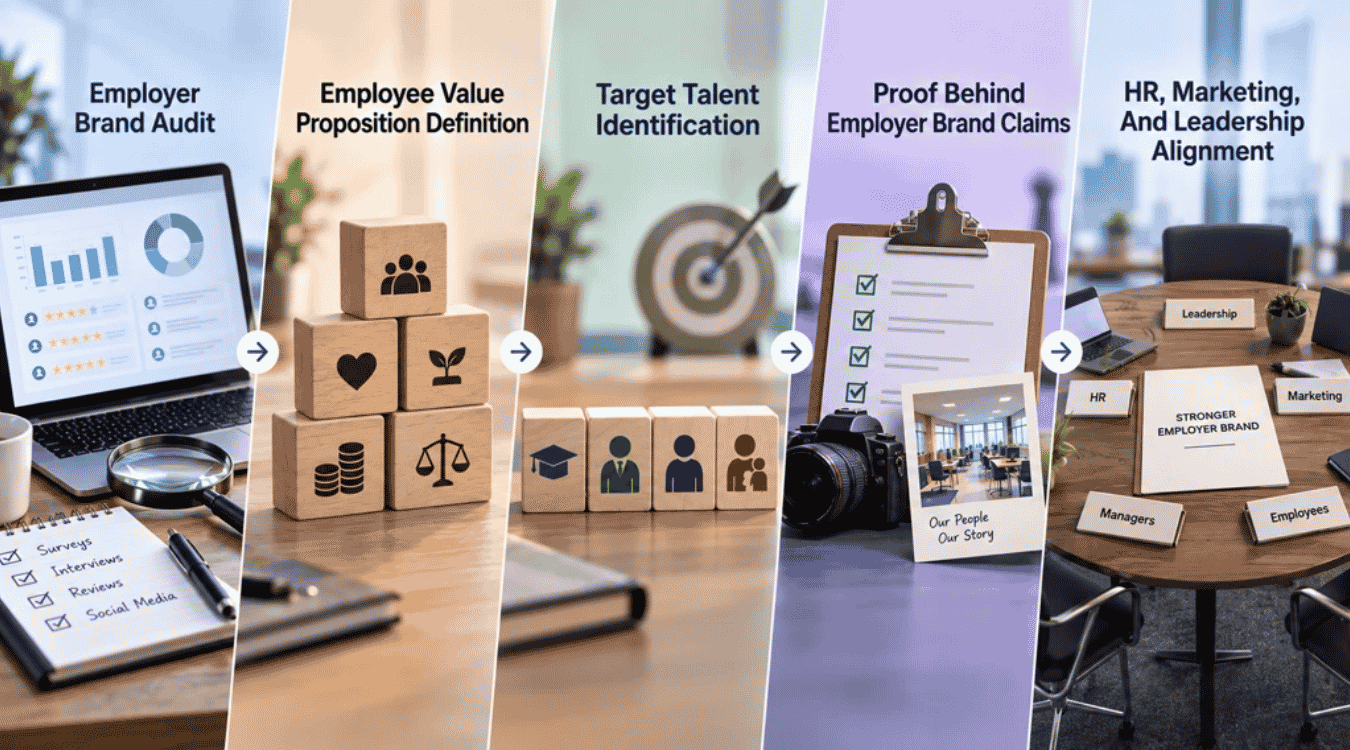
Building a real employer branding strategy takes more than a mission statement and a nice careers page. It's a strategic process with clear steps. Partnering with a HR management platform can support that work at every stage. Get these five pieces right, and everything else, from job postings to employee retention, gets easier.
Employer Brand Audit
Before you change anything, find out what people already think. Pull data from employee surveys, exit interviews, and candidate feedback forms. Check employer review sites and social media platforms for patterns in what current employees and former employees are actually saying.
Look at your careers site, job descriptions, and LinkedIn company page too. Compare all of it against a few competitor brands in your space. Gaps usually show up fast.
The point isn't to collect complaints. It's to find the exact spot where your employer brand messaging and your actual employee experience stop matching.
- Employee surveys and eNPS scores
- Exit interview themes
- Candidate feedback after interviews
- Employer review sites (Glassdoor, Indeed)
- Careers page and job descriptions
- Social media platforms and company news
- Competitor employer brands
Employee Value Proposition Definition
A compelling Employee Value Proposition communicates why candidates should choose your company over the next one. Research shows a well-defined EVP attracts better-aligned candidates and directly improves employee retention and engagement. Organizations with clear EVPs attract 50% more qualified applicants, according to LinkedIn.
Building one means asking real employees what actually keeps them there, not guessing. Look across compensation, employee benefits, company culture, career growth, work life balance, and a sense of purpose.
Effective EVPs reflect authentic organizational strengths and real employee priorities, not aspirational copy. If your EVP promises flexibility but managers still expect people online at 7 AM, that gap will surface fast, usually on a review site.
- Compensation and employee benefits
- Company culture and values
- Career development and growth
- Flexibility and work life balance
- Sense of purpose and mission
Target Talent Identification
Not every qualified candidate wants the same thing. A recent graduate cares about career growth. A senior hire cares about autonomy and impact. A parent returning to work cares about flexibility. Treating them all the same wastes your employer branding efforts.
Talent Segment | Likely Priorities | Messaging Focus |
|---|---|---|
Early career | Learning, mentorship, growth | Career growth and development paths |
Mid career | Compensation, autonomy | Ownership and impact on real work |
Senior / leadership | Culture fit, influence | Company's values and strategic role |
Caregivers / returners | Flexibility, stability | Work life balance and support |
Skip the elaborate persona decks. A simple table like this is usually enough to sharpen your employer brand messaging for each group without overcomplicating the recruitment process, especially when your team is already using HR software for small businesses.
Proof Behind Employer Brand Claims
This is where most employer branding efforts actually fail. Companies write EVP claims that sound great on a careers page, then never back them up. Candidates notice fast, and trust drops the moment a claim feels hollow.
The fix is a simple framework: Promise, then Proof, then Experience. Every claim on your careers page should map to something real.
- Claim "career growth" → show actual promotion data or internal mobility rates
- Claim "flexibility" → publish the real remote or hybrid policy, not a vague statement
- Claim "great benefits" → link to a clear, specific breakdown of what's offered
- Claim "strong culture" → let employee testimonials carry the message, not a marketing paragraph
Employee-generated content is perceived as more authentic and trustworthy than anything HR writes. A short video of an employee describing their actual day does more for employer branding success than a polished culture page ever will.
HR, Marketing, And Leadership Alignment
Employer branding efforts fall apart when one department owns messaging and another owns reality. HR writes the values. Marketing designs the careers page. Leadership says something different in an all-hands. Candidates and employees notice the mismatch immediately.
Team | Responsibility |
|---|---|
HR | Owns EVP definition, employee surveys, and hiring process consistency |
Talent Acquisition | Delivers the brand promise through job descriptions and candidate experience |
Marketing | Shapes external messaging, social media platforms, and career site content |
Leadership | Models transparent leadership and backs employer brand claims publicly |
Managers | Deliver day-to-day employee experience that matches the promise |
Employees | Provide authentic employee stories and word-of-mouth reputation |
Transparent leadership builds trust between employees and employers faster than any campaign. Candidates seek evidence of honest and communicative leadership, and that evidence either shows up across every team, or it shows up nowhere at all, often reflected in how well your HR management settings and workflows are aligned with the values you promote.
How To Strengthen Employer Branding Across The Employee Lifecycle
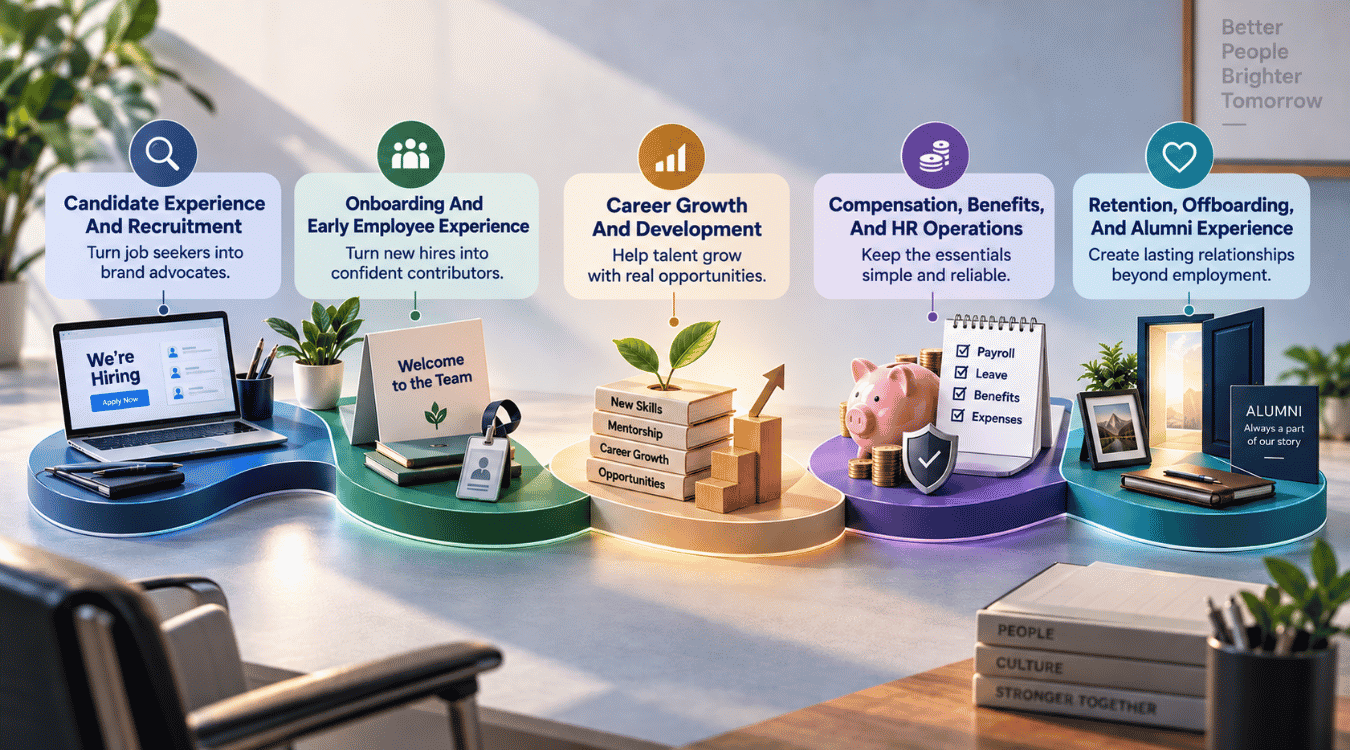
Employer branding doesn't stop once someone accepts an offer. The whole employee life cycle carries it forward, from the first job posting to the day someone leaves. Attract, recruit, hire, onboard, develop, reward, retain, offboard. Every stage either backs up your employer brand or quietly undercuts it.
Candidate Experience And Recruitment
The hiring process is where your employer brand messaging meets reality for the first time. Job search, application, interview, communication, offer, preboarding. Candidates judge your company at every single step, not just the final offer, which is why many teams lean on an all-in-one HR management system to keep that experience consistent.
A positive candidate experience can convert unsuccessful applicants into brand advocates. Even people you don't hire can become fans of your company, if you treat them well along the way. Ghosting candidates, dragging out the recruitment process, or failing to manage basics like accurate, automated attendance tracking does the opposite, turning rejected applicants into people who leave a bad review instead.
Job descriptions matter more than most companies think. Vague, jargon-filled postings scare off qualified candidates before they even apply. Clear, honest job descriptions are one of the easiest employer branding initiatives you can start this week, especially if you're a startup building your HR stack with HR software tailored for startups and growing businesses.
Onboarding And Early Employee Experience
The first few weeks decide a lot. New hires are watching closely to see if the job matches what they were promised during hiring. Your EVP either holds up here, or it falls apart fast.
Good onboarding covers more than paperwork. Clear expectations, real manager communication, proper training, and a way for new employees to give feedback early all count.
- HR setup and system access
- Payroll and first-paycheck clarity
- Leave policy and time-off basics, supported by an automated leave management system
- Manager introduction and expectations
- Initial training and resources
- Early feedback check-ins
Get this stage right, and new employees start telling people your company does what it says. Get it wrong, and you've lost them before their first month ends.
Career Growth And Development
Ambitious talent notices clear pathways for professional growth. People don't just want a job. They want to know where it leads.
Career development doesn't have to mean a formal ladder. Mentorship, internal mobility, skill-building programs, manager support, and tools like employee self-service payroll systems that give people more control over their data all count. What matters is that employees can see a real path, not just hear about one in a job posting.
Here's proof this works in practice. A company that promotes 20% of its team internally every year has a much easier employer branding story to tell than one that only hires from outside. Current employees repeat that kind of career growth to friends, and candidates hear about it before they even apply.
Compensation, Benefits, And HR Operations
Employer brand promises get tested against daily reality right here. Payroll accuracy, leave management, and expense reimbursement aren't exciting topics, but they shape employee satisfaction more than almost anything else.
HR Touchpoint | Employee Expectation | Employer Brand Impact |
|---|---|---|
Payroll accuracy | Paid correctly and on time, every time | Errors erode trust fast, even if rare |
Leave requests | Simple process, clear approval timeline | Friction here reads as poor company culture |
Expense reimbursement | Fast, transparent, no chasing approvals | Slow reimbursement signals disorganization |
HR communication | Clear answers, self-service where possible | Confusing HR processes damage daily experience |
None of this needs to be flashy. Just working reliably is enough. A payroll platform like Payrun removes a whole category of friction that quietly wears down employer branding success over time.
Retention, Offboarding, And Alumni Experience
Employer branding doesn't end when someone decides to stay, or even when they decide to leave. Engaged employees are more productive and more committed to staying, and that engagement is worth protecting long after onboarding ends.
Organizations that align employer branding efforts with company culture see a 30% increase in employee engagement levels, according to Universum's Employer Brand Insights. Retention isn't an accident. Getting the earlier stages right, from accurate payroll processing to respectful management, and keeping that consistency going is what actually produces it.
Offboarding matters just as much. A respectful exit interview and a clean, dignified departure process turn former employees into quiet advocates instead of critics. Alumni talk. Some come back. Some refer new candidates. Some leave a review that shapes your reputation for years after they're gone.
How To Activate And Measure Your Employer Brand
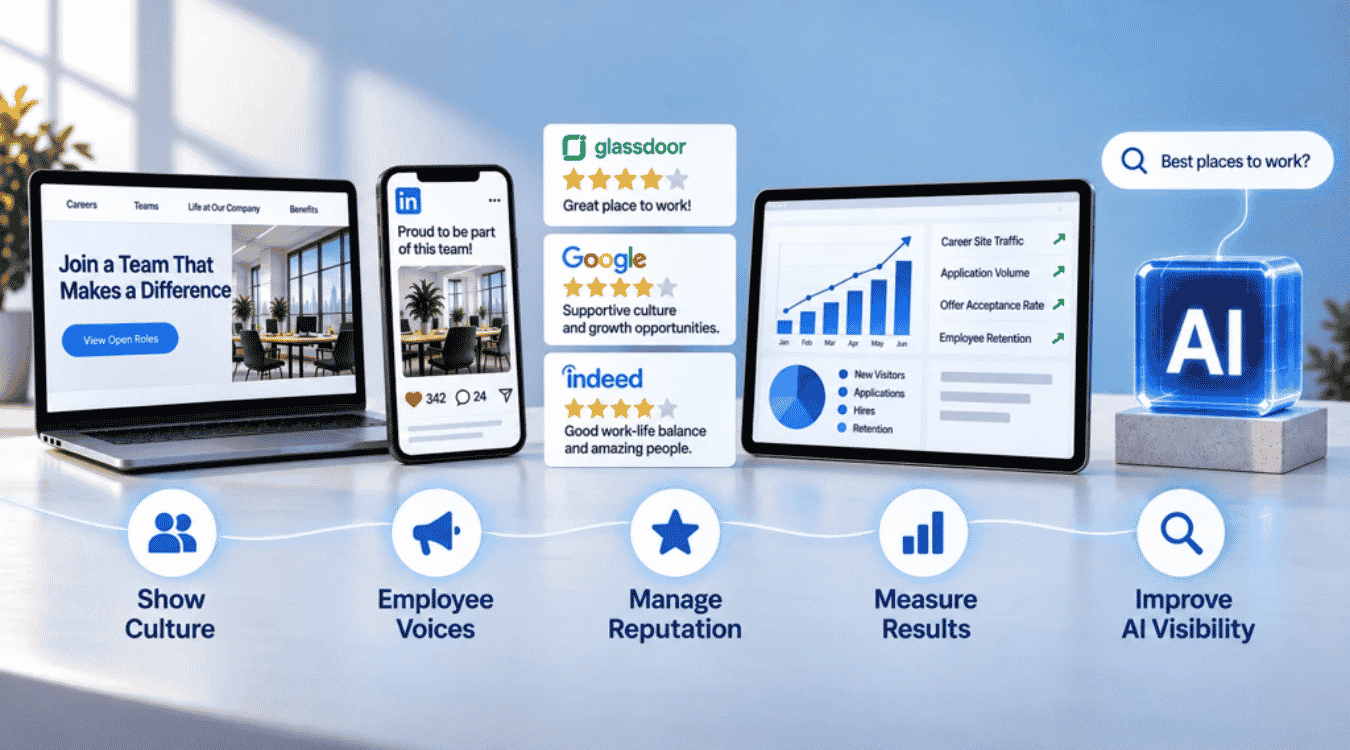
Having a strong EVP means nothing if nobody sees it. Activation turns your employer brand strategy into something candidates and employees actually encounter. Measurement tells you whether any of it is working.
Careers Pages, Job Descriptions, And Social Channels
Every channel where candidates find you is a chance to prove your employer brand claims, or quietly contradict them. Consistency across channels matters more than volume. Posting constantly on social media platforms means little if your careers page still looks like it was built in 2019.
Channel | Purpose | Content Type | Proof |
|---|---|---|---|
Careers page | First real impression of company culture | EVP summary, employee stories, benefits overview | Photos and quotes from actual employees |
Job descriptions | Set honest expectations before applying | Role clarity, growth path, team context | Specific, real language, no filler buzzwords |
LinkedIn company page | Ongoing visibility with passive candidates | Company news, employee highlights, culture posts | Regular posting, real engagement, not just ads |
Employer review sites | Third-party validation of your brand | Employer responses, transparency | Genuine responses to both good and bad reviews |
Don't just tell candidates what you offer. Show them, using the same channels they're already scrolling through anyway.
Employee Stories And Advocacy
Employee-generated content is perceived as more authentic and trustworthy than anything a marketing team writes. A candidate reading a polished mission statement is skeptical by default. A candidate watching a real employee talk about their actual week believes it.
Employee advocacy increases trust in employer branding efforts, but it has to be genuine. Forced testimonials read as fake immediately, and they can damage credibility faster than saying nothing at all.
- Do let employees speak in their own words, unedited
- Do share both wins and honest challenges
- Do make participation optional, never mandatory
- Avoid scripting testimonials word for word
- Avoid only featuring leadership or top performers
- Avoid publishing stories nobody at the company recognizes as true
Employer Reviews And Online Reputation
Your company's reputation lives on review sites whether you manage it or not. Ignoring employer review platforms doesn't make the reviews disappear. Staying out of the conversation is all that accomplishes, especially when issues like delayed pay or errors in payroll processing services are at the root of many complaints.
A simple framework keeps this manageable. Listen to what's being said. Identify patterns across multiple reviews, not just one angry post. Fix the real problem behind the pattern. Respond honestly and specifically, not with a copy-paste template. Then monitor to see if the pattern actually changes.
Transparent communication fosters lasting employee loyalty, and that same transparency applies to how you handle public criticism. A thoughtful response to a bad review often does more for your employer brand than ten generic five-star ones.
Employer Brand Metrics And ROI
Tracking key performance indicators is crucial for measuring employer branding success. Without numbers, you're just guessing whether any of this is working.
Think of it as a funnel. Awareness leads to consideration, which leads to application, which leads to hiring, then experience, then retention. Each stage has its own signal.
Stage | KPI | What It Tells You |
|---|---|---|
Awareness | Career site traffic, social reach | Whether people know you exist as an employer |
Consideration | Follower growth, engagement rate | Whether your employer brand messaging resonates |
Application | Application volume, source quality | Whether job descriptions attract the right people |
Hiring | Offer acceptance rate, time-to-fill | Whether your brand promise holds up in negotiation |
Experience | Employee Net Promoter Score (eNPS) | Whether current employees would recommend the job |
Retention | Turnover rate, tenure by segment | Whether the promise keeps holding after the offer |
High offer acceptance rates indicate strong employer brand resonance. Candidates turning down offers late in the process rarely points to compensation alone. Usually, it's a sign the employer brand promise didn't survive contact with reality during interviews or with the basics of how you run payroll software and related HR operations.
AI Search And Employer Brand Visibility
Candidates don't just Google companies anymore. They ask AI. ChatGPT, Gemini, Claude, and AI Overviews are quietly becoming a new front door for how people evaluate your employer brand before they ever visit your careers page.
Built In's 2026 research found that 91% of surveyed talent leaders say AI now influences candidate discovery, while only 33% feel confident their employer brand is represented accurately in AI results. Whoever fills that gap first sets the story, so leaving it unmanaged means someone else's version of your reputation fills the space instead. Under the hood, reliable AI results often depend on clean, consistent data flowing from systems like a modern payroll management system.
AI tools tend to pull from the same places people already trust. That means the fundamentals still matter most.
- Keep employer review sites accurate and actively managed
- Publish real employee-generated content regularly, not just once a year
- Fix outdated job descriptions and old company information across the web
- Make sure your careers page and social media platforms say the same thing
- Treat every public data point as evidence an AI model might pull from
Nobody can fully control what an AI system says about a company. But a consistent, honest employer brand across every channel gives it accurate material to work with, instead of stale or contradictory scraps.
8 Common Employer Branding Mistakes To Avoid
Even companies that care about employer branding make avoidable mistakes. Most come from treating employer branding as a marketing project instead of an honest reflection of company culture. Here are the ones that cause the most damage.
- Generic EVP claims. "We're a great place to work" tells candidates nothing on its own. A compelling Employee Value Proposition needs specifics, real numbers, real policies, real examples. Vague claims just blend into every other job posting out there.
- Poor candidate experience. Slow communication, confusing interview processes, and unexplained rejections push qualified candidates away fast. A poor candidate experience spreads through word of mouth and review sites just as quickly as a good one does.
- Inconsistent messaging across channels. If your careers page promises flexibility but your LinkedIn company page shows a rigid culture, candidates notice the mismatch. Inconsistent employer brand messaging erodes trust before anyone even applies.
- Forced employee advocacy. Mandatory or heavily scripted employee testimonials backfire fast. Candidates can spot a forced quote immediately. Genuine employee stories build far more trust.
- Unanswered employer reviews. Letting negative reviews sit unanswered signals that nobody's paying attention. A thoughtful, honest response often matters more than the original complaint.
- Vanity metrics over real KPIs. Follower counts and page views feel good but don't tell you much. Tracking offer acceptance rate, eNPS, and turnover actually shows whether your employer branding efforts are working.
- Overpromising during hiring. Fast career growth or a perfect company culture, promised during interviews, sets up disappointment fast. New hires who feel misled rarely stay long, and they tend to talk about why.
- Treating branding as a recruitment campaign. Employer branding touches the entire employee life cycle, not just hiring season. Companies that only think about it when they need to hire end up rebuilding trust from scratch every time.
Employer Branding Strategy Checklist
Use this as a working list, not a read-once section. Copy it into your own project plan and check items off as you go.
Research
Before changing anything, find out what people already think. A clear picture of your current employer brand shows exactly where the gaps sit.
- Audit current employer brand across review sites, social media, and employee surveys
- Collect feedback from existing employees and recent exit interviews
- Research 3 to 5 competitor brands in your industry
- Identify the key elements candidates mention most in reviews
- Review careers page and job descriptions for outdated claims
EVP
Your employer value proposition (EVP) only works if it matches reality. Build it from real employee input, not guesses about what sounds appealing.
- Define your EVP using real employee input, not assumptions
- Confirm the EVP reflects actual employee growth opportunities, not aspirational copy
- Check that compensation, culture, and flexibility claims are all verifiable
- Segment messaging for at least 2 to 3 talent groups
- Test the EVP language with a small group of current employees first
Experience
Employee experience proves or breaks every EVP claim you make. Map it honestly across onboarding, development, and daily work to spot where reality slips.
- Map the candidate journey from job posting to first day
- Review onboarding for gaps between promise and reality
- Check internal communications for consistency with external messaging
- Support employee development through visible, real growth paths
- Monitor employee well-being, not just engagement scores
Activation
A strong EVP means nothing if candidates never see it. Activation puts your employer brand in front of the right people, consistently and honestly.
- Update careers page, job descriptions, and LinkedIn company page, and make sure they accurately reflect the capabilities of any innovative HR features you rely on
- Publish real employee stories on a regular schedule
- Encourage employees to share genuine experiences, without scripting them
- Evaluate recruitment marketing platforms if visibility is weak, especially if you're in a fast-growing sector like SaaS where HR and payroll software built for software businesses can double as a visibility and operations layer, and consider consolidating your stack by replacing disconnected HR tools.
- Consider employee resource groups if none currently exist
Reputation
Your reputation lives online whether you manage it or not. Staying active on review sites keeps you part of the conversation, not just a subject of it.
- Respond to employer reviews consistently, good and bad
- Track recurring themes across review sites
- Fix root causes behind negative patterns, not just the complaints
- Set a regular schedule for reputation monitoring, not just when issues arise
- Assign clear ownership for who responds to reviews
Measurement
Numbers tell you whether any of this is actually working. Track key performance indicators across the full funnel, not just hiring metrics alone, and connect them with operational data from tools like payroll software.
- Track offer acceptance rate, eNPS, and turnover by segment
- Review recruitment costs and time-to-fill quarterly
- Compare awareness, application, and retention metrics against last quarter
- Set a baseline now so future progress is measurable
- Report metrics to leadership on a consistent schedule
AI Visibility
Candidates now ask AI tools about companies before they ever apply. Keeping your information accurate everywhere gives AI systems the right story to tell.
- Confirm employer information is accurate across review sites and social platforms
- Refresh outdated job descriptions and company details across the web
- Check how your company appears when asked about directly in AI tools
- Keep employee-generated content current and easy to find
- Audit for contradictions between your careers page and third-party listings
Final Thoughts
A compelling employer brand doesn't come from a slogan or a redesigned careers page. Closing the gap between what you promise and what current employees actually live every day is where it really comes from. That honesty is what lets you attract and retain talent without outspending bigger competitors.
Building a well-crafted employer brand takes real work across every stage, from your EVP to onboarding to how you handle a bad review. But the payoff compounds. A strong, consistent corporate brand reduces hiring costs, shortens recruitment cycles, and keeps people around longer once they're in.
Your employer brand's reach now extends into AI search too, so consistency matters more than ever. Start with your current employer brand audit, fix the gaps you find, and keep showing up honestly. Doing that consistently is what an effective employer branding strategy actually looks like in practice.