Skills Gap Analysis For Effective Workforce Planning In 2026
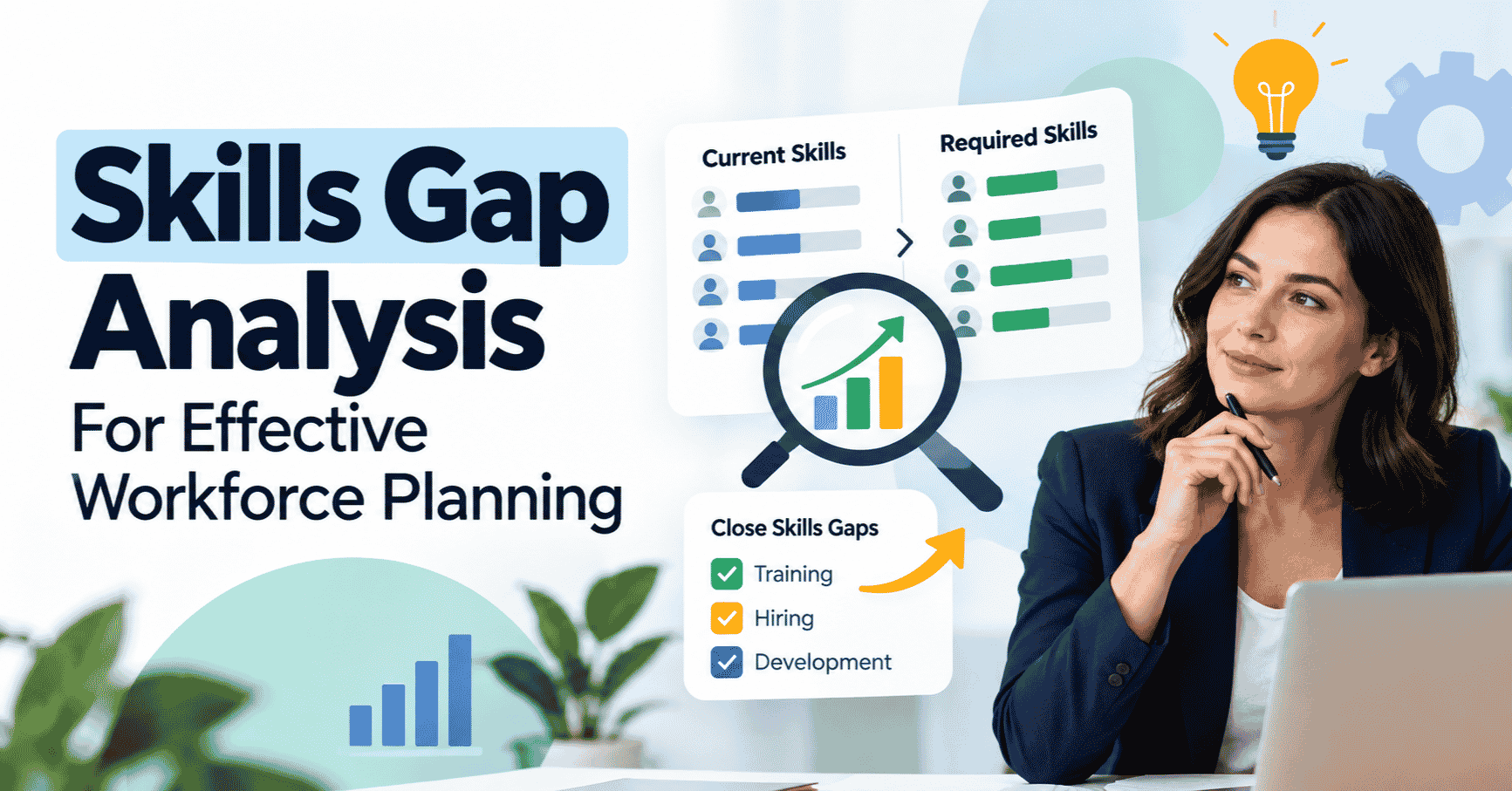
Table of Contents
Skills gap analysis sounds like something only big enterprises run. Small business owners assume they need a dedicated L&D team or expensive software to figure out where their team falls short. That is not true.
A skills gap analysis is a structured way to identify the difference between what your employees can do today and what your business actually needs. Maybe your team is great at customer service but struggles with new software. Maybe one department is stretched thin because nobody else knows how to cover a critical task.
Once you know where those gaps sit, you can decide whether to train your current staff or hire someone new. No fancy tools required. Just a clear process and the data you already have sitting in your HR files.

What Is Skills Gap Analysis?
A skills gap analysis compares your team's existing skills with the skills needed to hit business goals. It shows you exactly where your workforce falls short and why certain tasks keep stalling. Small businesses often skip this step and end up guessing instead of measuring.
Running a gap analysis gives you real data instead of assumptions. You see which employees have strong existing skills in one area but lack required skills in another. Skills gaps rarely show up all at once. They build slowly until productivity drops and deadlines slip.
Signs Your Business Needs A Skills Gap Analysis
Skills gaps rarely announce themselves. They show up in small, unrelated ways until you connect the dots. Here are five signs identifying skills gaps in your business is overdue.
Employees Struggle With New Technology
New software rolls out and adoption stalls. Employees fumble through basic tasks that should take minutes, and support tickets pile up fast. Skill deficiencies around technology often hide behind excuses like "the tool is confusing" or "we need more time."
Give it a few weeks and the pattern becomes obvious. Productivity dips, errors increase, and frustration builds on both sides. A quick skills gap analysis at this stage tells you whether the problem is the tool or the training.
Performance Gaps Persist Despite Training
Training sessions get completed, certificates get signed, and yet performance barely moves. Managers assume the issue is motivation when the real cause sits deeper. Gaps exist in application, not just knowledge, and generic training rarely closes that distance.
Employees can memorize a process without knowing how to apply it under pressure. Identifying skills gaps at this stage means testing real tasks, not just attendance sheets. Small businesses that skip this step keep repeating the same training with the same disappointing results.
Projects Require Skills Your Team Lacks
A new client project lands and suddenly nobody on the team has done this exact work before. Deadlines get pushed while employees learn on the fly, and quality takes a hit early on. This pattern repeats every time your business model shifts direction.
Growth naturally exposes skill deficiencies that stayed hidden during routine work. A skills gap analysis before the next big project saves you from repeating the same scramble. It also shows which employees are close to ready with a little support.
Hiring For Certain Skills Becomes Difficult
Job postings sit open for weeks and every applicant seems to be missing the same critical skill. That pattern usually means the gap is not just external. Your current team likely faces the same deficiency, just less visibly.
Recruiters chase candidates who barely exist in the market instead of developing people already on payroll. Customer expectations keep rising while the hiring search drags on. Identifying skills gaps internally often reveals a faster, cheaper fix than another round of job ads.
Business Goals Require New Capabilities
Leadership sets an ambitious target and the current team structure was not built for it. Maybe the business model is shifting toward new services, or customer expectations have changed faster than your team's skill set. Either way, the mismatch shows up fast.
Setting goals without checking capability first is a common small business mistake. Running a skills gap analysis important to your growth plan clarifies what needs to change before the goal becomes unreachable. It turns ambition into an actual, workable plan.
Types Of Skills Gaps
Not every skills gap looks the same. Some hit the day to day work, others hold back growth. Here are six types worth knowing before you run an analysis.
Technical Skills Gap
Technical skills gaps show up when employees cannot handle the actual tools and systems their job requires. A bookkeeper who struggles with new accounting software or a support agent who cannot navigate a CRM both fall into this category. Specific skills tied to a role are missing, and workarounds only slow everyone down.
Small businesses feel this gap hardest because one undertrained employee can bottleneck an entire process. Cross-training helps, but only once you know exactly which technical skills are missing. Guessing wastes time that a short assessment could save.
Soft Skills Gap
Soft skills gaps are harder to spot because they rarely show up on a resume or a certificate. Communication, critical thinking, and collaboration fall apart quietly, usually surfacing as missed deadlines or team friction nobody can quite explain. Core competencies like these matter just as much as technical ability.
Employees can be brilliant at their trade and still struggle to explain a problem clearly or push back on unrealistic requests. Skipping soft skills in an analysis means missing half the picture. Training here often moves the needle faster than expected.
Digital Skills Gap
Digital skills gaps grow every year as emerging technologies change how work gets done. Employees who learned a system five years ago may now be behind on basic digital literacy, automation tools, or data handling expected in their role today.
Small teams without a dedicated IT function feel this gap the most. Nobody flags it until a client asks for something the team simply cannot deliver. Regular check ins on digital skills keep this gap from growing unnoticed.
Leadership Skills Gap
Leadership capability gaps appear the moment a strong individual contributor gets promoted into a management role. Technical talent does not automatically translate into the ability to delegate, coach, or resolve conflict within a team.
Promoting from within is smart business, but it only works with support. A leadership skills gap left unaddressed usually shows up as high turnover under a specific manager. Catching it early through an analysis protects both the new leader and their team.
Compliance And Certification Skills Gap
Compliance gaps carry real legal and financial risk, not just a productivity dip. An expired certification or a missed regulatory update can expose a small business to fines or liability nobody budgeted for.
Industries like healthcare, finance, and construction feel this gap most acutely. Specific skills tied to licensing or certification need regular tracking, not a once a year glance. A skills gap analysis focused on compliance catches expirations before they become a legal problem.
Future Skills Gap
Future skills gaps are the hardest to spot because the need has not fully arrived yet. Business goals shift, industries evolve, and the skills that mattered last year may not carry the same weight next year.
Staying ahead means looking past current job descriptions toward where the business model is heading. Employees strong in today's core competencies may need entirely new training within a year or two. Planning for future skills now avoids a scramble later.
How To Conduct A Skills Gap Analysis
Running a skills gap analysis does not require fancy software. Follow these five steps to conduct a skills gap analysis that connects directly to your business strategy and organizational goals.
Define Business Goals And Critical Roles
Start by writing down your actual business objectives for the next 12 months. Growth targets, new services, or expansion plans all shape which roles matter most right now. Key positions tied directly to those goals deserve attention first, not every job title on the payroll.
Small businesses often skip this step and jump straight to skills testing. Skipping the goal setting stage means measuring against nothing. Tying the analysis to real business strategy from the start keeps the whole process focused and useful.
Identify Required Skills And Proficiency Levels
Every key position needs a clear list of required skills, not a vague sense of what the role involves. Pull from job descriptions first, then check with managers since most descriptions go stale within a year or two. Critical skills often get missed when nobody updates the paperwork.
Desired skill level matters just as much as the skill itself. A customer service role might need basic software knowledge, while a team lead needs advanced troubleshooting ability. Setting desired skills at the right proficiency avoids overtraining or under preparing your team.
Assess Current Employee Skills
Now measure employees current skills against that list. Self assessments, manager reviews, and short skills tests all work, and combining a couple of these methods gives a more honest picture than relying on just one.
Employees often rate themselves differently than their manager would, and that gap in perception matters too. Necessary skills sometimes exist quietly within a team without ever showing up on paper. A structured assessment surfaces those hidden strengths along with the real weak spots.
Compare Current And Required Skills
This is where you identify gaps by lining up what employees can do against what the role actually demands. Some roles will show a wide gap, others barely any at all, and that spread tells you where to focus first.
Patterns often emerge across an entire department rather than just one employee. A shared gap across several people usually points to a training issue, while an isolated gap points to an individual development plan. Spotting that difference early saves wasted effort later.
Prioritize The Most Important Gaps
Not every gap deserves the same urgency. Rank them by business impact, starting with skills that directly affect revenue, safety, or client delivery. A minor software skill gap can wait, but a compliance related gap usually cannot.
Small businesses have limited time and budget, so tackling every gap at once is not realistic. Picking the two or three gaps with the highest business impact keeps the plan achievable. The rest can move to a later phase once the priority gaps close.
How To Measure A Skills Gap
Numbers turn a fuzzy feeling of "our team seems behind" into something you can actually act on. A skills gap assessment works best when it follows a repeatable method, not guesswork.
Create A Proficiency Scale
A proficiency scale gives every skill a number instead of a vague label like good or needs work. Most small businesses land on a simple 1 to 5 range, running from beginner up to expert, since anything more detailed gets hard to score consistently.
The table below shows a scale that works well for most workforce skills. Employee self assessments and manager ratings both get easier once everyone scores against the same fixed levels.
Score | Proficiency Level |
|---|---|
1 | Beginner |
2 | Basic |
3 | Intermediate |
4 | Advanced |
5 | Expert |
Calculate The Skills Gap
Once skill levels are scored, the math is simple. Skills Gap equals Required Skill Level minus Current Skill Level, and that one formula drives the entire assessment.
A score of 4 required against a current score of 2 leaves a gap of 2, a clear signal that training or hiring needs attention soon. Running this calculation across every key role turns raw skills data into a ranked list. Employee capabilities that fall short by the widest margin should rise to the top of your action plan.
Use Multiple Assessment Methods
Relying on just one method skews results more often than people expect. Self assessments tend to run generous, while manager reviews sometimes miss context only the employee actually has.
Combining self assessments with performance reviews and a short skills test gives a fuller, more honest picture. Each method fills a blind spot the others leave open. An effective skills gap analysis rarely comes from a single data source, so blending two or three methods is worth the extra effort.
Build A Skills Gap Matrix
A skills gap matrix lays every employee against every required skill in one simple grid. Rows for people, columns for skills, and scores filling each cell turn scattered notes into one clear view.
Patterns jump out fast once the matrix is built. A whole row of low scores points to an individual gap, while a whole column points to a skill missing across the team. This single view supports informed decisions better than any spreadsheet of separate notes ever could.
Track Skills Gap Changes Over Time
A skills gap assessment is not a one time event. Workforce skills shift as employees complete training, take on new projects, or simply grow into their roles over a year.
Rerunning the same scale every six months or so shows whether gaps are closing or quietly growing. Comparing scores over time also proves whether your training budget is actually working. Skills data collected just once goes stale fast, so building tracking into the process from day one saves a lot of guesswork later.
Skills Gap Analysis Example
A skills gap analysis template turns theory into something you can actually use. Seeing real numbers next to real names makes the whole process click faster than any explanation could.
The table below shows a sample from a small current workforce. Employee A shows a small Excel gap worth an upskill, while the Data Analysis gap runs deeper and calls for targeted training. Employee B is solid on Excel but weak on Financial Reporting, a common pattern where workforce capabilities vary sharply by task. Employee C sits somewhere in between.
This format helps you address specific gaps instead of running one generic training for everyone. Sorting by priority also points straight to target development where it matters most.
Employee | Skill | Required Level | Current Level | Gap | Priority | Recommended Action |
|---|---|---|---|---|---|---|
Employee A | Excel | 4 | 3 | 1 | Medium | Upskill |
Employee A | Data Analysis | 4 | 2 | 2 | High | Targeted Training |
Employee B | Financial Reporting | 5 | 3 | 2 | High | Training + Coaching |
Employee B | Excel | 4 | 4 | 0 | Low | Maintain |
Employee C | Data Analysis | 4 | 3 | 1 | Medium | Upskill |
How To Close Skills Gaps
Finding gaps is only half the job. Addressing skills gaps well means picking the right fix for each situation, since one approach rarely works for everyone.
Upskill Existing Employees
Targeted training works best when the gap is narrow and the employee already shows some competence. A worker scoring 3 out of 5 on a required skill needs a boost, not a complete overhaul, and existing employees usually respond well to focused development programs built around their actual weak spots.
Different learning styles matter here too. Some employees learn fastest through hands on practice, others through structured courses or mentorship. Building continuous learning into regular workflows, rather than treating training as a one time event, keeps skills sharp long after the initial gap closes.
Reskill Employees For New Roles
Reskilling suits employees whose current role is shrinking or changing entirely. Rather than losing someone with years of institutional knowledge, a full retraining path moves them into a role your business actually needs filled.
This path takes longer than upskilling, often stretching across several months of structured development efforts. The payoff shows up in retention and loyalty, since employees notice when a company invests in their future instead of replacing them. Reskilling works especially well during business model shifts.
Redeploy Existing Talent
Sometimes the skill already exists, just in the wrong seat. An employee struggling in one department might be a strong fit in another where their natural strengths line up better with the role.
Redeployment costs far less than hiring and skips the ramp up time a new hire needs. Managers often overlook this option because it requires cross department visibility most small businesses never build. Reviewing skills data across the whole company, not just one team, surfaces these hidden fits fast.
Hire For Critical Skills
Training takes time, and some gaps are too urgent or too specialized to close internally. Bringing in outside talent fills the gap immediately while giving the rest of the team a stronger benchmark to learn from.
Smarter hiring decisions start with a clear list of the exact skill missing, not a vague job description copied from last year. Recruitment strategies built around specific, verified gaps produce better candidates than broad postings ever do. A tighter hiring process also saves time wasted screening the wrong applicants.
Redesign Roles And Responsibilities
Sometimes the gap points to a role that no longer makes sense as originally designed. Splitting one overloaded position into two focused ones, or shifting tasks to whoever already handles them well, can close a gap without any training or hiring at all.
This approach works best when a skills gap matrix shows the same weak spot across multiple employees in similar roles. Redesigning around actual employee capabilities, rather than outdated job descriptions, often solves a structural gap faster than any development program could. Recruitment efforts later also improve once the role itself makes more sense.
Common Skills Gap Analysis Mistakes
A skills gap analysis only works if it is run correctly. These six mistakes show up again and again in small businesses and quietly waste the effort.
Too Many Skills Measured At Once
Trying to score every skill across the entire workforce at once turns a simple assessment into an overwhelming spreadsheet nobody finishes. Focus solely on the skills tied to current organizational objectives instead of cataloging everything an employee could theoretically do.
A narrow list gets completed accurately, while a bloated one gets rushed or abandoned halfway through. Start with the roles that matter most this quarter. Expand the list later once the first round proves useful.
Employee Self-Assessments Used Alone
Self-assessments are useful, but leaning on them as the only data source skews results fast. Employees tend to rate themselves higher or lower than reality, depending on confidence rather than actual ability.
Pairing self-assessments with manager input or a short skills test balances that bias out. Not every gap shows up the same way in each method, so combining sources catches what a single survey would miss.
Future Skill Requirements Ignored
Measuring only against today's job description misses where the role is actually headed. Strategy shifts, new tools, and changing customer demands all create future needs that current skills data does not capture.
A skills gap analysis built only for the present goes stale within months. Building in a forward-looking question, like where the role is heading next year, keeps the results useful longer.
Every Gap Treated As Equally Important
Not every gap deserves the same urgency or budget. A missing certification tied to compliance carries very different weight than a minor software shortcut nobody actually needs daily.
Ranking gaps by business impact keeps limited training resources pointed at what matters. Treating a small gap with the same urgency as a critical one spreads effort too thin across the entire organization.
No Action Taken On The Results
Running the analysis and then filing it away defeats the entire purpose. Data without a following action plan is just an interesting document nobody revisits.
Every identified gap needs an owner and a timeline attached before the process wraps up. Skills gap results should feed directly into training schedules or hiring plans, not sit forgotten in a folder.
Skills Gap Analysis Treated As A One-Time Task
Roles change, employees grow, and organizational objectives shift throughout the year. A single analysis captures only one moment, and that moment expires faster than most businesses expect.
Rerunning the assessment on a set schedule, like every six months, keeps the data relevant across the entire workforce. Building it into a recurring process matters more than getting one round perfectly right.
How HR Software Supports Skills Gap Analysis
Running a skills gap analysis by hand works for a handful of employees. Past that, business leaders need software that keeps the data organized and easy to act on.
Centralize Employee Skills And Information
Spreadsheets scattered across different files make a talent gap analysis harder than it needs to be. HR software keeps employee records, roles, and skill notes in one secure place instead of buried in email threads.
Payrun's Employee Management feature stores job details and employment history in a single profile per employee. That centralized view makes it faster to spot which employees have the right skills for a role and which ones need support.
Connect Skills With Employee Performance
Skills gaps rarely stay hidden in day to day output. Attendance patterns, task completion, and productivity trends often point straight to where a gap is slowing someone down.
Payrun's Timeline and Productivity Tracking feature gives managers a real record of how employees are actually performing on the ground. Pairing that data with a skills gap analysis helps confirm whether a low score on paper matches what is happening in daily work.
Support Employee Development
Skills gap results only matter if they lead somewhere. Once a gap is identified, employees need a clear next step, whether that is training, a stretch project, or a shift in responsibilities.
Payrun's Project Management feature lets managers assign work based on who actually has the right skills for the task at hand. Matching real capability to real projects keeps development efforts grounded instead of theoretical.
Improve Hiring And Candidate Assessment
Sometimes closing a gap means bringing in new talent instead of training existing staff. Recruitment strategies work better when they are built around a specific, verified gap rather than a generic job posting.
Payrun's Hiring and Recruitment feature, with AI Resume Screening, helps surface candidates whose skills actually match the gap you are trying to fill. That focus leads to smarter hiring decisions and a faster path through the hiring process.
Maintain Workforce Data For Ongoing Analysis
A skills gap analysis helps most when it happens on a regular schedule, not once a year. That only works if the underlying data stays current and easy to pull up.
Payrun keeps employee records, leave history, and productivity data updated continuously through Employee Management and Leave Management. As future work trends shift what the business needs, that maintained data makes each new round of analysis faster than starting from scratch.
Final Discussion
A skills gap analysis is not a one-time project to check off a list. It is an ongoing habit that keeps your team aligned with where the business is actually headed. Small businesses that run this regularly build a real competitive edge over those still guessing.
The World Economic Forum keeps flagging how fast required skills are shifting across industries, and small teams feel that shift just as much as large enterprises. Addressing gaps early, whether through training, hiring, or redeploying existing talent, turns a scattered workforce into a future ready workforce.
Tie every gap you close back to actual business goals. That connection is what turns a simple exercise into lasting competitive advantage.