Exit Interview Questions Every Business Should Ask

Table of Contents
An employee's exit costs you twice: once when they leave, and again if you never learn why. 52% of exiting employees say their employer could have kept them, according to Gallup's 2023 State of the Global Workplace report. Exit interview questions are how you find that reason before it costs another hire.
A good question does one job: it turns a vague goodbye into a pattern you can act on.
Ask the wrong questions, departing employees hand back polite, safe answers that protect nobody. Ask the right ones, organized by category instead of random, and you get feedback worth building a retention strategy around. Below are the exit interview questions worth asking, plus a few worth cutting entirely.

What Is An Exit Interview
An exit interview is a structured conversation with a departing employee, held near their final week, to understand why they're leaving.
Employers use exit interview questions to surface honest feedback about management, workload, and culture that day-to-day check-ins rarely catch.
The goal is employee retention. Answers gathered here shape decisions that protect current and future employees, turning one departing employee's honesty into a better experience for the people who come next and informing broader employee retention strategies that reduce turnover.
When And How To Conduct An Exit Interview
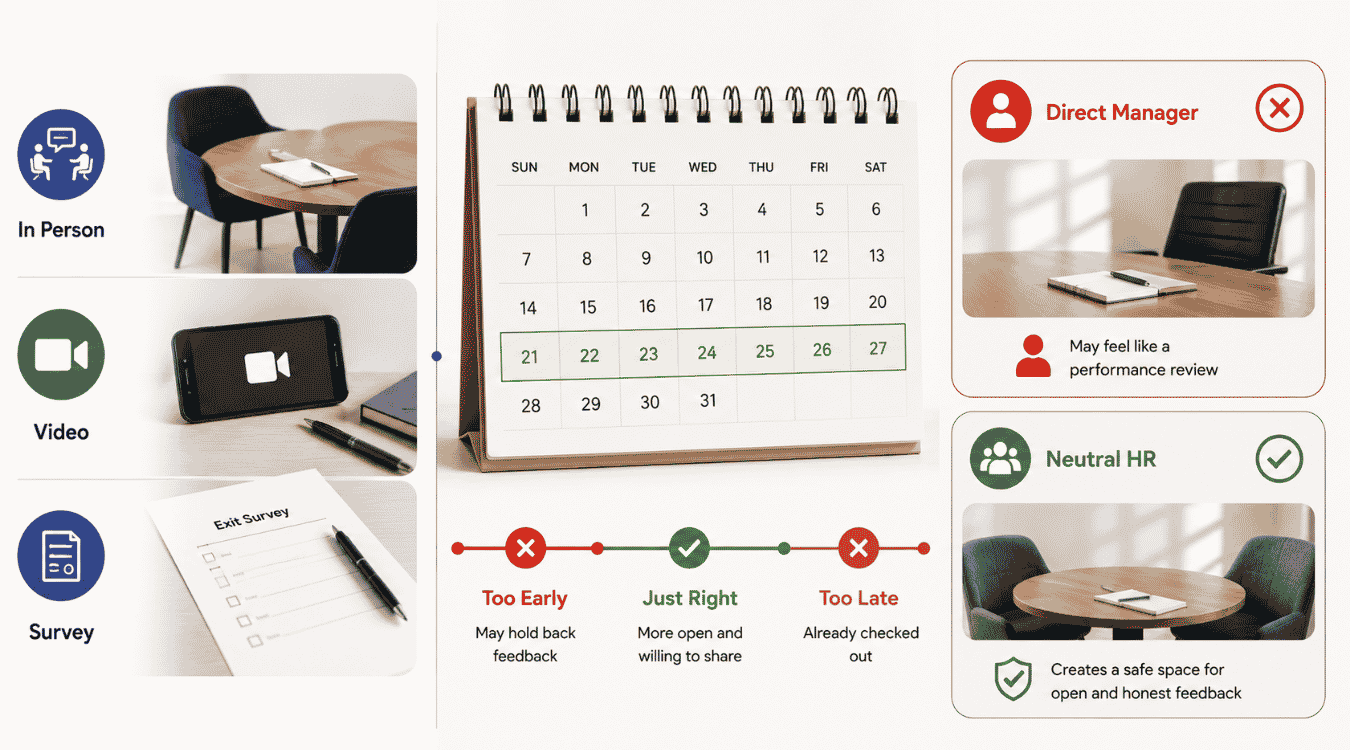
How you conduct an exit interview decides whether you get honest feedback or a polite goodbye. Format, timing, and who's in the room all shape the quality of the interview questions you ask.
Interview Format Options
Exit interviews work as in-person conversations, video calls, or written exit survey questions. Each format changes how much employees leave in their answers. In-person conversations often surface valuable insights that body language and follow-up questions can catch, since exiting employees relax when the tone feels conversational rather than clinical.
Written formats trade depth for volume.
A short exit survey questions form works well when you need employee exit interview questions answered by every departing employee, not just the ones willing to sit down and talk. A live employee exit interview paired with a written record usually produces the most complete exit interview insights.
Timing Relative To Last Day
Timing changes how much employees leave in their answers too. Ask employee exit interview questions too early and someone still finishing handoffs may hold back; wait until their last day and they may already be mentally gone.
The sweet spot sits in their final week.
By then, most employees leave with less to lose and more willingness to share honest feedback about job satisfaction, workload, and management. That same feedback is what improves effective exit interviews going forward for current employees still on the team.
Who Should Conduct It
Sample exit interview questions only get honest answers if the right person asks them. A direct manager sitting across the table can make an employee exit interview feel like a performance review, not a safe space for real employee satisfaction.
Neutral parties get better answers.
HR representatives or a second-line manager tend to gather more valuable insights, since they sit one step removed from the daily relationship. That distance protects the exit interview feedback loop and makes exiting employees more willing to talk openly about what pushed them out the door.
Core Exit Interview Questions By Category
Exit interviews matter most when the questions follow a plan instead of firing off at random. An exit interview template built around clear categories helps you spot patterns across exit surveys instead of one-off complaints, and asking the right exit interview questions here is what turns a single departing employee's response into something you can act on. Below are the best exit interview questions, grouped into six categories that cover almost everything worth asking.
Role And Responsibilities Questions
Conducting exit interviews around the role itself surfaces gaps in training, workload, and expectations that a manager rarely sees from the outside. These questions work well early in the conversation, since they're the easiest for a departing employee to answer without feeling defensive. Use them to build a clearer picture of what the job actually looked like day-to-day, versus what it was supposed to look like on paper.
- Were your job responsibilities clear when you started?
- Did you have the tools and resources you needed to do your job well?
- Did your daily workload match what you expected during hiring?
- Did you receive enough training to succeed in this role?
- What part of the job did you find most rewarding?
- What part of the job did you find most frustrating?
Manager And Team Questions
A direct manager shapes more of the daily experience than almost anything else, so exit surveys built around this category tend to reveal employee relations issues that never make it into a performance review. Departing employees are often more candid about management once they know there's nothing left to lose. Pay close attention here, since patterns across multiple exit interviews about the same manager are worth flagging fast.
- Did you feel supported by your direct manager?
- Did you receive regular, constructive feedback from your manager?
- How would you describe communication within your team?
- Did you feel comfortable raising concerns with your manager?
- Was recognition for your work handled fairly?
- What could your manager have done differently?
Compensation And Benefits Questions
Pay and benefits are sensitive territory, so framing these questions carefully tends to encourage honest, candid feedback instead of a guarded answer. A departing employee has less incentive to soften their response here than a current employee would during a normal review cycle. That makes this category one of the more reliable signals for identifying trends across an entire team or department.
- Did you feel fairly compensated for your role?
- Were the benefits offered competitive with other opportunities you considered?
- Did pay transparency at the company meet your expectations?
- Was there a specific compensation gap that influenced your decision to leave?
- What benefit, if any, was missing that would have changed your decision?
Culture And Work Environment Questions
An employee's experience of workplace culture rarely shows up in engagement surveys the way it does in an exit interview, once someone has nothing left to lose by being honest about the work environment. This category tends to produce some of the most quotable, specific feedback in the entire conversation. It's also where mismatches between stated company culture and lived experience tend to surface first.
- How would you describe the company culture during your time here?
- Did the workplace environment support your day-to-day productivity?
- Did you feel included and respected by your colleagues?
- Were company values reflected in how people actually behaved?
- Did you experience or witness anything that conflicted with stated workplace culture?
- What would you change about the work environment if you could?
Career Growth Questions
Conducting effective exit interviews means asking about the future someone wanted and didn't get, since a lack of growth is one of the most common reasons people leave. These questions help separate people who left for more money from people who left because the path forward simply wasn't there. Both reasons matter, but they call for very different fixes.
- Did you have access to clear paths for career advancement?
- Were your career goals discussed during regular check-ins?
- Did you receive opportunities to develop new skills?
- Was there a mentor or leader who supported your growth?
- Did a lack of advancement opportunities influence your decision to leave?
- What growth opportunity elsewhere ultimately won you over?
Would-Recommend And Referral Questions
How someone answers this category says the most about your employer brand, since it asks them to speak on your behalf even after they've already decided to go. A willingness to recommend the company, despite leaving it, is one of the strongest signals you can get from an exit interview. Use these questions last, once the conversation has built enough trust for an honest answer.
- Would you recommend this company to a friend looking for a job?
- Would you consider working here again in the future?
- What would you tell a candidate deciding whether to accept an offer here?
- Is there anything the company could have done to identify trends before they became a reason to leave?
- What's one thing you'd want leadership to know before you go?
- Would you speak positively about this company to your professional network?
Exit Interview Questions For Small Teams Without HR
Small companies rarely have a dedicated HR person to run an exit interview, which means the interview questions to ask often fall to whoever's left standing, usually a founder or the departing employee's direct manager. That doesn't have to be a disadvantage. A manager close to the daily work can gain candid feedback that a stranger from HR might never get, provided the conversation is handled with care.
Manager-Led Interview Question Set
Running the best exit interview without an HR department means picking questions that work well coming from someone the departing employee already knows. These questions lean practical, since a manager is better positioned to act on specific, honest insights than to unpack abstract culture feedback. Keep the tone conversational rather than formal, and the answers tend to get more useful fast.
- What made you start looking for a new role?
- Did our management practices support you in doing your best work?
- Did you feel your day-to-day tasks matched what we discussed when you were hired?
- Was there a specific moment that made you consider leaving?
- Did you feel comfortable coming to me with problems?
- What would have made this a more positive work environment for you?
- Did you feel our company's values align with how the team actually operates?
- Is there anything I could have done differently as your manager?
- What's one change that would boost employee morale on this team?
- Would you be open to sharing feedback again in a few months, once some distance has passed?
Keeping Responses Confidential In A Small Company
A small team makes confidentiality harder, since a candid comment about scheduling or a coworker can be traced back to one obvious source in minutes. Protecting that exit interview experience matters just as much as asking the right questions in the first place. Continuous improvement only works if people trust that honesty won't come back to bite them.
- Would you prefer to answer these questions in writing instead of out loud?
- Are you comfortable with your feedback being shared in general terms, without your name attached?
- Is there anything you'd rather discuss only with a founder or owner directly?
- Would you be more open to discussing sensitive topics over a call instead of in person?
- Is there any part of your answer you'd want kept out of a written summary?
- Would you be willing to revisit this conversation if we follow up with clarifying questions later?
Exit Interview Questions To Avoid
Not every question earns a place in an exit interview. Exit interviews offer a rare window into honest feedback, but the wrong question can shut that window fast, turning what should provide valuable insights into a defensive, guarded exchange. Skip these two categories entirely if you want the conversation to feel like more than just a formality.
Leading Or Loaded Questions
A leading question already contains the answer you want, which defeats the purpose of asking in the first place. These questions rarely produce meaningful insights, since a departing employee can sense when they're being steered toward a specific response. Cut anything that assumes fault, blame, or a predetermined conclusion before the person has even answered.
- Don't you think management could have handled things better?
- Wasn't the workload obviously too much for one person?
- You must have felt pretty unsupported here, right?
- Wouldn't you agree the team culture needs a complete overhaul?
- Didn't you feel your job expectations were unfair from the start?
Legal Risk Questions
Some questions expose the company to risk rather than employee growth, especially anything that edges into protected categories or invites a comment you can't legally act on the way it's framed. A satisfied workforce isn't built on questions that could later look like fishing for a lawsuit. When in doubt, run any question that touches age, health, family status, or discrimination past legal counsel before it ever reaches a departing employee.
- Do you think your age had anything to do with how you were treated here?
- Did your pregnancy or family situation affect how management viewed you?
- Was there any discrimination based on your religion or background?
- Do you believe your disability was ever held against you?
- Did your relationship status outside of work ever come up in performance conversations?
How To Turn Exit Interview Answers Into Action
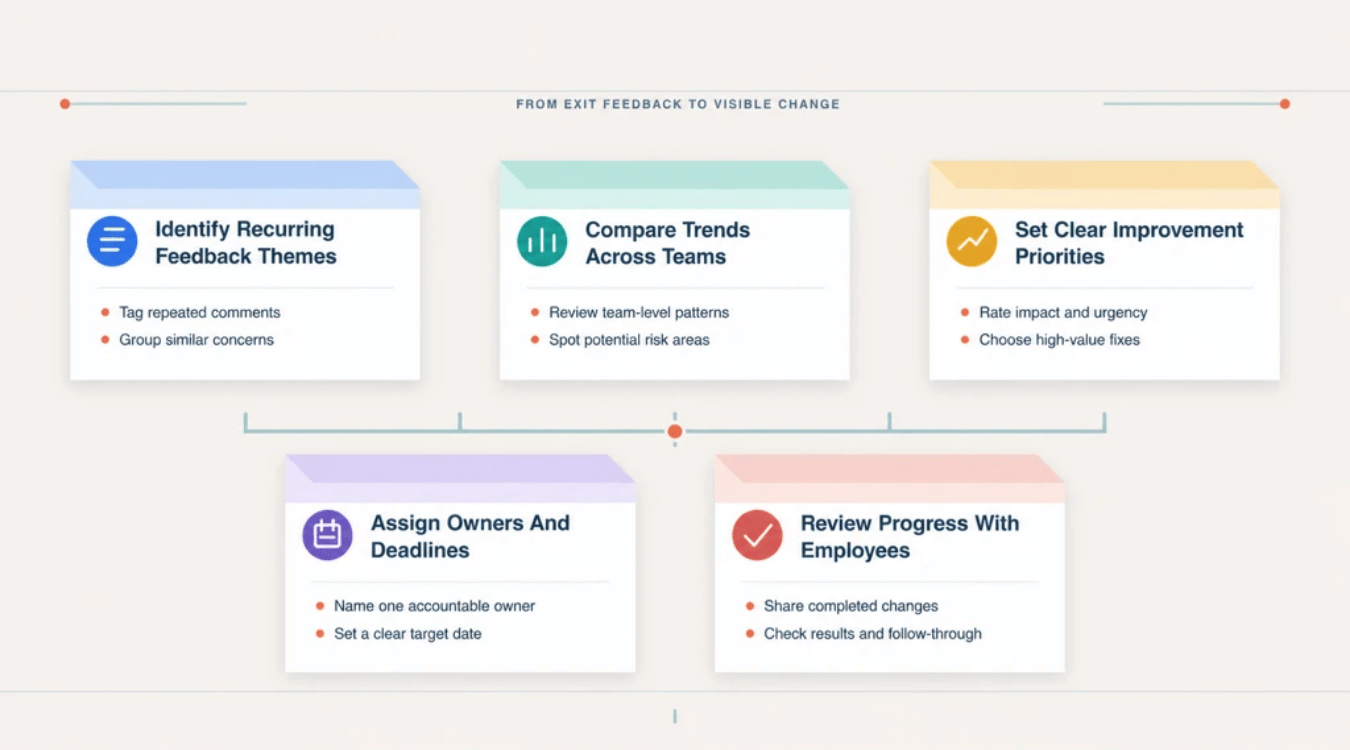
Honest answers are worthless if they sit in a folder nobody opens again. Gathering feedback from every employee exit only pays off when it becomes a strategic tool for retention strategies, not a formality tied to someone's departure. The five steps below turn a structured conversation into real change.
Identify Recurring Feedback Themes
A single comment about a manager might be one bad week. The same comment from five departing employees across six months is a pattern worth acting on. Reviewing exit interview answers as a set, not one at a time, is what separates a strategic tool from a stack of forms nobody revisits.
Look for repetition first.
Group answers by theme, not by which employee's departure triggered them, and the real signal usually shows up within the first ten or so interviews.
Compare Trends Across Teams
The same question can surface very different answers depending on which team or manager an employee reported to. Comparing responses across teams helps separate a company-wide culture problem from an isolated leadership effectiveness issue tied to one manager, especially when paired with data from employee performance tracking software.
This step matters most in growing companies, where one team's experience can look nothing like another's despite sharing the same job description on paper.
Set Clear Improvement Priorities
Not every theme deserves equal attention right away. Some findings point to quick fixes in leadership practices, while others point to something bigger, like a job description that no longer matches the actual role. Rank findings by how many people they affect and how easily they can be fixed.
Prioritize what's fixable first.
A soon-to-be-released engagement survey or performance cycle is a natural moment to check whether last quarter's priorities actually moved anything.
Assign Owners And Deadlines
A theme without an owner rarely turns into action. Assign each improvement priority to a specific person, whether that's a department head, a founder, or someone in HR, along with a realistic deadline for a first update.
Vague ownership kills follow-through faster than a bad idea does.
Naming a deadline, even a loose one, keeps example questions like "did you feel supported by your manager" from turning into the same unanswered question next year.
Review Progress With Employees
Closing the loop with current employees, not just the ones who already left, is what makes this whole process feel like more than data collection. Sharing what changed because of past feedback signals that gathering feedback actually leads somewhere.
That kind of follow-through is what most improves leadership effectiveness over time, since employees stay engaged with a process they can see working, rather than one that only ever asks and never answers back.
Exit Interviews And Your Offboarding Checklist
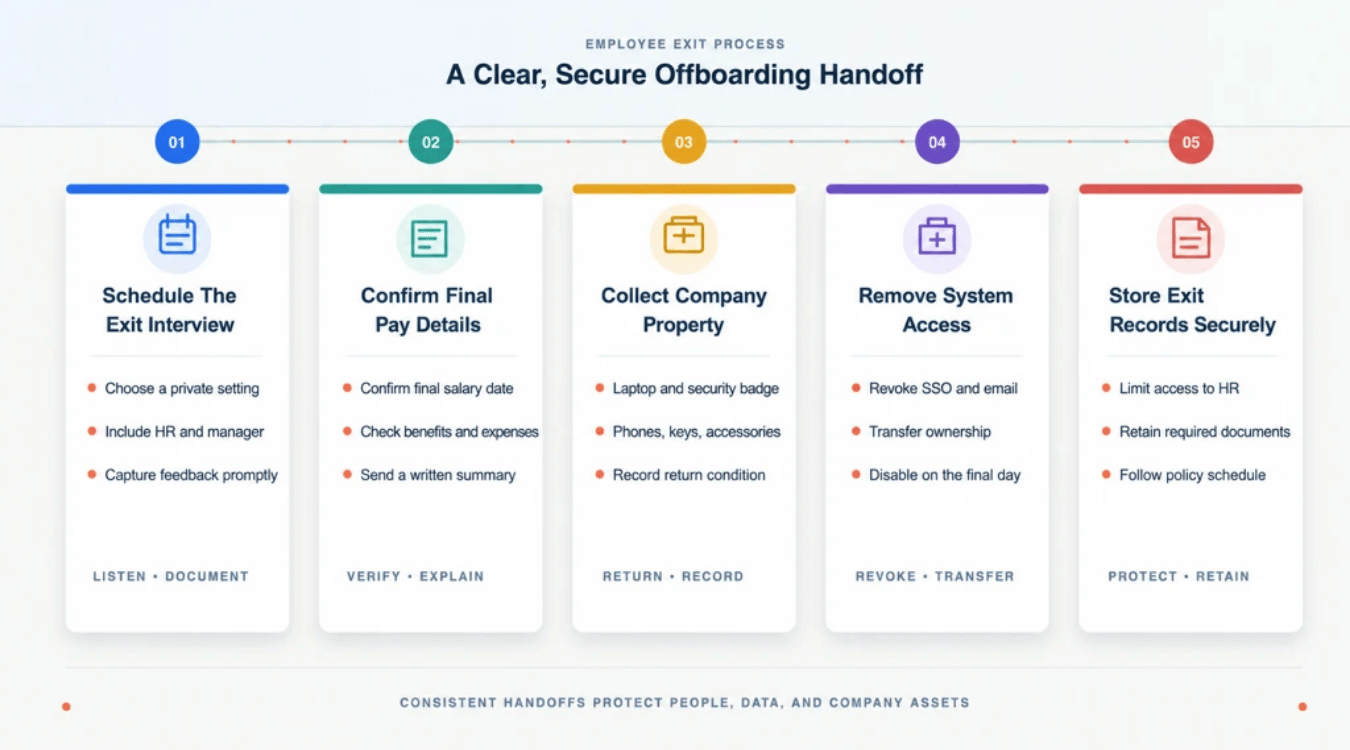
An exit interview is one piece of a much longer offboarding process, not a standalone event. HR professionals who treat it as the finish line often miss actionable insights that only surface once it's folded into the rest of the checklist. Handled well, it can shed light on future turnover before the next resignation letter lands on someone's desk.
Schedule The Exit Interview
Timing the exit interview against the rest of offboarding avoids a rushed, tacked-on conversation. Most companies place it during the employee's final week, once notice has been given but before the last day arrives.
Book it early, not last.
Scheduling it too close to the final day risks losing the conversation entirely if the employee is already checked out or pulled into handoff tasks.
Confirm Final Pay Details
Final pay questions come up constantly during exit conversations, so confirming the details before the interview avoids an awkward, half-answered moment. This step overlaps with payroll more than any other part of the offboarding checklist, and getting it wrong creates real risk for the management team.
Have the numbers ready beforehand.
An employee who trusts their final paycheck is accurate is more likely to give honest, unguarded answers about everything else.
Collect Company Property
Laptops, badges, keys, and any other company property should come back before or during the exit interview window, not weeks after. Building this into the same checklist step as the interview keeps offboarding from dragging out. It also gives senior leaders a clean cutoff point for accountability.
Remove System Access
Access removal is a security step, not an HR afterthought, and it belongs on the same day-of checklist as the exit interview itself. Delaying it past the employee's last day creates a window where former credentials still work, which is a risk no offboarding process should carry longer than necessary.
Store Exit Records Securely
Exit interview notes, final thoughts shared by the departing employee, and any related documents need a secure, consistent home, ideally managed within employee file management software instead of scattered folders. Scattered records make it nearly impossible to identify areas for improvement later, since nobody can pull last year's feedback to compare against this year's.
Keep everything in one place.
A well-organized record also protects positive aspects of the process too, since it lets HR professionals point to real examples when a management team asks whether exit interviews are actually worth the time.
Free Exit Interview Question Template
Copy this template into your next exit interview, or adapt it for a written exit survey.
Exit Interview Template
Employee name: Role and department: Manager: Last day of employment: Interviewer:
Section 1: Reason For Leaving
- What made you decide to leave?
- Was there a specific moment that influenced your decision?
Section 2: Role And Manager
3. Did your day-to-day work match your job description?
4. Did you feel supported by your direct manager?
Section 3: Culture And Environment
5. How would you describe the work environment here?
6. Did company values match how the team actually behaved?
Section 4: Compensation And Growth
7. Did you feel fairly compensated for your role?
8. Did you have a clear path for career growth?
Section 5: Closing Questions
9. Would you recommend this company to others?
10. Is there anything leadership should know before you go?
Notes and follow-up items:
Fill this out once, save the format, and reuse it for every departure.
That consistency is what turns individual answers into a trend you can actually track.
Final Thoughts
Exit interview questions only matter if someone reads the answers and does something with them. A single response is an anecdote. Fifty responses across a year, sorted by category, become a strategy for keeping the employees who are still here.
Start small if you have to. A five-question form asked consistently beats a twenty-question interview that only happens when someone remembers to schedule it. Build the habit first, then layer in structure like the categories and template above.
The goal was never a perfect goodbye conversation. It was catching the same problem before a second, third, and fourth person walks out the door for the same reason the first one did.