People Analytics: How To Turn Workforce Data Into Better Decisions
Table of Contents
People decisions can shape everything from employee retention to business growth. Yet many HR teams still rely on assumptions when deciding who to hire, why employees leave, or where performance problems begin. People analytics replaces those guesses with workforce data and actionable insights.
People analytics brings together employee data from HR systems, payroll, performance management, employee surveys, and other data sources. HR leaders can use that information to identify patterns, understand employee engagement, and make more informed decisions about their workforce.
But collecting more data is not the goal. The real value comes from asking the right questions and turning relevant data into action. This guide explains how people analytics works, what to measure, and how to use it responsibly for better business outcomes.

What Is People Analytics?
People analytics is the practice of collecting and analyzing employee data to make better workforce decisions. It combines HR data with business data to identify patterns in areas such as hiring, employee performance, engagement, retention, and workforce costs. The goal is simple: turn people data into actionable insights that support better business outcomes.
Unlike basic HR reporting, people analytics looks beyond what happened. HR professionals can use data analysis to understand why a workforce trend occurred and what action may help. More advanced approaches can also use predictive analytics to forecast future outcomes.
Relevant data can come from HR systems, employee surveys, performance data, payroll records, and other business systems. Together, these data sources give HR leaders a clearer view of workforce challenges and opportunities.
People Analytics Vs HR Analytics Vs HR Reporting
People analytics, HR analytics, and HR reporting all use workforce data, but they serve different purposes. HR reporting shows what has happened. HR analytics examines HR processes and outcomes. People analytics goes further by connecting employee data with business data to understand patterns, guide decisions, and improve business outcomes.
Area | HR Reporting | HR Analytics | People Analytics |
|---|---|---|---|
Main Purpose | Track HR activity | Analyze HR performance | Improve workforce and business decisions |
Key Question | What happened? | Why did it happen in HR? | What does it mean, and what should we do? |
Typical Data | Headcount, attendance, payroll | Hiring, turnover, performance metrics | HR data, employee data, business data |
Analysis Depth | Descriptive | Descriptive and diagnostic | Descriptive, diagnostic, predictive, and prescriptive |
Example | Turnover reached 12% | Turnover rose in one department | Identify turnover drivers and decide how to improve employee retention |
The three approaches can work together. HR reporting creates a reliable view of historical and current data. HR analytics helps HR professionals investigate workforce challenges. People analytics combines relevant data from HR systems and other business systems to gain insights that support business strategy.
For example, a turnover report may show that more employees are leaving. People analytics can segment the data by role, tenure, manager, compensation, or employee engagement to identify patterns. Business leaders can then use those actionable insights to address retention issues instead of relying on assumptions.
What Data Does People Analytics Use?
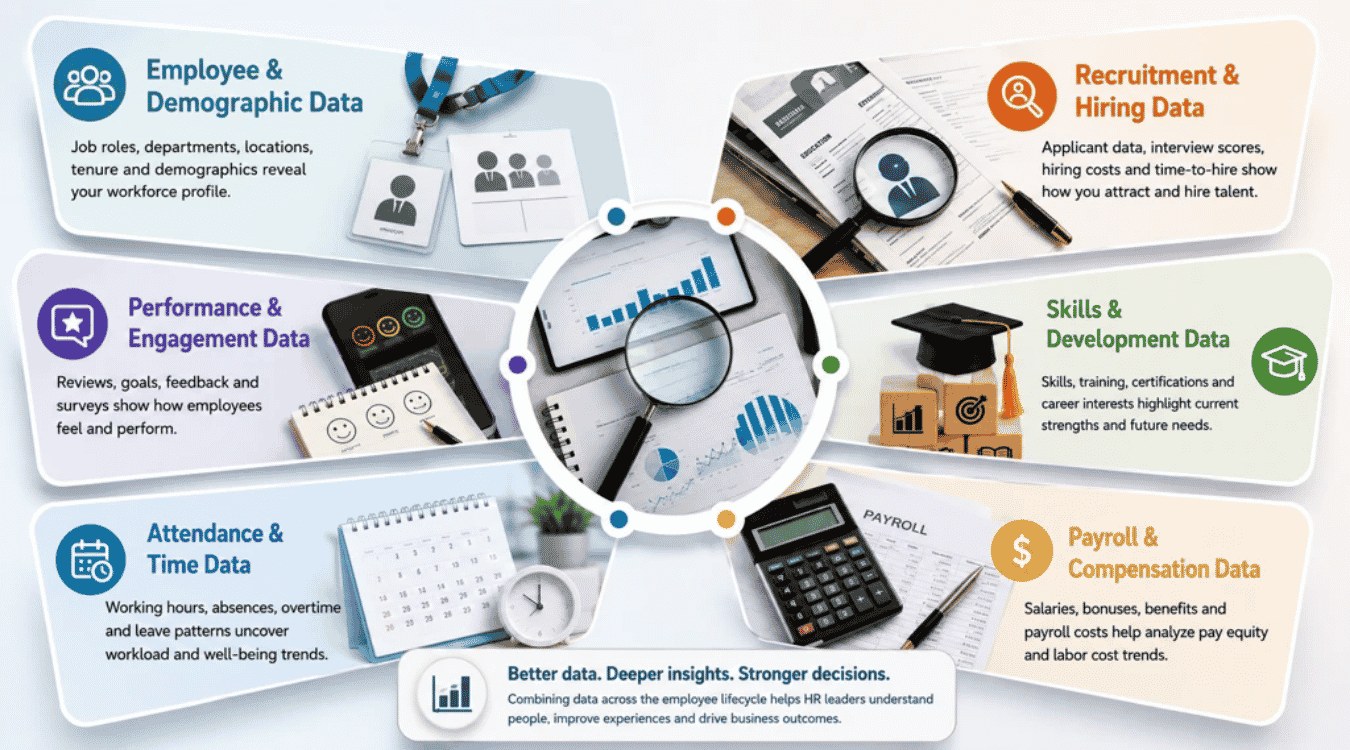
People analytics uses data from across the employee lifecycle, not just one HR system. Combining workforce data from recruitment, performance, payroll, attendance, and employee feedback gives HR leaders a more complete view of their people and helps uncover patterns that isolated data sources can miss.
Employee And Demographic Data
Employee data provides the foundation for many people analytics insights. A centralized employee database or human resources information system may hold job titles, departments, locations, employment status, tenure, manager relationships, and employee demographics.
HR professionals can segment this demographic data to understand workforce composition and identify meaningful trends. For example, teams can compare employee retention across departments, locations, roles, or tenure groups. Demographic analysis can also support diversity, equity, and inclusion efforts by measuring representation across the organization. Strong data quality matters here because incomplete or inconsistent employee records can produce misleading results.
Recruitment And Hiring Data
Recruitment data shows how effectively an organization attracts and hires talent. Common data sources include applicant tracking systems, candidate records, interview scores, hiring costs, offer acceptance rates, and time-to-hire data.
Talent analytics and employee performance review software can connect hiring information with later performance and retention data. That helps HR leaders look beyond how quickly a position was filled and assess whether a hiring decision produced a strong long-term outcome. A data-driven approach can also reveal which recruitment channels produce better hires, where candidates leave the process, and where hiring costs are unnecessarily high. Those insights can support smarter hiring practices and workforce planning.
Performance And Engagement Data
Performance data can come from performance reviews, goal tracking, manager feedback, productivity metrics, and performance management systems. Employee engagement data often comes from employee surveys, pulse surveys, and other forms of employee feedback.
Together, the data can show how employees feel about work and how performance changes across teams or over time. Engagement and sentiment pulse surveys, for example, can provide useful signals about employee morale. People analytics can then help identify patterns between employee engagement, performance, management practices, and employee turnover. The goal is not to reduce employees to scores, but to give HR leaders better evidence for improving the employee experience.
Skills And Development Data
Skills data helps organizations understand what employees can do today and what capabilities they may need next. Relevant data can include employee skills, certifications, training history, course completion, assessment results, career interests, and development plans.
Talent management teams can analyze data to identify skills gaps across roles, departments, or the entire organization. The findings can guide talent development, internal mobility, succession planning, and future hiring decisions. Historical and current data can also show whether learning programs lead to stronger employee performance or career progression. Reliable skills data becomes especially valuable when business strategy requires new capabilities or workforce needs begin to change.
Attendance And Time Data
Attendance and time data, including employee time log reports, can reveal workforce challenges that performance reviews alone may not show. Common data includes working hours, absences, overtime, leave, paid time off, schedules, and attendance patterns.
People analytics can help HR professionals identify unusual trends across teams, locations, or employee groups. A sustained rise in overtime, for example, may point to workload pressure, staffing shortages, or scheduling problems. Repeated absence patterns may require a different investigation. Context remains important because attendance data alone cannot explain why a pattern exists. HR leaders should combine it with other relevant data before drawing conclusions about employees or making workforce decisions.
Payroll And Compensation Data
Employee payroll records and compensation data provide valuable business data for people analytics. Relevant information may include salaries, bonuses, overtime pay, payroll costs, compensation changes, benefits, and other employer labor costs.
Data analysis can connect compensation with employee retention, performance, tenure, role, or department. Organizations can use those insights to understand labor cost trends and identify potential pay disparities. Compensation data can also support pay equity analysis and broader diversity, equity, and inclusion goals. When payroll data is integrated with other HR data and business systems, business leaders gain a clearer view of how workforce decisions affect both employees and financial outcomes.
Data Type | Common Data Sources | What It Can Reveal |
|---|---|---|
Employee And Demographic | HRIS, employee records | Workforce composition and retention patterns |
Recruitment And Hiring | ATS, interview records | Hiring quality, cost, and efficiency |
Performance And Engagement | Reviews, goals, employee surveys | Performance and engagement trends |
Skills And Development | LMS, assessments, talent systems | Skills gaps and development needs |
Attendance And Time | Time tracking, leave records | Absence, overtime, and workload patterns |
Payroll And Compensation | Payroll and compensation systems | Labor costs, pay trends, and equity signals |
4 Types Of People Analytics
People analytics is commonly grouped into four types based on the questions the data needs to answer: descriptive, diagnostic, predictive, and prescriptive analytics. Together, they move HR teams from understanding historical data to deciding what action to take. Consider employee turnover as one example throughout the four stages.
Descriptive Analytics
Descriptive analytics answers a basic question: What happened? It summarizes historical and current data to give HR professionals a clear picture of past workforce activity.
For employee turnover, descriptive analytics may show the turnover rate for the past year and how it changed by month, department, location, or role. HR data from a human resources information system, payroll records, and other data sources can support the analysis. Common measures include headcount, employee retention, absenteeism, hiring rates, and performance metrics. Descriptive analytics identifies trends, but it does not explain why those trends occurred.
Diagnostic Analytics
Diagnostic analytics asks: Why did it happen? Once a workforce trend is visible, HR leaders can analyze relevant data to find factors that may have contributed to it.
Suppose descriptive analytics shows unusually high employee turnover in one department. Diagnostic analytics could compare turnover with compensation, tenure, employee engagement, manager changes, workload, performance data, and employee feedback. Segmentation can reveal patterns that company-wide averages hide. The analysis may suggest possible causes, but correlation does not automatically prove causation. HR professionals still need context before deciding why employees left or what action to take.
Predictive Analytics
Predictive analytics asks: What is likely to happen next? It uses historical data, statistical models, and sometimes machine learning to estimate future workforce outcomes.
For turnover, predictive analytics can examine patterns associated with previous departures and identify groups with a higher likelihood of leaving. Organizations can also use predictive analytics to forecast staffing needs, recruitment demand, absenteeism, or future skills gaps. Predictions are probabilities rather than guarantees. Data quality, model design, and changing workplace conditions can affect their accuracy. HR leaders should use predictive insights as decision support, not as automatic judgments about individual employees.
Prescriptive Analytics
Prescriptive analytics asks: What should we do next? It combines data analysis with possible actions to help business leaders decide how to respond to a workforce challenge.
If predictive analytics indicates elevated turnover risk in a specific team, prescriptive analytics may help compare potential responses. Options could include reviewing compensation, adjusting workloads, improving management support, or creating development opportunities. The recommended action should still consider business strategy, employee experience, cost, and human judgment. Prescriptive analytics completes the process by turning people analytics insights into practical decisions that can be tested and measured.
Type | Key Question | Turnover Example | Output |
|---|---|---|---|
Descriptive | What happened? | Turnover increased | Historical trend |
Diagnostic | Why did it happen? | Identify factors linked to departures | Possible causes |
Predictive | What may happen next? | Estimate future turnover risk | Forecast |
Prescriptive | What should we do? | Compare retention actions | Recommended response |
How Is People Analytics Used In The Workplace?
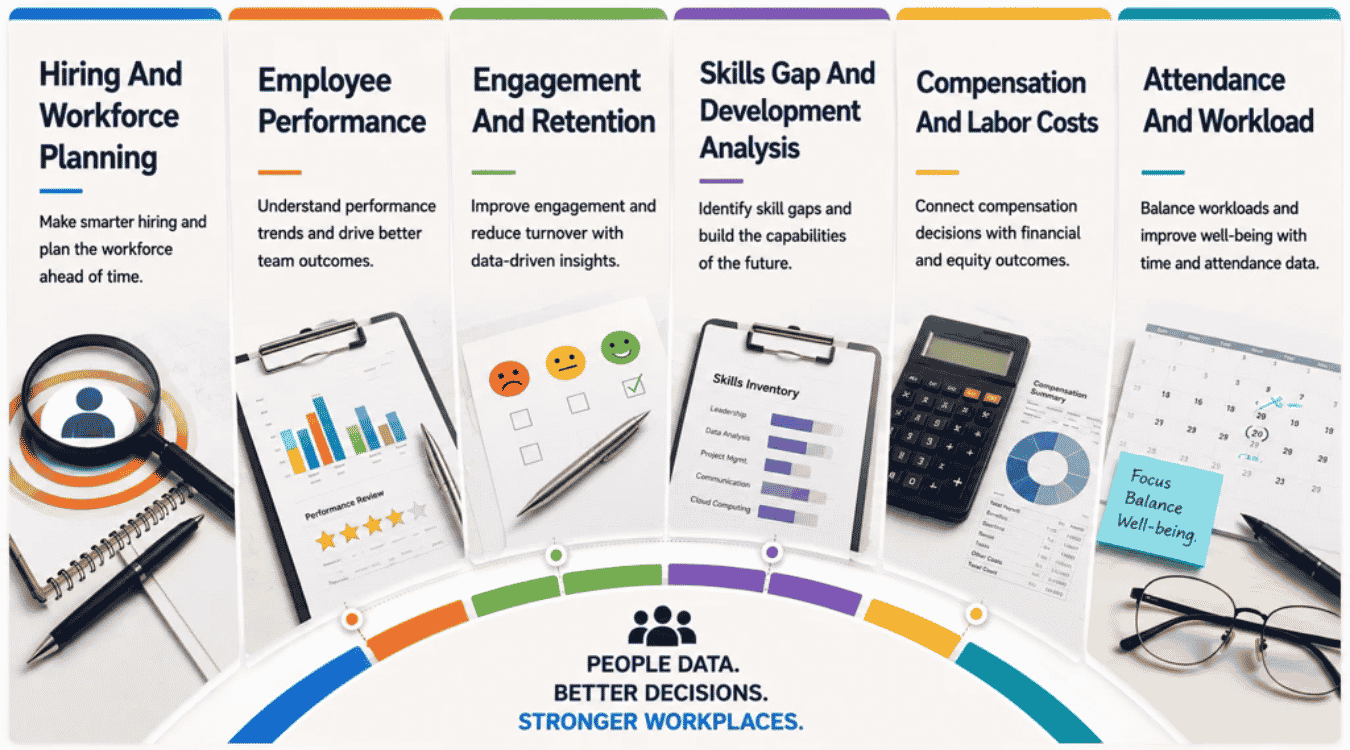
People analytics can help organizations solve practical workforce challenges across the employee lifecycle. HR leaders can use workforce data to improve hiring, performance, retention, development, compensation, and workload decisions. The value comes from connecting relevant data to a clear business question and turning the findings into action.
Hiring And Workforce Planning
People analytics helps HR professionals understand where talent comes from, how well new hires perform, and what skills the organization may need next. Recruitment data can reveal which hiring channels produce stronger employees and where candidates drop out of the process.
Predictive analytics can also use historical data to forecast future staffing needs, often supported by workforce management software that consolidates headcount, scheduling, and attendance information. HR leaders can compare headcount, turnover, hiring demand, and business strategy to plan ahead rather than react to vacancies. Data-driven insights can support better hiring quality while helping control recruitment costs.
Key metrics: Time to hire, cost per hire, quality of hire, headcount growth.
Employee Performance
People analytics helps organizations understand employee performance trends instead of relying only on individual reviews or manager opinions. Performance data can be analyzed across teams, roles, locations, and time periods to identify patterns.
HR leaders may combine performance metrics with training, tenure, engagement, or workload data, including insights from a mobile HR app for employee self-service, to understand what supports stronger results. The findings can guide performance management, coaching, team design, and organizational development. Data should provide context rather than replace human judgment, especially when individual performance is assessed.
Key metrics: Goal attainment, productivity metrics, performance ratings, high-performer retention.
Engagement And Retention
Employee surveys, pulse surveys, feedback, turnover data, and tenure records can help organizations understand the employee experience. Engagement and sentiment surveys are particularly useful for tracking morale and identifying satisfaction factors.
People analytics can also identify patterns associated with employee turnover. HR teams might find that retention differs by manager, department, tenure, workload, or compensation level. Early signals can help teams investigate retention issues before they become larger problems. That matters because replacing employees creates recruitment, onboarding, and productivity costs.
Key metrics: Employee engagement score, voluntary turnover rate, retention rate, average tenure.
Skills Gap And Development Analysis
Talent analytics can show which skills exist across the workforce and where important gaps remain. HR teams can combine skills assessments, training records, performance data, certifications, and career information to build a clearer view of workforce capabilities.
The insights can support talent development, internal mobility, succession planning, and future hiring, as well as better leave management processes that affect employee availability and workload. For example, a company may find that an upcoming business strategy requires skills that few current employees possess. Leaders can then compare training, internal transfers, and external hiring before the gap becomes urgent.
Key metrics: Skills coverage, training completion, internal mobility rate, development progress.
Compensation And Labor Costs
Payroll and compensation data, often managed through payroll software with automation, help connect people decisions with financial analysis. Business leaders can examine salaries, bonuses, overtime, benefits, and other labor costs alongside employee demographics, tenure, performance, and retention.
People analytics can reveal compensation trends and potential disparities that broad payroll totals may hide. The same data can support pay equity and diversity, equity, and inclusion analysis when used carefully. Leaders can also track whether workforce costs are changing because of headcount growth, pay increases, overtime, or another factor.
Key metrics: Cost per employee, payroll growth, overtime cost, compensation distribution.
Attendance And Workload
Attendance, scheduling, leave, and working-time data from smart attendance tracking software can help identify workload problems across teams. A rise in overtime, for example, may signal understaffing, uneven work distribution, seasonal demand, or another operational issue.
HR analytics can compare attendance patterns with employee engagement, turnover, performance, and staffing levels to gain deeper insights. Patterns should always be interpreted in context. Absence or overtime alone does not explain why a workforce problem exists. Used responsibly, the data can help organizations make better staffing and workload decisions.
Key metrics: Absenteeism rate, overtime rate, PTO utilization, working hours.
How To Implement People Analytics
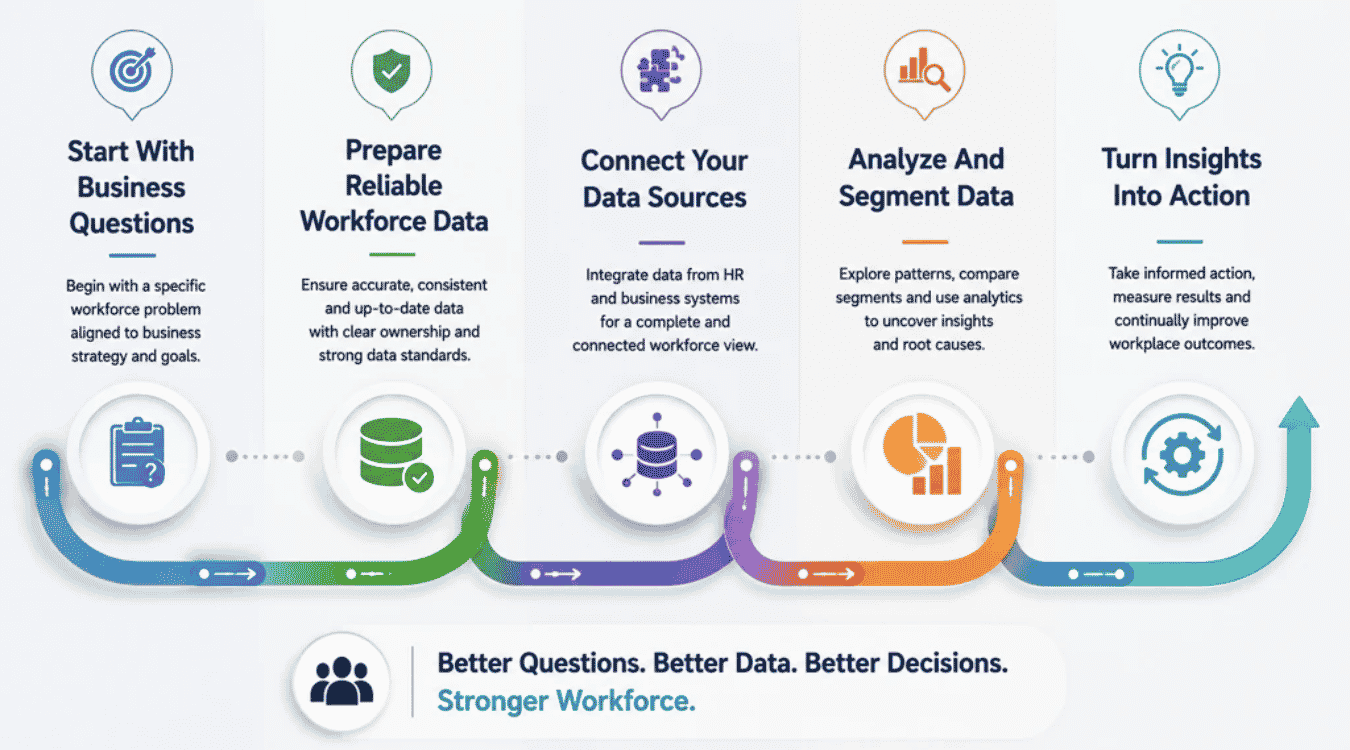
A successful people analytics strategy needs more than software or a large collection of employee data. Start with a business problem, build a reliable data foundation, and connect the right data sources. From there, HR teams can analyze patterns and turn people analytics insights into measurable action.
Start With Business Questions
Start with a specific workforce question instead of collecting data without a clear purpose. HR leaders might ask why employee turnover increased, which hiring channels produce stronger employees, or why overtime costs are rising.
The question determines what relevant data and key metrics you need. For a retention problem, that could include turnover, tenure, compensation, employee engagement, performance, and manager data. Clear questions also connect the analysis to business strategy. A focused approach prevents teams from tracking dozens of metrics that look useful but do not support a real decision.
Prepare Reliable Workforce Data
Reliable analysis depends on reliable workforce data. Before analyzing anything, check HR data for missing values, duplicate employee records, inconsistent job titles, incorrect employment status, outdated compensation details, and other quality problems.
Set clear data management standards so the same fields have consistent meanings across the entire organization. Ownership matters too. Teams should know who maintains each dataset and how often it needs an update. Strong data quality and governance reduce the risk of misleading conclusions. Even advanced analytics or artificial intelligence cannot produce dependable insights when the underlying data is incomplete or inaccurate.
Connect Your Data Sources
Useful people analytics often requires data from several HR and business systems. A human resources information system may contain employee record management, while payroll, recruitment, performance management, attendance, and employee surveys hold other pieces of the workforce picture.
Data integration brings those sources together, helping organizations simplify HR by replacing disconnected tools. A shared employee identifier, for example, can help connect hiring data with later performance or employee retention outcomes. Breaking down data silos also gives HR professionals a more complete view of workforce challenges. Access should still follow clear privacy rules so employees only see information appropriate to their roles.
Analyze And Segment Data
Once the data is ready, analyze it at a level that can reveal meaningful patterns. Company-wide averages can hide major differences between departments, locations, roles, managers, or employee groups.
Segmenting employee data can expose those differences. If overall turnover appears stable, for example, one department may still have a serious retention problem. Compare segments with historical data, internal benchmarks, and relevant business outcomes. Diagnostic analytics can help explore why a pattern exists, while predictive analytics may estimate what could happen next. Keep context in mind because a relationship between two metrics does not automatically prove cause and effect.
Turn Insights Into Action
People analytics creates value only when insights lead to better decisions. Once a pattern is identified, decide what action could address it and how success will be measured.
Suppose data analysis links high turnover in one team with heavy overtime and low employee engagement. HR leaders could review staffing levels, workloads, management practices, or retention measures. After the change, track the same metrics to see whether outcomes improve. That closes the loop between analytics and business results.
Question → Data → Metric → Analysis → Decision → Action → Recheck
A data-driven approach works best when teams repeat this cycle instead of treating people analytics as a one-time reporting exercise.
How To Use People Analytics Responsibly
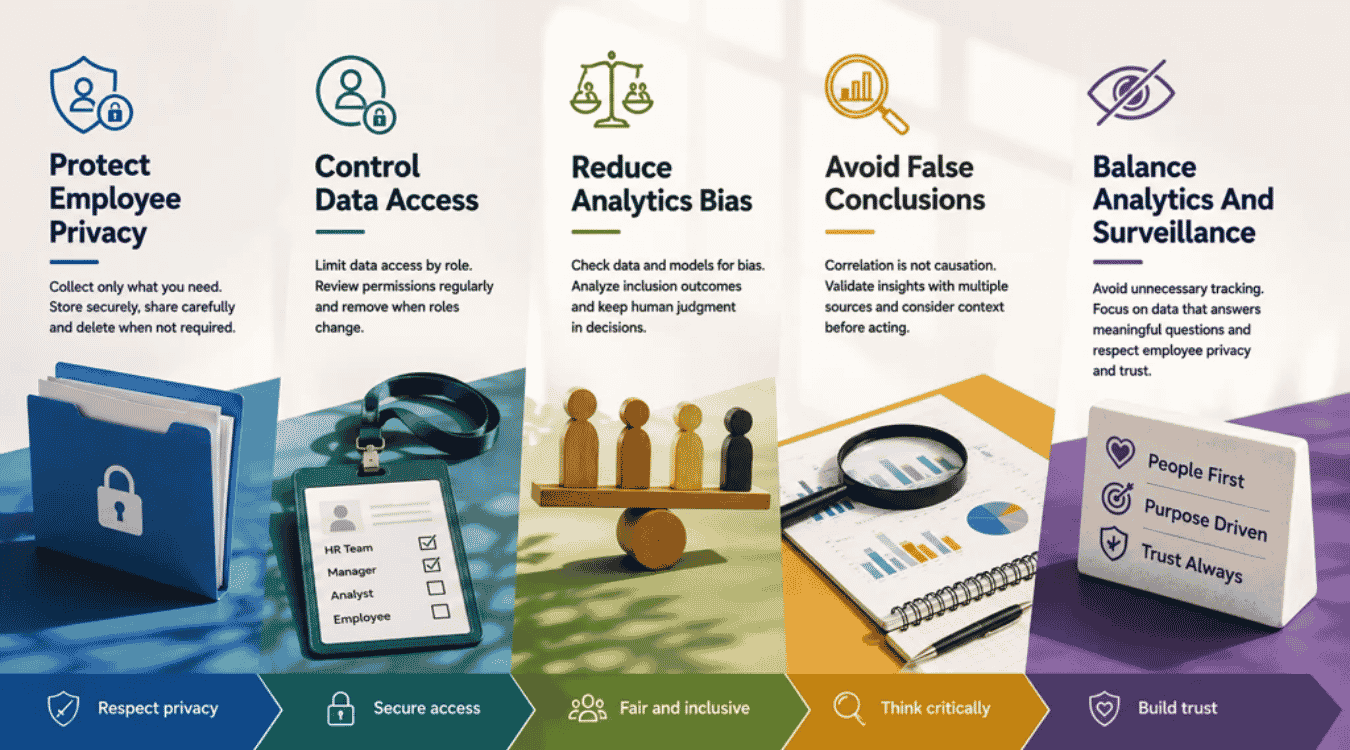
People analytics benefits an organization only when employee data is handled responsibly. Strong data governance should guide data collection, access, analysis, and retention. HR leaders also need clear boundaries around privacy, bias, and monitoring so valuable insights do not come at the expense of employee trust.
Protect Employee Privacy
Employee data can include sensitive details about compensation, performance, demographics, attendance, health benefits, and employee feedback. Collect only relevant data with a clear business purpose, and avoid keeping information simply because it may become useful later.
Privacy safeguards should cover how internal data is collected, stored, shared, and deleted. Aggregation or anonymization can reduce exposure when individual-level information is unnecessary. HR teams should also understand applicable privacy requirements before integrating people analytics across HR systems. Clear policies help employees understand how their information is used and protect trust in the process.
Control Data Access
Not everyone needs access to every workforce dataset. HR professionals, payroll teams, managers, analysts, and business leaders often require different levels of information.
Role-based data access can limit employees to the information needed for their responsibilities. A manager may need team-level retention trends, for example, without seeing individual compensation records or sensitive demographic data. Organizations should document permissions, review them regularly, and remove access when responsibilities change. People analytics software should also support appropriate security and access controls. Strong access management reduces privacy risks while still allowing teams to gain insights from relevant workforce data.
Reduce Analytics Bias
People analytics can reproduce existing workplace bias when the underlying data or analytical method is flawed. Historical hiring or promotion data, for example, may reflect decisions that were not equally fair to every employee group.
Teams should review datasets, assumptions, metrics, and models for potential bias before using results for human resource management decisions. Diversity, equity, and inclusion analysis can also help identify disparities in hiring, compensation, promotion, or retention. Artificial intelligence and machine learning models require particular care because complex outputs can appear objective even when biased historical data influences them. Human review should remain part of important workforce decisions.
Avoid False Conclusions
A visible relationship between two workforce metrics does not prove that one caused the other. Suppose employees who work more overtime also show higher employee turnover. Overtime may contribute, but poor management, staffing shortages, compensation, or company culture could influence both.
HR teams should compare multiple data sources, analyze appropriate employee groups, and consider context before reaching a conclusion. Analyzing historical data can reveal useful patterns, but past relationships may not continue under new conditions. Good data literacy helps HR leaders question results instead of accepting every dashboard or data analytics output at face value.
Balance Analytics And Surveillance
People analytics should help organizations understand workforce patterns, not create unnecessary surveillance. Tracking every message, click, location, or minute of employee activity can damage trust and may provide little meaningful insight into employee performance.
Set clear limits on what a people analytics platform or other business systems collect. Focus on data that connects to a legitimate workforce question and organizational effectiveness. Employees should know what information is monitored and why when appropriate. A responsible people analytics strategy balances business needs with employee privacy, context, and human judgment.
Do | Don’t |
|---|---|
Collect data for a defined purpose | Collect employee data without a clear need |
Limit access by role | Give broad access to sensitive data |
Check data and models for bias | Assume analytics is automatically objective |
Consider context and other factors | Treat correlation as proof of causation |
Measure meaningful workforce outcomes | Turn people analytics into constant surveillance |
How To Measure People Analytics Success
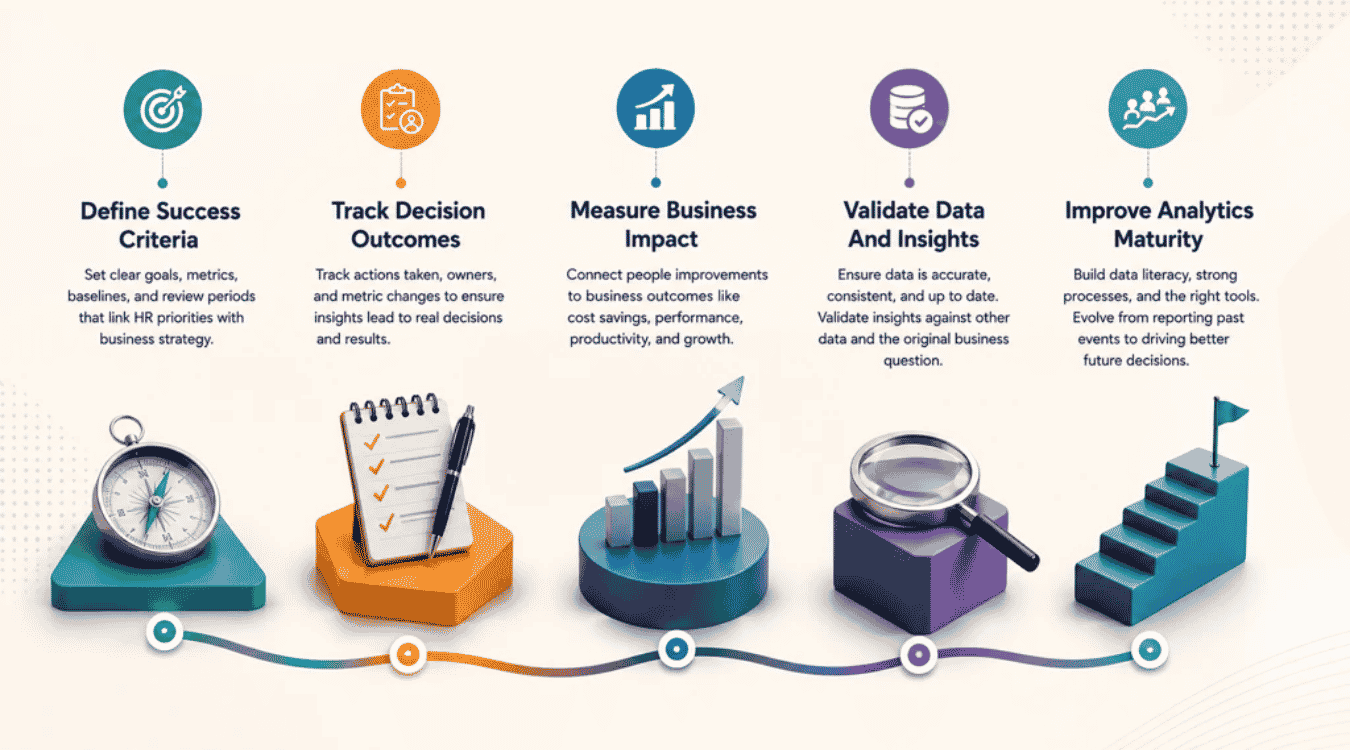
People analytics success should be measured by what changes, not by how many dashboards or reports a team creates. A strong program connects people analytics insights to workforce decisions, employee experience, organizational effectiveness, and business outcomes. Clear goals also make it easier to see where the strategy needs improvement.
Define Success Criteria
Start by defining what success means for the workforce challenge you want to solve. A retention project might aim to reduce voluntary turnover, while a hiring initiative could focus on improving quality of hire or lowering recruitment costs.
Choose a baseline, target, key metrics, and review period before taking action. The criteria should connect HR priorities with business strategy rather than measure analytics activity alone. A clear vision also helps HR leaders decide which employee data matters. One industry benchmark found that 84% of people analytics teams had a clear vision and mission, highlighting the importance of direction before deeper analysis.
Track Decision Outcomes
A valuable insight matters only if it leads to a decision and that decision produces a measurable result. Track what action was taken, who was responsible, and whether the target metric changed afterward.
For example, data analytics may reveal high employee turnover among new hires. HR leaders could change onboarding or manager support and then compare retention before and after the intervention. Tracking the result closes the gap between analysis and action. That gap can be significant: one industry finding reported that only 32% of organizations effectively make changes based on analytics insights.
Measure Business Impact
People analytics should eventually connect workforce improvements to broader business outcomes. Depending on the goal, that could mean lower turnover costs, stronger employee performance, better hiring quality, improved productivity, or more effective workforce planning, including for organizations managing a remote workforce with HRM software.
Look beyond HR metrics when possible. Business data such as labor costs, revenue, customer outcomes, or operational performance can provide additional context, particularly when organizations understand how payroll works for growing teams. Organizations may also see better collaboration across business units when teams work from shared workforce insights. Research has reported that 57% of HR professionals believe people analytics improves business outcomes, reinforcing the value of connecting HR decisions with measurable organizational results.
Validate Data And Insights
Reliable decisions require reliable inputs. Review data quality regularly and check whether data sources remain complete, accurate, consistent, and current. Changes to HR systems, payroll processes, job structures, or data collection methods can affect results over time.
Validation should also test whether people analytics insights still answer the original business question. Compare findings with other relevant data and question unexpected results before acting on them. A people analytics solution cannot compensate for poor underlying information, just as effective payroll processing for growing businesses depends on accurate and consistent payroll inputs. Regular validation helps HR professionals separate valuable insights from patterns caused by missing records, inconsistent definitions, or weak data integration.
Improve Analytics Maturity
Analytics maturity grows as an organization moves from reporting past events to using data for better decisions. Strong data literacy, clear ownership, reliable business systems, and innovative HR software features in suitable people analytics platforms all support that progress.
Limited analytics skills can prevent teams from getting full value from workforce data. Organizations may need training, clearer processes, or dedicated analytics expertise as their needs grow. Some industry research has found organizations with a dedicated head of people analytics to be twice as effective, especially when supported by specialized HR and payroll software for SaaS businesses. However, maturity does not require every company to build a large analytics team. The goal is to develop the capabilities needed for better decisions.
Reporting → Diagnosis → Prediction → Decision → Action
How Payrun Turns Workforce Data Into Actionable Insights
Payrun brings employee records, payroll, attendance, leave, hiring, and time data into one all-in-one HR platform. Instead of relying on disconnected spreadsheets and business systems, HR teams can keep relevant workforce data organized and accessible in one place.
Payrun provides visibility into employee information, timesheets, attendance patterns, leave records, payroll history, and workforce activity. Its payroll tools also help teams review payroll expenses and trends, while centralized records create a more consistent data foundation for reporting and workforce planning. Managers can use available workforce information, including detailed employee time log reports, to spot patterns and make more informed operational decisions.
For organizations integrating people analytics into human resource management, Payrun can provide reliable HR and payroll data that supports a more data-driven approach to workforce decisions as a strategic HR management partner.