PTO Payout Laws By State: 2026 Guide For Employers
Table of Contents
Losing an employee is hard enough without wondering what happens to their unused vacation days. Some states treat that time as earned wages and require a payout no matter what your handbook says. Others leave the decision entirely up to your company policy. Get it wrong, and you could face a wage claim, a fine, or worse.
A 2025 wage and hour survey found over 12,000 unpaid final wage complaints filed with state labor agencies, according to the U.S. Department of Labor. Many involved PTO payouts that employers assumed were optional. This guide breaks down exactly what your state requires, what counts as a mandatory payout, and how to build a policy that protects your business from day one.

What Are PTO Payout Laws?
PTO payout laws determine whether employers must compensate employees for unused vacation time once employment ends. Accrued PTO becomes relevant the moment someone resigns, retires, or gets terminated.
Several states treat vacation pay as earned wages, so PTO laws require payout no matter what a handbook says. Other states let a written PTO policy decide the outcome, as long as employees received employee written notice of the terms. That balance becomes part of the PTO payout count at termination.
PTO payout is not the same as PTO rollover. Rollover covers what happens to unused vacation time while someone stays employed. Payout decides whether that time becomes unpaid wages once the job ends.
PTO Payout Vs PTO Rollover
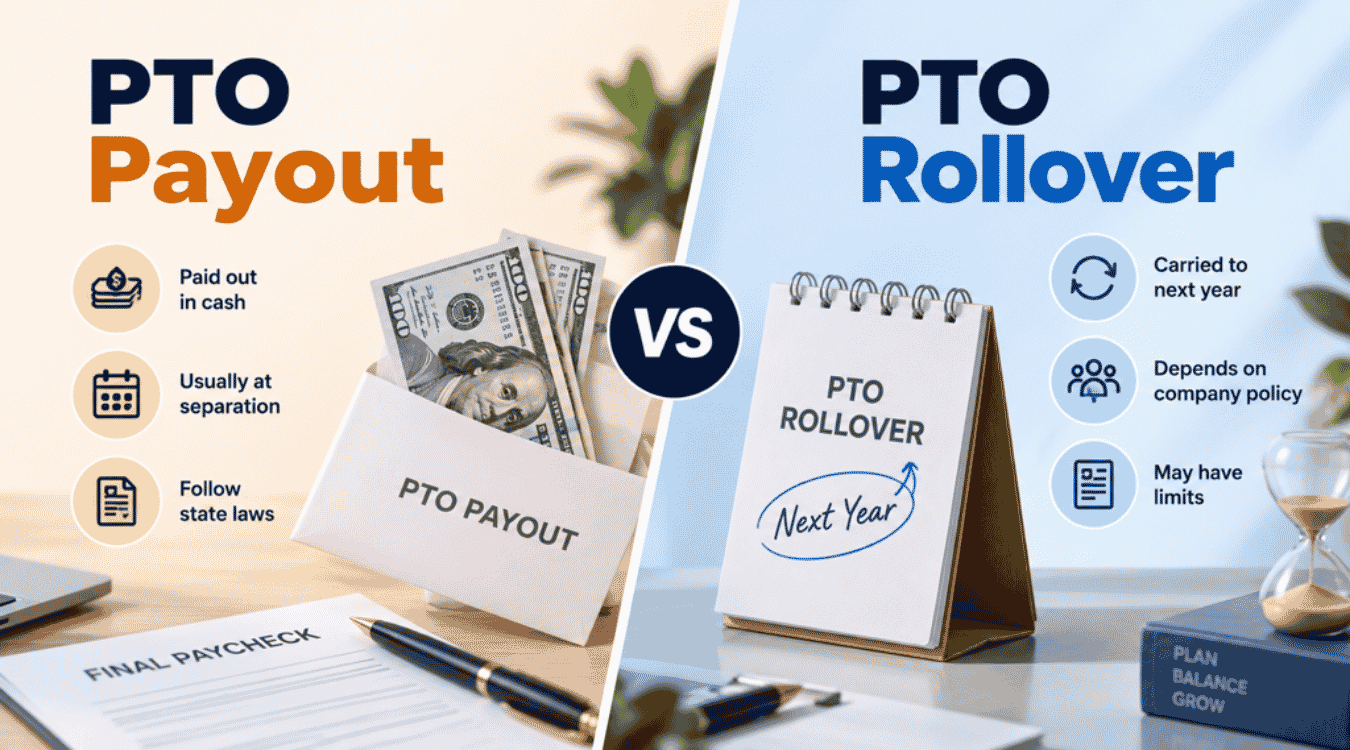
Rollover and payout solve two different problems, and mixing them up causes real compliance mistakes. Rollover determines what happens to unused vacation time while someone stays on the payroll. A policy might cap how much accrued vacation pay carries into the new year, or it might allow unlimited rollover.
Payout only matters once the job ends. At that point, state pto laws decide whether accrued vacation time must convert into wages for departing employees. North Dakota is one of several states that treats this as earned compensation, not a discretionary bonus.
An employment agreement can shape the details, but both the employer and the employee need written notice of the terms before a dispute happens. Confusion between the two usually shows up during offboarding, when a company assumes a use it or lose it rollover rule also cancels any duty to compensate departing employees. State law, not the handbook, has the final say.
Factor | PTO Rollover | PTO Payout |
|---|---|---|
When it applies | During active employment | At termination or resignation |
What it governs | Carryover of unused vacation time into a new period | Whether accrued vacation pay becomes wages |
Who decides | Company policy, within state limits | State pto laws, sometimes overridden by policy |
Employee protection | Notice of accrual caps | Written notice of forfeiture terms |
Risk if ignored | Employee loses banked time unfairly | Employer owes unpaid wages to departing employees |
Which States Require PTO Payout?
.png)
PTO payout rules split into four real categories, not just yes or no. Some states treat unused vacation pay as wages the moment it's earned. Others leave it entirely to the employer's written policy, and a few have no specific state requirement at all.
State-By-State PTO Payout Laws
PTO payout rules split into four real categories, not just yes or no. Some states treat unused vacation pay as wages the moment it's earned. Others leave it entirely to the employer's written policy, and a few have no specific state requirement at all.
Payout Requirement | Use-It-Or-Lose-It | States | Key Conditions |
|---|---|---|---|
Required | Prohibited | California, Colorado, Illinois, Louisiana, Massachusetts, Montana, Nebraska | Unused vacation pay counts as earned wages; no forfeiture allowed regardless of policy |
Conditional | Prohibited with exceptions | Maine, Maryland, New Hampshire, North Dakota, Rhode Island, West Virginia | Payout generally required, but tenure thresholds, employer size, or written notice can change the outcome |
Policy-Dependent | Allowed | Alabama, Alaska, Arizona, Arkansas, Connecticut, Delaware, Hawaii, Idaho, Indiana, Iowa, Kansas, Kentucky, Michigan, Minnesota, Missouri, Nevada, New Jersey, New Mexico, New York, North Carolina, Ohio, Oklahoma, Oregon, Pennsylvania, South Carolina, Tennessee, Texas, Utah, Vermont, Virginia, Washington, Wisconsin, District of Columbia | Employer's own PTO policy, handbook, or employment agreement decides whether unused accrued vacation gets paid out |
No Specific State Requirement | Allowed | Florida, Georgia, Mississippi, South Dakota, Wyoming | No statute addresses vacation pay at all; outcome depends purely on what the employer chooses to promise |
States That Require Payout
Eight jurisdictions treat unused vacation pay as earned compensation the moment it accrues: California, Colorado, Illinois, Louisiana, Massachusetts, Montana, Nebraska, and North Dakota. In these states, employers cannot rely on handbook forfeiture language to avoid payout upon termination. Federal law sets no baseline here at all, so state labor departments enforce these rules independently, and a private employer's own policy cannot override them.
States With Conditional Payout
A handful of states require payout but attach real conditions. Maine only applies its rule to employers with 11 or more staff. Rhode Island requires one full year of tenure before payout kicks in. Maryland and New Hampshire treat vacation accrual as wages, but only once a written policy establishes the benefit, and an employer can avoid the obligation with a clear written notice of forfeiture.
North Dakota allows employers to withhold payout from employees who resign with under a year of service and give short notice. Employer size, tenure requirements, and separation circumstances all matter here, not just the state name on the paycheck.
States Where Employer Policy Controls
Most states fall into this category, and "no statutory payout mandate" does not mean an employer owes nothing. A company can create a fully enforceable obligation through its own PTO policy, employee handbook, employment agreement, collective bargaining agreements, or even an established pay period practice it never wrote down.
Paycor's own state breakdown identifies dozens of states where the employer's policy or agreement is what ultimately determines whether unused accrued vacation gets paid out, not the absence of a statute. This is exactly where Payrun can outperform the simplistic yes/no tables competitors publish.
A silent policy in a policy-dependent state is not the same as a policy that explicitly denies payout, and treating them as identical is how private employers end up compensating departing employees they thought owed nothing, or getting sued by ones they thought had no claim.
How PTO Payout Rules Work When Employment Ends
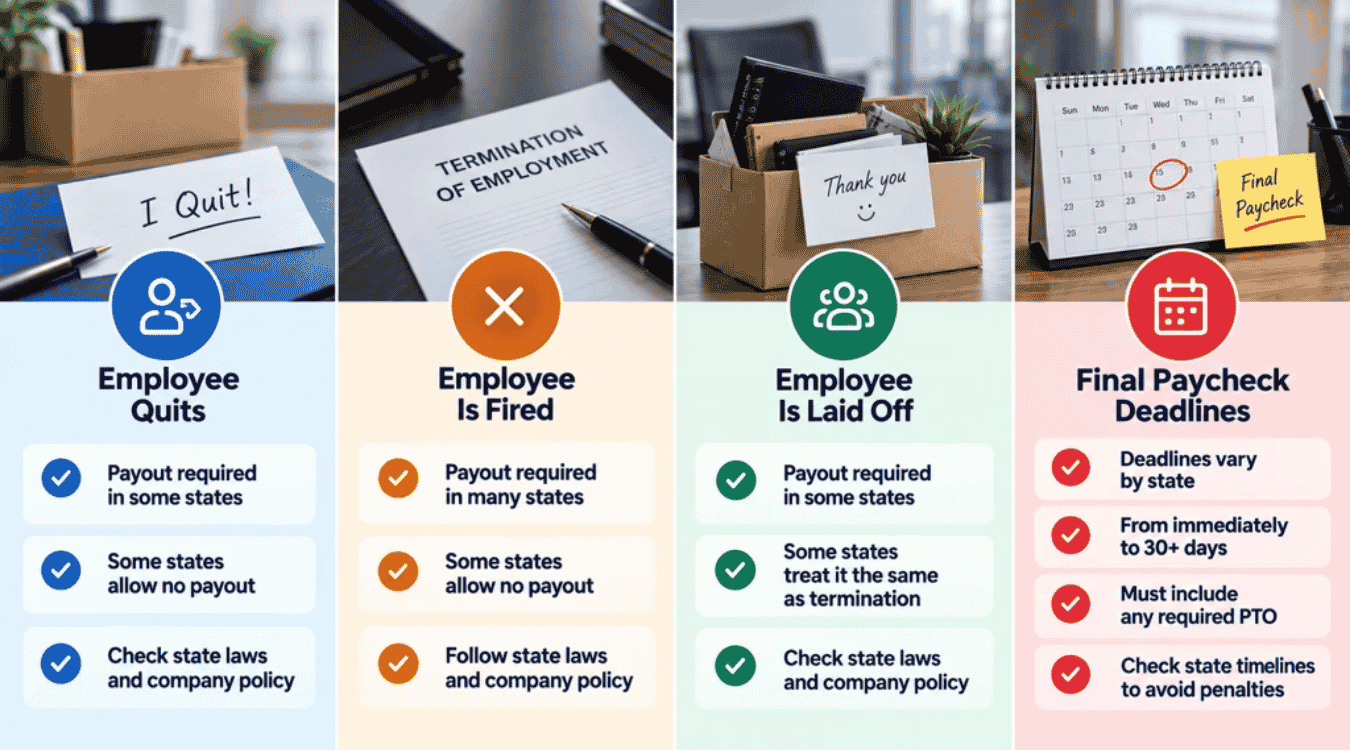
Separation type changes very little about whether vacation payout applies, but it changes almost everything about the deadline. State law decides the obligation, and the reason someone left decides the clock.
Employee Quits
Resignation does not erase a vacation payout obligation in states that treat accrued time as owed wages. If the employee works in a required state, the payout still applies whether they gave two weeks' notice or walked out the same day. Employers still need to check both pto laws by state and their own written policy before assuming resignation changes anything.
A resigning employee in West Virginia, for example, may still be owed accrued paid time under state rules even though they chose to leave. Policy language can add conditions in policy-dependent states, but it cannot cancel a right that state law already protects.
Employee Is Fired
Involuntary termination triggers the same underlying payout rules, though several states shorten the deadline specifically for terminated employees. An employer fails to comply the moment a required state payout window closes, regardless of the reason for the firing. Cause-based termination sometimes lets a written policy withhold payout, but only where state law allows that carve-out in the first place.
Timing tends to matter more here than the payout obligation itself. States that treat vacation as taxable income owed at separation often demand faster processing for a firing than for a standard resignation, so payroll teams need a clear internal deadline the moment a termination is entered.
Employee Is Laid Off
Layoffs and reductions in force get treated as involuntary separations for payout purposes, so accrued PTO should be reviewed the same way a firing is reviewed. Employers should notify employees of their final PTO balance before the layoff takes effect, not after the final paycheck already went out.
Batch layoffs raise their own risk, since one payroll error can repeat across dozens of terminated employees at once. A quick balance audit before a mass layoff catches miscalculations while there's still time to fix them, instead of discovering the mistake through a wave of wage complaints, and accurate employee timeline tracking data makes that audit far easier to run at scale.
Final Paycheck Deadlines
PTO entitlement only answers what is owed. Final paycheck law answers when it has to arrive, and the two rules do not always move together.
California illustrates this clearly. An employee who quits with at least 72 hours' notice must receive their final paycheck on their last day, while an employee who resigns without notice can wait up to 72 hours. A discharged employee, by contrast, must be paid immediately at the time of termination. This is a completely separate rule from whether vacation payout is owed at all, and confusing the two is one of the most common payroll mistakes employers make.
PTO Policy Vs State Law
A simple hierarchy resolves almost every payout dispute. Applicable state law comes first, followed by any employment agreement or collective bargaining agreement. The written PTO policy, and finally payroll processing itself, carries out whatever the first three layers require.
A policy cannot waive rights that state law already makes nonforfeitable, no matter how clearly it's written. This is different from something like the Family and Medical Leave Act, which protects job-protected time off rather than accrued vacation pay, so the two shouldn't be confused when building a policy. Payroll executes the payout correctly only when it follows this order, instead of treating the handbook as the final word.
How Use-It-Or-Lose-It And PTO Carryover Affect Payout
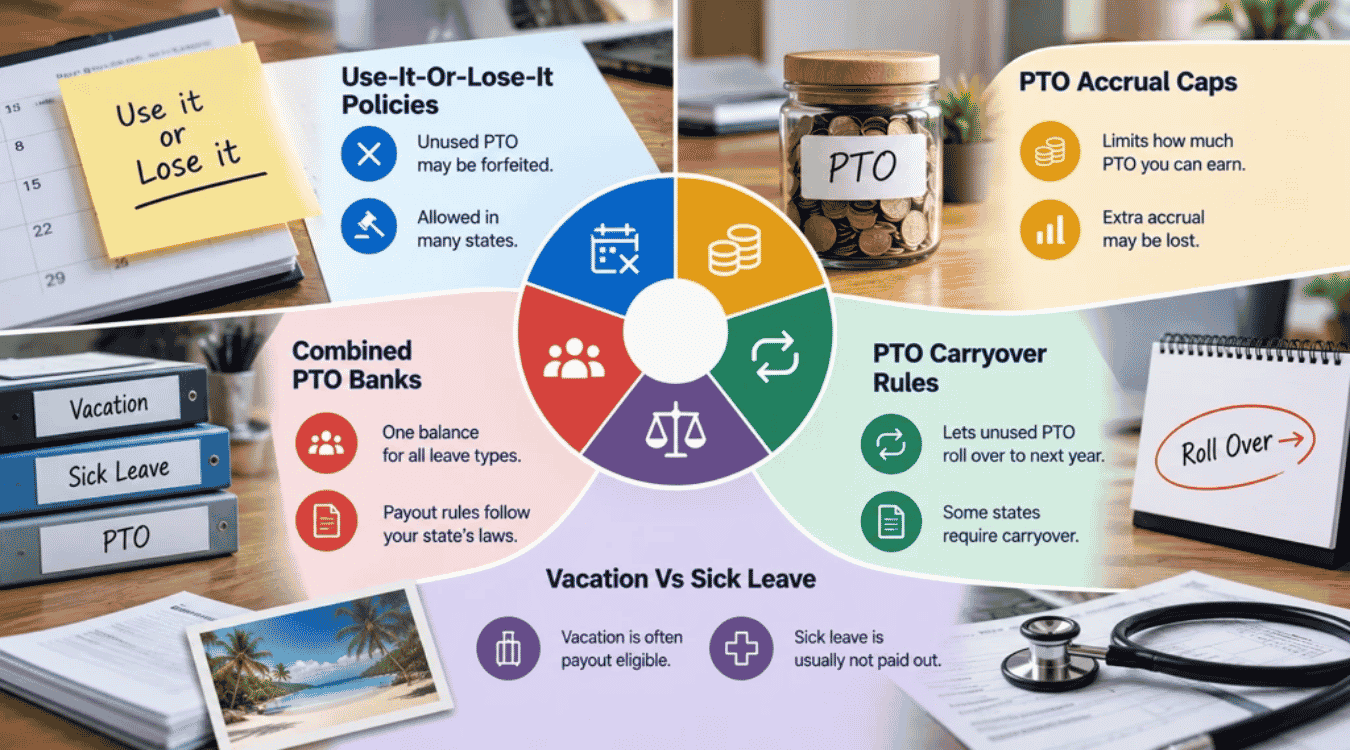
Use-it-or-lose-it policies, accrual caps, and carryover rules get mixed up constantly, but each one controls a different part of how PTO payout actually functions at separation.
Use-It-Or-Lose-It Policies
A use-it-or-lose-it policy cancels unused vacation time at the end of a set period instead of letting it carry forward or convert to pay. Whether such a policy holds up depends entirely on the state, since some states allow it outright and others ban it completely regardless of what the handbook says.
In states that treat accrued vacation as earned wages, a state statute overrides any forfeiture language, no matter how clearly it's written. In policy-dependent states, the same written policy is generally enforceable as long as eligible employees received notice of the terms before the forfeiture date arrived.
PTO Accrual Caps
An accrual cap is not the same thing as forfeiture, and treating them as interchangeable is a common employer mistake. A cap simply stops new vacation time from accruing once a balance hits a set ceiling, while forfeiture erases time an employee already earned and would otherwise be owed, which is why many employers rely on dedicated leave management software to enforce caps correctly.
California and Colorado both restrict forfeiture outright but still permit a reasonable accrual cap, since the employee never loses time they've already banked under such a policy. Labor management teams should build the cap into the accrual system itself rather than relying on year-end manual adjustments that are easy to get wrong.
PTO Carryover Rules
Carryover determines how much unused vacation time rolls into the next period while someone stays employed, and it has nothing to do with what happens at termination. A generous carryover policy can still sit next to a strict payout rule, and a strict carryover cap doesn't reduce what's owed once separation occurs.
Employers shouldn't treat carryover limits as a substitute for a real payout policy, since the two answer completely different questions. One controls what happens during employment, and the other controls what happens the day someone leaves.
Vacation Vs Sick Leave
Most PTO payout laws apply to vacation time, not standalone sick leave, and this distinction gets missed constantly. Paid sick leave tied to a paid family and medical leave program typically follows its own statute, with no payout requirement at separation at all.
Vacation pay, by contrast, converts to wages in required states the moment it's earned. An employer gave fewer payout dollars than they legally owed more than once simply by assuming sick leave and vacation time shared the same rule, so the two need to stay separate in any written policy.
Combined PTO Banks
Combining vacation, personal days, and sick time into a single PTO bank can quietly increase payout exposure in states that treat vacation as wages. Once sick leave gets blended into the same bucket as vacation, some states stop distinguishing between them and treat the entire balance as earned paid leave subject to payout.
Nebraska is a clear example, since a combined bank there can pull the whole balance into payout obligations that a separate sick-leave policy would have avoided entirely. Keeping the two tracked separately, even under one umbrella policy, is the simplest way to limit this risk.
How To Calculate PTO Payout
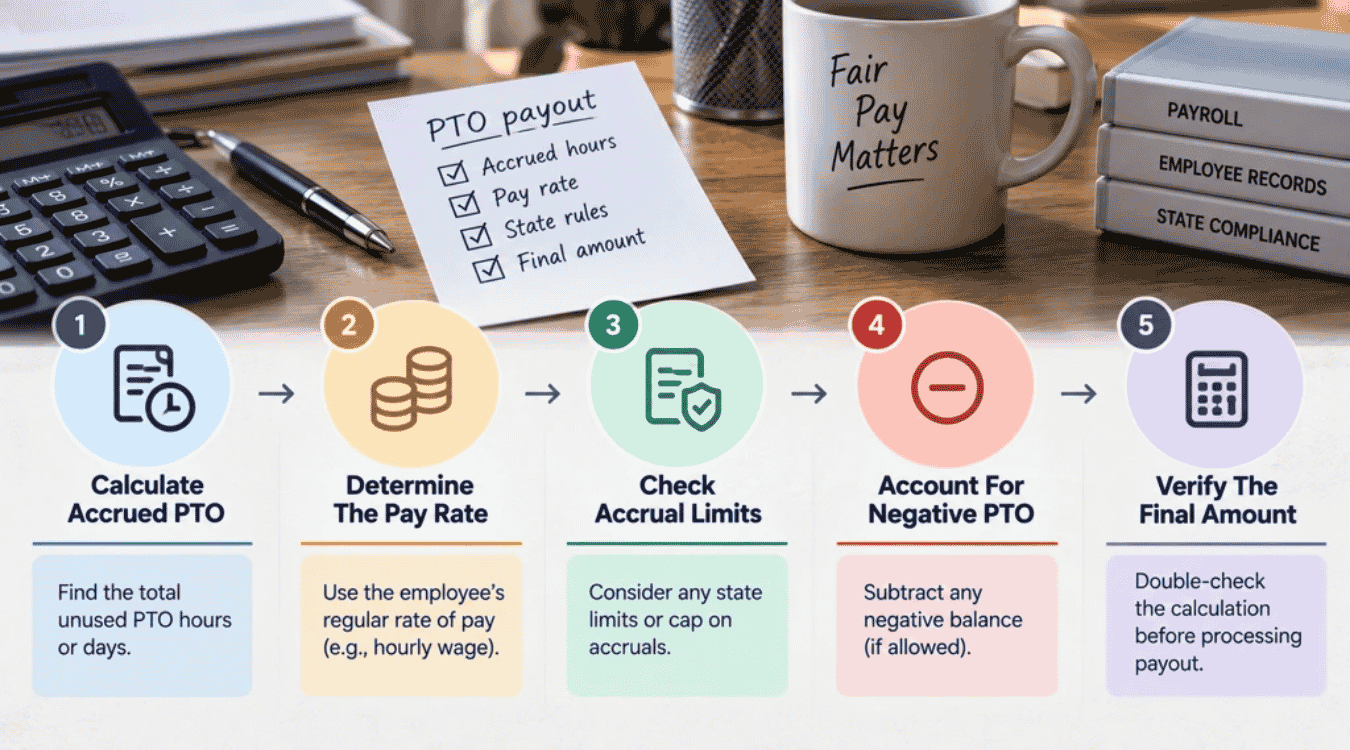
Legal reference only answers whether a payout is owed. This section answers the number payroll actually needs to cut, which is where Payrun's all-in-one HR platform becomes genuinely useful instead of purely informational.
Calculate Accrued PTO
The basic formula is simple: unused PTO hours multiplied by the applicable pay rate equals the gross PTO payout. An employee with 48 unused hours at a $25 hourly rate comes out to 48 times $25, or $1,200 in gross PTO payout before any deductions apply, and an accurate employee time tracking app is what keeps those underlying hours correct in the first place.
That number is only the starting point, though, since whether those hours actually qualify for payout still depends on state law and written policy. Cash value gets attached to accrued time only once the applicable rules confirm the hours are payable, not before.
Determine The Pay Rate
Hourly employees are the most straightforward case, since their applicable rate is already fixed at the time of separation. Salaried employees require converting an annual salary into an hourly-equivalent rate first, typically by dividing salary by standard annual work hours, before the same formula applies.
Final or current rate requirements can differ by state, so payroll should confirm whether a raise or rate change right before termination affects the payout calculation. Variable compensation, like commissions or shift differentials, adds another layer, since not every state treats those the same way vacation pay itself gets treated, so there's no single universal calculation rule that covers every employee type.
Check Accrual Limits
Before finalizing any number, payroll should verify exactly how much PTO an employee has actually earned against how much they've used. Earned hours, used hours, carryover from a prior period, and any accrual cap all feed into the true remaining balance.
Manual adjustments are where errors tend to hide, since a one-off correction entered months earlier can quietly change the final balance without anyone noticing until termination. Confirming the remaining balance directly against the accrual system, not just the last payslip, protects employees from being shorted and protects the employer from overpaying, especially when paired with reliable employee time log reports.
Account For Negative PTO
Some employees use more PTO than they've actually accrued by the time they separate, leaving a negative balance on the books. Employers should not automatically deduct that shortfall from a final paycheck without first checking applicable wage-deduction law, since several states restrict or flatly prohibit deducting negative PTO from wages.
Getting this wrong can turn a routine payroll adjustment into a wage claim, and the court costs and penalties that follow are rarely worth whatever the negative balance was worth in the first place. When in doubt, treat a negative balance as a policy and legal question before treating it as a payroll deduction.
Verify The Final Amount
Before the payout finalizes, payroll should confirm the applicable pay rate, the verified accrual balance, any required advance notice was given if the state requires it, and that no negative-balance deduction was applied without a legal check. A quick final review catches the errors that a rushed final paycheck usually produces, since exactly how unused pto depends on getting every one of these details right, not just the multiplication at the end.
How Are PTO Payouts Taxed?
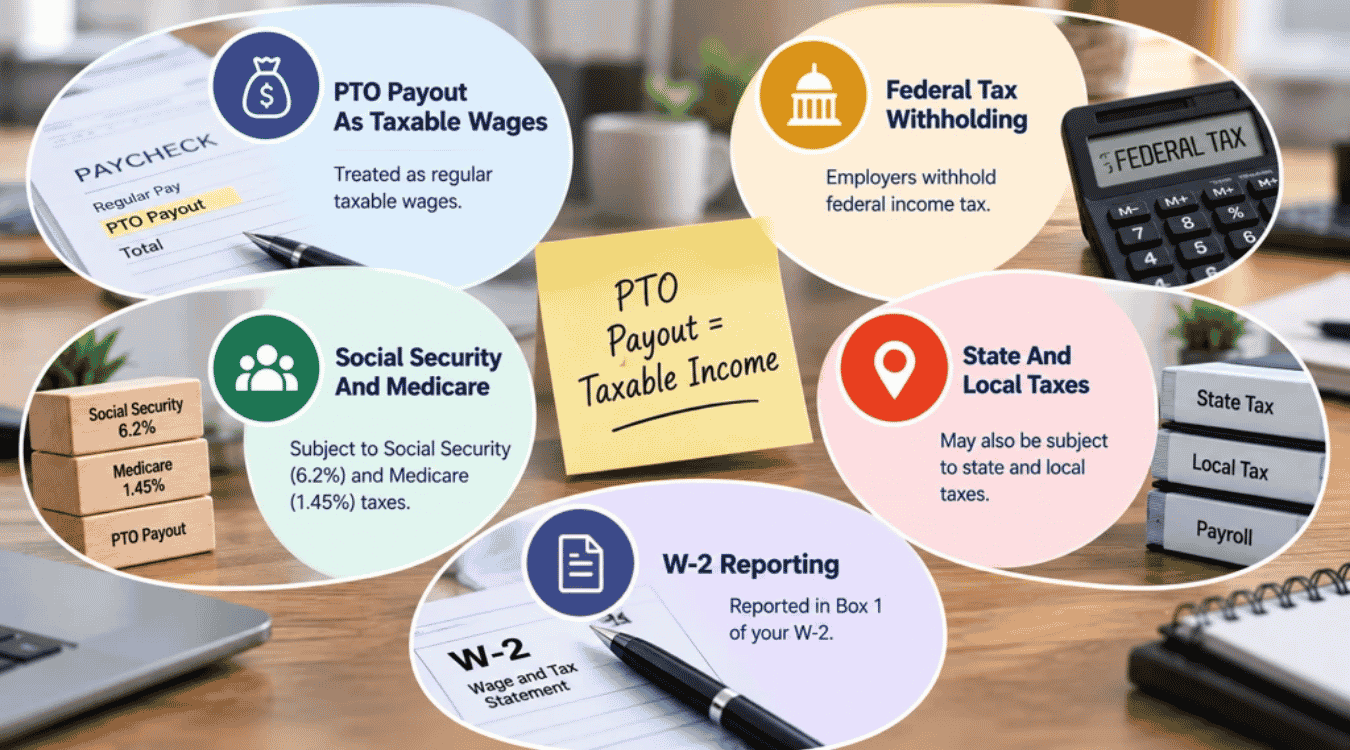
PTO payouts are not a separate category of pay. Once unused paid time converts to cash at employment separation, tax rules treat it the same as any other wage payment.
PTO Payout As Taxable Wages
A PTO payout is considered wages the moment it's paid, not a gift or reimbursement sitting outside normal payroll. It gets added to the employee's regular earnings for that pay period and taxed exactly the way a paycheck for hours worked would be taxed.
This matters most when annual unused vacation time adds up to a large lump sum, since a big one-time payout can push an employee into a higher marginal withholding bracket for that check alone. The employee ultimately reconciles the correct total at tax filing, but payroll still needs to withhold it properly the moment pto accrues into a payable balance.
Federal Tax Withholding
The IRS treats a PTO payout as supplemental wages, which means it can be taxed using either the aggregate method or the flat supplemental rate, depending on how it's paid out alongside regular wages. Employers typically use the flat rate when the payout is issued as its own separate check, and the aggregate method when it's combined into a final regular paycheck.
Getting the method wrong doesn't change what the employee ultimately owes at tax time, but it can mean an employee gave fewer take-home dollars than expected on that specific paycheck. Consistency across employees matters here, since mixing methods case by case creates unnecessary payroll disputes, which is why many employers lean on modern payroll software to standardize how PTO payouts are taxed and processed.
Social Security And Medicare
PTO payouts are subject to Social Security and Medicare withholding the same as any other wage, with no special exemption for unused time being cashed out. The standard 6.2% Social Security rate and 1.45% Medicare rate apply up to the usual annual wage base limits.
An employee near the Social Security wage base cap by year-end may see little or no additional Social Security withholding on the payout itself, purely because they've already hit the cap through regular pay. Medicare withholding, by contrast, has no cap and applies in full regardless of how much the employee already earned that year, which is one reason payroll automation software is so valuable for handling complex withholding rules at scale.
State And Local Taxes
Most states that tax income also tax PTO payouts as ordinary wages, following the same state withholding tables used for a regular paycheck. A handful of states with no income tax simply skip this step entirely, and local jurisdictions with their own wage tax can add another layer on top of the state rate, which becomes especially complex in multi-jurisdiction setups covered in a dedicated multi-state payroll guide.
Employers with employees across multiple states need to withhold based on where the employee actually worked, not where the company is headquartered, since that's the same rule that determines whether unpaid pto even needs to be paid out in the first place. Getting the withholding jurisdiction wrong is a separate compliance problem from getting the payout amount wrong.
W-2 Reporting
A PTO payout gets reported in Box 1 of the employee's W-2 along with all other taxable wages for the year, with no separate box or code specific to vacation payout. It also factors into Boxes 3 and 5 for Social Security and Medicare wages, following the same rules that applied when the payout was withheld.
There's no year-end reconciliation step unique to PTO payouts beyond normal W-2 accuracy checks, since the payout was already taxed correctly at the time it was paid, assuming payroll used the right method and rate. Treating it as a routine wage line item, rather than a special case, keeps year-end reporting simple, particularly when PTO data flows cleanly through a modern payroll management system.
How Employers Can Stay Compliant With PTO Payout Laws
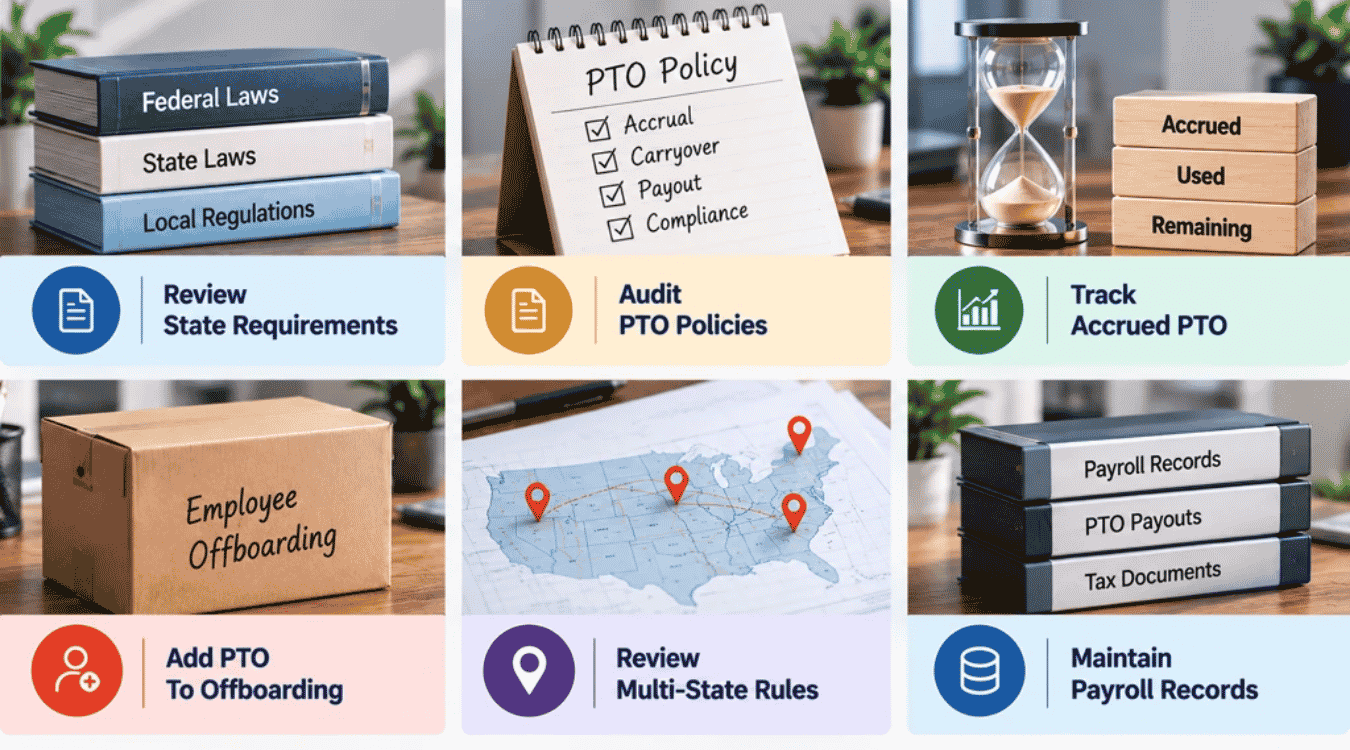
Staying compliant comes down to a repeatable process, not a one-time policy read. Here's the actual workflow that keeps PTO payout decisions consistent every time someone leaves.
Review State Requirements
The applicable law is always determined by where the employee actually works, not where the company is headquartered. A business based in a policy-dependent state can still owe mandatory payout to a remote employee working in a required state, so headquarters location tells payroll nothing useful here.
This becomes a real compliance gap the moment a company hires its first out-of-state remote worker without updating its process. Checking the employee's work-state law before finalizing any separation, every single time, is the only way to avoid defaulting to the wrong rule, and robust HRM software for remote workforce management makes tracking those work locations far more reliable.
Audit PTO Policies
A written policy only protects an employer if it actually addresses the situations that come up at separation. Accrual, carryover, accrual caps, forfeiture language, and payout eligibility all need clear, specific wording rather than a vague one-line mention of vacation time.
Most policy gaps show up exactly at termination, when an ambiguous handbook leaves a payout decision open to dispute. A regular audit, done before separations pile up rather than during one, catches vague language while there's still time to fix it and communicate the update to staff, especially when policies are managed centrally in comprehensive HR management software.
Track Accrued PTO
Payroll needs a running, accurate balance of earned hours, used hours, manual adjustments, and remaining PTO at all times, not just a number pulled together at termination. A balance that's only reconciled when someone leaves is a balance that's likely to be wrong, which is exactly the problem automated leave management for HR teams is designed to solve.
Real-time tracking through payroll or HR software removes the guesswork that manual spreadsheets tend to introduce over time, especially when employers move from spreadsheets to a dedicated payroll management system. It also gives payroll a clean, defensible number the moment a separation happens, instead of a scramble to reconstruct months of adjustments under deadline pressure.
Add PTO To Offboarding
PTO payout works best as one fixed step in a standard offboarding sequence rather than something handled ad hoc. Employee separation should trigger a clear order: determine the applicable law, review the written policy, verify the accrued balance, calculate the payout, confirm the final-pay deadline, process payroll, and retain the records.
Building this sequence directly into an offboarding checklist keeps the process consistent across every departure, regardless of who's handling HR that week. It also removes the risk of skipping a step under the time pressure a sudden termination usually creates by replacing ad hoc tools with a unified HR platform that automates each step.
Review Multi-State Rules
A single nationwide PTO policy can create very different financial obligations depending on which state each employee actually works in. What reads as one uniform benefit on paper can quietly become a mandatory-payout state, a policy-dependent state, and a no-requirement state all under the same handbook language.
This matters most for growing small businesses adding their first few remote or multi-state hires, since that's usually the point where a single generic policy stops being enough. Reviewing the policy against every state the company actually employs people in, not just the state it was originally written for, closes that gap before it becomes a payroll error.
Maintain Payroll Records
Every payout decision should leave a paper trail: which policy version applied at the time, the verified PTO balance, the calculation itself, the final payroll data, and any separation documents tied to the departure. Retention windows vary by state, so records should be kept at least as long as the strictest applicable requirement.
Good records are what actually resolve a wage dispute quickly if one ever comes up, rather than leaving an employer to reconstruct events from memory months later. Treating recordkeeping as part of the payout process itself, not an afterthought, is what makes the rest of this workflow defensible, particularly when using HR and payroll software for SaaS businesses that centralizes those records.
Final Discussion
PTO payout laws come down to one question repeated fifty different ways: does the state, the policy, or both decide what an employee is owed when they leave? Getting that answer wrong costs real money, whether through an unpaid wage claim or an overpayment nobody caught in time.
The safest approach treats every separation the same way, regardless of how routine it feels. Check the employee's work-state law first, then the written policy, then the accrued balance, and only then calculate the payout. Skipping straight to the math is how avoidable mistakes happen.
Compliance here isn't a one-time policy review. States update their rules, businesses add remote hires in new states, and a nationwide handbook written for one location can quietly stop covering everyone it needs to.
.jpg)