Performance Review Questions: 50+ Questions For Better Employee Reviews
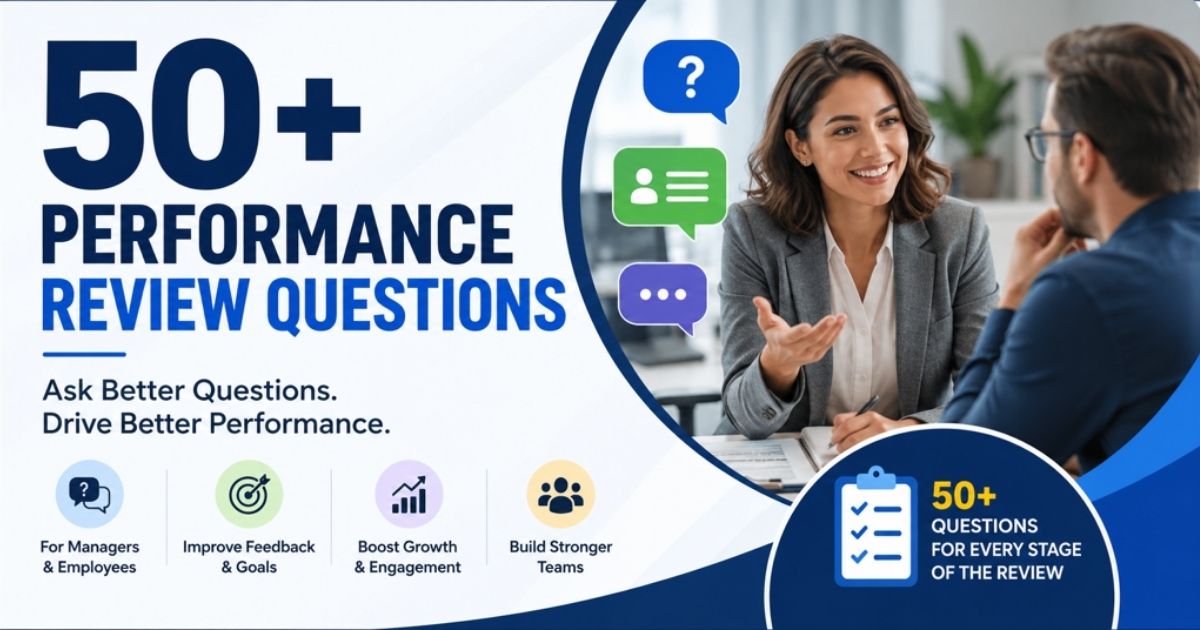
Table of Contents
Ask the same five questions every cycle, and employees start rehearsing the same five answers. Nothing shifts. Only 20% of employees say their company's performance practices actually push them to do better work, according to a Gallup workplace report. That's not a motivation problem. It's a question problem.
Vague prompts breed vague feedback. Sharp, specific questions turn a review from a box-checking ritual into a conversation that actually moves someone forward. Whether HR runs a polished annual cycle or a founder is winging their first-ever review, the questions asked matter more than the process wrapped around them.

What Are Performance Review Questions
Performance review questions are the specific prompts managers and employees use during the review process to evaluate progress, strengths, and areas to grow. Good ones go beyond a rating scale. They open up real employee feedback instead of a one-word answer.
The best performance review questions ask about wins, obstacles, and what support someone needs next. Employee performance reviews built around sharp employee review questions surface honest input on professional growth, not rehearsed answers. Before the next performance review rolls around, swapping vague prompts for targeted ones changes what the whole conversation delivers.
50+ Performance Review Questions To Ask Employees
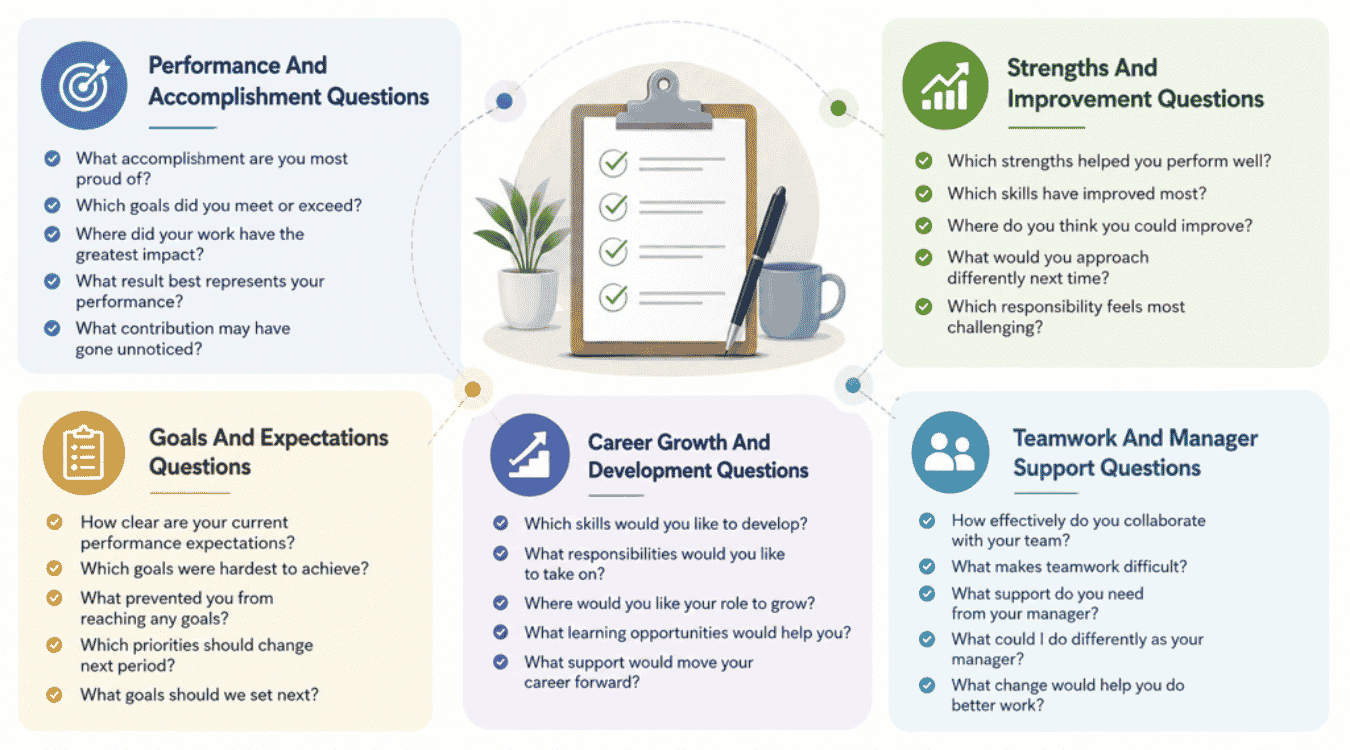
Good performance review questions turn a routine performance review process into a real conversation. Knowing how to conduct performance reviews well starts with asking questions employees actually want to answer, not just checking boxes.
Performance And Accomplishment Questions
Start with results. These questions give employees room to explain contributions that never made it into a spreadsheet of performance data.
- What accomplishment are you most proud of during this review period?
- Which goals did you meet or exceed?
- Where did your work have the greatest impact?
- What contribution may have gone unnoticed?
- What result best represents your performance?
- Which project or responsibility went particularly well?
Question: What accomplishment are you most proud of during this review period?
Why Ask It: The answer reveals what the employee considers meaningful, which matters as much as the metrics behind effective performance reviews.
What To Listen For: Specific results, measurable impact, initiative, and contributions that may not have received enough recognition.
Strengths And Improvement Questions
A performance review should recognize what works while pointing toward real professional development, not just a list of flaws.
- Which strengths helped you perform well?
- Which skills have improved most?
- Where do you think your performance could improve?
- What would you approach differently next time?
- Which responsibility feels most challenging?
Question: Where do you think your performance could improve?
Why Ask It: Self-identified gaps tend to land better than a manager's list, and the answer often points to where constructive feedback will actually stick.
What To Listen For: Ownership over specific skills rather than a vague admission that things could always be better.
Goals And Expectations Questions
Expectations shift quietly over a year, and these questions catch the gap before it becomes a bigger problem.
- How clear are your current performance expectations?
- Which goals were hardest to achieve?
- What prevented you from reaching any goals?
- Which priorities should change next period?
- What goals should we set next?
Question: How clear are your current performance expectations?
Why Ask It: Confusion about expectations is a common, quiet driver of missed goals, and this question surfaces it directly instead of guessing.
What To Listen For: Any mismatch between what the manager assumed was clear and what the employee actually understood, which often points back to weak performance management.
Career Growth And Development Questions
Career goals rarely stay static, and treating them as fixed is a fast way to lose someone who wanted more. This is where succession planning and career development start.
- Which skills would you like to develop?
- What responsibilities would you like to take on?
- Where would you like your role to grow?
- What learning opportunities would help you?
- What support would move your career forward?
Question: Which skills would you like to develop?
Why Ask It: The answer ties continuous improvement to something the employee actually wants, not a generic development plan handed down from above.
What To Listen For: Skills that build on current strengths rather than a completely unrelated direction, since that combination usually signals real readiness and gives the manager helpful feedback to act on.
Teamwork And Manager Support Questions
Team members rarely volunteer honest feedback about collaboration unless asked directly, so this category has to ask.
- How effectively do you collaborate with your team?
- What makes teamwork difficult?
- What support do you need from your manager?
- What could I do differently as your manager?
- What change would help you do better work?
Question: What could I do differently as your manager?
Why Ask It: Managers rarely ask this, so the answer often reveals a gap between the support they think they're giving and what their team members actually experience.
What To Listen For: Specific, actionable requests. A vague answer usually means the employee hasn't felt safe giving honest feedback before now.
Communication Questions
Communication problems rarely show up as a line item in performance data. They surface through a direct question, and this category makes room for one.
- How clearly do you communicate with your team members?
- What communication style works best for you?
- When has a message you shared been misunderstood?
- How do you prefer to receive constructive feedback?
- What would make team communication easier?
Question: How clearly do you communicate with your team members?
Why Ask It: Clear communication often separates someone doing a job effectively from someone quietly struggling in silence, and managers rarely see that gap firsthand.
What To Listen For: Specific examples of communication that landed well or fell flat, not just a general self-rating.
Problem Solving Questions
Traditional performance reviews often skip this category, even though it says more about job performance than a results list alone.
- What is the toughest problem you solved this period?
- How do you approach a task with no clear answer?
- What decision are you most confident about?
- Where did you need extra support to solve something?
- What would help you solve problems faster?
Question: What is the toughest problem you solved this period?
Why Ask It: The answer shows how someone thinks under pressure, which matters more for long-term career goals than whether they hit a routine target.
What To Listen For: A clear description of the problem, the options considered, and why one approach won out over another.
Engagement And Role Satisfaction Questions
Employee engagement rarely shows up in performance data on its own, so a direct question is usually the fastest way to find out.
- What part of your role keeps you engaged?
- What drains your energy at work?
- How connected do you feel to the company's mission?
- Do your daily tasks reflect the company values you signed up for?
- What would make your role more satisfying?
Question: How connected do you feel to the company's mission?
Why Ask It: Employees who feel disconnected from the company's mission often disengage long before performance numbers reflect it. That kind of drift is exactly what employee retention efforts need to catch early.
What To Listen For: Genuine enthusiasm versus a rehearsed answer, and any mention of a gap between stated values and daily reality.
Resources And Blockers Questions
Honest feedback about blockers protects someone's own performance from being judged against obstacles they never controlled. Left unresolved, those same blockers are a common driver of employee turnover.
- What is slowing down your work right now?
- What tool or resource would help you most?
- What decision from leadership affected your work this period?
- Where do you feel unsupported?
- What would remove your biggest blocker?
Question: What is slowing down your work right now?
Why Ask It: This question often points straight to where professional development opportunities or resources are missing, not just where effort is lacking.
What To Listen For: Recurring blockers mentioned in your last performance review. A repeat answer signals a process problem, not a performance one.
Future Priorities Questions
Career development conversations land better when they come from a question instead of an assumption. These answers also feed directly into broader workforce planning for the team.
- What should we prioritize together next period?
- What career goals do you want to work toward?
- What skill matters most for where you want to go?
- How do your career aspirations line up with company growth?
- What would you want to revisit at your next performance review?
Question: What career goals do you want to work toward?
Why Ask It: Career goals shift over time, and assuming they haven't changed since the last performance review is a common way managers miss this.
What To Listen For: Specificity. A vague answer usually means the employee hasn't had space to think about this before being asked.
Performance Review Questions For Different Review Types
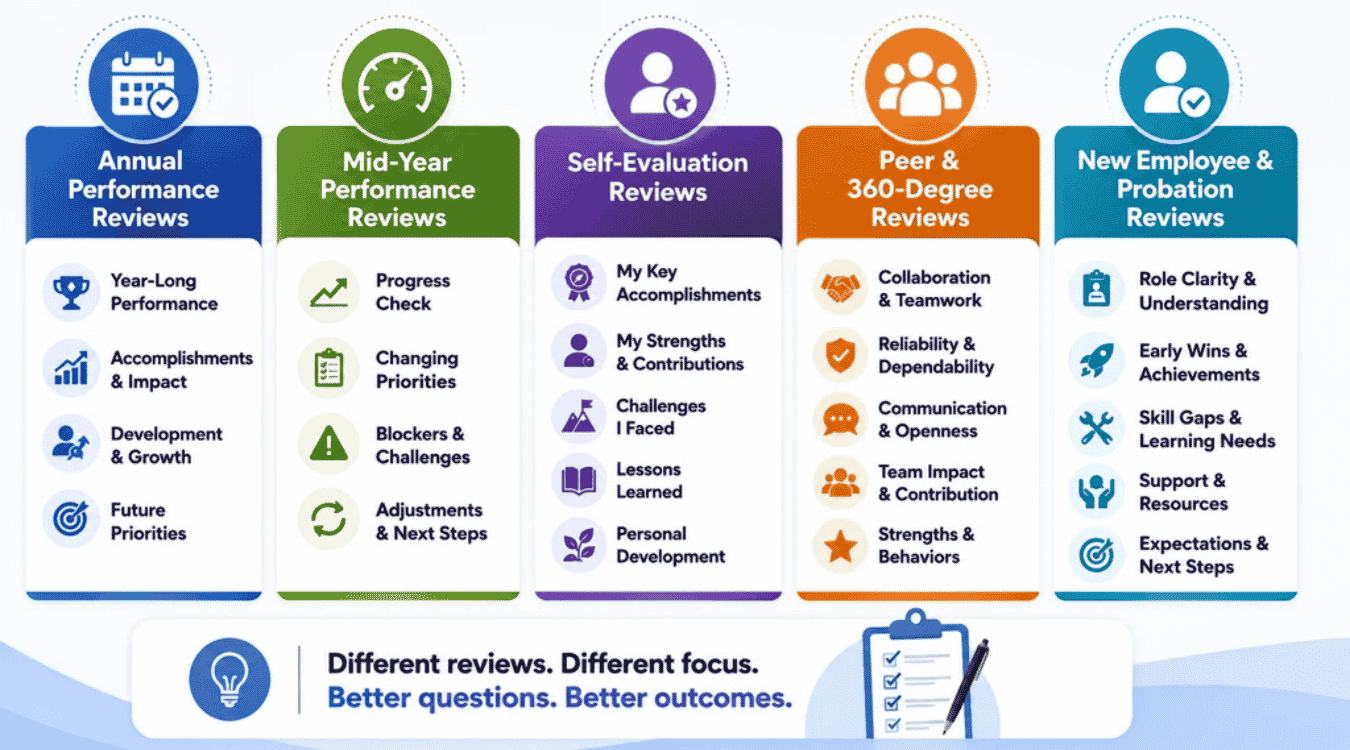
Not every performance review needs the same questions. A review cycle changes shape depending on timing and purpose, so the right prompts shift too, whether the moment calls for a look back or a check-in.
Annual Performance Reviews
A full evaluation period covers a lot of ground, so annual conversations carry more weight than a typical check-in. Many teams treat this as the most important performance review of the year, since compensation, promotions, and company goals for the year ahead often hinge on it. It is one of the biggest personnel management events on the calendar.
The right prompts trace how someone grew across the full review cycle, not just the last quarter. A side-by-side look at biggest wins against toughest setbacks gives a fuller picture than isolated metrics, and it sets up the professional goals worth carrying into next year.
Mid-Year Performance Reviews
Halfway through a review cycle, priorities rarely look the same as they did on day one. Mid-year check-ins exist to catch drift early, surfacing which professional goals are still realistic and which ones need adjusting before the year closes out. A stalled goal raised only at the annual review often costs months.
Good questions at this stage focus on blockers, not blame. What's standing in someone's way, and whether they feel supported enough to solve it, delivers valuable insights a year-end review alone would miss. There's still time left in the evaluation period to act on what surfaces.
Self-Evaluation Reviews
Self-evaluations put the employee in the driver's seat before anyone else weighs in. A specific accomplishment named alongside honest employee's strengths and a challenge that exposed a gap builds self-awareness no manager's notes can fully replicate. Lessons learned this way tend to stick, since the person arrived at them independently rather than being told.
Questions framed around personal growth rather than a checklist get more honest answers. A person reflecting on their own development tends to offer meaningful feedback about what actually helped, which often reveals more than a manager guessing from the outside.
Peer And 360-Degree Reviews
Peer reviews work because coworkers see things a manager never will, the daily reliability, the way someone handles a tense meeting, the small favors nobody logs anywhere. Observable behavior matters more here than intent, since a colleague can only speak to what they actually witnessed.
Job title rarely predicts how well someone collaborates, which is exactly why these reviews matter across a flat team as much as a hierarchical one. Good questions ask for specific moments, not general impressions, since a vague compliment says far less than one clear example of team impact.
New Employee And Probation Reviews
New hires need a different kind of review, one built around whether the role matches what was promised in the offer. A first check-in should confirm role clarity and surface early skill gaps before either compounds into a bigger problem.
Workload and support matter as much as output this early, since employee growth stalls fast when someone is quietly overwhelmed and too new to say so. A probation review works best when it asks directly whether expectations still make sense given what the job actually turned out to be. This early stage sets the tone for the rest of the employee lifecycle.
Review Type | Main Purpose | Best Question Focus | Suggested Questions |
|---|---|---|---|
Annual | Full performance evaluation | Results + growth | 8–10 |
Mid-Year | Course correction | Progress + blockers | 5–8 |
Self-Evaluation | Employee reflection | Impact + learning | 5–8 |
360 Review | Multi-source feedback | Behavior + teamwork | 4–6 |
Probation | Early performance check | Fit + expectations | 5–7 |
Performance Review Questions Employees Should Ask Managers
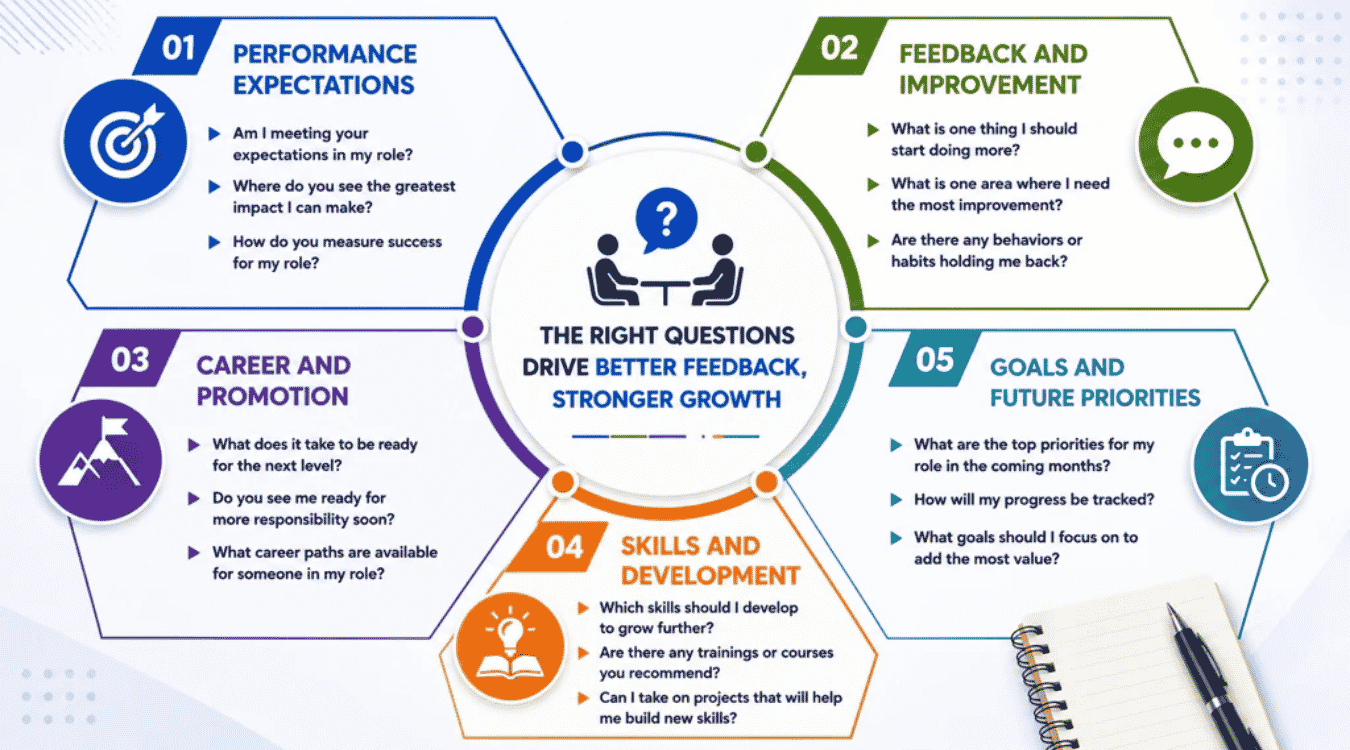
Reviews shouldn't run one direction. Employees who come prepared with their own questions tend to leave the room with a clearer, more comprehensive view of where they stand, not just a summary of what leadership noticed.
Performance Expectations
Overall performance can look fine from the outside while feeling unclear from the inside. Asking directly closes that gap before it turns into a surprise at the next review.
- What would excellent performance look like in my role?
- How will my progress be measured?
- Am I meeting the expectations set for my employee's role?
- Where could I be having greater impact?
Feedback And Improvement
Getting enough feedback shouldn't depend on luck or timing. Employees who ask directly usually get sharper, more specific answers than the ones who wait to be told.
- What should I continue doing?
- What is one area where I could improve most?
- What behavior or habit is holding back my progress?
- Which result from this past quarter stood out to you?
Career And Promotion
Career conversations move faster when the employee raises them first instead of waiting for a manager to bring it up unprompted.
- What would make me ready for more responsibility?
- What does it take to move into my next position?
- Are we on the same page about my long-term direction here?
- What criteria matter most for a promotion on this team?
Skills And Development
Not every skill gap is obvious from the outside. A direct question puts the employee in control of shaping their own development instead of waiting for it to be assigned.
- Which skills should I develop next?
- What training or mentorship would help me most right now?
- What project would stretch me in a useful direction?
- Which competencies matter most for where I want to go?
Goals And Future Priorities
Self-assessments only go so far without a manager's input on what actually matters next. This category exists to align both sides before the next cycle starts.
- What should success look like for me by the next review period?
- What goals should I be setting for the next few months?
- What would you want me to focus on if priorities shifted tomorrow?
- Is there anything from this past quarter I should carry forward?
How To Choose The Right Performance Review Questions
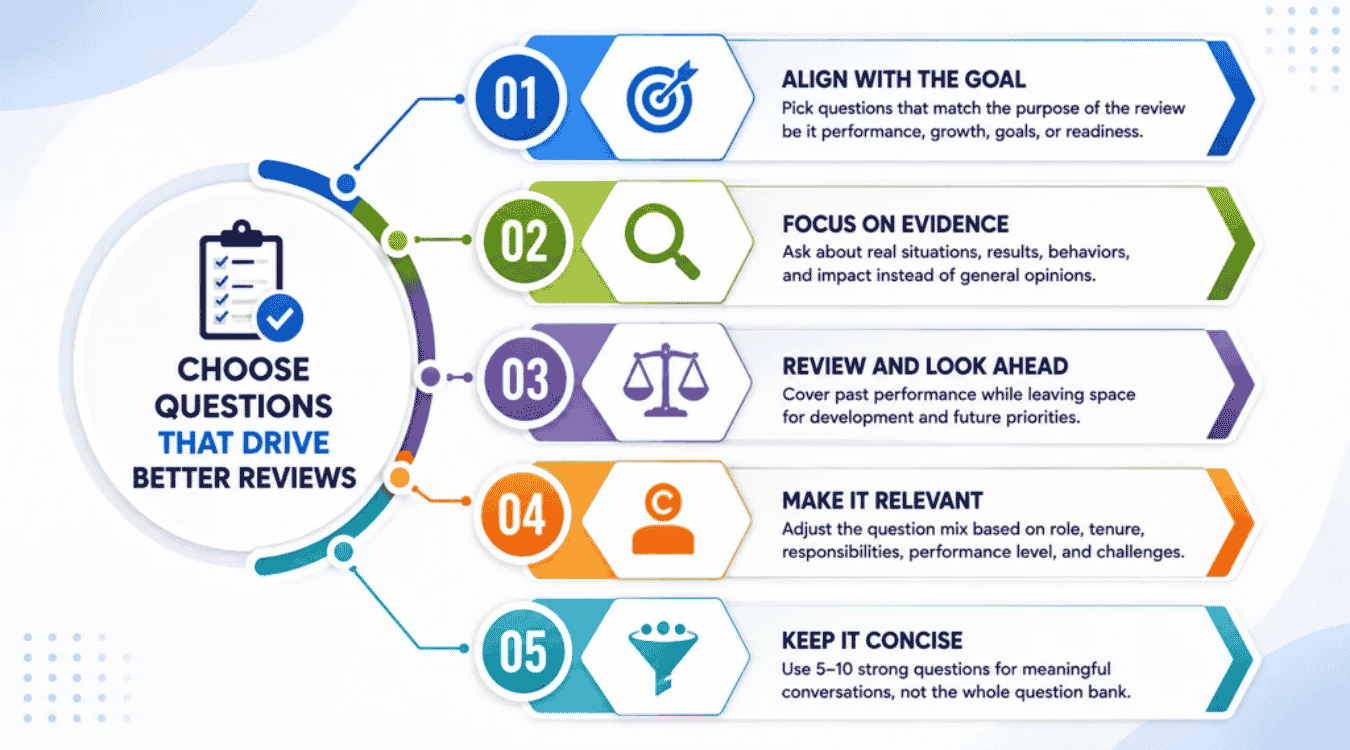
Fifty questions sitting in a bank don't make a good review. Picking the right five or ten for the actual conversation does. The goal matters more than the question count, and matching one to the other changes everything. Getting this wrong is one of the most common HR challenges teams face.
Match Questions To Review Goals
A review built to evaluate work performance needs different questions than one meant to solve a specific problem or prepare someone for more responsibility. Start by naming the goal before pulling questions from any list, since a mismatched question wastes the time both people set aside for the conversation.
Use Evidence-Based Questions
Personality judgments rarely lead anywhere useful. Asking for a specific situation, a measurable result, or an observable behavior gives both sides something concrete to discuss instead of a vague impression neither can fully defend. Evidence-based prompts also tend to produce better reviews overall, since they leave less room for bias to creep into the conversation.
Balance Past And Future Questions
Dwelling only on the last review invites a conversation that feels like a report card. Leaving space for what happens next, priorities, development, and goals for the coming period keeps the discussion forward-looking instead of purely evaluative.
Adapt Questions To The Employee
The same five questions rarely fit a new hire and a ten-year veteran equally well. Role, tenure, current performance level, and whatever challenges someone is navigating right now should all shape which questions actually make the cut, since a generic set flattens the employee experience into something impersonal.
Keep The Question List Focused
Working through an entire question bank in one sitting exhausts both people before the conversation reaches anything useful. Somewhere around five to ten strong, well-chosen questions tends to serve the actual goal of the review better than volume ever could, and it keeps the discussion tied to real business goals instead of drifting.
Performance Review Questions To Avoid
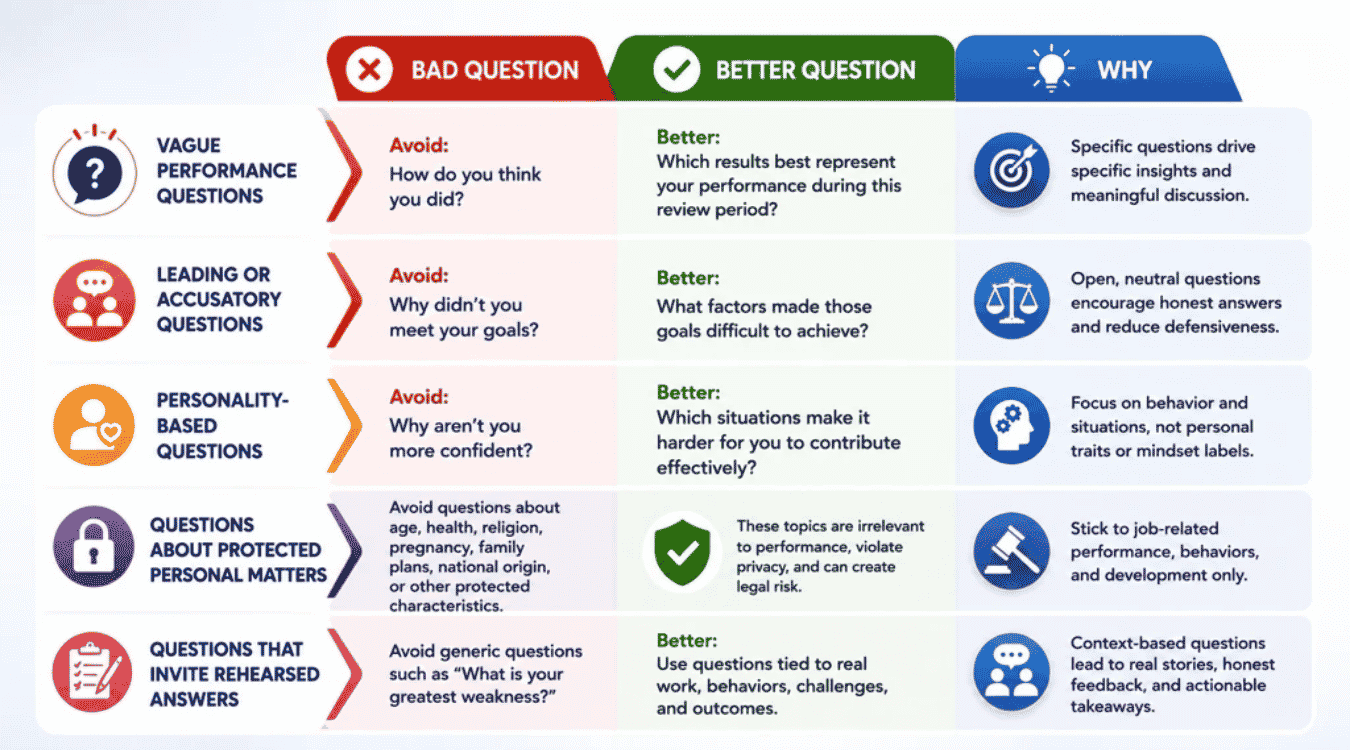
Some questions do more harm than good, no matter how well-intentioned they sound in the moment. Swapping a weak version for a sharper one usually takes nothing more than one better sentence. These are common HR mistakes worth catching early.
Vague Performance Questions
Avoid: How do you think you did?
Better: Which results best represent your performance during this review period?
Why: A vague prompt invites a vague answer. Questions managers ask should point toward something specific enough to actually use afterward, not just fill space on a form.
Leading Or Accusatory Questions
Avoid: Why didn't you meet your goals?
Better: What factors made those goals difficult to achieve?
Why: A question that sounds like an accusation shuts people down before they've said anything. Employees feel safer explaining obstacles when the question assumes there's a reason worth hearing, not a mistake worth defending.
Personality-Based Questions
Avoid: Why aren't you more confident?
Better: Which situations make it harder for you to contribute effectively?
Why: Personality isn't something a review should try to fix. Tying the question to current projects and specific situations keeps the conversation about work, not who someone is as a person.
Questions About Protected Personal Matters
Avoid: Any question touching age, health, religion, pregnancy, family plans, national origin, or other protected characteristics.
Better: Redirect to job-related performance, responsibilities, or outcomes tied to the role itself.
Why: These topics carry legal risk and have no place in a performance conversation. When in doubt, loop in the HR team before a question like this ever reaches a review.
Questions That Invite Rehearsed Answers
Avoid: What is your greatest weakness?
Better: What's one thing you'd approach differently on a project you worked on this quarter?
Why: Generic prompts get generic, pre-loaded answers most people have prepared before walking in. A question tied to real behavior and actual outcomes is harder to fake and easier to act on, whether the goal is comparing someone against other employees or just getting an honest read on how they'd receive feedback next time.
How To Turn Performance Review Answers Into Action
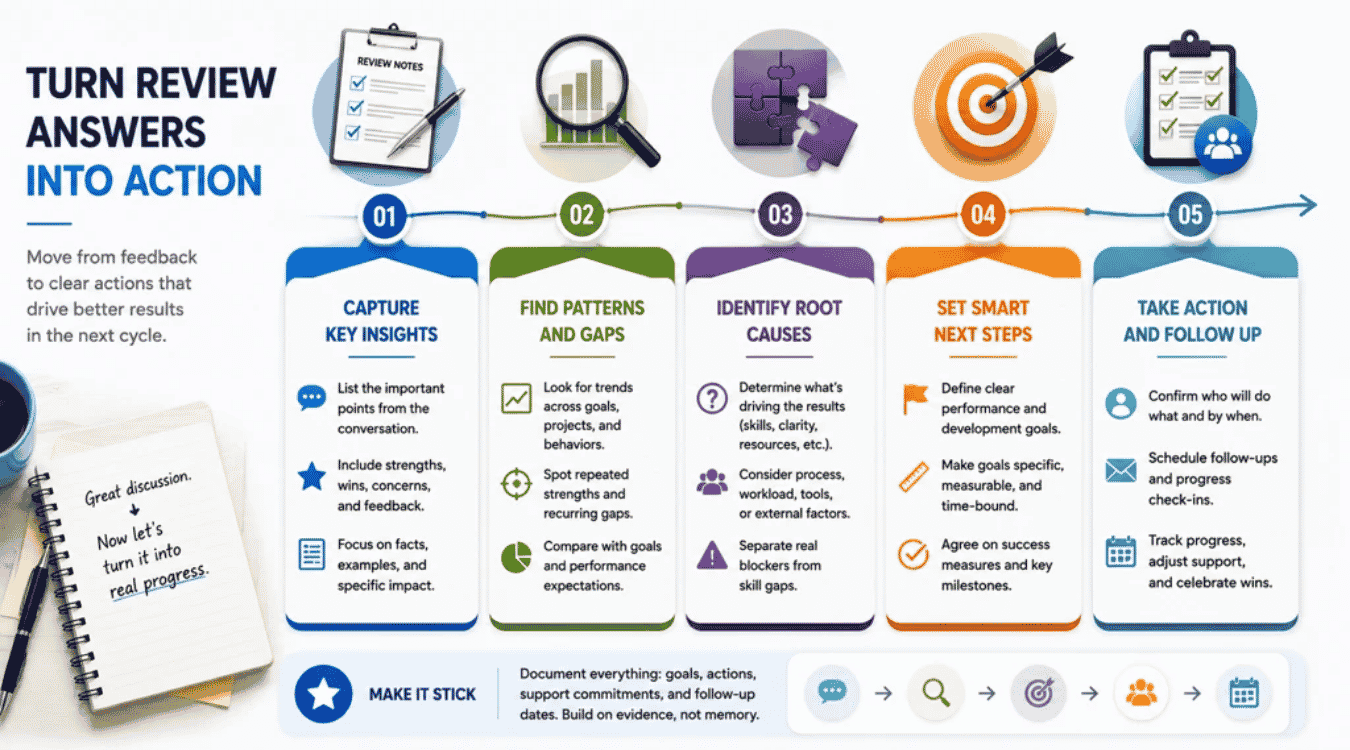
A review that ends with good answers and no follow-through changes nothing. Turning those answers into real action plans is what actually moves performance forward.
Identify Patterns And Performance Gaps
A single answer rarely tells the full story on its own. Comparing what someone said against their goals, actual outcomes, manager observations, and any relevant peer feedback surfaces patterns that a single conversation would miss, especially when set against the past year as a whole. This step separates a one-off comment from a real trend worth acting on. That is exactly what performance tracking makes visible.
Separate Blockers From Skill Gaps
Poor results rarely come from one single cause. Workload, unclear expectations, missing resources, a broken process, or a genuine skill gap can all produce the same disappointing outcome, so treating them as interchangeable leads to the wrong fix. A manager who assumes capability is the problem when workload is the real issue ends up solving nothing.
Set Clear Next-Step Goals
Vague intentions rarely survive contact with a busy quarter. Converting the conversation into specific, measurable goals, tied to real growth opportunities rather than general aspirations, gives both sides something concrete to check progress against later. Personal goals stick better when they're written down with a number or deadline attached.
Assign Manager And Employee Actions
Every action item needs an owner, not just a good intention floating between two people. Recording exactly what the employee will do next to what support the manager commits to providing keeps both sides accountable instead of leaving the follow-through to memory or good faith.
Document And Follow Up
Key takeaways fade fast once the meeting ends. Writing down the agreed goals, feedback, support commitments, and follow-up dates means the next review starts with evidence instead of a hazy recollection of what was said months ago. Regular check-ins between formal reviews keep that documentation useful instead of collecting dust until the next cycle. This is exactly the gap performance review software is built to close.
Final Discussion
The best performance review questions share one trait. They ask for something specific instead of settling for a vague impression either side can walk away from without learning much.
A results-focused question, a blocker surfaced early, a career goal named out loud, each one only works if it leads somewhere afterward. The conversation itself matters less than what happens once it ends. A goal written down, a follow-up date set, a piece of support actually delivered.
Whether the review runs on a strict annual cycle or gets built from scratch by a manager doing this for the first time, the same principle holds. Better questions get better answers, and better answers only matter when someone acts on them. Good human resource management with asking better questions.