IRS Per Diem Rates 2026: Complete Guide For Employers
Table of Contents
Sending an employee on a business trip brings a familiar question every year: how much should a company pay for meals, lodging, and incidental expenses without creating a tax headache? IRS Per diem rates answer that question with a flat daily amount, set by the government, that keeps expense reports simple for both the employer and the traveling employee.
For 2026, those rates shifted again, and knowing the current numbers matters for accurate reimbursements and clean payroll records. Guessing at a daily allowance, or reusing last year's figures, risks either shortchanging employees or triggering unnecessary taxable income. A clear grasp of how per diem works, what the 2026 rates actually are, and how to apply them correctly saves finance teams real time every travel season.

What Are IRS Per Diem Rates
IRS per diem rates are fixed daily amounts a company pays employees to cover lodging, meals, and incidental expenses during business travel, instead of reimbursing every individual receipt. The IRS per diem rates 2026 update these figures annually, with separate amounts for destinations within the continental United States and areas outside it.
This flat-rate approach simplifies payroll and answers other questions employees might have about what counts as a reimbursable cost. A well-run per diem system removes guesswork for both employers and traveling staff. Getting this right often comes down to tighter payroll and expense management overall.
How Do IRS Per Diem Rates Work
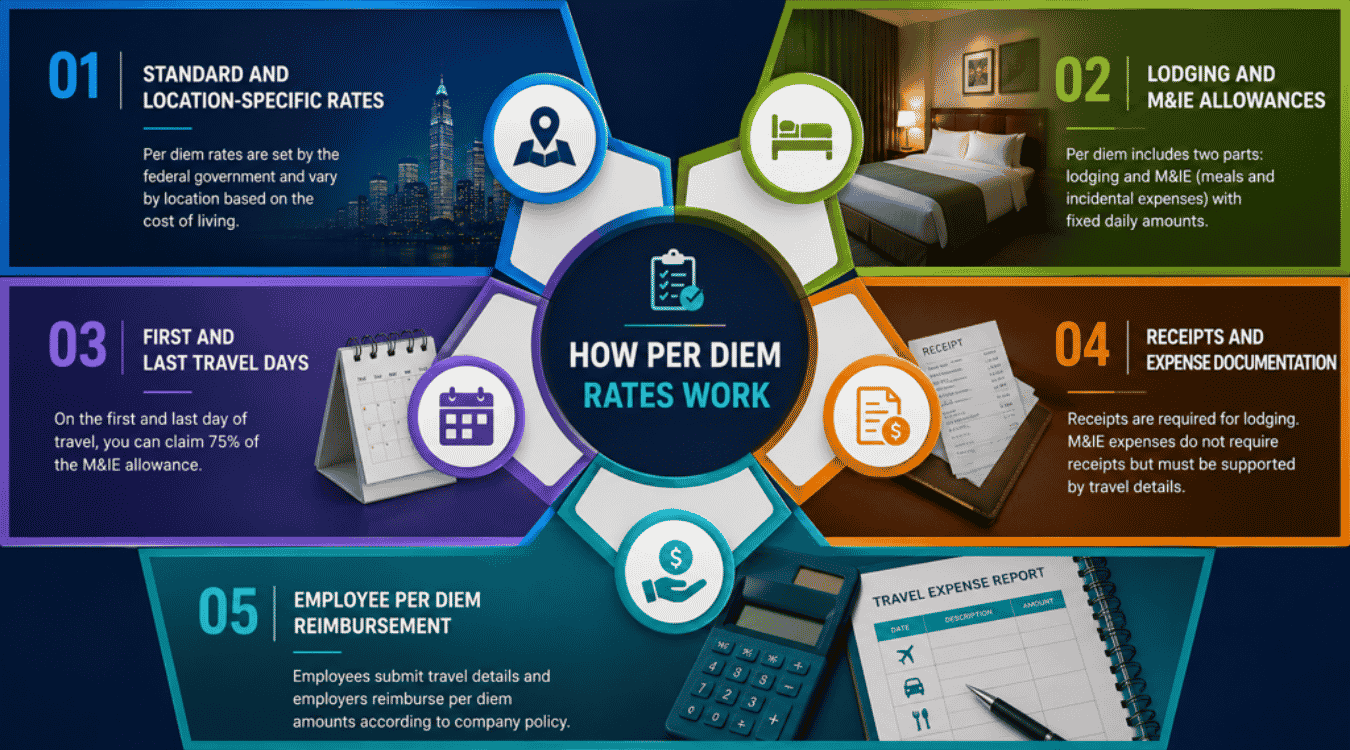
A per diem system replaces receipt-by-receipt reimbursement with one flat daily rate covering travel expenses. Employers set the amount using government tables, then employees receive that fixed sum regardless of exactly what they spend during a trip.
Standard And Location-Specific Rates
Most cities across the country fall under one standard rate that applies by default unless a location is specifically listed otherwise. This keeps the diem system simple for finance teams managing dozens of employee trips throughout the fiscal year without researching every destination individually.
Expensive travel destinations get their own higher number instead of the standard figure. A trip to San Francisco carries a noticeably different daily allowance than a trip to a smaller city, since local lodging and meal costs vary so widely. Foreign rates follow a completely separate table, published by a different government agency than domestic figures use.
Lodging And M&IE Allowances
Every per diem rate splits into two distinct parts that companies can handle differently depending on their travel policy. Lodging covers the hotel or rental cost for the night, while meals and incidental expenses, known as M&IE, cover food and small incidental costs like tips or laundry during the trip.
Some companies pay both portions together as one combined daily amount, simplifying the reimbursement process for employees and payroll alike. Others reimburse lodging separately based on actual hotel receipts, then apply only the M&IE portion as a flat rate. Either approach works, as long as the travel policy states clearly which method the company follows.
First And Last Travel Days
Travel days rarely match a full 24-hour stay, so the first and last day of a trip typically pay out at a reduced rate rather than the full daily amount. Most travel policies apply 75 percent of the standard M&IE rate on these partial days.
This reduction exists because the employee likely wasn't away from home for the entire 24 hours on departure or return day. A company flying someone out mid-morning and back mid-afternoon a few days later shouldn't pay a full day's meal allowance for those two partial travel days.
Receipts And Expense Documentation
One clear advantage of a diem system is the reduced paperwork burden it creates for both employees and finance teams. Employees generally don't need to save every meal receipt, since the flat rate already accounts for incidental costs like small tips, coffee, or parking fees along the way.
Lodging receipts still matter if a company reimburses hotel costs separately from the per diem meal allowance rather than folding both into one flat number. Keeping those lodging receipts on file protects the business if an expense report ever gets questioned during an audit. Many teams handle this with dedicated expense tracking software instead of spreadsheets.
Employee Per Diem Reimbursement
Reimbursement usually happens through a standard expense report, with the employee listing trip dates and destination rather than itemizing every individual cost from the trip. This makes the approval process faster for managers reviewing multiple travel requests in the same week.
Rates reset each fiscal year, so payroll and finance teams should confirm they're applying the current year's table rather than carrying over outdated figures from a prior trip. A written travel policy that references the current rate table helps avoid confusion when new numbers are published. A quick refresher on how payroll works helps new hires understand where these numbers fit.
IRS Per Diem Rates 2026 And Allowances
Two systems set 2026 per diem rates, and most employers pick one method and stick with it. The GSA standard rate covers ordinary travel destinations, while the IRS high-low method offers a simpler two-tier alternative for companies that want one rate for expensive cities and one for everywhere else.
Method | High/Standard Rate | Low/Other Rate | Effective Period |
|---|---|---|---|
GSA Standard CONUS | $178/day ($110 lodging + $68 M&IE) | Varies by location for non-standard areas | Oct 1, 2025 – Sept 30, 2026 |
GSA M&IE Tiers | $68, $74, $80, $86, $92 | Based on cost-of-living band | Oct 1, 2025 – Sept 30, 2026 |
IRS High-Low Method | $319/day ($233 lodging + $86 M&IE) | $225/day ($151 lodging + $74 M&IE) | Oct 1, 2025 – Sept 30, 2026 |
The GSA held both standard rates flat against 2025 figures, according to GSA's FY2026 CONUS Per Diem announcement (GSA, August 2025). Employers using the high-low method must apply it consistently to every employee for the full calendar year rather than switching mid-year.
How To Calculate Per Diem For Business Travel
Calculating per diem comes down to picking a daily rate, then adjusting it for partial travel days and trip length. The math stays simple once the base rate and travel dates are confirmed against the current GSA or IRS tables. Employers use the same figures to calculate payroll taxes on any excess amount.
Step 1: Find The Applicable Daily Rate
Start by identifying the destination's rate. Most cities use the GSA standard rate of $178 per day ($110 lodging plus $68 M&IE). Cities on the non-standard list carry their own higher figure, found through the GSA per diem lookup tool by city or ZIP code.
Companies using the IRS high-low method skip the lookup step entirely. A trip lands in one of two buckets: $319 per day for a high-cost locality, or $225 per day for everywhere else in the continental United States.
Step 2: Count Full Travel Days
Multiply the daily rate by the number of full days spent at the destination. A four-night trip with three full days at the standard GSA rate looks like this:
3 full days × $178 = $534
This figure covers lodging and M&IE for every day the employee was fully present at the destination, not counting departure or return days.
Step 3: Apply The 75% Rule To Travel Days
The first and last day of a trip only pay 75% of the M&IE portion, since the employee wasn't away from home the full 24 hours. Lodging on these days still pays in full if a hotel night applies.
M&IE at 75%: $68 × 0.75 = $51 per travel day
For a trip with one departure day and one return day at the standard rate, the calculation adds:
2 travel days × $51 = $102
Combined with lodging for those nights, the partial-day M&IE portion stays lower than a full day, even though the lodging rate doesn't change.
Step 4: Add It All Together
A full example makes the math concrete. Take a five-day trip (three full days, two travel days) to a standard-rate city:
- Full days: 3 × $178 = $534
- Travel day M&IE: 2 × $51 = $102
- Travel day lodging: 2 × $110 = $220
Total reimbursement: $534 + $102 + $220 = $856
Step 5: Adjust For Non-Standard Or High-Cost Locations
The same formula applies to non-standard cities and the IRS high-low method, just with different base numbers. A three-day trip to a high-cost locality under the high-low method, with one full day and two travel days, calculates as:
- Full day: 1 × $319 = $319
- Travel day M&IE: 2 × ($86 × 0.75) = 2 × $64.50 = $129
- Travel day lodging: 2 × $233 = $466
Total: $319 + $129 + $466 = $914
Swapping in the correct rate for the destination and method keeps this same four-step process accurate for any trip length or location.
IRS High-Low Per Diem Method
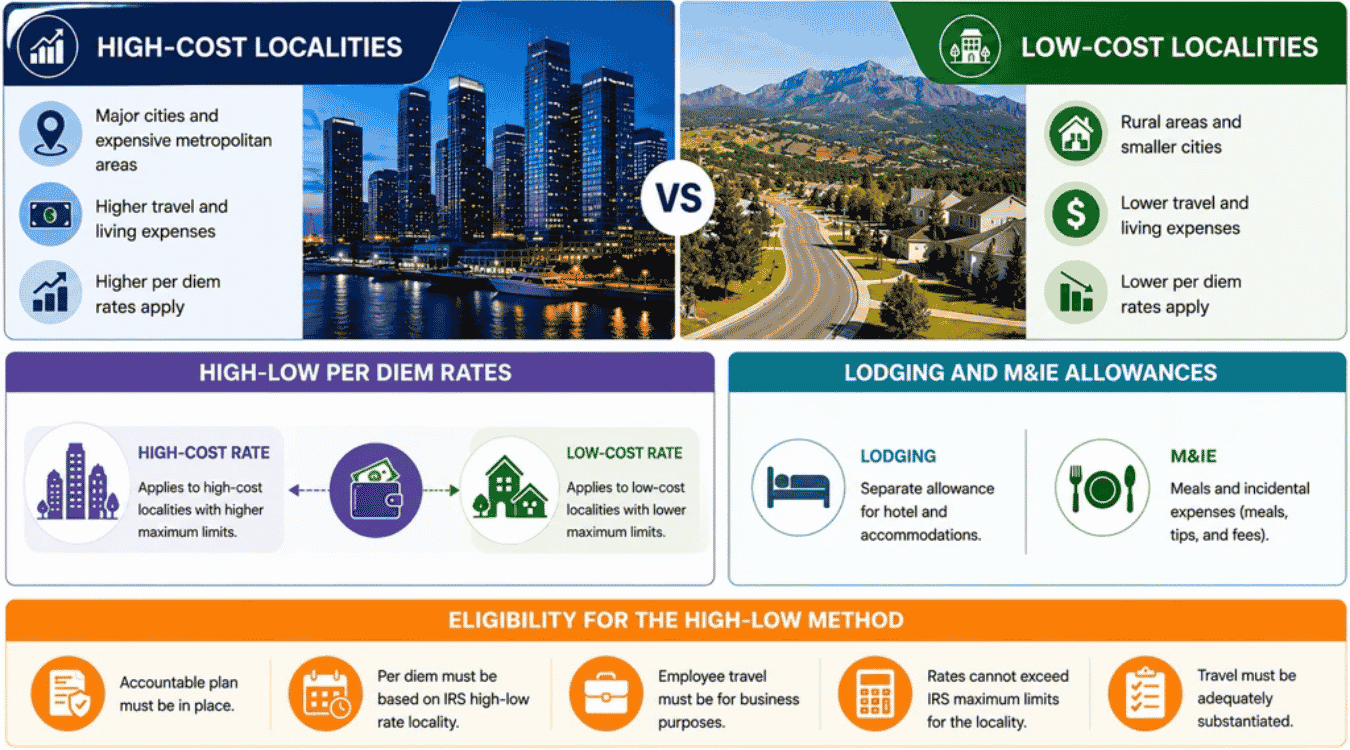
The high-low method replaces the GSA's city-by-city lookup with just two rates for the entire continental United States. Employers pick one of two daily figures based on whether a city appears on the IRS high-cost list, simplifying reimbursement across an entire travel program.
High-Cost And Low-Cost Localities
The IRS publishes a fixed list of high-cost cities each year, covering major metros and popular business destinations like New York, San Francisco, and Boston. Any city not on that list defaults to the low-cost rate automatically, so employers never need to research an individual hotel or standard rate for smaller cities. Some locations only qualify as high-cost during specific months, since travel demand and hotel pricing shift seasonally in tourist-heavy areas.
High-Low Per Diem Rates
For the period running through September 30, 2026, high-cost localities pay $319 per day, while every other city within the continental United States pays $225 per day. These two numbers replace the hundreds of individual GSA rates a company would otherwise need to track city by city. A department managing frequent travel across many locations often finds this method far easier to administer than checking a lookup table before every trip.
Lodging And M&IE Allowances
Each high-low rate splits into a lodging portion and a meals portion, just like the standard GSA rate. High-cost localities allocate $233 toward hotel costs and $86 toward meals, while low-cost localities split their $225 into $151 for lodging and $74 for meals. Employees don't need itemized hotel receipts under this method, since the lodging figure functions as a flat allowance rather than a reimbursed actual cost.
Eligibility For The High-Low Method
The high-low method applies only to travel within the continental United States, not to a foreign destination, since international trips fall under separate Department of State rates. Employers who choose this method must apply it consistently to every employee for the remainder of the calendar year, rather than switching between high-low and standard GSA rates mid-year. One added restriction worth noting: per diem benefits under either method can't be paid to any employee who owns 10 percent or more of the business, since that arrangement would otherwise let ownership convert regular income into a tax-free allowance.
IRS Per Diem Vs Actual Expense Reimbursement
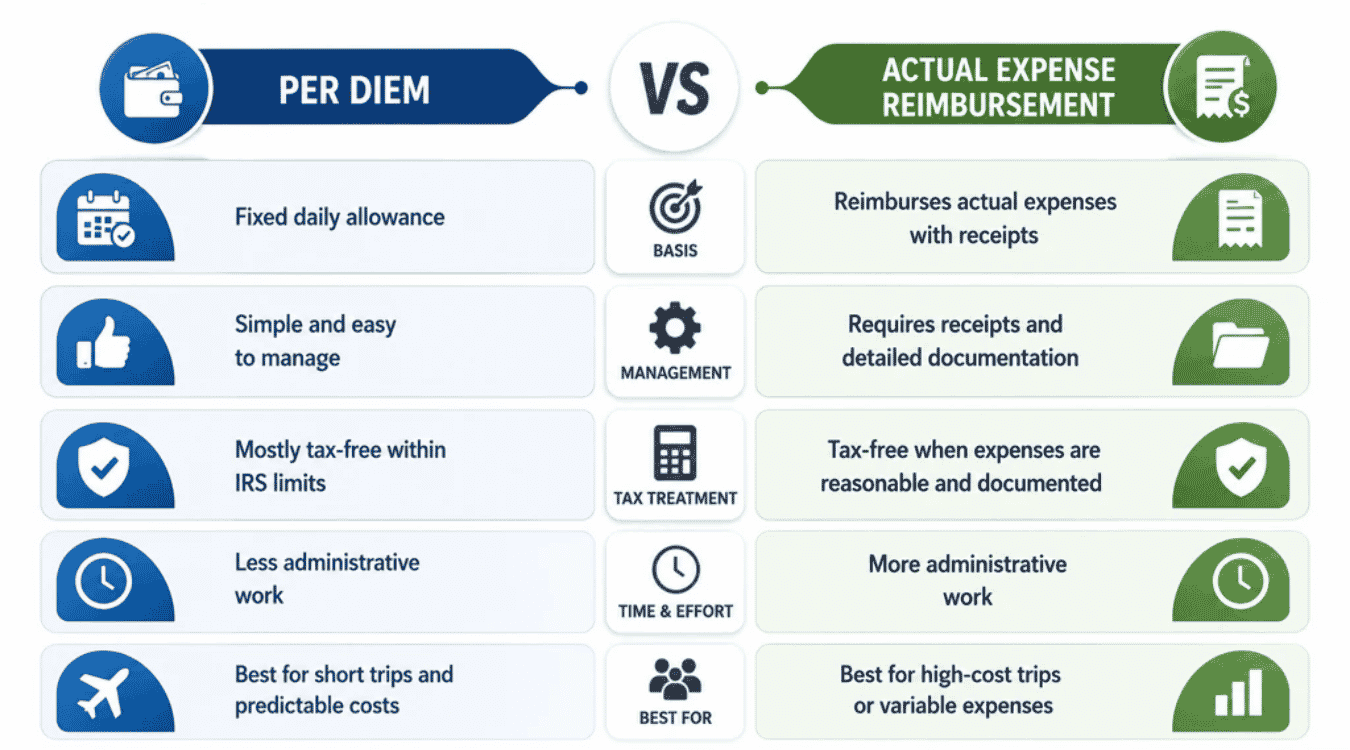
Choosing between per diem and actual expense reimbursement comes down to how much administrative work a company wants to take on. Per diem pays a flat daily rate for lodging, meals, and incidentals regardless of what an employee actually spends, which keeps expense reports short and payroll processing predictable. Actual expense reimbursement, by contrast, pays back the exact dollar amount spent, backed by receipts for every hotel stay, meal, and incidental cost along the way.
Per diem works especially well for frequent travelers heading to standard destinations, since nobody has to search through a stack of receipts at the end of a trip. Actual expense reimbursement fits better for irregular or unusually expensive travel, like trips to Alaska, Hawaii, or U.S. territories, where costs can swing well outside a flat daily rate. Many companies end up using both methods, applying per diem to routine domestic trips and actual expense tracking to outlier destinations that don't fit a standard rate cleanly.
Factor | IRS Per Diem | Actual Expense Reimbursement |
|---|---|---|
Receipts Required | No, for meals and incidentals | Yes, for every expense |
Administrative Effort | Low | High |
Predictability For Budgeting | High, fixed daily cost | Low, varies by trip |
Best For | Standard CONUS destinations, frequent travel | Alaska, Hawaii, territories, foreign, high-variance trips |
Unspent Amount | Employee keeps it tax-free (accountable plan) | Employer only pays actual cost |
Overspend Handling | Employee absorbs the difference | Employer reimburses full documented amount |
Setting Authority | GSA (CONUS), DoD (Hawaii/Alaska/territories), State Dept (foreign) | Company travel policy |
How Does IRS Per Diem Affect Payroll And Taxes
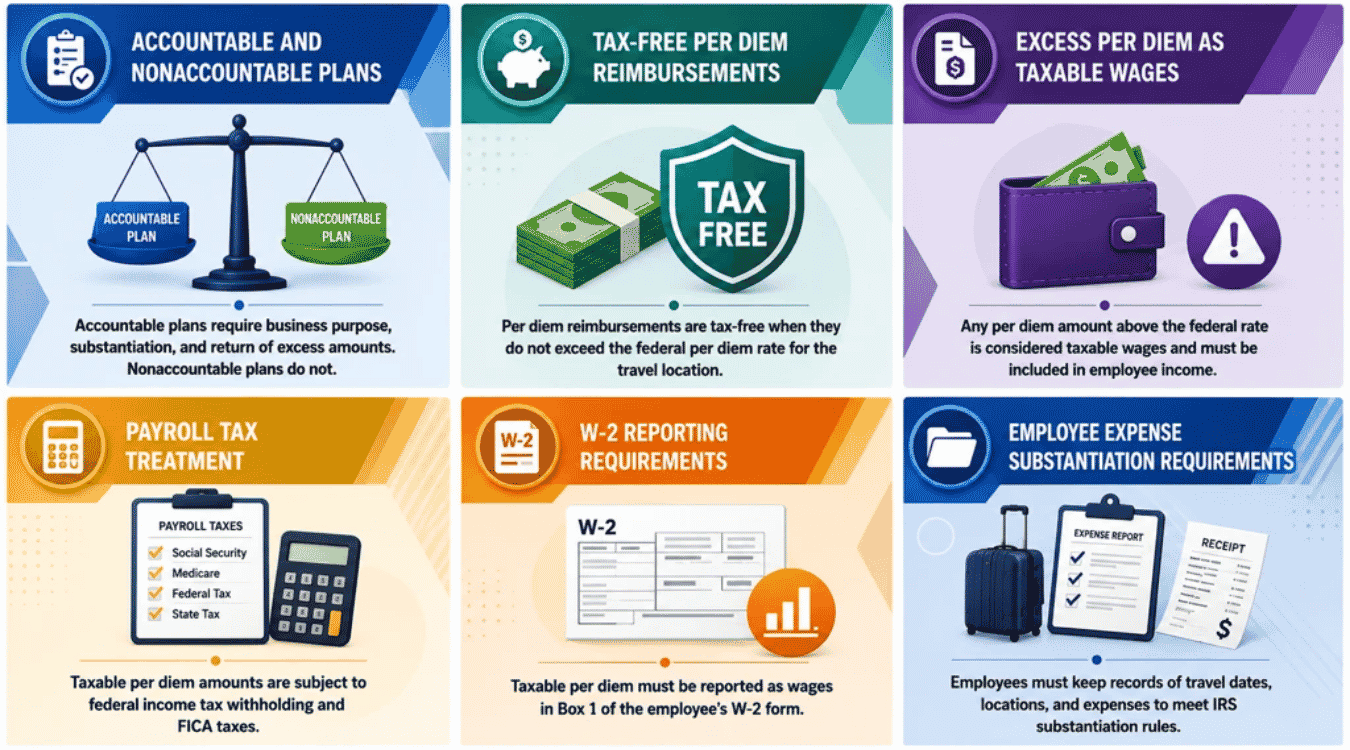
Per diem payments interact directly with payroll and tax reporting, and getting the structure wrong can turn a simple travel reimbursement into unexpected taxable income. The plan type a company uses determines almost everything about how these payments show up on a paycheck or a W-2. These are exactly the kind of details that trip up employer payroll taxes filings if they're handled loosely.
Accountable And Nonaccountable Plans
An accountable plan requires employees to substantiate their travel with proof of the trip's time, place, and business purpose, then return any unused advance to the company. A nonaccountable plan skips those requirements entirely, which means the IRS treats the full payment as regular wages regardless of how the money gets spent. Most employers structure their per diem programs as accountable plans specifically to avoid the tax consequences that come with the nonaccountable version.
Tax-Free Per Diem Reimbursements
Per diem paid at or below the federal rate under an accountable plan stays tax-free to the employee, with no income tax or payroll tax withheld. This applies to GSA rates, Department of Defense rates for Hawaii and Alaska, and Department of State rates for foreign travel, as long as the payment doesn't exceed the applicable published amount.
Excess Per Diem As Taxable Wages
Any amount paid above the federal rate becomes taxable wages for the portion that exceeds the limit, even if the rest of the payment stays within bounds. A company paying $200 per day when the standard rate caps at $178 creates $22 per day in taxable income, which needs to run through payroll like ordinary wages. Employers should set up payroll deductions correctly to capture this taxable amount.
Payroll Tax Treatment
Taxable excess per diem gets treated the same way regular wages do for payroll tax purposes, meaning it's subject to Social Security, Medicare, and federal income tax withholding. Properly substantiated per diem within the federal rate skips this treatment entirely, since it's classified as a reimbursement rather than compensation. Getting this distinction wrong is one of the more common payroll taxes mistakes employers make.
W-2 Reporting Requirements
Per diem paid within federal limits under an accountable plan doesn't need to appear as income in Box 1 of an employee's W-2. Excess amounts, however, do need to be reported as wages, and employers should keep clear internal records showing which portion of each payment fell above the rate.
Employee Expense Substantiation Requirements
Employees still need to document the basics of each trip, even under a flat-rate per diem system. Recording the date, destination, and business purpose of travel satisfies the IRS substantiation requirement, and this paperwork should be kept on file well past the September close of the fiscal year in case a return ever gets reviewed.
IRS Per Diem Rules And Employer Compliance
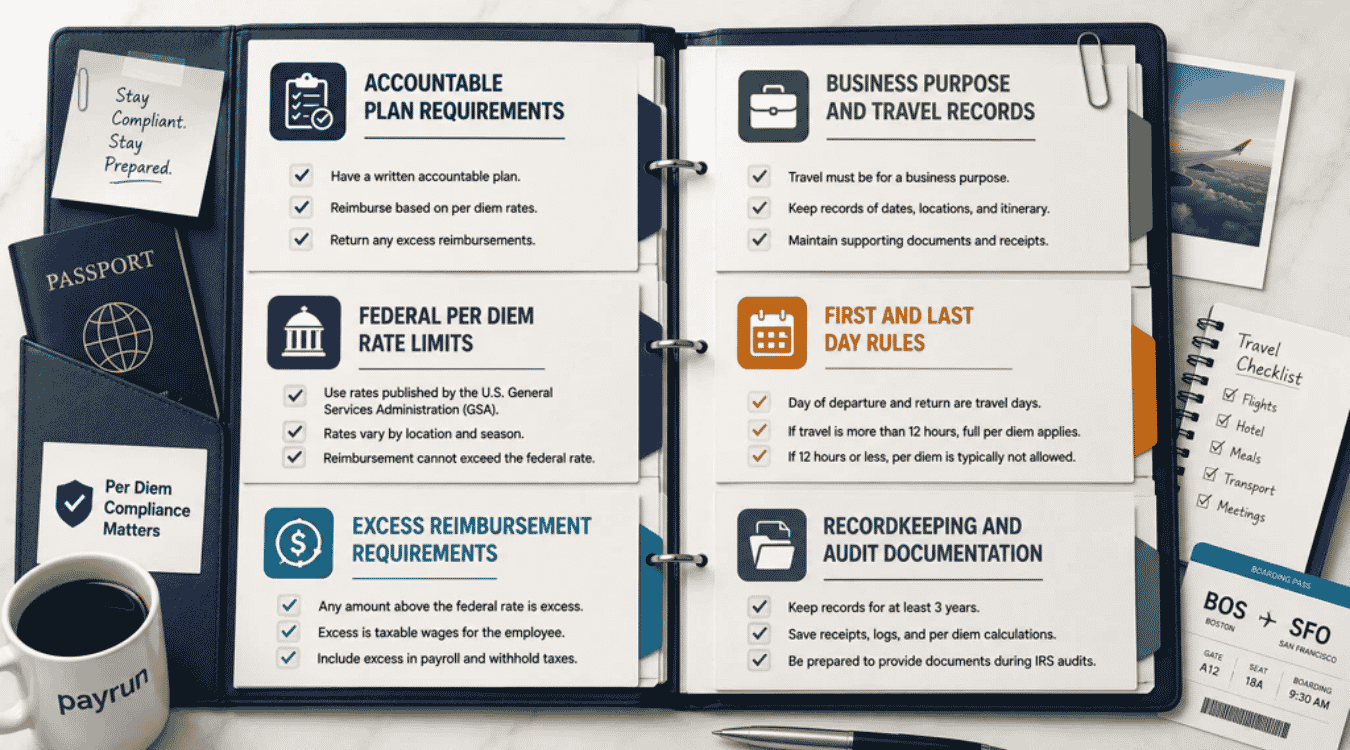
Running a compliant per diem program takes more than picking a rate and paying it out. A handful of IRS rules govern how employers structure, document, and report these payments to keep the tax-free treatment intact. Strong payroll compliance starts with getting these fundamentals right from day one.
Accountable Plan Requirements
An employer must set up an accountable plan to keep per diem tax-free, which means the plan has to require proof of business connection, timely reporting, and return of any excess advance. Companies that skip these steps end up treating per diem like regular wages, losing the tax advantage the flat-rate system was designed to provide. Running through a payroll compliance checklist before rollout catches most of these gaps early.
Business Purpose And Travel Records
Every trip needs a documented business purpose, even under a flat daily rate. Employees should record where they traveled, when the trip happened, and why it was necessary for work, since this basic paper trail supports the reimbursement if it's ever questioned later. These records matter even more once multi-state payroll enters the picture.
Federal Per Diem Rate Limits
Employers can provide per diem up to the applicable federal rate without triggering income tax or payroll tax withholding. Living costs vary significantly across different areas, so the rate that applies depends entirely on the destination city or region, not a single flat number nationwide. This becomes especially tricky for federal vs state payroll tax rules once travel crosses state lines.
First And Last Day Rules
The first and last day of any trip pay out at 75 percent of the standard M&IE rate, regardless of what time the employee actually departs or returns. This rule applies uniformly across GSA rates, the high-low method, and foreign per diem tables, so payroll teams only need to remember one formula for partial travel days.
Excess Reimbursement Requirements
Any per diem paid above the federal rate needs to be identified and reported as taxable wages, not folded quietly into the rest of the reimbursement. Employers should build a simple check into their expense process that flags payments exceeding the current rate before they hit payroll. This kind of monitoring is really just routine payroll tax compliance work.
Recordkeeping And Audit Documentation
Keeping organized records protects both the employer and the employee if a per diem program ever faces an audit. Trip dates, destinations, business purpose, and the rate applied to each reimbursement should stay on file for as long as tax law requires, giving the company clear proof that its per diem system followed the rules from day one. These same records are the first thing a payroll audit will ask to see.
How To Create An IRS Per Diem Policy For Your Business
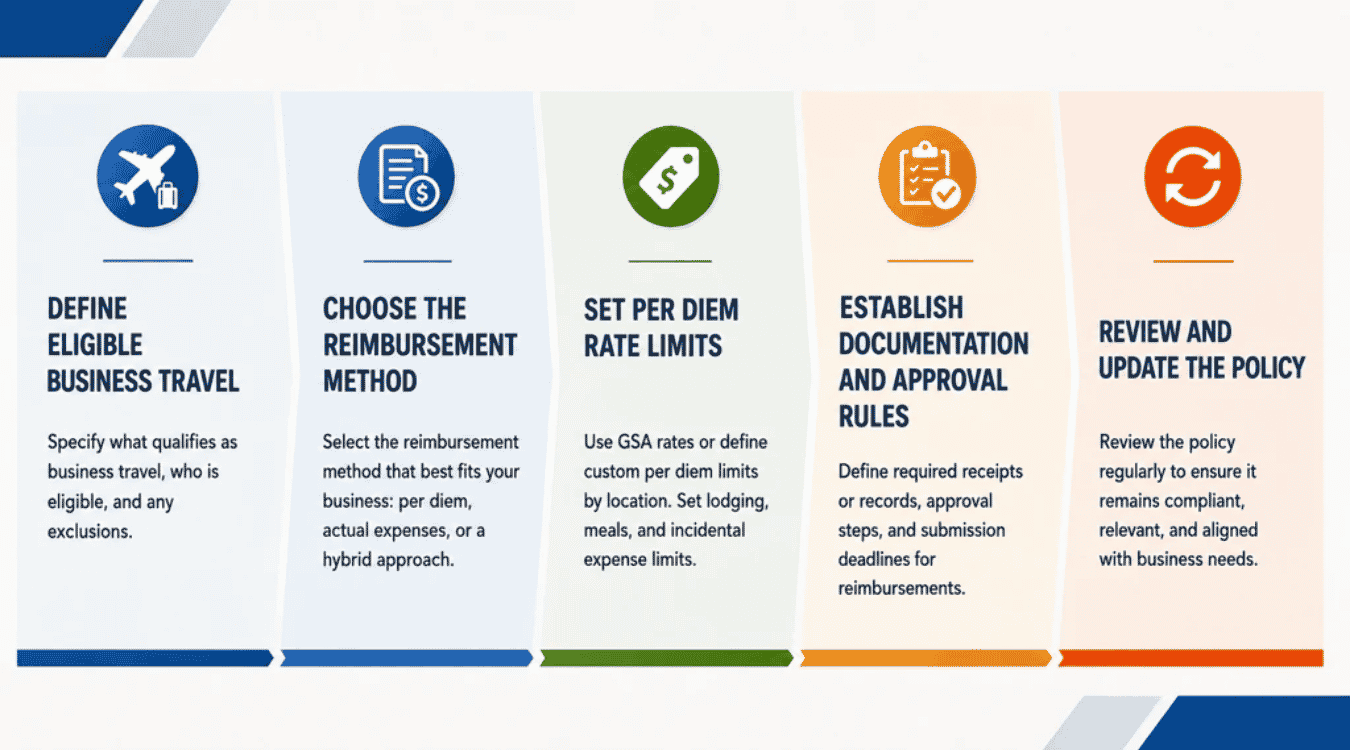
A written per diem policy keeps a company's travel program consistent and protects it from tax complications down the road. The steps below cover what needs to go into a policy before employees start submitting travel expenses under it.
Define Eligible Business Travel
Start by spelling out exactly what counts as eligible travel, since this is where confusion usually starts for employees new to a company's expense process. A policy should state the minimum distance or number of miles from the office that qualifies a trip, along with the minimum time away from home needed to trigger per diem rather than a simple local mileage reimbursement for a short same-day errand.
Choose The Reimbursement Method
Decide upfront whether the company will use GSA CONUS rates based on destination, the IRS high-low method, or actual expense reimbursement for certain trip types outside standard coverage. Some businesses mix methods, applying per diem to routine domestic travel and actual expenses when trips fall outside the continental United States. Whatever gets chosen, write it into the policy clearly so payroll and traveling employees both know what to expect before booking. This choice also affects how a business handles payroll for contractors who travel occasionally.
Set Per Diem Rate Limits
Document the specific rate the company will pay, whether that's the current standard GSA rate, a locality-specific figure, or one of the high-low tiers. Rates change based on GSA, and IRS updates roughly once a year, so the policy should reference "the current published rate" rather than hardcoding a number that will need editing every twelve months. This small wording choice saves a rewrite each time new figures come out.
Establish Documentation And Approval Rules
Spell out what employees need to submit before a trip and after one, including expected travel dates, destination, and business purpose written in plain language. A simple manager approval step before booking helps catch issues early, rather than finding a problem once an employee is already away and can't easily adjust plans. This also gives finance a heads-up on upcoming travel costs.
Review And Update The Policy
Set a recurring review, ideally each fall when new GSA and IRS rates typically publish for the coming fiscal year, so the policy stays current without anyone needing a reminder. A policy left untouched for several months, or worse, several years, tends to fall out of step with current rates, creating gaps between what the document says and what payroll actually pays out to employees.
Final Thoughts
Per diem rates simplify one of the more tedious parts of running a business: reimbursing employees for travel without drowning in receipts. Whether a company follows the GSA's standard rates, applies the IRS high-low method, or builds a custom policy around actual expenses, the goal stays the same. Pay travelers fairly, keep the process tax-compliant, and avoid year-end payroll surprises.
The 2026 figures held steady from the prior year, which gives finance teams a rare stretch without a rate change to chase down. That stability is a good moment to write or update a clear per diem policy if one doesn't already exist. A documented process, paired with the current federal rates, keeps travel reimbursement simple for everyone involved, from a first-time business traveler to the payroll team processing the report.