55+ Structured Interview Questions With Examples And Scorecards
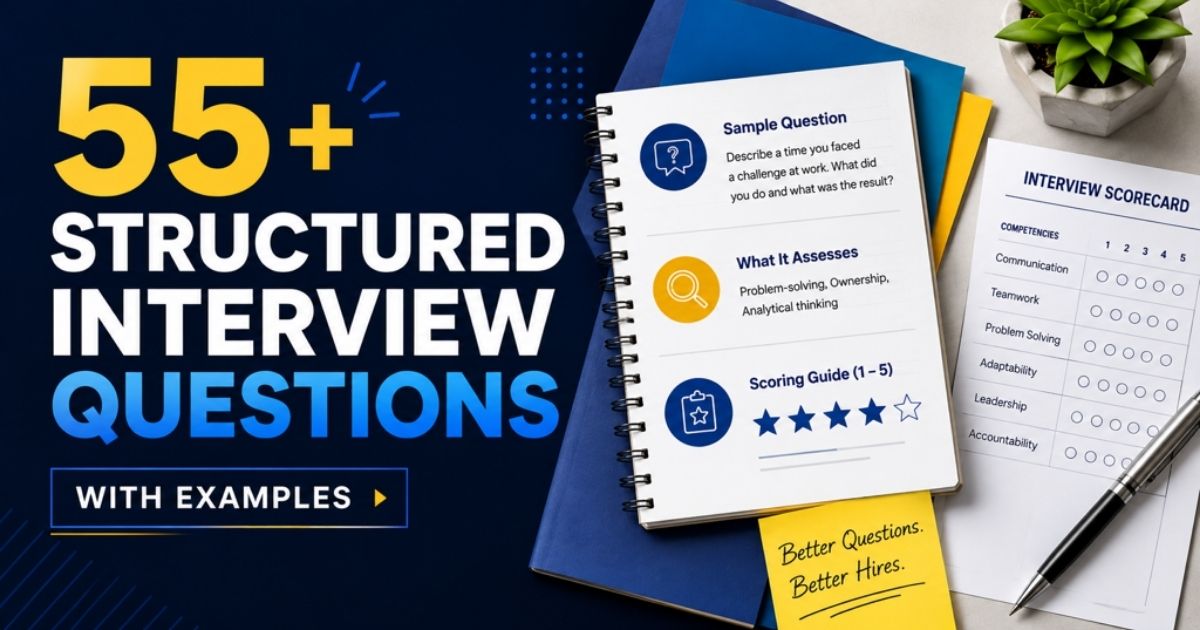
Table of Contents
Hiring the wrong person costs more than a bad quarter. It costs onboarding time, team morale, and often another six months spent posting the same job again. Structured interview questions fix the biggest reason hiring goes wrong: inconsistent evaluation. When every candidate answers the same set of questions, scored the same way, gut feelings stop deciding who gets hired.
Below you will find 55+ structured interview questions organized by category, real example answers to compare against, and printable scorecards for rating each response fairly. Small business owners rarely have a dedicated recruiter running interviews, so these questions and scorecards are built to work without one. Grab the ones that fit your open role and start building a consistent process today.

What Are Structured Interview Questions
Structured interview questions follow a fixed script that every candidate answers in the same order. Instead of a free-flowing chat, structured interviews rely on a prepared list so hiring managers can compare responses side by side. Job interviews built this way remove much of the guesswork that comes from casual conversation, giving small teams a fairer read on who actually fits the role.
Many prompts ask a candidate to describe a time they solved a problem, missed a deadline, or handled conflict at work. Difficult structured interview questions push past rehearsed answers, revealing how someone actually thinks under pressure rather than what they memorized beforehand.
55+ Structured Interview Questions By Competency
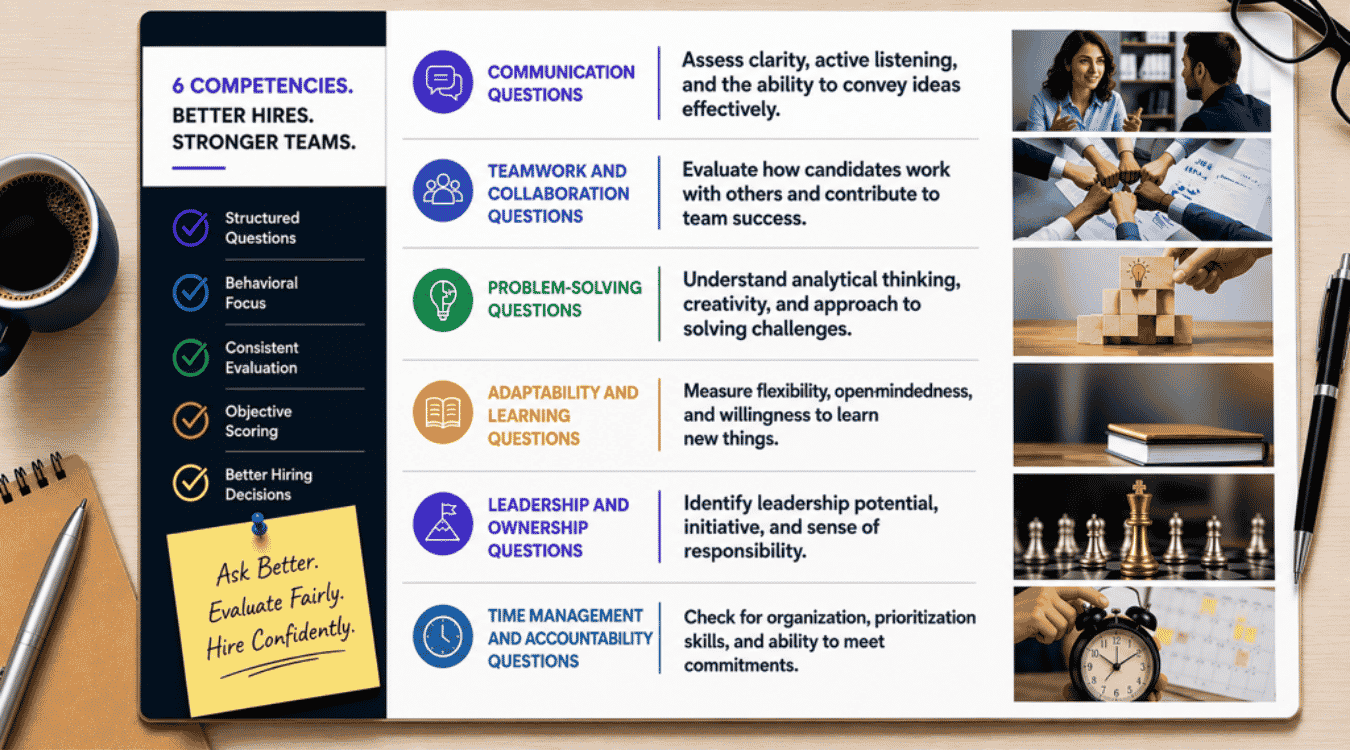
A strong structured interview format covers more than one skill area. The sections below group 57 questions into six competencies so hiring managers can build a complete, fair interview process for any role.
Communication Questions
Clear communication touches every part of a job, from client emails to daily standups. These questions ask candidates to explain how they get their point across, especially when the message is hard to deliver. Hard and soft skills both show up here, since a candidate needs to explain technical ideas in plain language.
- Tell me about a time you had to explain a complicated idea to someone with no background in it.
- Describe a time you had to deliver bad news to a client or coworker.
- Walk me through a time your message was misunderstood. How did you fix it?
- Tell me about a time you had to persuade a team to accept your idea.
- Describe a situation where you had to give clear instructions to a group.
- Tell me about a time you received negative feedback on how you communicated something.
- Describe how you keep a remote team updated on project status.
- Tell me about a time you had to communicate a decision you personally disagreed with.
- Walk me through how you handle a conversation with an upset customer.
- Describe a time you simplified a technical process for a non-technical audience.
Teamwork And Collaboration Questions
No job happens in a vacuum, so behavioral questions about teamwork reveal how a candidate actually works alongside others rather than how they claim to. This matters most when scaling a team quickly. Look for specific examples, not general statements about being "a team player."
- Tell me about a time you worked with a difficult teammate.
- Describe a project where you had to rely heavily on other people to succeed.
- Tell me about a time you disagreed with a team decision. What did you do?
- Walk me through a time you helped a struggling coworker meet a deadline.
- Describe a time your team missed a goal. What was your role in that?
- Tell me about a time you had to collaborate with a department outside your own.
- Describe how you handle a teammate who isn't pulling their weight.
- Walk me through a time you gave credit to a team member for your idea.
- Tell me about a time trust broke down within a team you were on.
Problem-Solving Questions
Situational questions work well here because they show how someone thinks through a new problem in real time, not just how they recall a past one. A mix of both keeps the interview process balanced. This kind of problem-solving comes up constantly when tackling everyday HR challenges.
- Tell me about a time you solved a problem with no clear right answer.
- Describe a situation where you had limited information but still had to make a call.
- Walk me through how you would handle a sudden drop in website traffic.
- Tell me about a time you found a creative solution to a budget constraint.
- Describe a problem you noticed that nobody else had caught yet.
- Tell me about a time your first solution to a problem didn't work.
- Walk me through how you would prioritize three urgent tasks due the same day.
- Describe a time you had to troubleshoot an issue with almost no support.
- Tell me about a time you simplified a process that was more complicated than it needed to be.
- Describe how you would handle a client asking for something outside your scope.
Adaptability And Learning Questions
Small businesses change direction often, so hiring managers should assess candidates on how they respond to shifting priorities rather than just steady routines.
- Tell me about a time your role changed suddenly. How did you adjust?
- Describe a time you had to learn a new tool or skill quickly.
- Walk me through a time a project's direction changed midway through.
- Tell me about a time you had to work outside your usual job duties.
- Describe a time you made a mistake because a process was new to you.
- Tell me about a time you had to unlearn an old habit at work.
- Walk me through a time you adjusted your plan after new information came in.
- Describe how you keep up with changes in your industry.
- Tell me about a time you were asked to do more with fewer resources.
Leadership And Ownership Questions
Leadership questions matter for every level of hiring, not just management roles. Someone who takes ownership of their work tends to raise the standard of the whole hiring process around them. Traits like these are also what to look for when building out succession planning.
- Tell me about a time you took charge of a project without being asked.
- Describe a time you had to hold a teammate accountable.
- Walk me through a time you made a decision that wasn't popular.
- Tell me about a time you mentored someone at work.
- Describe a time you owned up to a mistake in front of your team.
- Tell me about a time you had to motivate a team through a rough stretch.
- Walk me through a decision you made that affected people outside your immediate team.
- Describe a time you pushed back on a request from leadership.
- Tell me about a time you had to fire, discipline, or redirect an underperformer.
Time Management And Accountability Questions
An unstructured interview often skips this competency entirely, yet missed deadlines are one of the most common reasons small teams fall behind. These questions dig into how candidates actually manage their workload. Many of these habits get easier to verify once reliable time tracking is in place.
- Tell me about a time you missed a deadline. What happened next?
- Describe how you organize your day when everything feels urgent.
- Walk me through a time you had to say no to a request because of your workload.
- Tell me about a time a project ran long. What caused the delay?
- Describe a time you had to juggle multiple deadlines in the same week.
- Tell me about a time you delegated part of a task to hit a deadline.
- Walk me through how you track your own progress on a long project.
- Describe a time you asked for help because you were falling behind.
- Tell me about a time you finished early. What made that possible?
- Describe a habit you use to stay accountable without someone checking in on you.
Structured Interview Questions For Different Roles
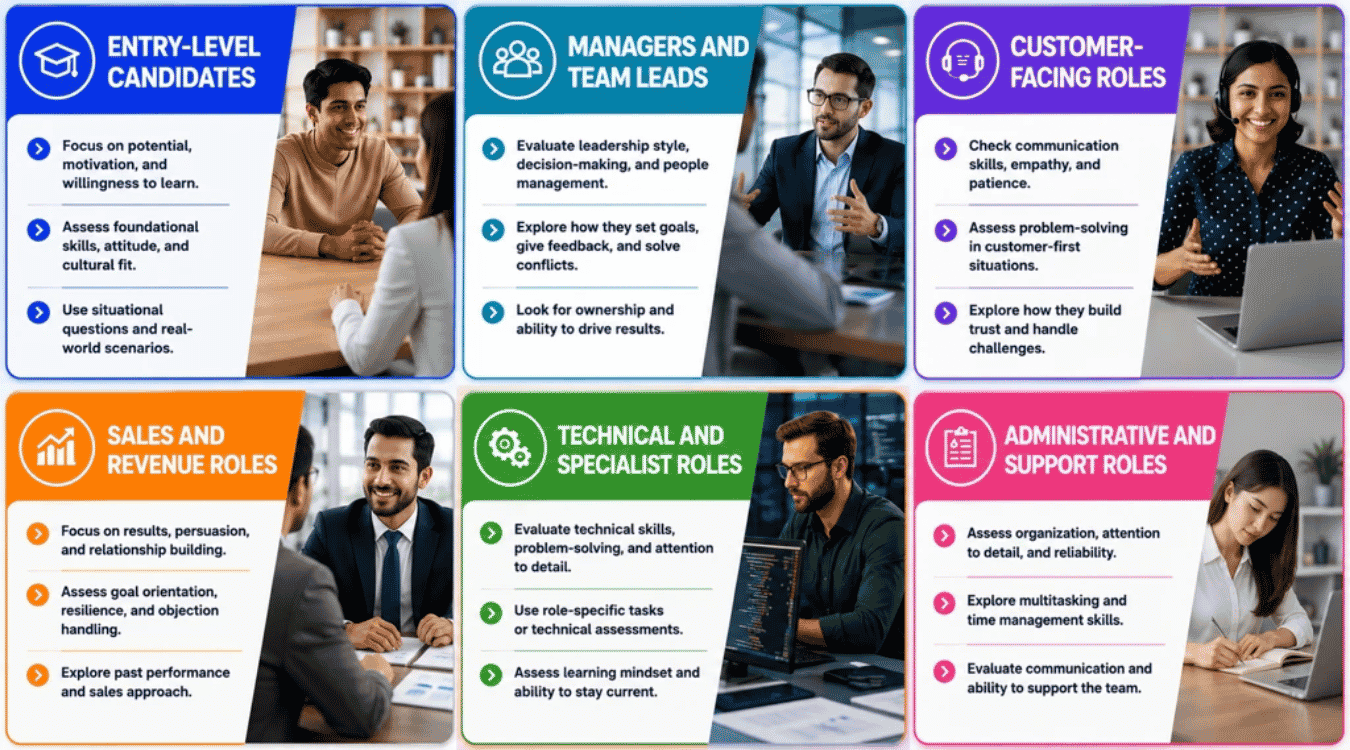
Every position has a different skill profile, so the best structured interviews adjust their predetermined questions to match. Keeping environmental conditions held constant across candidates for the same role stays just as important as picking the right questions.
Entry-Level Candidates
Candidates with little to no work history often need questions that reach into school projects, internships, or volunteer roles. Hiring managers should write questions that focus on attitude and potential rather than years of experience. This attitude-first approach lines up closely with skills-based hiring.
- Tell me about a group project where you had to contribute under a tight deadline.
- Describe a time you had to learn something new fast for a class or job.
- Walk me through a task you completed with very little guidance.
- Tell me about a time you asked for feedback on your work.
- Describe a moment you felt proud of something you built or finished.
Managers And Team Leads
Leadership roles call for questions that dig into how a candidate handles people, not just tasks. Strong answers usually show real problem-solving skills applied to a team situation rather than a solo project. These same signals tend to resurface later in a formal performance review.
- Tell me about a time you had to manage a team member's underperformance.
- Describe a decision you made that your team initially resisted.
- Walk me through how you handled two direct reports who disagreed with each other.
- Tell me about a time you had to deliver a hard message to your own manager.
- Describe how you set priorities for your team during a busy quarter.
Customer-Facing Roles
Anyone dealing directly with customers needs composure under pressure and a steady way of handling complaints. Ask about a time they received negative feedback from a customer and how they responded in the moment. How a candidate handles these moments says a lot about long-term employee retention.
- Tell me about a time a customer was upset and how you calmed the situation.
- Describe a time you had to say no to a customer request.
- Walk me through a call or interaction that didn't go the way you planned.
- Tell me about a time you turned around a bad customer experience.
- Describe how you stay patient when a customer repeats the same complaint.
Sales And Revenue Roles
Sales interviews benefit from questions that reveal how a candidate handles rejection and closes deals under pressure. Compare answers against top-scoring answers that include real numbers, a clear process, and a specific outcome. A strong sales hire also deserves a structured employee onboarding plan to ramp up quickly.
- Tell me about a deal you lost. What did you learn from it?
- Describe your process for following up with a cold lead.
- Walk me through your best sales win and what made it work.
- Tell me about a time a client tried to negotiate you down. How did you respond?
- Describe how you handle a long sales cycle without losing motivation.
Technical And Specialist Roles
Technical hires often answer a research question or work through a sample problem live during the interview. Ask for examples of structured interview scenarios drawn directly from their past projects rather than hypothetical situations. Logging these details in an applicant tracking system keeps every hiring panel aligned.
- Tell me about a bug or issue that took much longer to fix than expected.
- Describe a technical decision you made that you would change today.
- Walk me through how you would explain a technical tradeoff to a non-technical stakeholder.
- Tell me about a time you had to learn a new system or tool on the job.
- Describe a project where your specialized skill made the biggest difference to the outcome.
How To Create Structured Interview Questions
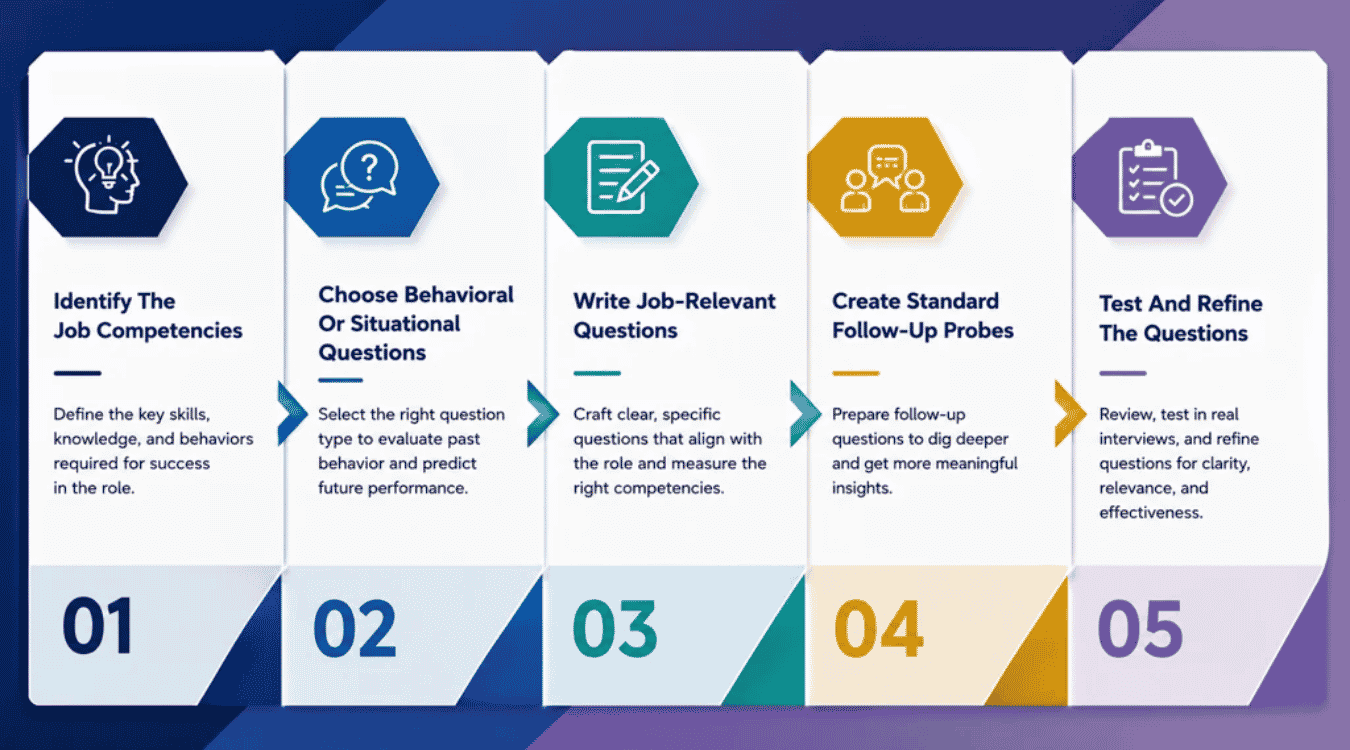
Building a solid interview guide takes more than pulling questions off a list online. Good structured interviews start with the job itself, move through a clear question-writing process, then get refined once real interviewer asks reveal which prompts actually work.
Identify The Job Competencies
Start with what the role actually requires, not a generic list of personality traits. Pull real responsibilities and expected outcomes from the job description, then narrow them down to five or six competencies that matter most for success in the position. A mix of hard skills and soft skills usually gives the fullest picture of a strong hire. Good recruitment software can help surface these competencies straight from the job posting.
Choose Behavioral Or Situational Questions
Behavioral questions ask what a candidate actually did in their last job, drawing out real proof of how they behave under pressure. Situational questions flip that around, asking what someone would do if faced with a realistic scenario, like a tight deadline or a difficult client, that hasn't happened to them yet. Most strong interview guides use a blend of both, since past behavior predicts future performance while hypothetical scenarios test judgment on the spot.
Write Job-Relevant Questions
Every question should tie back to exactly one competency from your list. Vague prompts produce vague answers, so aim for specific scenarios tied to a new project, a missed goal, or a real conflict rather than abstract ideas about "leadership" or "communication." Keeping each question anchored to uniform context across every candidate makes comparing responses far easier later.
Create Standard Follow-Up Probes
Decide your acceptable follow-up prompts before interviews begin, not in the moment. Interviewers naturally want to dig deeper when an answer feels thin, but improvised follow-ups break the consistency that makes a structured format worth using. Prewritten probes, like asking a candidate to walk through the STAR technique for a specific example, keep every interviewer asking in the same direction without steering answers toward perfect answers that sound rehearsed.
Test And Refine The Questions
Run your question set through a few real interviews before locking it in for good. Watch for prompts that produce nearly identical answers from every candidate, since those questions rarely help hiring decisions. Set your scoring criteria and rating system ahead of time too, then drop or rewrite any question that fails to separate strong candidates from weak ones once real scoring system data comes in. Feeding those results into ongoing performance tracking closes the loop between hiring and on-the-job success.
How To Score Structured Interview Answers
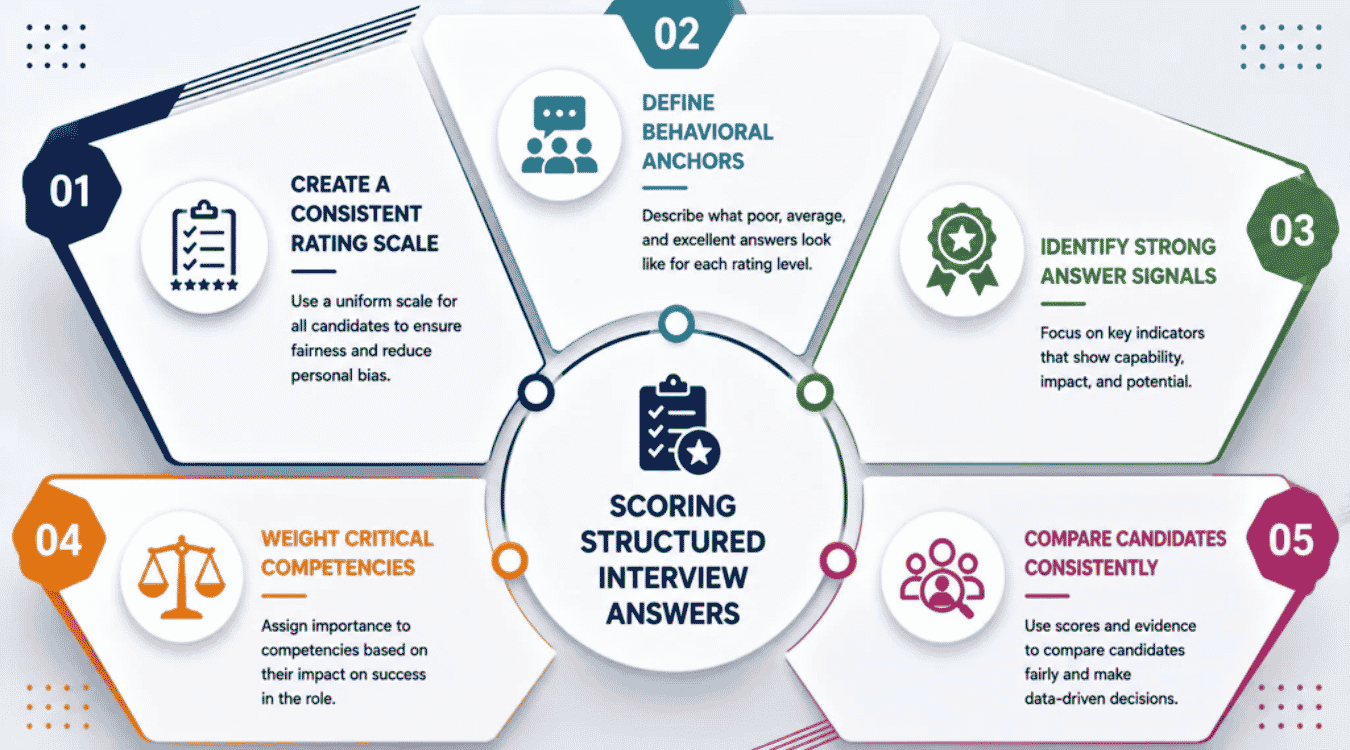
Asking the same set of questions means little without a fair way to determine which candidate performed best. A scoring system turns each interview from a gut-feel conversation into evidence an interviewer can easily compare across every applicant.
Create A Consistent Rating Scale
A simple 1 to 5 scale works well for most small teams, giving enough range to separate a strong answer from a weak one without overcomplicating the review. Every interviewer should use the same scale on the same set of questions, since mixing scoring methods across a hiring panel makes results impossible to compare later.
Define Behavioral Anchors
Numbers alone leave too much room for interpretation, so each score needs a written meaning attached to it. Behavioral anchors describe exactly what a 2 looks like versus a 4, removing the guesswork that usually creeps into unscored interviews.
Example:
Score | Meaning |
|---|---|
1 | No relevant example or evidence |
2 | Weak example with limited ownership |
3 | Relevant example with acceptable outcome |
4 | Strong evidence and clear reasoning |
5 | Exceptional evidence with measurable impact |
Identify Strong Answer Signals
Strong answers share a few traits regardless of the question asked. Look for specific examples rather than vague summaries, clear personal contribution rather than "we" language that hides individual effort, and sound reasoning behind the decisions described. A candidate who explains how they experienced conflict with a co-worker and walked away with a lesson learned usually scores higher than one who simply says the problem "worked itself out."
Weight Critical Competencies
Not every competency deserves equal weight for every role. Hard skills might carry more weight for an engineering position, while a customer-support role leans harder on communication and patience under pressure. Assigning weight ahead of time keeps the best candidate for the role rising to the top of the results, instead of a generalist who scores evenly but unremarkably across every category.
Compare Candidates Consistently
Interviewers should score each answer immediately after the interview, before group discussion muddies individual impressions. This keeps environmental conditions fair across every candidate and stops one confident personality from swaying the whole panel's memory of how the interview actually went. Following these steps consistently is a cost effective way to assess talent without hiring an outside recruiter, and it gives hiring managers a clear understanding of exactly why one candidate outscored another.
How To Conduct A Structured Interview
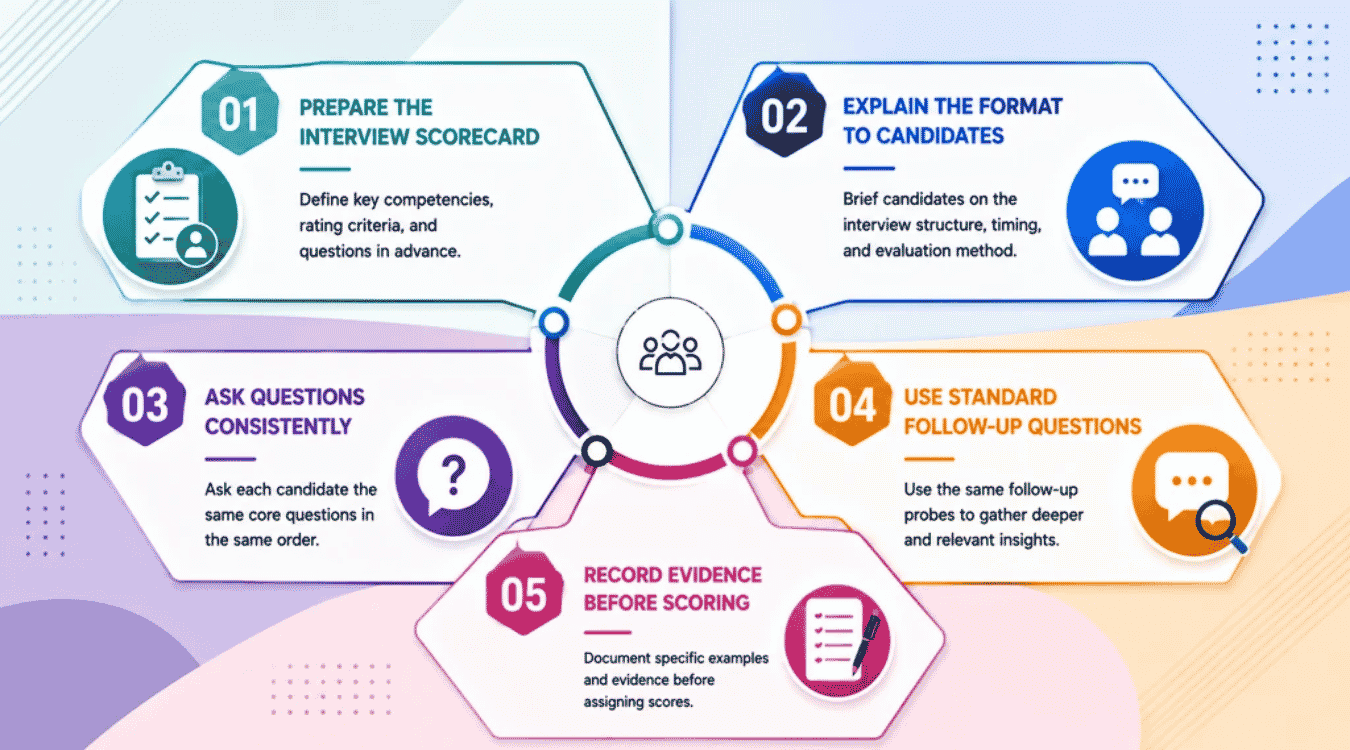
Writing strong questions solves only half the problem, since the actual interview still needs a consistent process to protect fairness. The steps below help any hiring manager conduct interviews that feel professional to candidates while producing results that are easy to compare afterward.
Prepare The Interview Scorecard
Every interviewer on the panel needs the same scorecard before the first candidate walks in. Handing out a shared document with the exact questions asked, the scoring scale, and space for notes keeps strong parity across interviewers who might otherwise focus on completely different things during the conversation.
Explain The Format To Candidates
Candidates sometimes tense up when they notice an interviewer taking detailed notes or reading from a script. A quick explanation up front, letting the candidate know that questions follow a set structure and notes support fair evaluation, keeps the conversation feeling less like an interrogation and more like a normal exchange.
Ask Questions Consistently
Preserve the wording and order of your specific questions as closely as possible across every candidate for the same role. Small changes in phrasing can shift how a candidate interprets a prompt, so reading questions the way they were written protects the comparison you're trying to build.
Use Standard Follow-Up Questions
Candidates often need a nudge to describe specific situations in more depth, and that's fine as long as the nudge stays standard. Prewritten follow-ups work well here. Asking every candidate to expand on a difficult situation the same way keeps one person from getting more room to shine than another.
Record Evidence Before Scoring
Write down what the candidate actually said before forming an opinion about how the interview went overall. Separating raw responses from personal impressions gives a much clearer view of a candidate's real skills, rather than a memory colored by tone of voice or how comfortable the conversation felt in the room.
Common Structured Interview Mistakes To Avoid
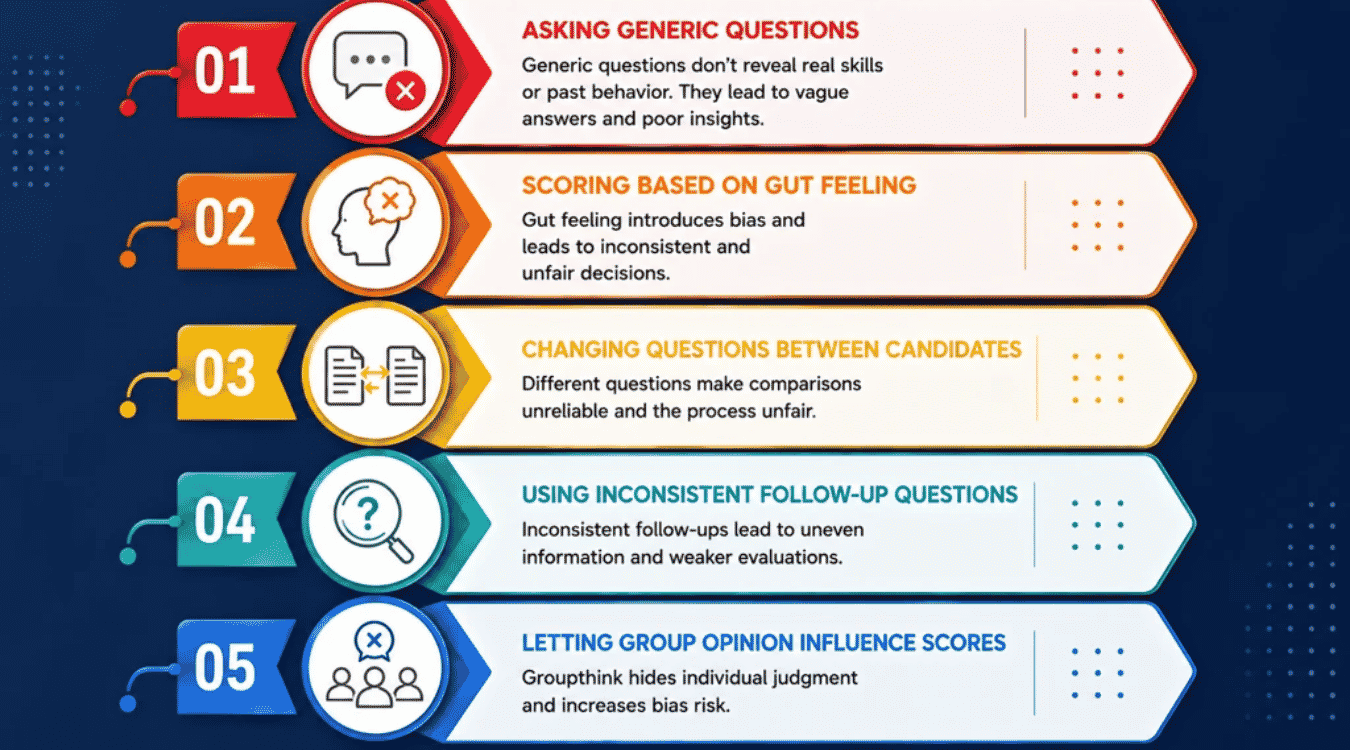
Even a well-planned structured interview can lose its value the moment a hiring team drifts from the method. The mistakes below show up often in small business hiring and quietly undo the fairness a structured format is supposed to protect.
Generic Interview Questions
A generic question rarely tells a hiring manager anything useful about job performance. Asking someone to "describe their greatest strength" produces a rehearsed answer for almost every candidate, while a question tied to a real project or a specific skill reveals far more. Before an interview, prepare each question with one clear purpose in mind, and cut anything that doesn't connect back to the job itself.
Gut Feeling Scoring
Handing out a number without predefined criteria defeats much of the purpose behind building a structured process in the first place. A score should reflect specific detail from the candidate's answer, not a general sense of whether the conversation felt comfortable. Teams that skip this step often end up back where they started, hiring on instinct instead of evidence.
Inconsistent Questions Between Candidates
Swapping in other questions partway through a hiring round, even with good intentions, breaks the comparison the whole process depends on. One candidate answering an easier prompt than another makes it nearly impossible to judge them side by side. Sticking to the same set of questions for every candidate applying to a role keeps results honest.
Inconsistent Follow-Up Questions
Improvised probing can hand one candidate a real advantage over another without anyone noticing in the moment. A company that lets interviewers freestyle their follow-ups risks giving a confident talker more room to shine than a quieter candidate with equally strong answers. Writing standard follow-up prompts ahead of time closes that gap.
Group Opinion Bias In Scoring
Letting the loudest voice in the room shape everyone else's score introduces bias before independent judgment gets a fair chance. Requiring each interviewer to score candidates on their own, before any group discussion begins, protects the integrity of a structured method. Once scores are compared, the conversation can shift to explaining the reasoning behind them.
A structured process should always stay anchored to job relevance, steering clear of questions about age, family status, religion, disability, or other personal topics unrelated to the role. Keeping written records of questions asked and scores given also matters, since documentation supports fair hiring decisions if a process is ever reviewed. Hiring laws vary by location, so it's worth confirming applicable requirements with legal counsel rather than relying on general guidance alone.
Final Thoughts
Structured interview questions turn hiring from a series of gut calls into a process built on real evidence. When every candidate answers the same questions, scored against the same criteria, the best fit for the role becomes much easier to spot and defend later.
Start small. Pick one open role, build a question set from the competencies that actually matter for it, and create a simple scorecard before the first interview. Consistency matters more than volume, so five well-chosen questions scored fairly will tell you more than twenty scattered ones asked differently to each candidate.
Small teams rarely have room for a bad hire. A structured process, even a basic one, protects the time and budget every small business depends on to grow.