Automated Candidate Matching Approach For High-Quality Hiring
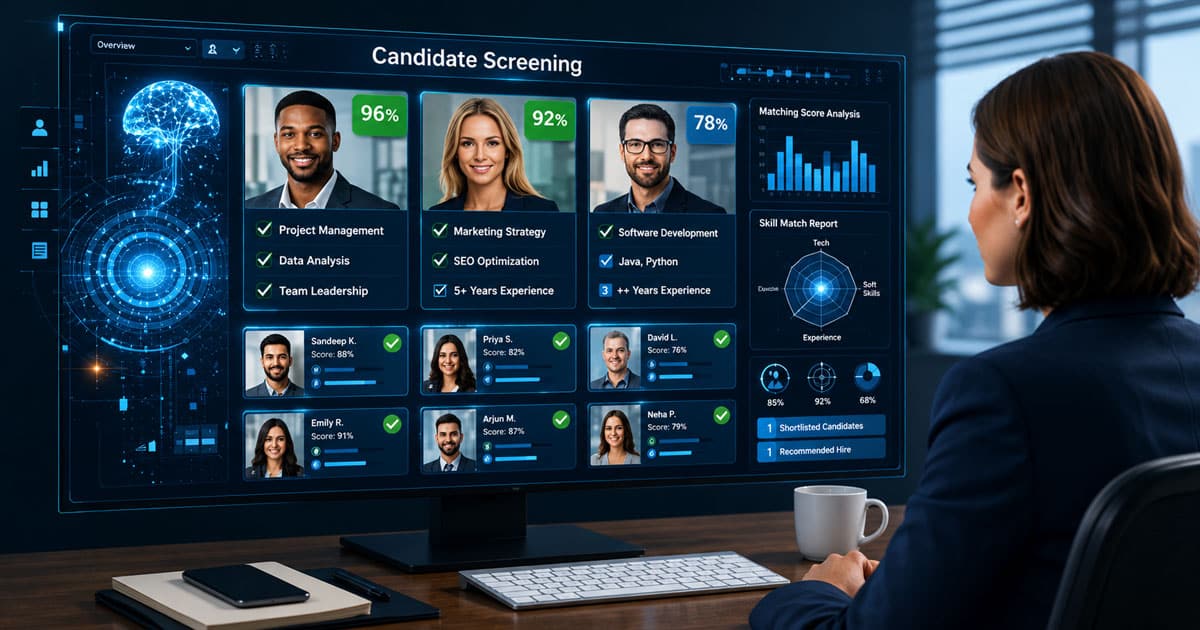
Table of Contents
Automated candidate matching helps companies find the right candidates faster and with better accuracy. Research shows it can reduce time-to-hire by up to 50% and lower recruitment costs by nearly 30%. Organizations that use AI candidate screening also report a 35% improvement in hire quality. Predictive analytics and machine learning improve candidate matching accuracy by about 67%. AI-powered systems analyze candidate profiles, job descriptions, and historical hiring data to identify qualified candidates and rank candidates based on job requirements.
Modern recruitment relies on automated candidate screening to simplify the recruiting process. AI-powered candidate matching helps hiring teams find top candidates quickly and reduce manual work. This article explains how candidate matching works, key components of candidate screening tools, major benefits for high-quality hiring, and practical strategies for improving the entire recruitment process.

What Is Automated Candidate Matching
Automated candidate matching uses AI-powered systems to match candidates with open roles based on skills, experience, and job requirements. A matching engine reviews candidate profiles, job titles, and the job description to identify qualified candidates and best fit candidates. Many platforms rely on resume parsing, natural language processing, and semantic matching to understand structured data from resumes and job posts. AI candidate matching tools also analyze historical hiring data and career trajectories to improve matching accuracy and match quality.
Modern matching tools use machine learning and advanced AI to rank candidates based on experience, transferable skills, and company culture. AI-powered candidate matching helps hiring managers and hr teams identify top talent, high-potential candidates, and passive candidates within a large talent pool.
Automation removes time-consuming tasks from the recruiting process and supports better candidate engagement. Recruiters find candidates quickly and reduce irrelevant outreach. The hiring team can focus on human judgment while AI systems support the entire hiring process and the entire recruitment process, which leads to successful recruitment and stronger hiring accuracy in modern recruitment.
Core Components Of Automated Candidate Matching Systems
Modern automated candidate matching systems rely on four interconnected technical components that transform unstructured resume data into applicable hiring insights. These elements work together to parse documents, extract relevant information, match candidates semantically, and generate accurate rankings.
Natural Language Processing For Resume Analysis
Natural language processing is the foundation for resume parsing. An AI resume parser processes a three-page CV in 2.3 seconds. The system handles three distinct document types differently: native digital documents preserve text while maintaining formatting cues like headers and bullet points, text-based PDFs extract content while preserving spatial relationships, and image-based PDFs require OCR processing to recognize characters from pixel data.
Resume data extraction systems today use deep learning OCR models trained on document layouts to identify text regions, recognize characters, and reconstruct original structure. OCR accuracy affects downstream skill extraction. A 97% character recognition rate sounds impressive until you think about a typical resume containing over 3,000 characters. Quality parsers implement post-OCR correction using language models trained on technical terminology.
Skills And Experience Extraction
Named Entity Recognition identifies and classifies key elements in unstructured resume text. NER algorithms detect and group elements like skills, job titles, companies, educational qualifications, and dates into preset categories. NLP resume parsing today uses transformer-based models trained on millions of annotated resumes. These models learn contextual patterns that rule-based systems miss.
A trained NER model understands that "Python" following "Monty" in an interests section carries a different meaning than "Python" following "developed in" within experience descriptions. The contextual placement of words helps NER models separate similar terms used differently.
Taxonomy mapping transforms raw skill lists into standardized, searchable data. Candidates describe similar skills in dozens of different ways, so skill taxonomy mapping solves this by linking variations to canonical skill identifiers. Taxonomy systems organize skills hierarchically and enable both exact matching and intelligent broadening. A search for "Frontend Development" skills returns candidates with React, Vue, Angular, and related expertise.
Semantic Matching Algorithms
Semantic matching goes beyond matching keywords to understand context and meaning. These algorithms recognize synonyms, related terms, and industry jargon. A job description asks for "software development," and a resume mentions "coding," "programming," or "engineering." Semantic search understands that these terms are relevant and related.
Cosine similarity calculates the angular distance between two vectors in multi-dimensional space to compare resume and job description vectors. Scores range from 0 to 1, with higher numbers showing better matches. This method focuses on how vectors point rather than their size to find candidates whose skills match job needs.
Scoring And Ranking Mechanisms
AI analyzes skills, experience, responses, and role-specific weights to score and rank candidates. Each factor receives a numerical score, typically 0 to 100. Not everything matters the same for every role, so weighting comes in. A senior engineer position might weight technical skills at 40%, relevant experience at 35%, education at 15%, and other factors at 10%.
The most advanced systems use multiple specialized AI agents that work together. A screening agent identifies qualifications from resumes, an assessment agent evaluates candidate responses and communication quality, and an analytics agent compares candidates across your pool. Each agent focuses on what it does best, and then they work together to produce more accurate rankings than any single model could achieve.
Key Benefits Of Automated Candidate Matching For High-Quality Hiring
Organizations adopting AI matching see measurable improvements at every stage of the recruiting process. The move from traditional methods to automated candidate matching delivers quantifiable benefits that affect hiring quality and business performance.
Faster Time-To-Hire And Cost Savings
AI recruitment automation reduces time-to-hire by 75%. Companies using AI-driven sourcing experience a 26% faster hiring cycle compared to those relying on manual processes. To cite an instance, AI tools can cut the time-to-hire by 40-60% when they analyze resumes, shortlist qualified candidates, and even schedule interviews.
The average cost-per-hire reaches around $4,700. Organizations that employ AI in recruitment witness a 27% reduction in cost-per-hire while maintaining or improving candidate quality. Companies cut their cost-per-hire by 30-40% when they implement automated candidate screening. Research shows that 77.9% of HR professionals saved money after adding AI to their hiring process.
Improved Match Quality And Retention Rates
Employees with higher match scores for the roles they were hired into exhibit much better retention rates. Stronger match employees had a retention rate of 78.40% compared to 74.17% for mixed composition groups and 66.49% for weaker match groups. This translates to an 11.91% difference in retention rates between stronger match and weaker match candidates.
AI assessments improve quality-of-hire by 32% according to industry research. Organizations using AI-driven hiring software report 40% longer employee tenure on average. Extending tenure from 2 years to 2.8 years can save around $30,000 in employee turnover-related costs for a position with a $60,000 salary.
Reduction Of Unconscious Bias
Research published in the Journal of Applied Psychology explains that AI-based assessments can reduce hiring bias by 25%, promoting a more inclusive recruitment process. Companies such as Dell Technologies reported a 300% increase in diverse candidates after implementing AI-driven metrics. Also, 72% of companies using AI for recruitment found that it helped alleviate unconscious bias.
AI-powered pre-screening reduces unconscious bias by converting personal information such as names, ages, and demographic data into non-identifiable formats. These platforms ensure shortlisting decisions are based on relevant qualifications and experience. AI-powered hiring systems prevent unconscious biases from influencing decisions by focusing on job-related criteria.
Scalability For High-Volume Recruitment
AI matches candidates with over 90% accuracy and automates the entire high-volume hiring workflow. Tools reduce manual work by 82%, allowing hiring teams to focus on candidate engagement rather than administrative tasks. Automated screening slashes shortlisting times by up to 75%, ensuring no promising candidates are overlooked due to human limitations.
High-volume recruitment amplifies manual, repetitive hiring tasks. Automation frees recruiters to focus on higher-value activities like building relationships with candidates and coaching hiring managers. Organizations can process large numbers of applications and manage multiple roles without sacrificing quality or consistency.
How Automated Candidate Screening Works Step By Step
Understanding the step-by-step workflow reveals how candidate screening tools transform raw applications into ranked shortlists. Each phase builds on the previous one to create a more efficient hiring process.
Step 1: Job Description Analysis And Requirement Extraction
AI analyzes job descriptions through advanced algorithms that distinguish specific skills, experiences, and traits needed for success. The system scans job postings to identify the most important qualifications, responsibilities, and expectations. Machine learning and natural language processing get into job market trends, past hiring data, and industry standards to refine requirements.
AI structures job descriptions by analyzing past postings that received high-quality applications. It identifies commonly used skills, responsibilities, and qualifications while checking which wording and tone appeal most to qualified candidates. Keywords are balanced naturally throughout the description to improve visibility in job board algorithms.
Step 2: Candidate Profile Parsing And Data Collection
Resume parsing automatically extracts key information such as name, contact details, work experience, education, and skills. The system handles PDF, Word, and even image files through advanced AI extraction. Automated resume parsing software reads content and converts it into structured fields that fit applicant tracking systems once uploaded.
The process starts with text extraction from various file formats and then runs natural language processing to study patterns. AI spots skills, job titles, and timelines while removing noise and duplicates. Each detail gets mapped into the right field before the system sends final data into ATS for faster resume screening.
Step 3: AI-Powered Matching And Compatibility Scoring
AI checks candidates across multiple dimensions at once. Skills matching compares required competencies against shown abilities, while experience relevance considers years worked and direct relation to your needs. The system also checks education fit, cultural indicators from application responses, job stability through tenure patterns, and location logistics.
Each factor receives a numerical score between 0 and 100. The AI multiplies each factor score by its weight and then combines everything into an overall candidate score. You might weight technical skills at 40%, relevant experience at 35%, and education at 15% for a senior engineer position.
Step 4: Automated Shortlisting And Candidate Ranking
You can view candidates ranked by their AI-powered hiring score once scoring completes. The system expresses who's most likely to succeed in the role based on skills, experience, and cultural fit. Most advanced systems use multiple specialized AI agents that work together. The screening agent identifies qualifications, an assessment agent checks responses, and an analytics agent compares candidates across your pool.
Step 5: Continuous Learning From Hiring Outcomes
The model learns from hiring outcomes continuously and tracks who was hired and who succeeded. This feedback loop means automated candidate matching evolves over time. AI learns which job descriptions resulted in high-quality hires and adjusts future postings to improve outcomes by analyzing past hiring success. Systems like Workable learn from your decisions and refine suggestions based on added or disqualified candidates, assessments, and comments.
Essential Features Of Automated Candidate Matching Tools
Selecting the right candidate matching tools requires evaluating specific technical capabilities that separate simple keyword filters from intelligent matching engines. These key features determine whether a platform delivers accurate results or creates more work for your hiring team.
Advanced Semantic Search Capabilities
Semantic search capabilities allow recruiters to find qualified candidates using natural language queries without complex filters or Boolean operators. The best solutions understand context and recognize synonyms, related skills, and transferable experiences rather than matching exact keywords. Systems supporting 50+ languages enable multilingual talent sourcing. Transparency in search results matters just as much. You need to see why certain candidates appear and adjust search criteria to influence the result rankings. Personalization options that let you customize semantic libraries based on your industry strengthen matching accuracy.
Integration With Existing ATS And CRM Systems
Continuous connection with applicant tracking systems eliminates manual data entry and keeps candidate information synchronized on platforms of all types. Leading platforms integrate with over 350 ATS systems. API connections and pre-built connectors sync with popular platforms like Workday and SuccessFactors without disrupting existing workflows. Integration extends beyond ATS to include email platforms, calendar software, LinkedIn, and skills assessment tools. This connected ecosystem automates data flow and reduces admin work.
Transparent Match Explanations And Scoring
Recruiters need to trust AI recommendations. Choose software offering transparent match scores with visual explanations for why candidates fit specific roles. Candidate scores should break down by individual skills and behaviors rather than presenting just a number. This transparency helps you make confident hiring decisions that you can explain to hiring managers and candidates.
Customizable Matching Criteria And Weights
Platforms that work let you set criteria as required, desired, or not required. Required criteria are mandatory, and desired criteria act as assets that boost rankings while not required criteria get ignored. Weighted scoring assigns different importance levels to technical skills, experience, and education based on role needs. Customization ensures the matching engine adapts to your specific hiring priorities.
Data Security And Compliance Standards
Candidate data protection requires reliable security measures. Confirm the platform complies with GDPR, CCPA, and industry-specific privacy regulations. Encryption for data at rest and in transit keeps information unreadable to unauthorized parties. Multi-factor authentication adds extra security layers, preventing unauthorized access. Role-based access controls limit who sees sensitive candidate information.
Best Practices For Implementing Automated Candidate Matching
Automated candidate matching improves hiring accuracy and speed when used correctly. Many HR teams adopt AI-powered matching tools but fail to achieve full value without a clear strategy. Strong implementation improves candidate matching quality, strengthens the talent pool, and helps recruiters identify the best candidates faster.
Define Clear Job Requirements
Clear job requirements improve candidate matching accuracy from the start. A detailed job description helps the matching engine understand job titles, required skills, experience, and company culture. Strong input data improves how AI candidate matching systems match candidates and rank candidates based on relevance.
Research from LinkedIn shows that clear job requirements increase the chance of finding qualified candidates by over 40%. Recruiters who define skills, career trajectory, and transferable skills also help AI-powered candidate matching identify best-fit candidates more accurately. The hiring team gains better visibility into promising candidates and avoids poor matches in the recruiting process.
Use Structured Candidate Data
Structured data allows AI systems to analyze candidate profiles more effectively. Resume parsing converts resumes into structured data that AI matching algorithms can analyze quickly. Natural language processing also helps systems understand job descriptions and candidate experience.
A Deloitte HR report shows that organizations using structured candidate data improve hiring accuracy by nearly 35%. HR teams gain deeper insights into the talent pool. Recruiters also reduce time spent on time-consuming tasks. Better data improves semantic matching, match quality, and the ability to identify top candidates across the entire recruitment process.
Combine AI Insights With Human Judgment
AI-powered candidate matching works best when paired with human judgment. AI tools can rank candidates quickly, but hiring managers still evaluate team dynamics, company culture, and long-term career trajectory.
A Harvard Business School study found that AI-assisted recruiting improves candidate screening speed by 75%. However, recruiters still play a key role in final selection. Human evaluation ensures that high-potential candidates and passive candidates receive proper attention. Strong collaboration between AI systems and recruiters improves successful recruitment and candidate experience.
Expand Candidate Sourcing Channels
Candidate sourcing from multiple channels strengthens automated candidate matching. Recruiters who collect candidate profiles from job boards, internal databases, and referral programs build a stronger talent pool.
According to Jobvite recruiting data, nearly 30% of hires come from employee referrals, while job boards generate the largest number of applicants. AI-powered candidate matching tools analyze this broader candidate data and help recruiters find candidates quickly. Wider candidate sourcing also increases the chance of identifying the most promising candidates and perfect candidates for open roles.
Track Matching Accuracy And Improve Models
Continuous improvement keeps automated candidate matching effective. HR teams should monitor match quality, candidate engagement, and hiring accuracy after each recruitment cycle.
McKinsey research reports that organizations that track recruitment data improve predictive hiring results by up to 50%. Historical hiring data helps machine learning algorithms refine the matching algorithm over time. Recruiters gain insights into which candidates succeed after hiring. Data-driven updates strengthen AI-powered matching tools and improve results across the entire hiring process.
How Payrun Supports Automated Candidate Matching For Hiring
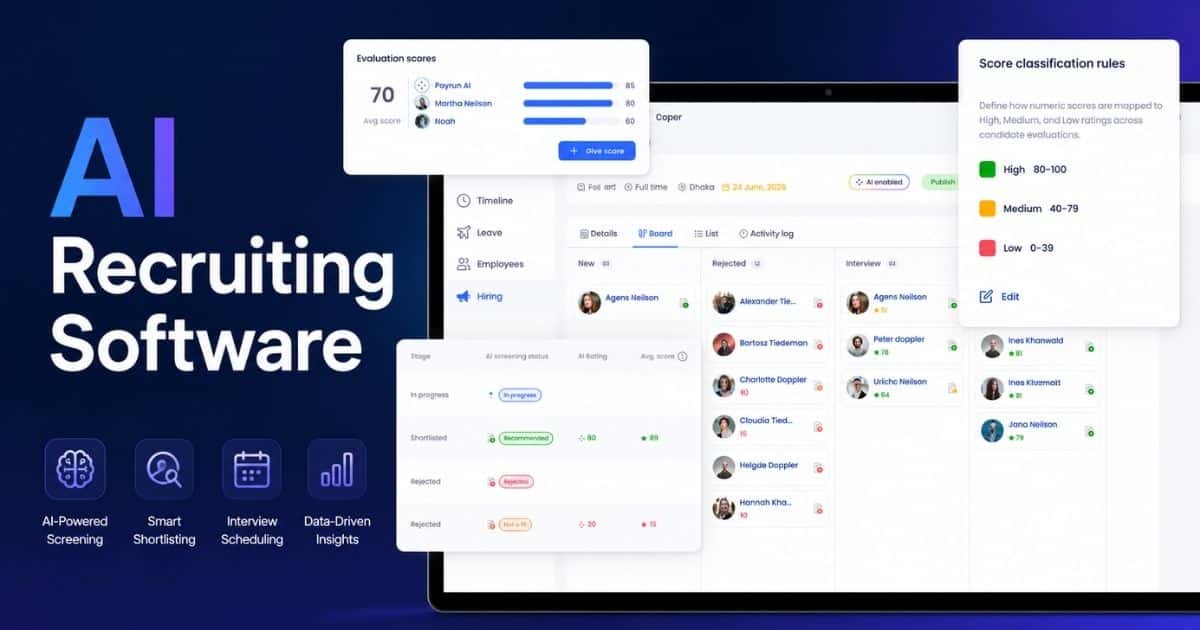
Payrun helps HR teams manage the recruiting process from one centralized platform. The system organizes candidate profiles, job descriptions, and hiring workflows so recruiters can find candidates quickly. Built-in resume screening and scoring tools analyze candidate data and highlight qualified candidates whose skills match job requirements.
AI-powered candidate matching within Payrun reviews resumes, ranks candidates based on suitability, and identifies the best candidates for each role. The platform also supports job posting, candidate sourcing, and application management, which helps hiring managers move promising candidates through the hiring process faster.
Automation reduces repetitive tasks in the entire recruitment process and improves candidate engagement. HR teams gain clearer insights into the talent pool and make faster decisions, which strengthens hiring accuracy and helps organizations secure top talent with a smoother recruiting process. You can enjoy Payrun at a suitable price.
FAQs
Can Automated Candidate Matching Identify Passive Candidates?
Yes, automated candidate matching can identify passive candidates within a large talent pool. AI-powered candidate matching tools analyze candidate profiles, historical hiring data, and online career signals to find candidates who match job requirements. Recruiters can discover high-potential candidates who are not actively applying.
Does AI Candidate Matching Work For Small Hiring Teams?
Yes, AI candidate matching works well for small HR teams and startups. AI tools automate repetitive tasks such as resume parsing, candidate screening, and ranking candidates based on job requirements. Smaller hiring teams can find qualified candidates faster without expanding recruitment resources.
How Does Automated Candidate Matching Improve Candidate Experience?
Automated candidate matching improves candidate engagement by reducing irrelevant outreach and ensuring better job fit. AI systems match candidates with suitable roles based on skills, career trajectory, and transferable skills. Candidates receive opportunities that align with their experience and job titles.
Can Automated Candidate Matching Help Predict Future Hiring Success?
Yes, predictive hiring models within AI-powered matching systems analyze historical hiring data and performance trends. Machine learning algorithms evaluate candidate profiles and rank candidates based on patterns linked to successful recruitment outcomes and long-term job performance.
What Factors Influence AI Candidate Matching Accuracy?
Matching accuracy depends on structured data quality, clear job descriptions, and strong machine learning algorithms. AI matching engines also rely on resume parsing, semantic matching, and updated candidate profiles. Accurate data improves match quality and helps recruiters identify top candidates faster.