New Hire Paperwork: A Complete Checklist For Employers
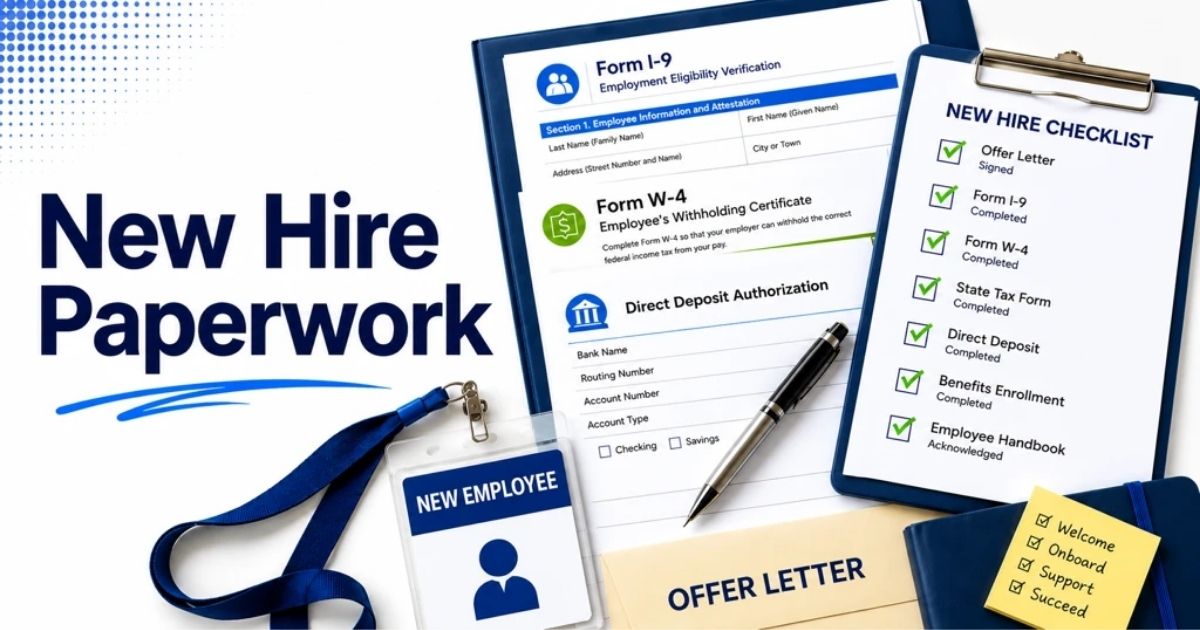
Table of Contents
A new employee is ready to start. But before the real work begins, there is a stack of new hire paperwork to handle. Form I-9, Form W-4, direct deposit details, tax forms, benefits documents, and company policies can quickly make the onboarding process feel complicated.
Each form has a purpose. Form I-9 helps verify identity and employment authorization, while Form W-4 determines federal income tax withholding. Employers also need the right employee forms to process payroll, collect emergency contact information, and meet state requirements.
A clear new hire process makes everything easier. This guide explains which new hire forms you need, when to complete them, and what to do with the employee documents afterward.

What Does New Hire Paperwork Mean?
New hire paperwork is the set of employee forms and documents needed when someone joins a company. It covers legal requirements, payroll details, benefits, and company policies. Common new hire forms include Form I-9, Form W-4, a direct deposit form, state tax forms, and an employee handbook acknowledgment.
Each document serves a different purpose. Form I-9 helps employers verify a new employee’s identity and employment authorization. Form W-4 provides the information needed to calculate federal income tax withholding.
Other hire paperwork may collect bank account details, emergency contact information, benefits choices, or signed company agreements. Together, these employee documents help employers maintain compliance, process payroll correctly, and give new hires a more organized onboarding process.
New Hire Paperwork Checklist For Employers
New employees need different forms for taxes, employment eligibility, payroll, benefits, and company records. Some new hire paperwork is required by law, while other employee forms depend on the state, benefits offered, or company policies.
Use this checklist as a quick reference. The exact hire forms you need can vary by employee and work location.
New Hire Paperwork | Required? | When To Complete | Main Purpose |
|---|---|---|---|
Form I-9 | Federal | Day 1 / within 3 business days | Verify work eligibility |
Form W-4 | Federal | When work starts | Set federal tax withholding |
State Tax Forms | State-dependent | Varies | Set state/local withholding |
New Hire Reporting | Required | State deadline | Report the new employee |
Direct Deposit Form | Employer-dependent | Before payroll | Set up wage payments |
Benefits Forms | Plan-dependent | During enrollment | Select eligible benefits |
Company Forms | Employer-dependent | During onboarding | Confirm policies and agreements |
Form I-9
Form I-9 is the federal Employment Eligibility Verification form. Employers use it to establish a new employee’s identity and employment authorization to work in the United States. Employers must complete an I-9 for each new employee hired for employment in the U.S.
The employee completes Section 1 no later than their first day of work. The employer or an authorized representative then reviews acceptable documents that establish identity and employment eligibility. Section 2 generally must be completed within three business days after the employee’s start date.
Form I-9 and E-Verify are not the same process. Employers should follow the applicable employment authorization and verification rules for each new hire.
Form W-4
Form W-4, Employee’s Withholding Certificate, tells an employer how to calculate federal income tax withholding from an employee’s wages. New employees provide information such as their filing status and any applicable withholding adjustments.
Ask new hires to provide a signed W-4 when they start work. The IRS says employers should make the form effective with the first wage payment. If an employee does not provide a completed W-4, specific default federal tax withholding rules apply.
Employees can submit a new W-4 later if their personal or financial situation changes. Employers should keep the current form available with their tax and payroll records.
State Tax And New Hire Requirements
Federal forms are only part of the hiring process. A new employee may also need a state tax withholding form. State withholding forms serve a similar purpose to Form W-4 where state or local income tax applies.
Employers also have new hire reporting obligations. Reporting deadlines, required details, and submission methods can vary by state. Check the rules for the employee’s work location instead of relying on one checklist for every hire.
Local laws may require additional notices or employee documents. Industry-specific regulations can add more legal obligations as well. A small business that hires employees across different locations should check each jurisdiction carefully to maintain compliance.
Payroll And Direct Deposit Forms
Payroll paperwork gives you the key details needed to process payroll correctly. A direct deposit form typically collects bank account details and authorizes the employer to send wages to the employee’s chosen account.
Before the first pay period, confirm the employee’s legal name, start date, job title, pay rate, pay schedule, work location, tax withholding, and payment method. The employee’s Form W-4 also affects how much federal income tax comes out of each paycheck.
Direct deposit authorization can help make wage payments more convenient and reliable. Bank information is sensitive, so access should remain limited to authorized personnel.
Benefits And Company Forms
Benefits paperwork depends on employee eligibility and what the employer offers. Health insurance documents, retirement plan information, beneficiary details, and enrollment forms may all become part of the onboarding process.
Company-specific new employee forms can include an employee handbook acknowledgment form, emergency contact form, employment contract, non-disclosure agreement, and other policy acknowledgments. Emergency contact information gives the employer names and phone numbers to use if an emergency occurs.
Applicable employers must also provide new hires with a Notice of Coverage Options within 14 days. Clear benefits and company paperwork helps employees understand their options, responsibilities, and company policies from the start.
When Should New Hire Paperwork Be Completed?
New hire paperwork does not all have the same deadline. Some employee forms can be prepared after the job offer, while federal forms and payroll details have specific timing requirements. A simple timeline helps new hires complete the right documents without slowing down the onboarding process.
Timeline | Paperwork And Action |
|---|---|
After The Job Offer | Send the offer letter, employment contract, and applicable background check forms |
Before The First Day | Prepare payroll, benefits, company policies, and other new employee forms |
On The First Day | Complete Form I-9 Section 1 and collect Form W-4 |
Within 3 Business Days | Review acceptable documents and complete Form I-9 Section 2 |
Before First Payroll | Confirm tax withholding, direct deposit, pay rate, start date, and deductions |
After The Start Date | Complete state new-hire reporting and required benefits notices |
Form I-9 has one of the clearest federal deadlines. A new employee must complete Section 1 no later than the first day of employment. The employer generally has three business days after that start date to review identity and employment authorization documents and complete Section 2.
Form W-4 should also be collected when the employee starts work. Employers use it to calculate federal income tax withholding beginning with the first wage payment.
Other deadlines depend on the requirement. Applicable employers must provide new hires with a Notice of Coverage Options within 14 days. New-hire reporting deadlines can vary by state, so employers should check the rules for each work location rather than assume one deadline applies everywhere.
What Paperwork Changes For Different Types Of Hires?
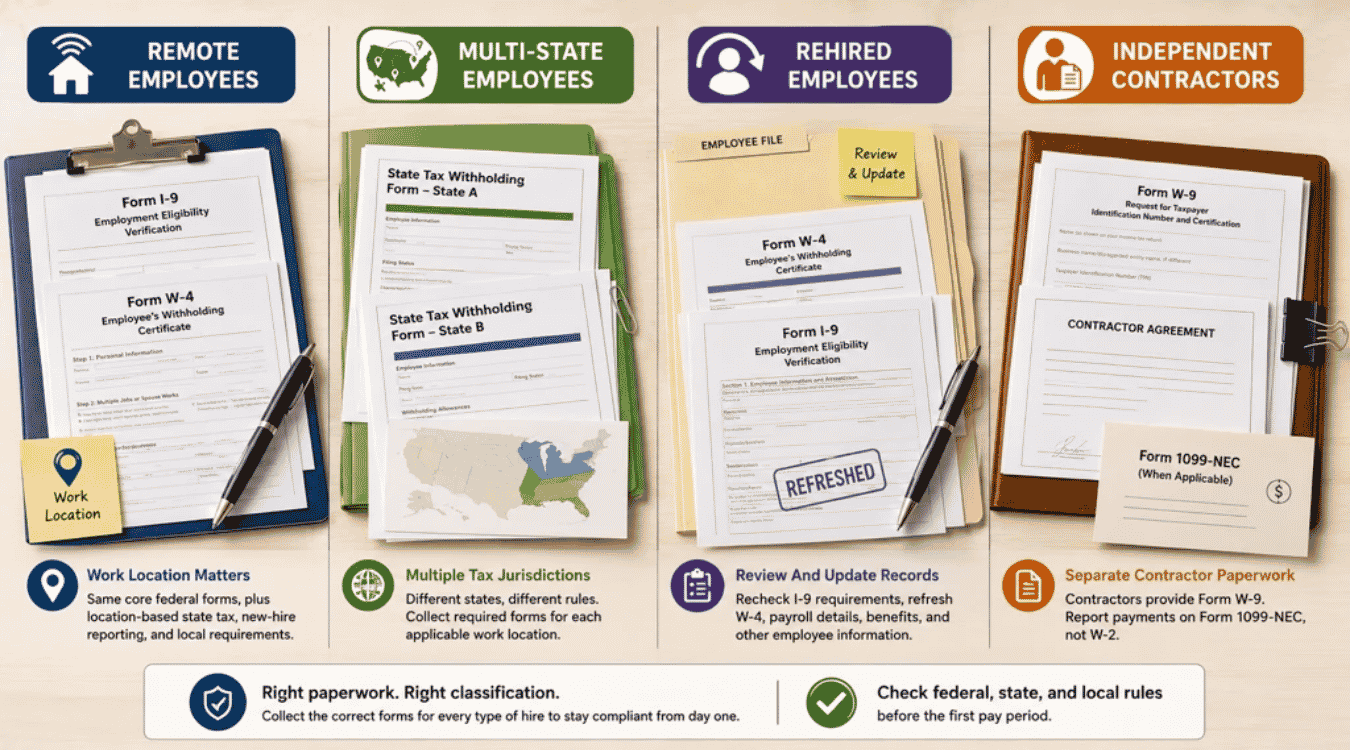
Not every worker follows the same new hire paperwork process. Work location, employment history, and worker classification can change which employee forms you need. Employers should identify the type of hire first, then check the federal, state, and local requirements that apply.
Remote Employees
Remote employees generally complete the same core federal hire forms as office-based employees. That includes Form I-9 for employment eligibility verification and Form W-4 for federal income tax withholding. HRM software for managing a remote workforce can help coordinate onboarding when teams are distributed. Remote work alone does not make someone an independent contractor. The actual working relationship determines worker classification.
Location adds another layer. Employers need the employee's actual work location to identify applicable state tax withholding forms, new-hire reporting rules, workers compensation requirements, and local notices. Secure digital onboarding and cloud HR tools for remote teams can make the process easier, but sensitive employee documents and bank account details should only be accessible to authorized personnel.
Multi-State Employees
Multi-state hires can create more paperwork because tax and employment laws vary by location. An employee may live in one state and work in another, or regularly perform work across several states. Employers should identify the relevant work locations before setting up payroll.
State withholding forms, new-hire reporting, workers compensation, and local laws may differ from one jurisdiction to another. Reciprocal tax agreements can also affect how state income tax is handled in some cases. Federal forms such as Form W-4 still apply, but employers may need additional state or local employee forms. Confirm the applicable rules before the first pay period to reduce compliance risks.
Rehired Employees
A returning employee should not automatically be treated as if every old form is still current. Review the employee's file and determine which documents can remain in effect and which ones need to be completed again.
Payroll information deserves particular attention. IRS guidance for 2026 says a rehired employee who does not provide a Form W-4 must be treated under the applicable default withholding rules. Employers should also review Form I-9 requirements, direct deposit authorization, emergency contact information, benefits enrollment, company policies, and state reporting requirements. A new start date or changed job title may also require updates to internal employee documents.
Independent Contractors
Independent contractors do not complete the same hire paperwork as employees. Correct worker classification should come first. The IRS looks at factors such as behavioral control, financial control, and the relationship between the business and worker. Misclassification can leave a business liable for employment taxes.
Employees generally complete Form W-4, while independent contractors normally provide Form W-9 with their name and taxpayer identification number. Businesses may later report qualifying contractor payments on Form 1099-NEC rather than Form W-2.
Keep the contractor agreement, tax forms, and other required records separate from the standard new employee forms used in your onboarding process.
What Should Employers Do After Collecting New Hire Paperwork?
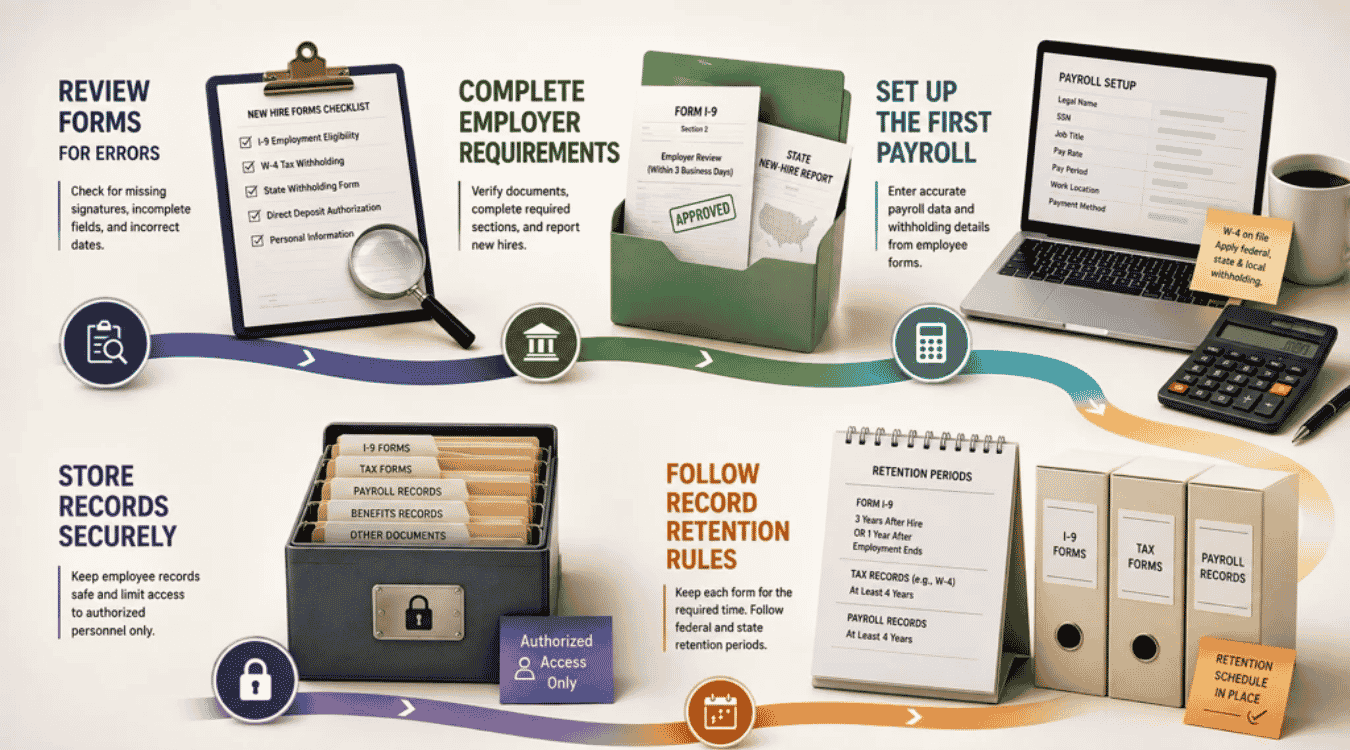
Collecting new hire paperwork is only the first step. Employers still need to review the employee forms, complete their own legal obligations, set up payroll, and store records correctly. A clear process helps catch mistakes early and reduces compliance risks.
Review Forms For Errors
Check new employee forms before adding information to payroll or the employee’s file. Look for missing signatures, incomplete fields, incorrect dates, and inconsistent personal details. Pay close attention to Form I-9, Form W-4, state withholding forms, and direct deposit authorization.
Errors should be corrected using the rules for that document. For example, USCIS says employees should correct mistakes they made in Section 1 of Form I-9 rather than having the employer change the information for them. Corrections should preserve the original information instead of hiding it.
A quick review can prevent tax withholding problems, payroll delays, and compliance issues later.
Complete Employer Requirements
Some new hire forms require action from the employer. Form I-9 is a clear example. After the employee completes Section 1, the employer reviews acceptable documents and generally completes Section 2 within three business days of the employee’s start date.
Employers must also report new employees to the designated state new-hire registry. All 50 states and most U.S. territories have new-hire registries, although reporting procedures can vary by location.
Check state and local laws for other requirements. Local notices, workers' compensation rules, and industry-specific regulations may create additional legal obligations.
Set Up The First Payroll
Next, turn the collected employee documents into accurate payroll data. Confirm the employee’s legal name, Social Security number, job title, start date, pay rate, pay period, work location, and payment method.
Use Form W-4 to set federal income tax withholding. Add any required state or local tax withholding details as well. The IRS tells employers to request a signed W-4 when a new employee starts and make it effective with the first wage payment.
Check direct deposit information carefully before you process payroll. Bank account details, deductions, benefits elections, and other key details should match the employee forms you received.
Store Records Securely
New hire paperwork can contain Social Security numbers, tax information, bank account details, emergency contact information, and other sensitive data. Store employee documents securely and restrict access to authorized personnel.
Keep records organized so HR and payroll teams can find what they need without exposing unnecessary information. Form I-9 records can be stored electronically, and USCIS recommends keeping I-9 forms separate from general personnel records.
A secure digital onboarding process and a modern employee record management system for HR teams can also reduce manual data entry and make paperwork easier to track. Access controls still matter, even when documents are stored electronically.
Follow Record Retention Rules
Do not delete hire paperwork simply because the onboarding process is complete. Different employee forms have different record retention requirements.
Employers must retain Form I-9 for three years after the date of hire or one year after employment ends, whichever is later. The same retention period applies whether the form is stored on paper or electronically.
Federal employment tax records generally need to be kept for at least four years. That includes copies of employee federal income tax withholding certificates such as Form W-4.
Create a retention schedule for tax forms, hire forms, benefits records, and other employee payroll records. Clear rules help maintain compliance without keeping sensitive records longer than necessary.
Common New Hire Paperwork Mistakes And How To Fix Them
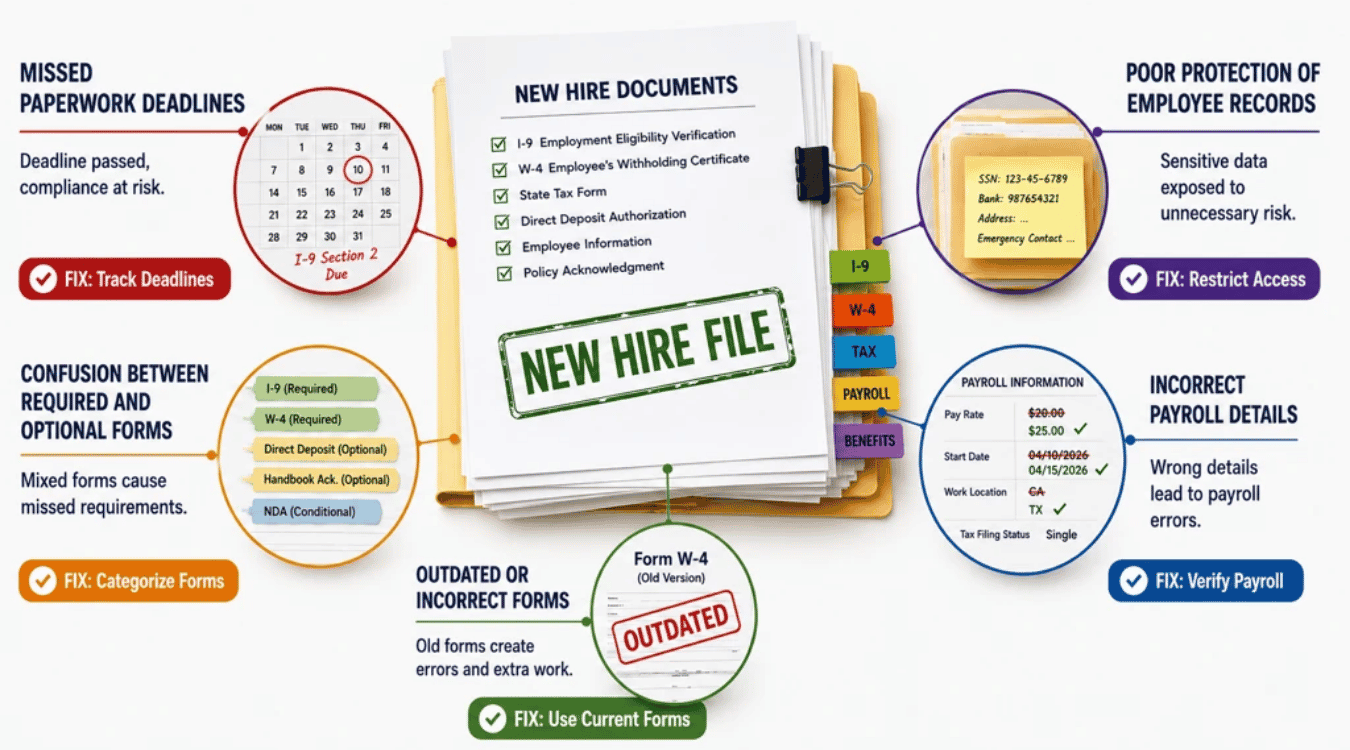
Small paperwork mistakes can turn into payroll delays, tax problems, or compliance risks. A good new hire process should catch errors before they reach payroll or the employee’s file. Here are five common problems employers should watch for and how to correct them.
Missed Paperwork Deadlines
A missed deadline can create legal challenges even when the right new hire forms are eventually collected. Form I-9 is a common example. The employee completes Section 1 by the first day of employment, while the employer generally completes Section 2 within three business days of the employee’s start date.
Create a checklist tied to each new hire’s start date. Add deadlines for federal forms, state requirements, benefits notices, and new-hire reporting. Assign an owner to each task instead of assuming HR or payroll will remember it. Clear due dates help new hires complete paperwork on time and support compliance throughout the onboarding process.
Confusion Between Required And Optional Forms
Not every document in a new hire packet has the same legal status. Form I-9 and Form W-4 serve federal requirements, while state withholding forms depend on location. A direct deposit form, employee handbook acknowledgment, emergency contact form, employment contract, or non-disclosure agreement may depend on company policies or the employment situation.
Label employee forms by category: federal, state/local, conditional, or company-specific. That simple distinction helps employees understand what they must complete. It also prevents employers from treating every internal document as a government form or overlooking actual legal obligations.
Outdated Or Incorrect Forms
Old paperwork can remain in an onboarding packet long after government forms change. An outdated Form W-4, incorrect state tax form, or old company policy can create extra work and inaccurate employee records. The IRS currently provides a 2026 Form W-4 for new employees.
Check government forms against official sources before adding them to the hiring process. Review the paperwork library whenever federal, state, or local laws change. Company documents need reviews too. Update the employee handbook, benefits information, job description, and policy acknowledgments when company policies change. A scheduled paperwork audit can keep the onboarding packet current.
Incorrect Payroll Details
Payroll errors often start with incorrect hire paperwork. A wrong bank account number can disrupt direct deposit. An incorrect pay rate, start date, work location, or tax setup can affect the employee’s paycheck.
Check key details before you process payroll. Match the employee’s legal information with payroll records. Verify direct deposit authorization, pay period, compensation, deductions, and state tax withholding. Form W-4 also matters because employers use the information on it to calculate federal income tax withholding.
Ask the employee for a corrected form when information is wrong. Do not guess what the employee intended to enter.
Poor Protection Of Employee Records
New hire paperwork can contain Social Security numbers, bank account details, tax information, emergency contact information, and other sensitive data. Broad access to those employee documents increases privacy and security risks.
Limit access to people who need the information for their jobs. The FTC recommends need-to-know access controls for sensitive personal information and secure storage for paper and electronic records.
Keep sensitive records in secure systems, set appropriate access permissions, and follow a clear retention and disposal policy. Digital onboarding and replacing disconnected HR tools with an all-in-one platform can make employee documents easier to organize, but employers still need strong controls over who can view or change them.
How To Create A Better New Hire Paperwork Process
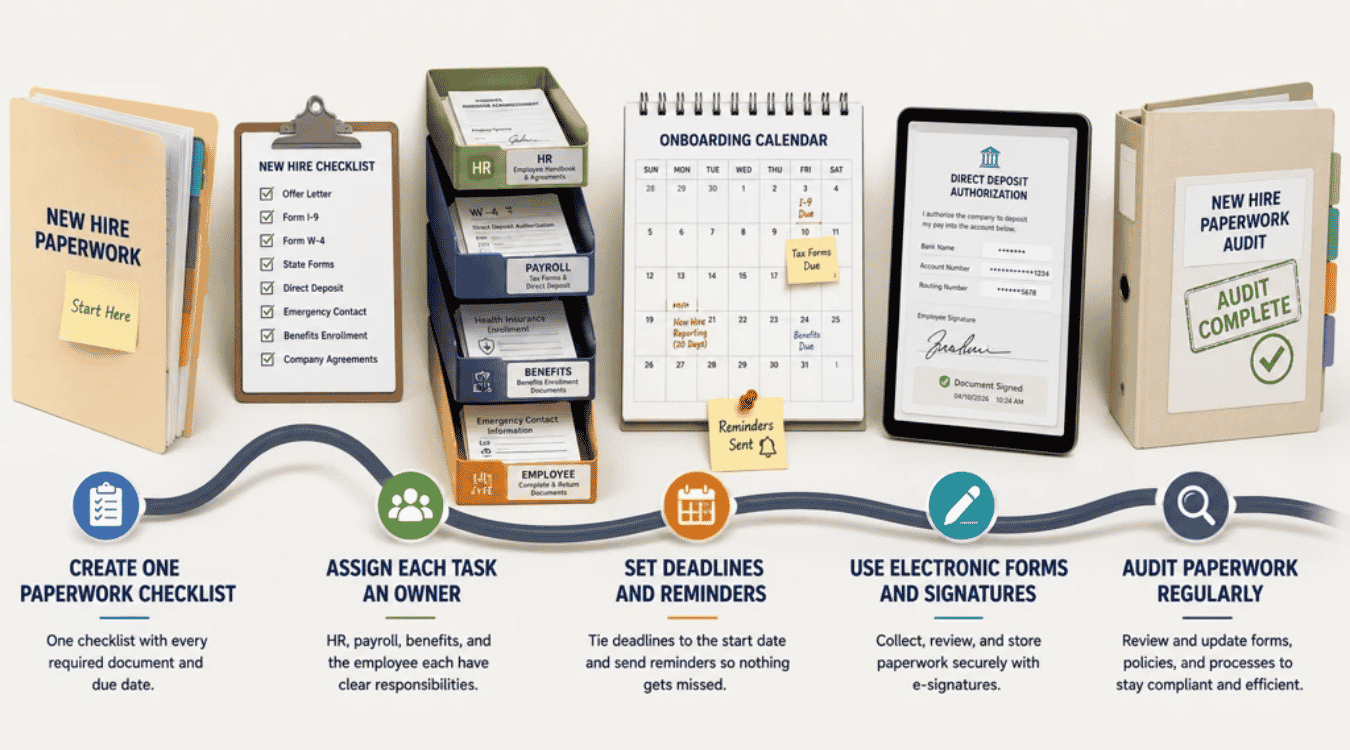
A good new hire paperwork process should be simple for both HR and new employees. Clear steps and HR workflow automation reduce missed forms, payroll errors, and last-minute questions. They also help new hires feel confident because they know what to complete, when it is due, and who can help.
Create One Paperwork Checklist
Start with one checklist that covers every document required during the onboarding process. Include the signed offer letter, Form I-9, Form W-4, state forms, direct deposit authorization, emergency contact form, benefits paperwork, and company agreements.
Group each item by purpose, such as federal, state, payroll, benefits, or company-specific. Add a status and due date so nothing gets lost between HR and payroll.
Employee forms matter because one missing document can affect tax withholding, payroll, benefits, or compliance. A single checklist also gives new hires clear expectations from the start and makes the hiring process easier to follow.
Assign Each Task An Owner
Every paperwork task should have someone responsible for it. HR may handle the employee handbook acknowledgment and employment documents. Payroll can verify tax and direct deposit details. Benefits teams may oversee the health insurance or retirement plan enrollment process.
The employee has responsibilities too. New hires need to complete their forms, provide accurate information, and return required documents on time.
Clear ownership prevents the common problem where everyone assumes someone else completed a task. It also helps new hires know exactly who to contact when they have a question. That smoother experience can introduce the company’s culture before the employee even settles into the role.
Set Deadlines And Reminders
Tie paperwork deadlines to the employee’s start date instead of relying on memory. Set reminders for Form I-9, tax forms, new-hire reporting, benefits documents, and company paperwork.
Federal law generally requires employers to report newly hired employees to the appropriate state directory within 20 days after hire, although states can establish their own procedures and shorter reporting schedules. Employers should always confirm the applicable state requirement.
Emergency contact forms do not have a general federal completion deadline, but collecting emergency contact information within the employee’s first few days is a practical onboarding step. Clear reminders help new hires complete important paperwork before small delays become bigger problems.
Use Electronic Forms And Signatures
Electronic forms and an all-in-one HR management system for growing teams can make hire paperwork faster to send, complete, review, and store. They also reduce repeated manual entry and make it easier to see which employee documents are still missing.
Electronic systems still need the right controls. Form I-9, for example, may be completed and stored electronically when the system meets federal requirements. Electronic signature systems must preserve the signature and maintain the integrity of the record.
Choose a secure workflow with access controls, reliable records, structured approval workflows in HR, and clear document status. A smoother digital process can reduce administrative work while giving new employees a more organized start.
Audit Paperwork Regularly
Review your new hire process on a regular schedule. Check government forms, state requirements, company policies, benefits documents, employment contracts, payroll procedures such as payroll processing for growing businesses, and agreements such as a non-compete agreement where applicable.
Benefits documents deserve attention too. For an ERISA-covered plan, the Summary Plan Description generally must be provided within 90 days after an employee becomes a participant in the plan.
An audit can also reveal unnecessary forms, duplicate data collection, outdated language, or unclear responsibilities. Update the checklist whenever employment laws, company policies, benefits, or business strategies change, and confirm that your payroll software features and automation still match your requirements. A current process supports compliance while keeping onboarding simple for everyone.
How Payrun Makes New Hire Paperwork And Payroll Setup Easier
Payrun brings hiring, onboarding, employee records, and payroll into one connected HR management system for growing teams backed by a trustworthy partner in HR management. Once you choose a candidate, you can onboard them as an employee and add key details such as employment status, job title, department, and start date. Payrun’s recruitment system to make hiring faster also reduces the need to move the same information between separate tools.
HR teams can keep employee data, onboarding documents, and company policies organized in one place. Structured workflows and innovative HR features in Payrun also make it easier to track onboarding tasks and reduce repeated manual work.
Once a new hire is ready for payroll, Payrun connects employee records with salary, deductions, benefits, and automated payroll processing and software features. That helps teams reduce data-entry errors, review payroll details, and move new employees from hiring to their first pay cycle with fewer manual steps as part of an all-in-one HR platform.