Multigenerational Workforce: How To Manage Different Generations
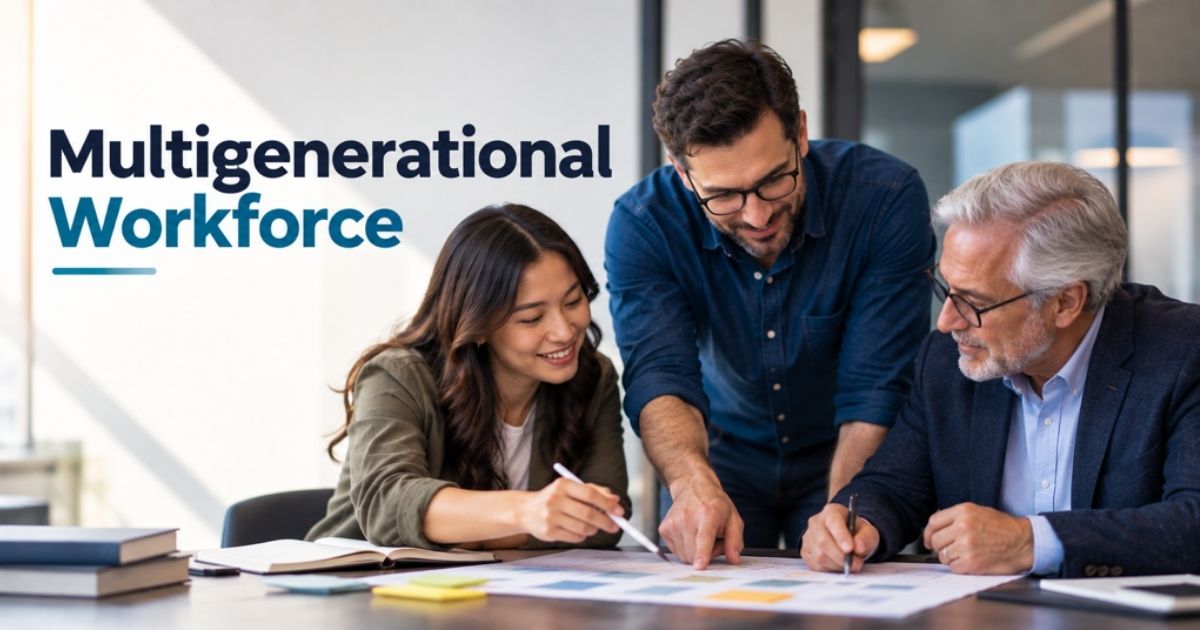
Table of Contents
Today’s workplace can bring several generations under one roof. Baby Boomers may work alongside Gen X, Millennials, and Gen Z employees, each with different experiences, skills, and career stages. In fact, today’s workforce can span up to five generations.
That age diversity can be a real advantage. Experienced professionals bring institutional knowledge, while younger workers add fresh perspectives and new skills. Yet communication preferences, working styles, and generational stereotypes can also create friction when they are poorly managed.
For employers, HR professionals, and managers, the challenge is not to manage people based on their age. The goal is to create a multigenerational workplace where different generations can contribute, collaborate, and grow. This guide explains the benefits and challenges and shows how to manage a multigenerational workforce without relying on stereotypes.

What Is A Multigenerational Workforce?
A multigenerational workforce is a workplace where employees from several age groups and generations work within the same organization. Today’s workforce can span up to five generations, bringing together people at different career stages with different experiences, skills, and perspectives.
A multigenerational workplace may include the Silent Generation, Baby Boomers, Generation X, Millennials, and Generation Z. Each generation brings unique perspectives, from years of institutional knowledge to fresh perspectives and newer technological skills. That age diversity can support stronger problem-solving, knowledge sharing, and collaboration across generations.
However, age alone does not define how someone works. Employers should understand generational differences without turning them into generational stereotypes. Individual skills, preferences, roles, and experiences still matter.
What Generations Are In The Workforce Today?
Today’s workforce can span up to five generations. That means employees may work with colleagues who differ widely in age, career stages, professional experience, and exposure to workplace change. AARP reports that multigenerational teams are now common as people continue to work later in life.
The table below shows the generations you may find in a multigenerational workplace. Birth-year ranges can vary slightly by source, so they are better treated as general reference points than strict boundaries, and should be integrated into broader employee lifecycle management rather than used as rigid categories.
Generation | Birth Years | Current Career Context | Workplace Context |
|---|---|---|---|
Silent Generation | 1928–1945 | Very late career or post-retirement work | A small workforce presence with decades of professional and institutional knowledge |
Baby Boomers | 1946–1964 | Late career or retirement transition | Experienced professionals who may hold deep organizational, industry, or leadership knowledge |
Generation X | 1965–1980 | Mid-to-late career | Often found across senior specialist, management, and leadership roles |
Millennials | 1981–1996 | Early-to-mid career | A large working-age group with growing management, specialist, and leadership responsibilities |
Generation Z | 1997–2012* | Early career | Younger workers entering and developing within today’s workforce |
Pew Research Center uses 1928–1945 for the Silent Generation, 1946–1964 for Baby Boomers, 1965–1980 for Gen X, and 1981–1996 for Millennials. Pew has used 1997 as the start of Gen Z while cautioning that generational cutoff points are not exact.
Generation Is Not A Management Profile
Generational labels can provide context, but they should not become instructions for managing people. Two employees from the same age group can have completely different communication preferences, working styles, career goals, technological skills, and expectations.
Research also challenges many common generational stereotypes. OECD notes that workers across age groups are often more alike in what they value at work than generational labels suggest. Policies based on those labels can create bias and make cross-generational collaboration harder.
Managers should focus on the person first. Consider an employee’s skills, role, career stage, life circumstances, and individual preferences. Generational differences can provide useful context, but they should never define what an employee needs or how that employee should be managed.
What Are The Benefits Of A Multigenerational Workforce?
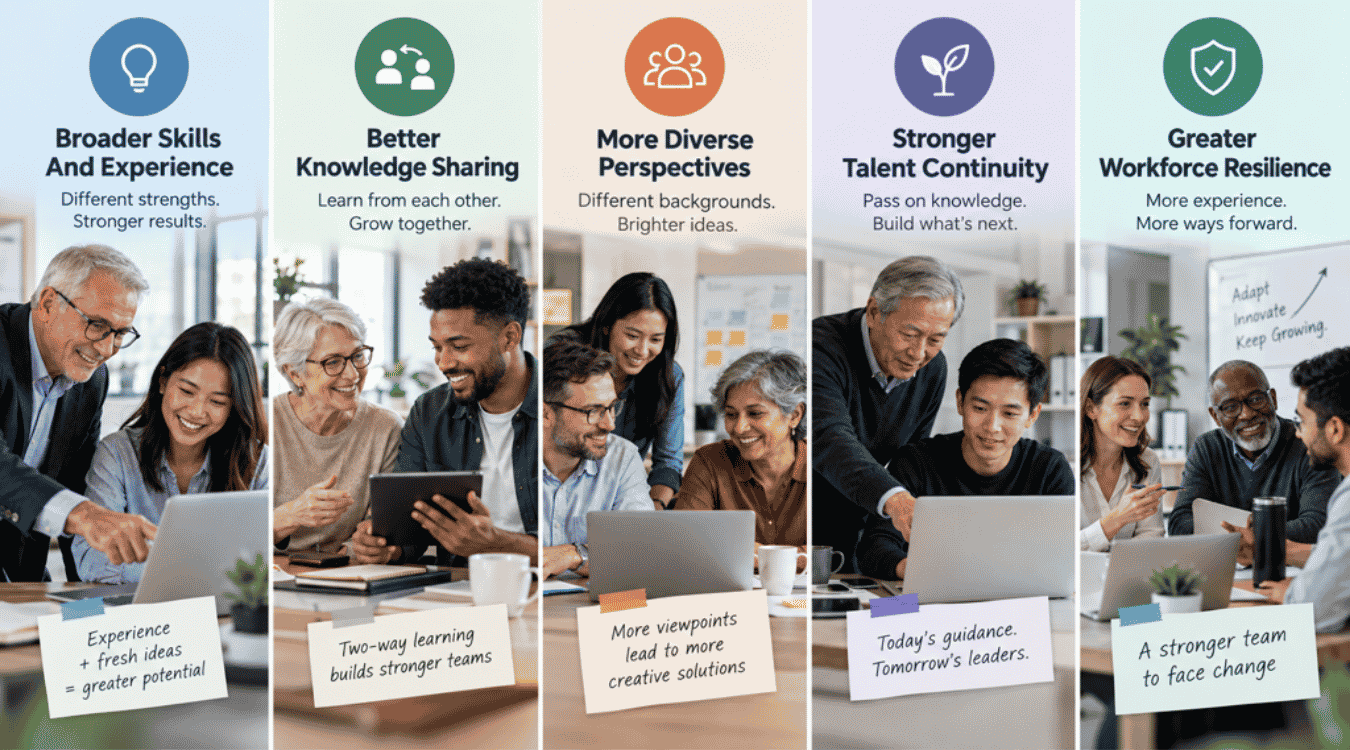
A multigenerational workforce brings people with different skills, experiences, and career stages into the same organization. When employers promote collaboration across generations, that age diversity can support productivity, knowledge sharing, innovation, and long-term workforce stability. Addressing broader HR challenges with modern solutions, including adopting cloud-based HR software for modern teams, can further strengthen how these mixed-age teams work together. OECD research also links mixed-age workforces with stronger talent pipelines and organizational resilience.
Broader Skills And Experience
Different generations often bring complementary strengths to a team. Experienced employees may have deep industry expertise, leadership experience, and institutional knowledge. Younger workers may bring new skills, fresh perspectives, and greater exposure to emerging technologies.
The value comes from combining those strengths rather than deciding which age group is better. OECD research found that younger and older employees can become more productive when they work with colleagues from another age group. Their different skills and experience create useful spillover effects across the team.
Better Knowledge Sharing
An age-diverse workforce creates natural opportunities for employees to learn from one another. Experienced professionals can share practical knowledge, customer insights, and lessons gained throughout their professional journey. Younger colleagues can introduce new ideas, digital tools, and different ways to approach work.
Two-way mentoring can make that exchange more intentional. Traditional mentoring helps experienced employees guide newer team members, while reverse mentoring allows younger employees to share their knowledge with older colleagues. AARP found that 87% of workers said working with younger colleagues gave them opportunities to share experience and knowledge.
More Diverse Perspectives
People from different generations have lived through different economic, social, and technological changes. Those experiences can shape how they look at customers, problems, risks, and opportunities.
Mixed-generation teams can use those diverse perspectives to challenge assumptions and find innovative solutions. AARP found that 85% of workers gained new perspectives from younger colleagues, while 87% reported the same benefit from older colleagues. Cross-generational collaboration was also associated with greater workplace creativity.
A diverse team may also understand a wider range of customer needs because employees can bring perspectives from different age groups and life stages.
Stronger Talent Continuity
Organizations can lose valuable know-how when experienced employees leave without passing it on. A multigenerational workplace makes it easier to transfer institutional knowledge before that happens.
Older workers can coach younger employees, share company-specific knowledge, and help prepare future specialists and leaders. At the same time, continuous learning helps experienced employees develop new skills and stay effective as work changes. OECD identifies lower turnover among older workers and knowledge spillovers to younger colleagues as important sources of workforce stability.
That exchange supports succession planning without treating leadership roles as something tied to a particular age.
Greater Workforce Resilience
A team with varied experience can have more ways to respond when business conditions change. Experienced professionals may recognize familiar risks, while employees with newer skills may identify different tools or approaches.
OECD links a multigenerational workforce with greater resilience, workforce continuity, stability, and retention of intellectual capital.
The mix can become a strategic advantage when employers create inclusive environments where people across generations can contribute. Strong multigenerational teams do not depend on one generation to have every answer. They combine experience, adaptability, technological skills, and new ideas to help the entire organization respond to change.
What Challenges Do Multigenerational Workforces Face?
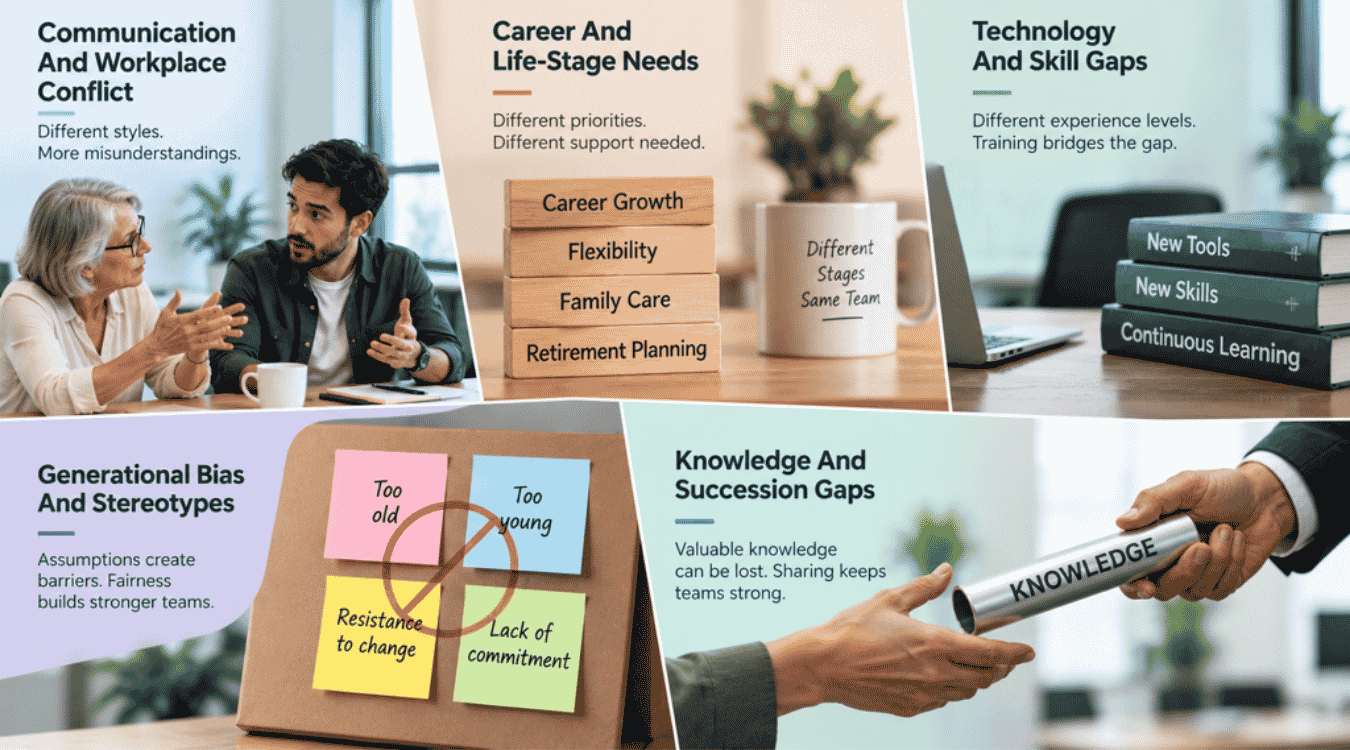
A multigenerational workforce can bring real advantages, but age diversity also creates management challenges. Communication preferences, career stages, skills, and workplace expectations may differ across generations. Problems usually grow when employers turn those differences into assumptions instead of understanding individual needs.
Communication And Workplace Conflict
Communication gaps can cause simple issues to become workplace conflict. Older employees may be more comfortable with formal communication, meetings, or phone calls. Younger employees often use shorter, more informal digital communication and instant messaging. SHRM identifies communication styles as one of the biggest challenges in a multigenerational workplace.
However, managers should not assume that every Baby Boomer, Millennial, or Gen Z employee communicates the same way. Role, workplace culture, and personal communication preferences also matter. Clear expectations around channels, response times, meetings, and feedback can reduce misunderstandings across generations.
Career And Life-Stage Needs
Employees can want different things from work at different stages of their professional journey. One employee may want rapid career growth. Another may need caregiver support, greater workplace flexibility, or a gradual transition toward retirement.
Work-life balance can also become more important as personal responsibilities change. Flexible work arrangements help employees at different life stages manage work alongside family and other responsibilities. OECD notes that flexible work can reduce burnout and help workers manage their work-life balance.
Employers should respond to individual circumstances rather than create rigid benefits or policies for each age group.
Technology And Skill Gaps
A common stereotype says younger workers are digital natives while older workers struggle with technology. Reality is more complicated.
Employees can have different technological skills based on their roles, experience, training, and exposure to digital tools. OECD notes that technological change can create skill gaps across the workforce. It also warns that a lack of training can leave experienced employees with outdated skills.
Training programs should therefore focus on actual skill gaps, not age. Continuous learning gives older and younger employees opportunities to build new skills as technologies and job requirements change.
Generational Bias And Stereotypes
Generational stereotypes can quickly damage an age-diverse workforce. Older workers may be labeled resistant to change, while younger employees may be viewed as inexperienced or lacking commitment. Such assumptions can influence hiring, promotion, development, and everyday team dynamics.
Recent SHRM reporting notes that age discrimination can disadvantage employees at both ends of the age spectrum. Younger workers, for example, may receive less support for caregiving responsibilities when managers associate caregiving with older employees.
Managers should address generational differences without turning them into rules. Skills, performance, goals, and individual needs provide a fairer basis for decisions.
Knowledge And Succession Gaps
Experienced professionals often hold institutional knowledge that is difficult to replace. A problem appears when that knowledge stays with one employee until they retire or leave the organization.
OECD identifies retirement and workforce change as risks to valuable expertise and emphasizes intergenerational knowledge transfer as a way to protect business continuity.
The challenge also works both ways. Younger workers may have new skills and experience with emerging technologies that other generations can benefit from. Without structured knowledge sharing, teams can miss both forms of expertise. Mentoring, reverse mentoring, job shadowing, and cross-generational collaboration can help close those gaps.
How To Manage A Multigenerational Workforce
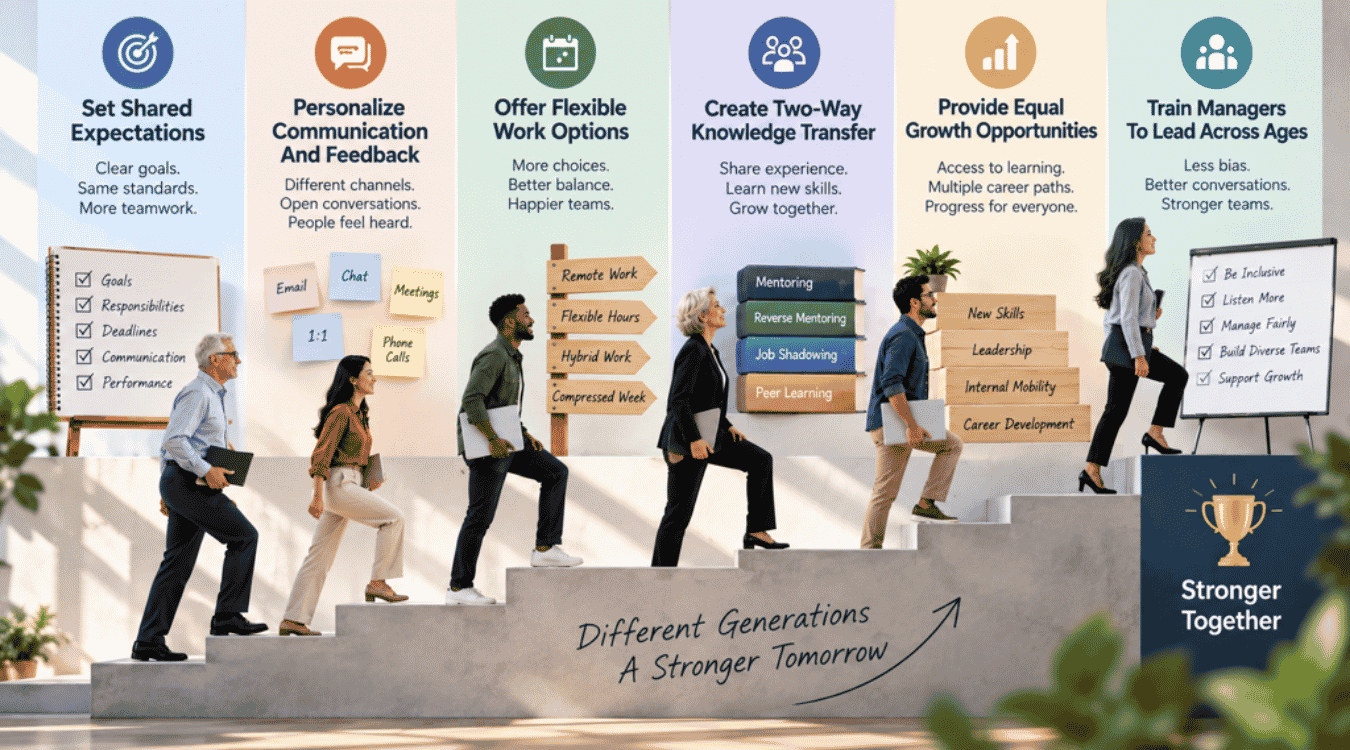
A multigenerational workforce works best when managers focus on people rather than generational stereotypes. Set common standards, but leave room for different communication preferences, career stages, and life needs. The goal is to help different generations work together without forcing everyone into the same mold.
Set Shared Expectations
Start with expectations everyone can understand. Define team goals, responsibilities, deadlines, communication rules, and performance standards. Employees should know what good work looks like regardless of their age group or working style.
Shared goals also give multigenerational teams something to work toward together. That can shift attention away from generational differences and toward results. SHRM recommends clear guidelines for communication channels and response times when teams span multiple generations.
Keep the standards consistent, but allow reasonable flexibility in how employees meet them. Clear expectations create accountability without asking Baby Boomers, Gen X, Millennials, or Gen Z employees to work exactly the same way.
Personalize Communication And Feedback
Communication preferences can vary across generations, but managers should never assume someone's preference based on age. Ask employees how they prefer to receive routine updates, important information, and performance feedback.
SHRM notes that older workers often lean toward meetings and phone calls, while younger employees tend to favor instant messaging. Yet role, workplace culture, and personal preference also shape communication styles.
Use a mix of digital tools, one-on-one conversations, team meetings, and written updates where appropriate. Transparent communication helps reduce communication gaps and makes employees feel heard. Feedback can also be personalized in frequency and format while performance expectations remain consistent, and employee performance tracking software and dedicated employee performance review software can help apply those standards fairly across generations.
Offer Flexible Work Options
Workplace flexibility can help employees across different career stages. A younger employee may value flexibility for study or family time. An experienced employee may have caregiving responsibilities or want a gradual transition toward retirement.
Flexible work arrangements can include remote or hybrid work, flexible start and finish times, compressed schedules, or other options that fit the role. OECD reports that flexible work can reduce burnout and help employees at different life stages manage work-life balance, and modern HRM software for managing remote workforces and cloud HR tools for remote teams can make those arrangements easier to coordinate.
Avoid labeling flexibility as something only Millennials or Gen Z want. Work-life integration can matter to older workers, caregivers, parents, and other employees too. Base options on individual needs and job requirements.
Create Two-Way Knowledge Transfer
Knowledge sharing should move in both directions. Experienced employees can pass on institutional knowledge, industry expertise, and lessons from years of work. Younger colleagues may contribute new ideas, digital fluency, and knowledge of emerging technologies.
Pair traditional mentoring with reverse mentoring, peer learning, job shadowing, and mixed-generation projects. SHRM defines reverse mentoring as a less experienced employee mentoring a more experienced colleague, which can help senior employees gain new ideas and update skills.
The exchange benefits both sides. AARP found that 87% of workers said younger colleagues gave them opportunities to share experience and knowledge, while 85% said they gained new perspectives.
Provide Equal Growth Opportunities
Career development should not stop because someone reaches a certain age or career stage. Give employees across generations access to training programs, new skills, leadership roles, internal mobility, and professional development.
OECD recommends regular skill and development reviews, experiential learning, mentoring, peer learning, and team training for workers of all ages.
Personalized career paths can still reflect different goals. One employee may want leadership responsibilities, another may want deeper technical expertise, and someone else may want to reskill. Fair access matters more than assuming what each generation wants from its professional journey.
Train Managers To Lead Across Ages
Managers can either reduce generational differences or make them worse. Train people leaders to recognize age bias, address intergenerational conflict, understand diverse preferences, and manage mixed-generation teams fairly.
OECD calls line managers pivotal to an age-inclusive work environment because they influence promotions, development opportunities, and internal mobility. Yet its cited employer survey found only 42% of employers provided managers with training on multigenerational workforce management practices.
Manager training should also promote collaboration instead of teaching fixed traits for each generation. Encourage managers to listen, ask questions, build diverse teams, and judge employees by their skills and performance. An inclusive environment gives every generation room to contribute its unique perspectives.
How To Build Age-Inclusive HR Practices
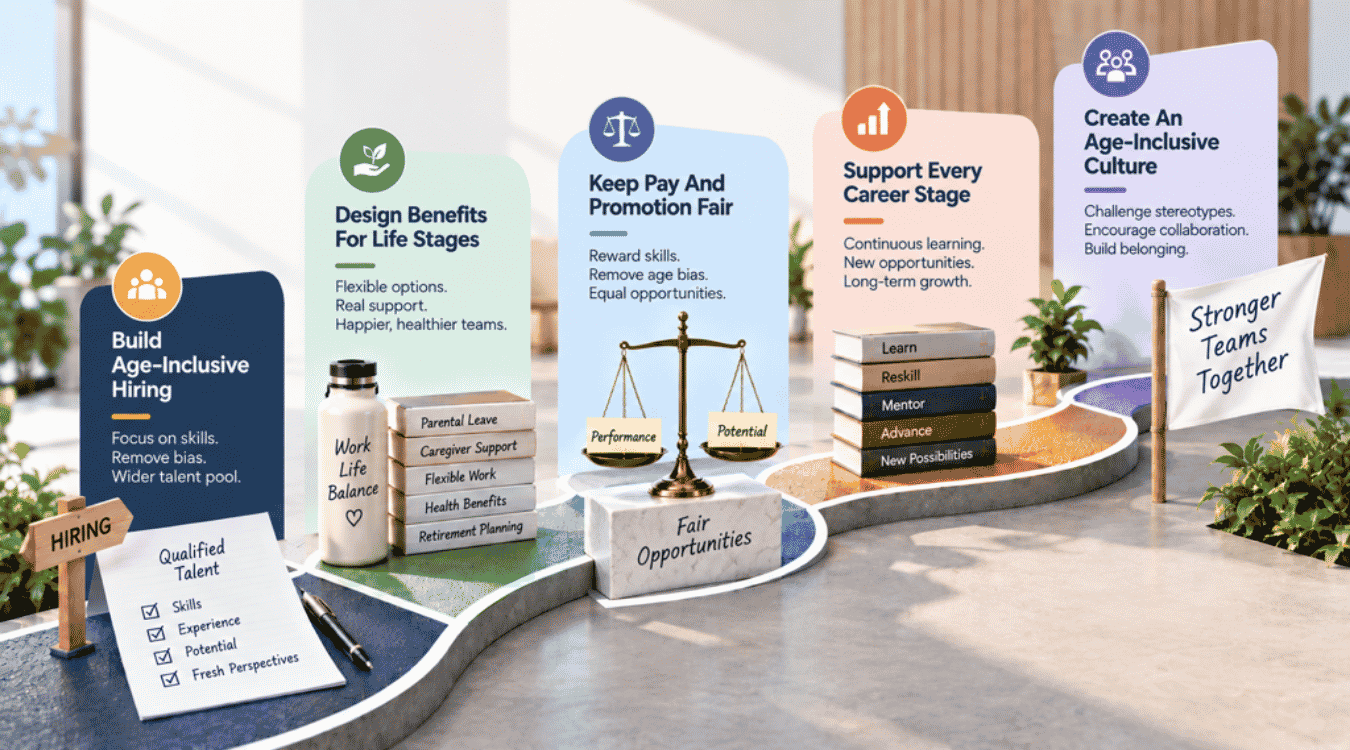
Age-inclusive HR practices give employees fair opportunities throughout their professional journey. Instead of creating separate rules for different generations, HR should focus on individual skills, needs, and career stages. OECD recommends an all-age and life-stage approach that covers recruitment, compensation, development, well-being, and retirement.
Build Age-Inclusive Hiring
Age bias can enter the hiring process before an interview even begins. Terms such as “digital native,” age-coded images, or unnecessary experience requirements may discourage qualified candidates from applying.
Use age-inclusive language and focus job requirements on relevant skills. Structured interviews, clear evaluation criteria, and skills-based hiring can also help reduce assumptions about older and younger workers. Modern recruitment software platforms and HR software for small businesses can support these practices by standardizing requisitions, screening, and communication. OECD recommends age-inclusive job ads, clear interview guidelines, and recruitment processes designed to limit explicit and implicit age bias.
The goal is simple: hire for capability, not generation. Modern HR software for small businesses can support that approach by standardizing recruitment, screening, and onboarding. A broader candidate pool can help an organization build an age-diverse workforce with experienced professionals, new skills, and diverse perspectives.
Design Benefits For Life Stages
Employees from the same generation do not always need the same benefits. Personal circumstances often matter more. One employee may need parental leave, while another needs caregiver support, workplace flexibility, health benefits, or retirement planning.
Offer choices that can support employees across career and life stages. Flexible work arrangements, paid time off, financial well-being support, and flexible work environments can help people balance changing responsibilities, and thoughtful leave management for remote teams supported by specialized leave management software, broader HR leave management systems, and modern leave management software to track and approve time off is increasingly part of that support.
OECD finds that tailoring policies to individual circumstances is more effective than designing them around age. Flexible work and other life-stage policies can also support work-life balance and help employers retain talent.
Keep Pay And Promotion Fair
Age should not determine who earns more or who gets a leadership opportunity. Pay and promotion decisions should reflect skills, responsibilities, performance, experience, and the value of the role.
Review compensation, performance ratings, promotions, and access to leadership roles for unexplained age-based patterns. Modern employee record management systems can help centralize this data so patterns are easier to spot and address. Older employees should not be passed over because someone assumes they are close to retirement. Younger employees should not be overlooked because managers assume they lack maturity or leadership ability.
OECD recommends pay practices based on productivity and competence rather than age. It also identifies age discrimination in promotion as a barrier to fair employment.
Support Every Career Stage
Career development is not only for younger employees. People may want to learn, advance, change roles, develop technological skills, mentor colleagues, or take on new responsibilities at many points in their careers, and structured succession planning processes can help align those aspirations with future organizational needs.
Provide continuous learning, reskilling, internal mobility, mentoring, and career development across the entire organization. Older workers can strengthen existing skills or prepare for a different role. Younger employees can build experience and prepare for future leadership roles, supported by fair evaluation practices such as employee timeline tracking and accurate employee leave tracking systems, reducing employee turnover where multigenerational talent is especially valuable.
OECD recommends lifelong learning and career development for workers of all ages. Career support can also improve engagement and help employers retain experienced employees as workforce needs constantly evolve.
Create An Age-Inclusive Culture
Policies alone will not create an inclusive environment. Workplace culture also needs to show that employees of every age are respected and able to contribute, supported by HR partners that prioritize people-first practices like Payrun’s approach to HR management.
Challenge generational stereotypes when they appear. Encourage cross-generational collaboration, mixed-generation teams, mentoring, and team-building activities that allow employees to know one another beyond age labels. Focus groups or employee resource groups can also give people a voice in workplace decisions.
HR should train managers to recognize age bias and hold leaders accountable for inclusive behavior. OECD notes that manager involvement and employee groups can be more effective at changing attitudes than diversity training alone.
A strong age-inclusive culture does not ask which generation fits the organization best. It creates an environment where multiple generations can contribute their unique perspectives, share knowledge, and succeed together.
How To Measure Multigenerational Workforce Success
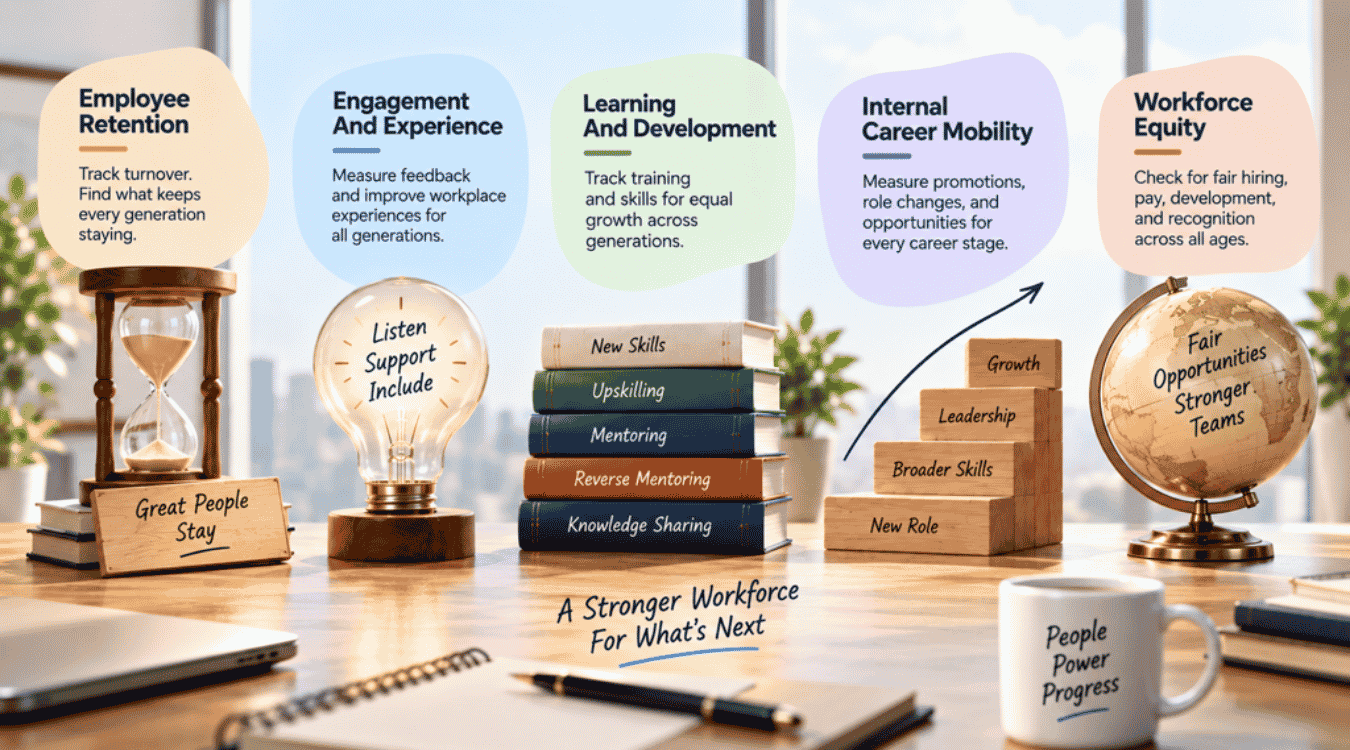
A successful multigenerational workforce should produce measurable results, not just generational diversity on paper. HR teams can track retention, employee engagement, development, career mobility, and workforce equity to see whether employees across generations have fair opportunities to succeed.
Employee Retention
Start by reviewing voluntary turnover and retention across age groups and career stages. Look for patterns, then investigate why they exist. Pay, job security, workplace flexibility, management quality, career opportunities, and caregiving responsibilities can all affect an employee’s decision to stay, and targeted employee retention strategies can help address these factors for different generations.
Do not assume age alone explains a retention gap. OECD notes that individual needs change throughout a person's career and that better working conditions, training, and support for caring responsibilities can improve retention.
Recent AARP and LinkedIn research also found that 85.4% of workers aged 50+ hired in June 2024 remained with their employer one year later, compared with 70.6% of younger hires. Consistent, accurate payroll processes for growing teams and transparent, respectful productivity tracking with timeline insights can both influence whether employees of different ages choose to stay.
Engagement And Experience
Employee engagement can show whether people feel supported and connected to the organization. Use engagement surveys, pulse surveys, focus groups, and employee engagement strategies to understand and improve experiences across generations.
The need is significant. Gallup reports that only 20% of employees worldwide were engaged at work in 2025, underscoring the value of intentional employee engagement strategies that work for every generation.
Compare results by age group where useful, but do not treat generational preferences as the automatic cause of every difference. Ask employees directly about communication, recognition, well-being, work-life balance, management, and career support. AARP found that 90% of workers expressed positive attitudes toward age-diverse teams, suggesting that cross-generational work itself does not have to reduce engagement.
Learning And Development
Track who receives training, who participates, which skills employees develop, and whether learning improves performance. Equal access matters in a multi-generational workforce because development opportunities can easily become uneven.
OECD reports persistent age gaps in workplace learning. Its latest overview says 35% of workers aged 55–64 across the EU participated in job-related formal or non-formal training, compared with 48% of workers aged 35–54.
Measure participation in training programs, mentoring, reverse mentoring, and cross-generational knowledge sharing. Also track outcomes. A strong learning system should help experienced employees build new skills while allowing younger workers to benefit from institutional knowledge.
Internal Career Mobility
Promotions are only one measure of career progress. Track lateral moves, internal hires, leadership opportunities, role changes, and succession pathways across different generations.
Internal mobility can show whether employees have room to grow throughout their professional journey. OECD notes that structured movement between roles supports skill development and transfer, improves succession planning, and can increase retention.
Compare access to opportunities rather than assuming what employees want based on age. Some may pursue leadership roles. Others may prefer specialist positions, reskilling, or a career change. Fair access gives the entire organization a stronger talent pipeline.
Workforce Equity
Finally, check whether age affects who gets hired, paid fairly, developed, promoted, or recognized. Review compensation, performance ratings, training access, promotions, layoffs, and leadership representation for unexplained differences between age groups.
Data can reveal inequities, but it should not reinforce generational stereotypes. OECD recommends age-inclusive policies that respond to individual needs throughout employees’ careers rather than relying on broad assumptions about different generations.
Measure outcomes over time and combine workforce data with employee feedback. Tools that provide timeline-based employee productivity insights can add another layer of objective data to those conversations. When people across generations receive fair opportunities to contribute and grow, a multi-generational workforce can become a competitive advantage rather than simply a demographic feature.
Final Thoughts
A multigenerational workforce can become a competitive advantage when employers value people as individuals, not generational labels. Generational diversity brings different experiences, ideas, and skills into one workplace. Yet the real value comes from how well those strengths work together.
Employers should avoid assuming that older employees resist change or that younger workers always prefer digital tools. Technology adoption, communication styles, job security, well-being, and career goals can matter differently to each person. Even generational preferences can change with role, career stage, and life circumstances.
A strong multi-generational workforce needs fair opportunities, flexible policies, open communication, and continuous learning. As employment policies evolve for growing businesses, HR teams also need systems and practices that keep every age group protected and informed. When HR teams support employee engagement and collaboration across age groups, different generations can share knowledge, adapt to change, and build a stronger workplace together.