What Are Boomerang Employees? A Guide To Rehiring Former Employees

Table of Contents
A former employee leaving does not always mean the relationship is over. Some employees return after a new job, a career change, or personal reasons no longer fit their plans. Those returning workers are known as boomerang employees. They can bring new skills, fresh perspectives, and knowledge of your company culture.
For HR professionals, the bigger question is whether bringing back a former employee is actually the right move. A familiar face can shorten the hiring process, but old problems can return too. Salary expectations, workplace changes, and employee resentment can all affect the outcome.
A smart boomerang hire starts with one thing: understanding why the employee left and what has changed since then.

What Are Boomerang Employees?
A boomerang employee is someone who leaves a company and later returns to the same company. The person may return to the former role or take a new position after gaining new skills, experience, or a different perspective. Some employees return after pursuing career growth, while others come back after personal reasons or a new job did not work out.
For HR professionals, boomerang employees can be valuable because the former employee already knows the company culture, former coworkers, and internal processes. However, a returning employee is not automatically the right person for the job. Past performance, the reason the employee left, and what changed since the previous job should all guide the hiring decision.
Why Do Employees Leave And Later Return?
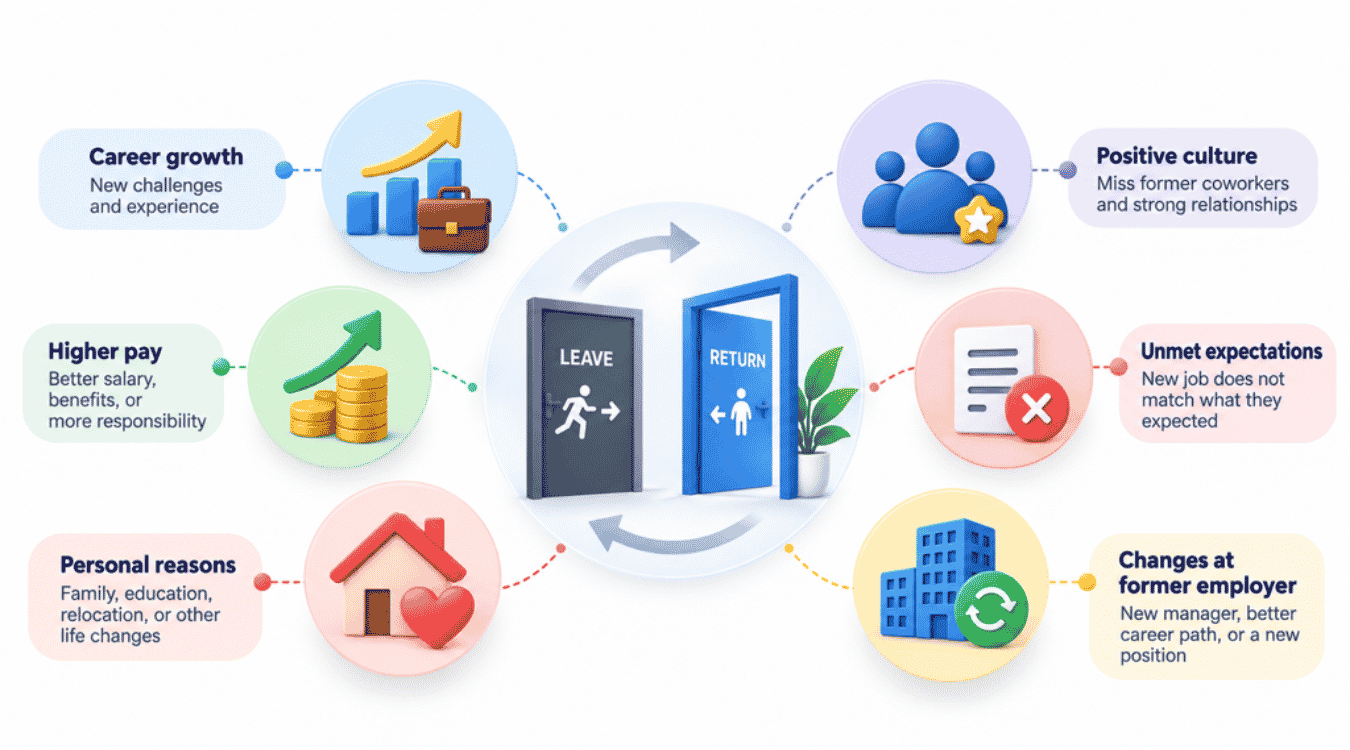
Employees do not always leave because they dislike a company. A person may leave for career growth, a higher salary, a new job, or personal reasons. Sometimes, the new company does not offer the career path or company culture they expected. Other employees miss their former coworkers, team members, and positive relationships. Research and HR guidance point to both career and personal factors behind many returns.
Career Growth And New Experience
Career growth can push an employee toward a new company. They may want new challenges, a new position, or experience in other industries. After gaining new skills, they may see a better role at their previous employer.
Compensation And Better Opportunities
Higher pay can also bring returning employees back. A former employee may receive a better job offer from the previous company, especially after gaining experience elsewhere. A new position with higher salary, better benefits, or more responsibility can make a return attractive.
Personal Or Family Circumstances
Personal reasons can make someone leave even when they enjoy their job. Family responsibilities, education, relocation, or other life changes may affect the decision. Once those circumstances change, employees may consider returning to their former employer.
Workplace Culture And Relationships
A positive company culture can be hard to replace. Former employees may miss their coworkers, managers, and team members. Strong relationships can also make returning feel less risky than starting over with a brand new company. Job satisfaction and familiarity can play a major role too.
Disappointment With A New Employer
Sometimes, the new job simply does not match expectations. The company culture may feel different, the role may lack growth, or the hiring process may have promised more than the job delivers. Such experiences can make a previous job look more attractive.
Changed Circumstances At The Former Employer
The former employer may also change while someone is away. A new manager, better career path, higher pay, or new position can create a reason to return. The employee may also have gained skills that fit a different role at the previous company. Seasonal businesses often see returning workers for similar reasons.
What Are The Benefits Of Boomerang Employees?
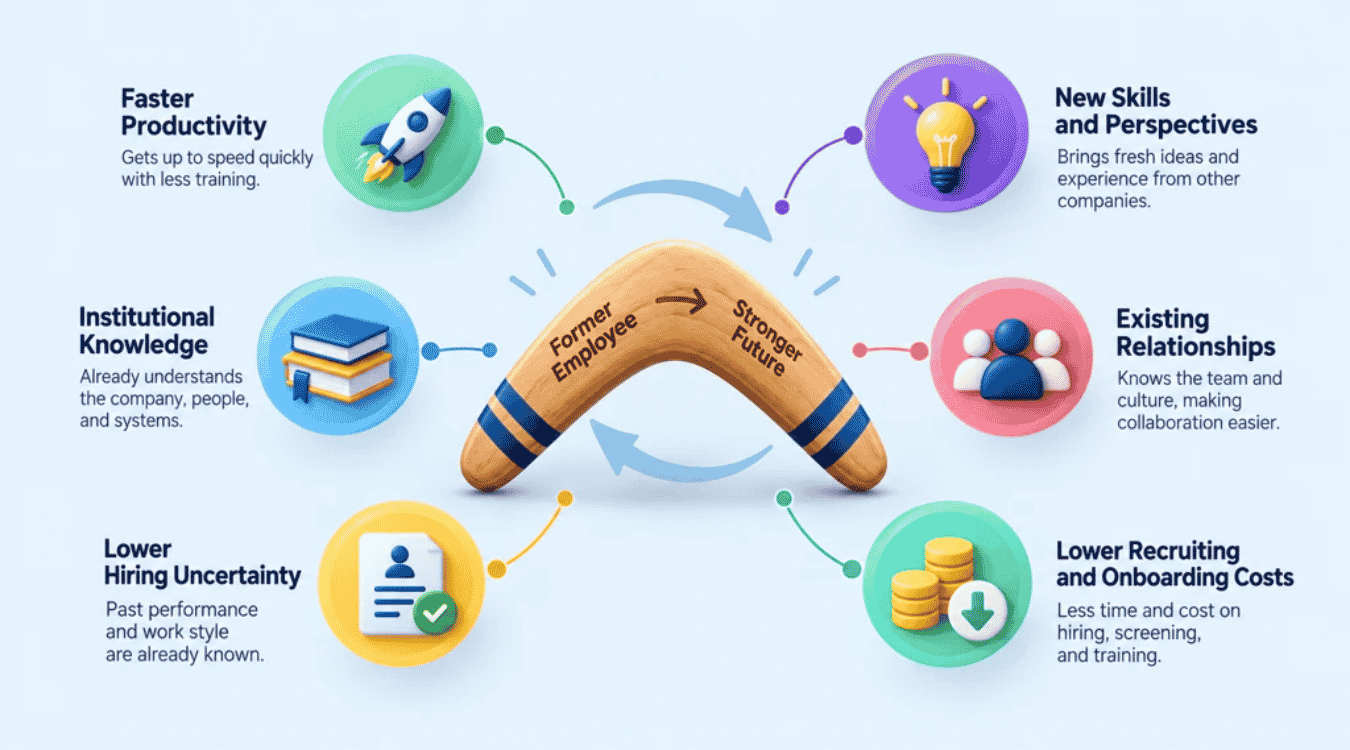
Hiring boomerang employees can give a company a useful mix of familiarity and fresh experience. A returning employee already knows parts of the company culture, internal systems, and team structure. At the same time, their time away may have given them new skills and different ways of working. Research from Cornell found that boomerang hires can outperform brand new hires in roles that depend heavily on internal relationships and coordination, especially when supported by robust recruitment software systems that track candidate history.
Faster Time To Productivity
A boomerang hire may reach productivity faster than a brand new hire. They already understand parts of the company, its processes, and its expectations. That can reduce the time spent on basic training and help returning employees contribute sooner. ADP notes that some boomerang employees may need less training because they already know the business, products, customers, and workplace. However, HR should still check what changed during their absence.
Existing Institutional Knowledge
Former employees already carry useful knowledge about the company. They may understand internal processes, customers, systems, and how team members work together. Cornell research found that familiarity with an organization's social system can help boomerang employees perform well, especially in roles that require coordination across teams. That knowledge can take a brand new hire much longer to build. A returning employee brings part of that understanding back with them.
Lower Hiring Uncertainty
Hiring managers have more information about a boomerang employee than they usually have about a new candidate. Their past performance, work habits, strengths, and relationships are already known. HR professionals can review that track record before making an informed decision. The approach still needs a proper hiring process. Familiarity should not replace interviews or skills checks. It should give the hiring manager better evidence when comparing a former employee with other candidates.
New Skills And Outside Experience
Returning employees can bring more than their previous company knowledge. Time at a new company may expose them to new skills, tools, industries, customers, and management practices. Those experiences can give a boomerang hire fresh perspectives that they did not have during their previous role. Cornell research also links outside organizational experience with return performance. A strong boomerang hire therefore combines knowledge of the former company with lessons learned elsewhere.
Existing Relationships And Networks
Former coworkers and other team members can make a return easier. A boomerang employee may already understand how people communicate, make decisions, and solve problems. Familiar relationships can reduce some of the friction that a brand new hire faces. Cornell research found that the advantage can be especially strong in jobs that depend on internal coordination. Returning employees can also bring outside networks and relationships built during their time away.
Lower Recruiting And Onboarding Costs
Hiring a former employee can reduce some recruitment and onboarding costs. The company already knows the candidate, which may reduce the time spent on sourcing, screening, and assessing cultural fit. A returning employee may also need less training than a brand new hire. Some industry research reports savings of up to 50%, but that figure should not be treated as a universal result; those savings depend heavily on the recruitment software. Actual savings depend on the role, hiring process, recruiter costs, and how long the employee has been away.
What Are The Risks Of Rehiring Boomerang Employees?
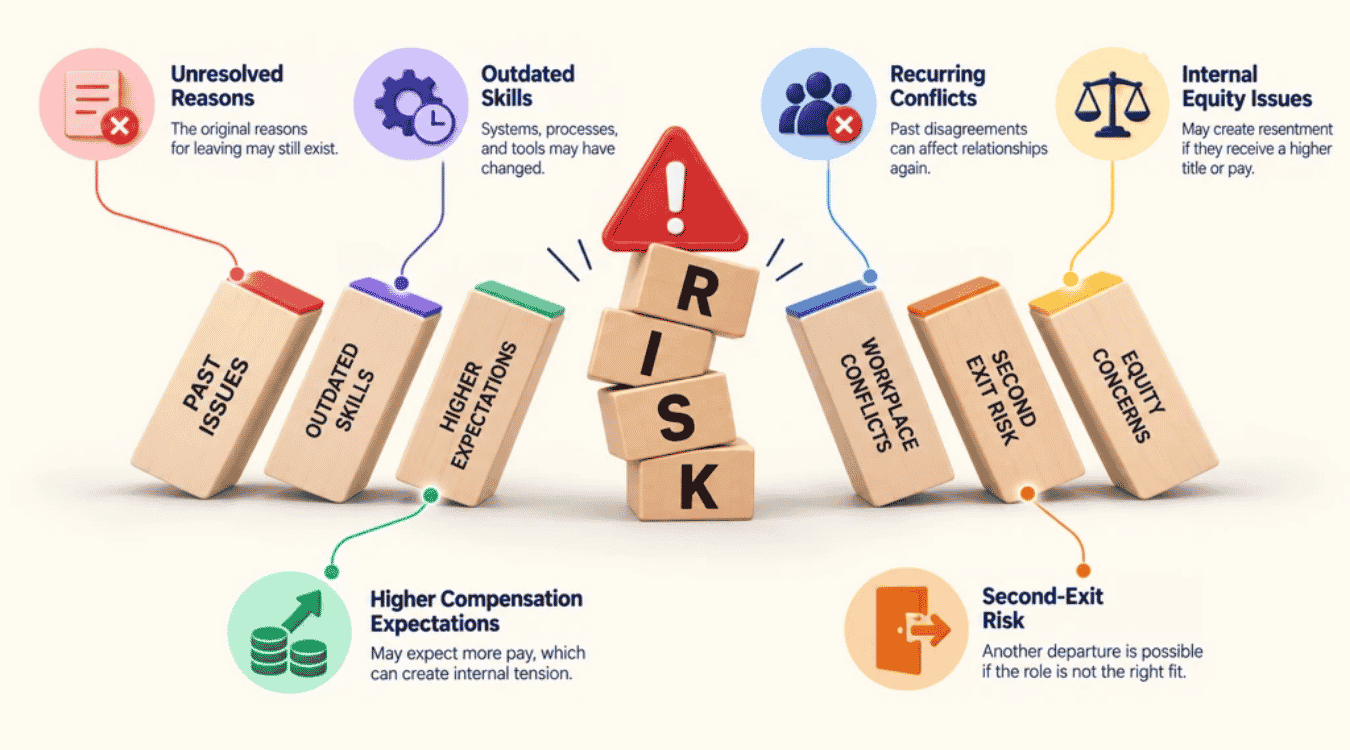
Rehiring a former employee can solve a hiring need, but familiarity does not remove risk. A returning employee may bring new skills and positive relationships, yet old problems can return too. Changed company culture, salary expectations, workplace resentment, and concerns about loyalty can all affect the second stint. ADP recommends reviewing why the employee left and whether those issues have actually been resolved before making a rehire decision.
Unresolved Reasons For Leaving
A person left for a reason, and HR should understand it before making a job offer. Problems with a manager, limited career growth, poor benefits, or workplace conflict may still exist. If the original issue remains, employee engagement and job satisfaction can suffer again after the return.
An exit interview can help the hiring manager understand the original situation. HR professionals should compare the former employee's reason for leaving with the current workplace. A successful boomerang hire requires more than wanting the right person back.
Outdated Skills And Knowledge
A former employee may know the company well, but some of that knowledge can become outdated. Systems, policies, products, managers, and team members may have changed since the person left. The employee may also expect the old job to feel familiar when the company now works very differently.
A returning employee may therefore need targeted training and re-onboarding. HR should explain major changes before the employee returns. A clear plan, supported by modern employee onboarding software, can help boomerang workers adjust to new processes while using the knowledge they already have.
Changed Compensation Expectations
Boomerang employees may expect higher pay after gaining new skills, certifications, or experience at another company. Their previous salary should not automatically determine the new offer. The hiring manager should consider the current role, market rate, skills, performance history, and internal pay levels.
Higher pay can also create tension among current employees. Team members may question why a former employee received a better salary or title after returning. A clear hiring process and consistent compensation rules can reduce perceptions of favoritism and protect internal equity.
Recurring Workplace Conflicts
Old workplace problems can follow a former employee back to the company. A past disagreement with a manager or former coworkers may still affect the working relationship. Bad blood from the previous job can also make reintegration harder, especially when the same team members are still there.
HR should review the employee's past performance and departure circumstances before approving a boomerang hire. Both sides should also discuss what has changed. Clear expectations can help prevent old conflicts from affecting employee engagement, team morale, and future success.
Second-Exit Risk
A boomerang employee has already left once, so another departure remains possible. The risk is higher when the employee returns mainly because a new job did not work out. SHRM notes that returning employees can later leave again, including to their previous employer.
A second exit does not mean hiring boomerang employees is a bad strategy. HR should understand the reason for the return and assess the person's long-term commitment. A realistic career path, clear job expectations, and a role that matches the employee's goals can support a stronger return.
Internal Equity Concerns
Rehiring a former employee can create workplace resentment when the returning worker receives higher pay, a better title, or a more senior position. Current employees may wonder why someone who left received an opportunity they did not receive. Such concerns can affect morale and employee engagement.
HR should not hide the business reason behind a boomerang hire. Managers can explain the value the returning employee brings without sharing private employment details. A fair hiring process, consistent standards, and clear communication can help other team members understand the decision and reduce unnecessary tension.
When Should You Rehire A Boomerang Employee?
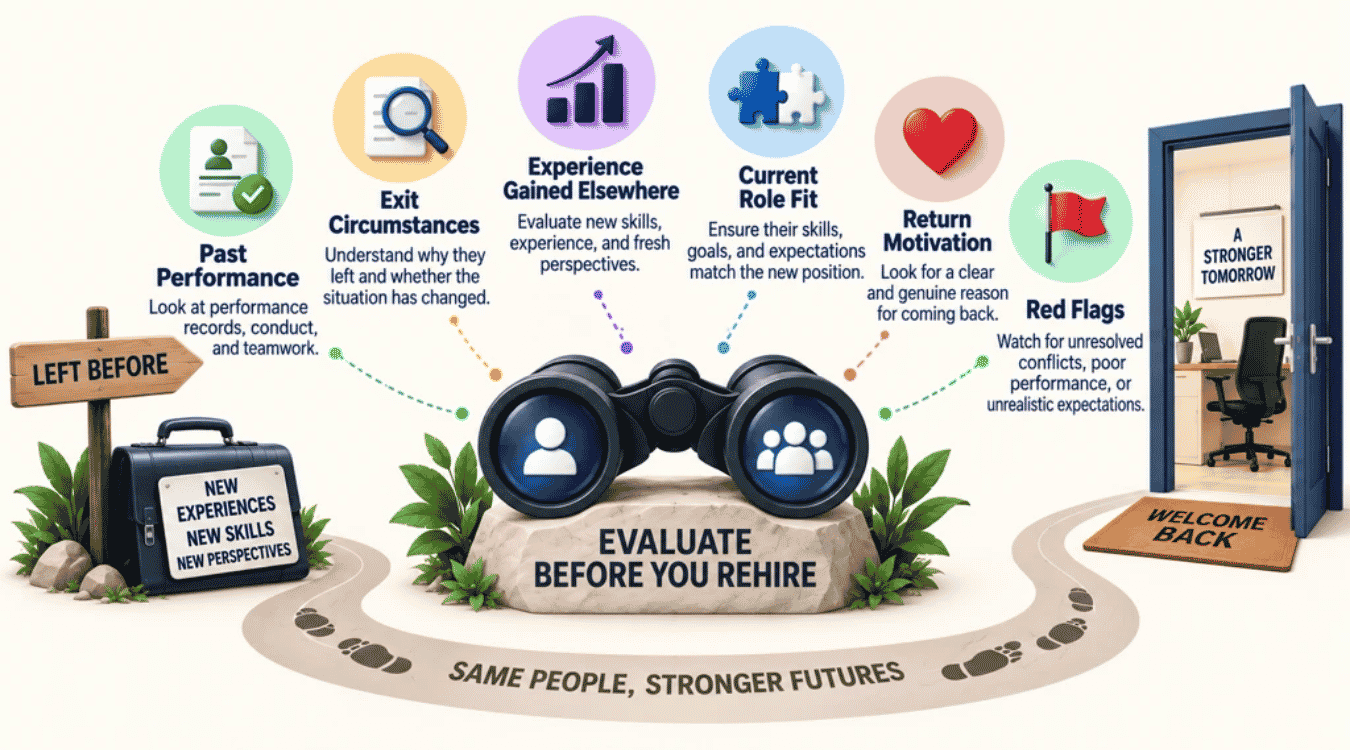
A former employee should not get an automatic second chance just because they already know the company. The decision should be based on past performance, the reason they left, what changed while they were away, and whether the new role fits their current goals. SHRM recommends using a structured decision matrix instead of relying on familiarity or instinct. Research also suggests that the reason for the original departure can help predict whether a returning employee will leave again.
Previous Performance And Conduct
Past performance gives a hiring manager useful evidence. Review performance records, attendance, reliability, teamwork, and conduct from the employee's previous role. Strong performance and positive relationships with former team members can support a rehire decision. A previous employee's track record should still be checked against the needs of the current position.
Conduct matters just as much as results. Serious performance or behavior problems should not disappear from consideration simply because the company needs someone quickly. SHRM recommends reviewing documented performance and skills before deciding whether a former employee is a suitable returning worker.
Original Exit Circumstances
The reason a person left can tell HR a lot about the potential success of a boomerang hire. Review the exit interview and previous employee records. A person may have left for personal reasons, career growth, education, relocation, or a new challenge. Those reasons do not carry the same rehire risk.
The bigger question is whether the situation has changed. If an employee left because of poor management, limited career growth, or workplace conflict, bringing them back without fixing the problem can recreate the same outcome. A case-by-case basis is safer than a blanket rehire policy.
Experience Gained Elsewhere
Time away can make a former employee more valuable, and modern tools like integrated recruitment systems make it easier to compare them fairly with new candidates. They may return with new skills, experience from other industries, or fresh perspectives from a new company. Those additions can make a returning employee a stronger candidate than they were during their previous job.
However, HR should look for evidence of actual growth. A new job title alone does not prove that the employee gained useful capabilities. Compare their new experience with the requirements of the current position and assess whether those skills can contribute to the company's future success. Research also suggests that organizations should consider the time horizon of performance and available alternative candidates before choosing a boomerang hire.
Current Role Fit
A former employee may have been an excellent fit for their old position but not for the role available today. The company may have changed, or the employee may have developed different career goals. HR should assess the new position on its current requirements rather than assuming the person belongs in the same position they held before.
Compare the employee's current skills, career path, salary expectations, and experience with the role, using your recruitment management software to keep evaluations consistent across candidates. A new position may be a better fit than the former role. The same hiring process should apply to the returning employee as it would to another qualified candidate. Familiarity should support the decision, not replace it.
Return Motivation
A strong return usually has a clear reason behind it. The employee may value the company culture, miss former coworkers, want a stronger career path, or believe the new position offers better long-term opportunities. SHRM recommends exploring the motivation behind the return rather than assuming the employee simply wants their old job back.
HR should also look for signs that the employee is returning toward a good opportunity rather than simply escaping a bad new job. A person who wants to rebuild a career with the former employer may show stronger long-term commitment than someone returning only because their new company disappointed them. ADP makes a similar distinction when discussing return motivation.
Rehire Red Flags
Certain warning signs should make HR slow down the decision. Unresolved workplace conflicts, weak past performance, poor conduct, unclear return motivation, or unrealistic salary expectations can create potential challenges. A former employee who left because of an issue that still exists may face the same problem again.
Another red flag is treating familiarity as a reason to skip the interview process. A rehired employee still needs a proper assessment. SHRM's current guidance recommends looking for both potential and risk, while research shows that some boomerang employees may turn over again for reasons similar to their original departure.
How Do You Rehire A Boomerang Employee?
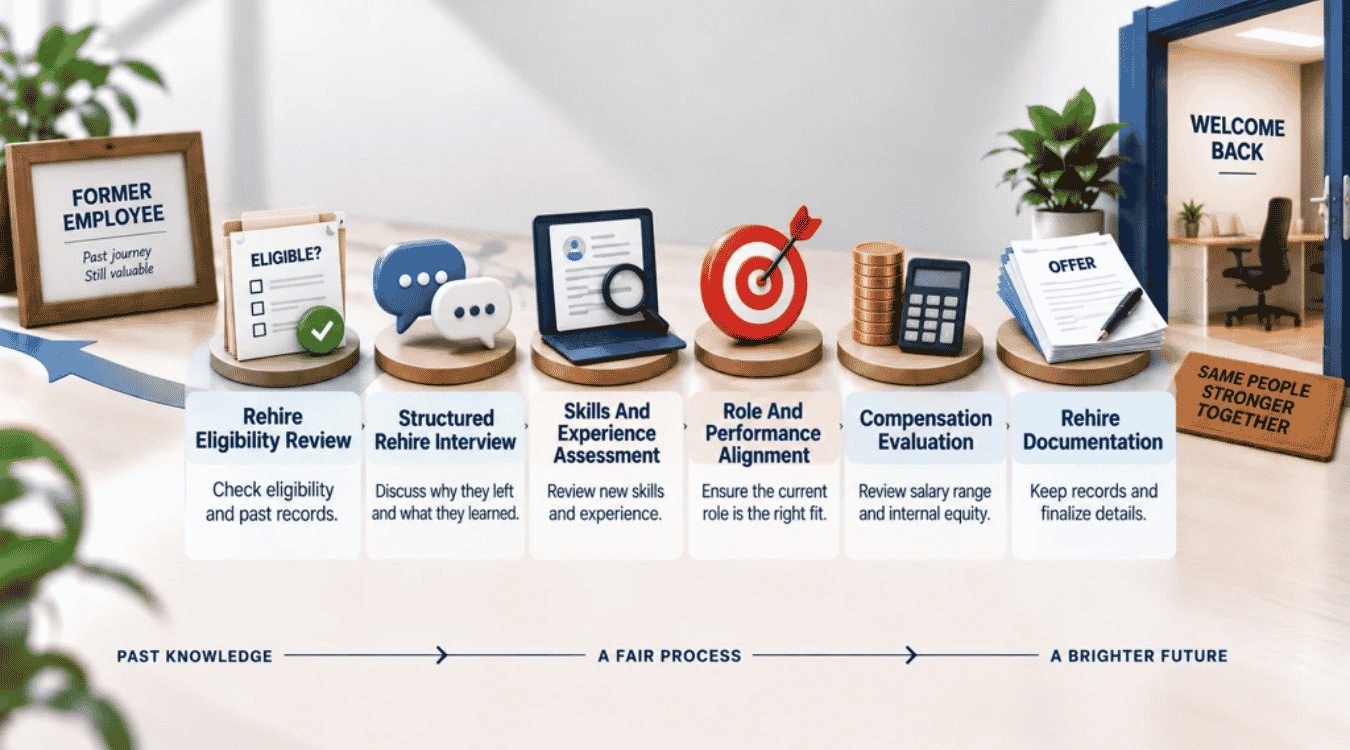
A boomerang hire should follow a clear hiring process. Familiarity with a former employee can help, but it should not replace proper evaluation. HR should confirm rehire eligibility, review past performance, assess new skills, and check whether the current role fits. A structured process also helps the hiring manager make a fair decision and gives the rehired employee clear expectations from the start, especially when supported by an applicant tracking system that standardizes hiring workflows.
Rehire Eligibility Review
Start by checking whether the former employee is eligible for rehire. Review the reason for departure, past performance, conduct, and any documented personnel issues. Company policy should clearly state which previous employees can return and which cases need additional review.
Review the employee's previous records before moving forward. A clean exit and strong track record can support the decision. Serious misconduct or unresolved issues may require a different approach. Each case should be assessed on its own facts rather than treated as an automatic return.
Structured Rehire Interview
A returning employee should still go through an interview process. The conversation can cover why they left, what they learned at their new company, and why they want to return. Interview questions should also explore what has changed since their previous job.
The hiring manager should avoid treating the interview as a formality. Ask about new skills, career goals, salary expectations, and the employee's view of the new role. A structured interview gives HR a fair way to compare the former employee with other candidates.
Skills And Experience Assessment
A former employee may return with new skills and fresh perspectives. Review what they learned after leaving. Their experience at a new company or in other industries may make them a stronger candidate for a new position.
Past experience should not be the only measure. Check whether the employee's current skills match today's requirements. Systems, tools, customers, and team structures may have changed since they left. A skills review helps confirm whether the returning employee can succeed in the role now.
Role And Performance Alignment
A former employee may not need the same position they held before. Their career path may have changed, and the company may now have a new position that better matches their experience. Review the role based on its current responsibilities, not its old structure.
Compare the employee's past performance with the expectations of the new role. Strong previous results can support the decision, but they should not guarantee a job offer. The goal is to confirm a genuine fit between the person, the role, the team, and the company's current needs.
Compensation Evaluation
A boomerang employee may expect higher pay after gaining experience elsewhere. HR should review the current salary range, market conditions, skills, responsibilities, and internal equity before making an offer. Previous salary should be treated as context, not an automatic benchmark.
Pay also affects how other employees view the return. A large difference between the returning employee's higher pay and similar team members' salaries can create resentment. A consistent compensation process helps the company explain the offer and maintain trust with current employees.
Rehire Documentation
Document the rehire decision from the start. Keep the eligibility review, interview notes, skills assessment, compensation decision, and final approval together. Clear records help HR explain why the former employee was selected and support a consistent hiring process.
The employee's record may also need updates after the job offer, and HR should plan these changes carefully as part of any broader HRIS migration or system update. Review the rehire date, role, salary, manager, department, benefits, PTO, and payroll details. Service dates and benefits can depend on company policy and applicable rules, so HR should confirm the correct treatment before finalizing the rehired employee's records.
How Can Offboarding Create A Future Boomerang Talent Pool?
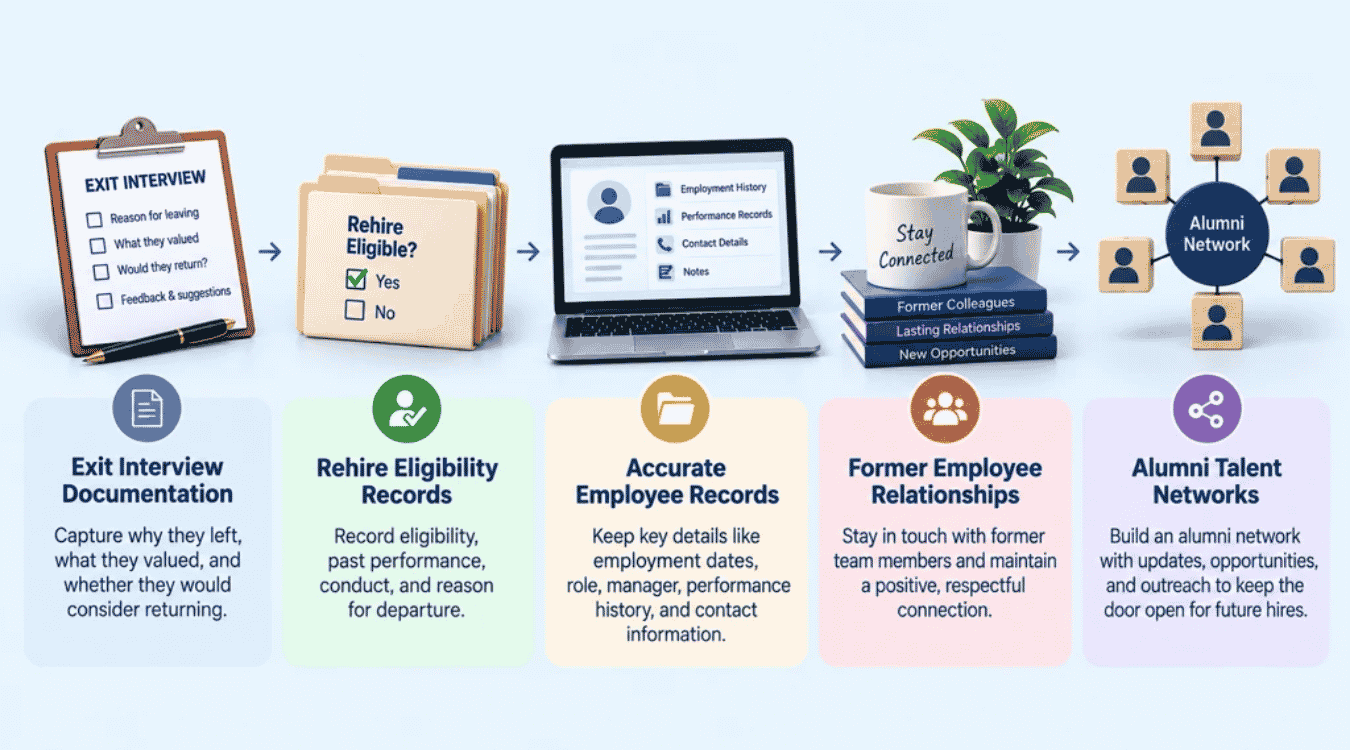
Offboarding can shape whether a former employee ever considers returning. A rushed exit may close the door, while a respectful one can keep the relationship alive. Companies can use the exit process to record useful information, identify potential boomerang employees, and maintain positive relationships after departure. LinkedIn recommends making the exit process part of the wider talent system, while recent HR guidance also treats former employees as a potential talent pool rather than a finished relationship.
Exit Interview Documentation
An exit interview should do more than collect a reason for leaving. HR can document why the employee left, what they valued, and whether they would consider returning. Questions about the previous job, company culture, career growth, and workplace relationships can provide useful context for future hiring decisions.
Keep the record factual and easy to review. A hiring manager should be able to understand the person's departure without relying on memory. LinkedIn recommends documenting the reasons for leaving and discussing rehire eligibility during the exit process.
Rehire Eligibility Records
Not every ex-employee should enter a future hiring pool. HR should record whether a former employee is eligible for rehire and why. A simple case-by-case basis can work better than treating all previous employees the same, especially when HR teams follow a consistent offboarding checklist.
The record can include past performance, conduct, reason for departure, and any conditions attached to a future return. HR Cloud also recommends checking the exit record and rehire eligibility before making an offer. A clear record helps HR avoid making rushed decisions when a new position opens.
Accurate Employee Records
Accurate records make future hiring easier, particularly when HR uses dedicated employee file management software instead of scattered spreadsheets or paper folders. HR should keep important information from the employee's previous role, including employment dates, position, department, manager, performance history, and contact details, ideally within a centralized HR software platform. The information can help talent acquisition teams understand who may be a strong future candidate.
Record accuracy also matters when a former employee becomes a rehired employee, which is where dedicated employee record-keeping software can help. Previous information can support the hiring process, while current details must be updated after the return. Capterra recommends creating a separate database of previous employees as part of offboarding so companies can use it as a future talent pool, ideally within a centralized employee record management system.
Former Employee Relationships
Maintaining relationships can make a future return feel natural. HR and managers can stay connected with strong former team members without turning every conversation into a recruitment pitch. A simple message, company update, or occasional professional interaction can keep the relationship positive.
A respectful departure also protects the employer brand. Former employees can become brand ambassadors when they leave with a positive view of the company. SHRM notes that strong relationships with managers and colleagues can help create future opportunities for boomerang workers.
Alumni Talent Networks
An alumni network gives companies a structured way to maintain relationships with former employees. It can include company updates, career opportunities, professional events, or occasional outreach. The goal is not to pressure previous employees to return. It is to keep a genuine connection alive.
A strong alumni network can become another talent acquisition channel, especially when combined with job posting software. When a suitable position opens, recruiters can contact relevant former employees instead of starting from zero. Current guidance recommends keeping alumni relationships warm and making former employees aware that the door is still open.
A thoughtful offboarding process can also support morale among current employees. It shows that the company respects people even when they choose a new company or career path. Over time, that approach can strengthen the employer brand and make boomerang employment a deliberate part of the talent strategy rather than an accidental outcome.
How Should You Re-Onboard A Boomerang Employee?
A rehired employee already knows part of the company, but that does not mean they can simply return to their desk and start working. Teams, systems, policies, managers, and priorities may have changed. SHRM recommends reboarding as a way to update returning employees on current work, team relationships, and expectations.
A good reboarding process should focus on what is new rather than repeating everything from the first onboarding. The goal is simple: help the returning employee reconnect with the company while closing the knowledge gaps created during their time away.
Previous Company Knowledge
A boomerang employee already has useful knowledge of the company culture, products, processes, and former team members. HR does not need to spend the same amount of time explaining basic company information as it would with a brand new hire. That can make the return smoother and help the employee contribute sooner.
However, previous knowledge should not be treated as fully current. The employee may remember the old job well, but some processes may have changed. Keep the familiar parts brief and focus the reboarding on information that is actually new.
Organizational Changes Since Departure
A former employee may return to a very different workplace. The hiring manager may have changed, former coworkers may have moved to other teams, and the company may have introduced new tools or processes. Even the employee's former position may now have different responsibilities.
HR should explain those changes early. A simple update can prevent confusion and frustration. The returning employee should know who leads the team, which priorities have changed, and how the organization now works. Current changes should take priority over repeating information from the previous job.
Current Policies And Systems
Policies and systems deserve special attention because they can change quickly, particularly when organizations move between cloud HR and on-premises HR systems. A boomerang employee may remember the old approval process, communication tools, security rules, or employee handbook. Following outdated processes can create unnecessary mistakes during the first few weeks.
Give the rehired employee access to current policies and systems before or at the start of their return. Update their HRIS access, payroll information, system permissions, and required acknowledgments as needed. A short review of major changes can be more useful than repeating the entire onboarding program.
Role-Specific Training
New skills do not remove the need for training. A returning employee may have gained valuable experience at another company, but they still need to understand how current tools and processes work. SHRM recommends upskilling returning employees when organizational processes, technologies, or frameworks have changed.
Focus training on the gaps that matter for the current role. A returning employee may already understand the company's customers but need training on a new platform. Someone returning to the same position may also need new training if responsibilities have changed. Tailored training keeps the process useful without wasting time.
30-60-90 Day Reboarding Plan
A 30-60-90 day plan gives the returning employee clear expectations. The first 30 days can focus on systems, policies, team relationships, and immediate responsibilities. The next 30 days can focus on independent work and role-specific goals. By 90 days, the employee should have clear performance expectations and regular feedback.
Manager check-ins also matter. SHRM notes that reboarding helps employees reconnect with their teams and work, which can support stronger engagement and job satisfaction. A structured plan gives both the manager and rehired employee a clear way to identify problems before they become bigger issues.
How Do Boomerang Employees Affect Current Employees?
A boomerang hire affects more than the returning employee. Current employees may notice changes in pay, promotions, team dynamics, and career opportunities. A returning worker can boost morale when they were well respected, but the opposite can happen if employees believe the company favors people who leave. Recent HR coverage warns that higher salaries, better titles, or greater flexibility for returning workers can make loyal employees feel overlooked.
Pay Equity Concerns
A rehired employee may return with higher pay after gaining new skills or experience elsewhere. The company may also offer more money to secure someone with a strong track record. Current employees may question the decision if their own pay has not changed.
HR should assess the role, market rate, experience, and internal salary levels before making an offer. A clear compensation process can reduce resentment. It also helps explain why the returning employee's pay is appropriate without revealing private salary details.
Promotion Equity Concerns
A former employee may return to a higher-level role after gaining experience at another company. That can be a valid talent decision. However, current employees may wonder why someone who left received a promotion that they had hoped to earn.
Hiring managers should apply the same role requirements to returning employees and internal candidates. Career growth should remain visible to current team members. A boomerang hire should add value without sending the message that leaving is the fastest route to advancement.
Employee Morale
A returning employee can boost morale when former team members had strong relationships with them. Their return may restore useful knowledge and help the team reconnect with someone they already trust. Recent company examples also show how organizations can use returning workers to reinforce company culture.
Morale can fall when employees believe the returning worker received special treatment. Pay differences, better titles, or preferential treatment can create workplace resentment. HR should make sure the return is based on a clear business need and that other employees still have fair access to development and career opportunities.
Manager Communication
Managers should not leave current employees guessing about a boomerang hire. A lack of communication can create assumptions about favoritism, pay, or promotion. Managers can explain the returning employee's role, responsibilities, and expected contribution without sharing confidential information.
The conversation should also reinforce opportunities for current employees. Managers can discuss career paths, development, and future roles with their teams. Clear communication helps the returning employee settle in while showing other team members that their work and career growth still matter.
Retention And Trust
Poorly managed boomerang hiring can create a difficult message: leaving may seem more rewarding than staying. Current employees could start looking elsewhere if they believe former coworkers return with higher pay or better positions. That can turn a hiring decision into a retention problem.
A thoughtful approach can have the opposite effect. Current employees can see that the company maintains positive relationships with former workers and values proven talent. The goal is to make boomerang hiring part of a broader retention strategy, not a substitute for fair pay, career growth, employee engagement, and internal mobility supported by deliberate employee retention strategies.
Boomerang Employee Vs External Hiring
Choosing between a boomerang employee and a brand new hire should depend on the role, not familiarity alone. A former employee already knows the company's culture, systems, and relationships. An external candidate can bring fresh perspectives, different experience, and skills from other companies or industries. Research shows that boomerangs can outperform external hires in some roles, particularly when the job requires strong internal coordination. Other research found that external hires improved more over time in some management roles. The best choice therefore depends on the position and the company's current needs.
Factor | Boomerang Employee | External Hire |
|---|---|---|
Company knowledge | Already familiar | Must learn |
Internal relationships | Existing | Must build |
New perspectives | Some from time away | Often stronger |
Hiring uncertainty | Lower due to past record | Higher |
Training needs | May be lower | Usually higher |
Cultural familiarity | Already established | Needs assessment |
Outside experience | Depends on previous role | Often broader |
Long-term fit | Must reassess | Assessed from the start |
Company Knowledge Advantage
A boomerang employee already understands parts of the company's systems, processes, culture, and working relationships. That knowledge can make the return easier, especially in roles that depend on coordination across teams. Research from Cornell found that boomerangs performed better than new hires in their initial job spell, with the advantage becoming stronger in roles that required greater internal coordination.
An external hire starts with less organizational knowledge. That can increase training needs and extend the adjustment period. However, a new hire may bring knowledge that the company does not already have. Familiarity is therefore an advantage, not an automatic reason to choose the former employee.
Proven Performance History
A rehired employee gives the hiring manager access to an existing track record. HR can review past performance, conduct, teamwork, and results before making an informed decision. The company may already know how the person handled pressure and worked with other team members.
An external candidate usually requires more prediction. Résumés, references, interviews, and assessments provide evidence, but the employer has not seen the person's performance inside the organization. Still, previous performance should not guarantee a return. Research comparing boomerang managers with external hires found similar first-year performance in one large study, showing why each candidate should still be evaluated on current requirements.
New Experience And Skills
Time away can give a boomerang employee something an external candidate cannot: knowledge of both the company and another workplace. A former employee may return with new skills, tools, industry experience, and fresh perspectives. That combination can be useful when the current role has changed since the employee left.
External hires can have an even wider range of experience. They may introduce different methods, technologies, and ideas that the company has not considered. If innovation or outside expertise is the main priority, an external candidate may offer more value than a familiar former employee.
Hiring Risk
A boomerang hire can reduce some uncertainty because the company already knows the former employee. HR has access to past performance and may already understand the person's working style. Yet the decision still carries potential challenges. The employee left once, and the same reasons could lead to another departure. Research has found that boomerang employees who left again often did so for reasons similar to their initial departure.
An external hire carries a different type of risk. The company has less direct evidence about how the person will perform in its environment. However, an external candidate may be the better choice when the organization needs capabilities that a former employee does not have.
Role And Culture Fit
A former employee may fit the company culture but not the current role. The organization may have changed, and the person's career path may have changed too. HR should therefore assess the returning employee against the current position rather than assuming the old fit still exists.
An external candidate has no previous connection to the company, so cultural fit needs more careful assessment. Yet they may challenge old assumptions and bring a different perspective. The right choice depends on whether the role needs established relationships or new thinking.
Long-Term Retention Potential
Retention should be part of the comparison, not an assumption. Some research has found that external hires were less likely to leave than boomerang managers in a large longitudinal study. The researchers also found that returning managers who left again often repeated the reason behind their original departure.
A boomerang employee may still be the stronger long-term choice when the original reason for leaving has been resolved and the new role offers a realistic career path. The hiring manager should assess motivation, expectations, role fit, and future goals for both candidates. Choose the person most likely to succeed in the role, not simply the person the company already knows.
How Can You Build A Boomerang Employee Policy?
A boomerang employee policy gives HR a consistent way to evaluate previous employees who want to return, especially when it is supported by scalable tools like HR software designed for small businesses. It should cover eligibility, prior service, compensation, reboarding, records, and review points. A clear policy also reduces favoritism concerns because the same standards apply to every former employee. Current HR guidance recommends defining eligibility, treatment of prior service, compensation, manager responsibilities, documentation, and exceptions in advance, and aligning these with your broader view of employee turnover causes in fast-growing companies.
Rehire Eligibility Rules
Start by defining who can return. Consider past performance, conduct, reason for departure, and whether the employee left in good standing. A former employee who resigned with proper notice may have a different status from someone terminated for serious misconduct. The policy should also explain whether layoffs, temporary assignments, and other departures qualify.
Avoid vague rules such as “good employees are eligible.” Use clear, job-related criteria instead. HR can classify former employees as eligible, eligible with review, or not eligible. Applying the same standard on a case-by-case basis helps keep rehire decisions consistent.
Service Bridging Rules
Decide in advance whether previous service counts after a returning employee comes back. The answer can affect PTO accrual, seniority, benefit eligibility, retirement plan treatment, and other employment benefits. A policy should state when prior service is bridged and when the employee starts a new service period.
The rule should not change simply because a hiring manager wants a particular former employee back. Put the treatment in writing before the job offer is finalized. Clear service rules make it easier for HR to explain what carries over and what resets.
Compensation Guidelines
A returning employee should be paid according to the current role, not simply their previous salary. Review the current pay range, market conditions, skills, experience gained elsewhere, and internal equity. Lattice recommends considering market benchmarks, skills, experience, and contributions since departure when setting compensation.
The policy should also explain who approves offers outside the normal salary range. A former employee may return with new skills and expect higher pay, but the company still needs a consistent process. Clear compensation guidelines can reduce concerns from other team members.
Reboarding Requirements
Do not let familiarity become a reason to skip reboarding. A returning employee may already understand the company culture, but policies, systems, managers, products, and team structures may have changed. SHRM recommends updating returning employees on current processes and expectations rather than assuming their previous knowledge is still complete.
The policy should define the minimum reboarding requirements. They may include updated training, handbook acknowledgment, system access, compliance paperwork, current role expectations, and a 30-60-90 day review plan. The amount of reboarding can vary based on how long the person has been away.
Employee Record Standards
HR should define which records must be reviewed before approving a boomerang hire. The list can include previous performance, conduct, exit interview notes, employment dates, compensation history, benefits, and the original reason for leaving. The rehire decision and approval should also be documented.
After the return, update the employee's current role, salary, manager, department, employment status, payroll details, benefits, and relevant service dates. Accurate records help HR apply the policy correctly and give the rehired employee a clear employment record, which becomes even more important as new employment policies for growing businesses increase compliance requirements.
Post-Rehire Review
A boomerang employee should have a formal review after returning. The policy can set checkpoints at 30, 60, and 90 days, followed by the company's normal performance cycle. Managers can use these reviews to check role fit, team integration, performance, and unresolved concerns.
A post-rehire review also gives HR useful data for future hiring decisions. Track retention, performance, engagement, and any second-exit patterns. If returning employees repeatedly leave for the same reasons, the company may need to review its hiring or retention practices rather than simply blaming the employee. A policy should be reviewed periodically and updated when recurring situations expose a gap.
How Do You Measure Boomerang Hiring Success?
A boomerang hiring strategy needs more than a high rehire rate. HR should measure whether returning employees become productive, stay with the company, perform well, and justify the cost of bringing them back. Comparing boomerang hires with external hires can also show whether the strategy is actually improving talent acquisition outcomes. Research suggests that performance and retention can vary by role and hiring group, so no single metric tells the full story.
Rehire Rate
Rehire rate shows how many new hires are previous employees returning to the company. Track it over time and compare it across departments, roles, and locations. A rising rate can show that maintaining relationships with former employees is creating a stronger talent pipeline. However, a high rate alone does not prove success. Pair it with retention, performance, and cost data.
Time To Productivity
Track how quickly a rehired employee reaches expected performance. Compare the result with similar brand-new hires in the same position. A shorter ramp-up can indicate that previous company knowledge is helping. Research suggests boomerangs can benefit from prior organizational experience, but performance advantages are not guaranteed across every role.
Cost Per Rehire
Measure the total cost of bringing a former employee back, using the same assumptions you apply when evaluating HR software pricing and ROI. Include sourcing, screening, interview process costs, onboarding, training costs, and recruiter time. Compare the result with external hiring costs for similar roles. A lower cost can strengthen the business case for boomerang hiring, but companies should avoid assuming every returning employee will produce the same savings.
90-Day And 12-Month Retention
Track whether returning employees remain with the company after 90 days and 12 months. Short-term retention can show whether the employee successfully reintegrated, while 12-month retention gives a stronger view of long-term fit. Compare both figures with external hires. Some research has found different turnover patterns among boomerang and external hires, so company-level data matters.
Second-Exit Rate
A second-exit rate measures how many boomerang employees leave again after returning. Track the timing and reasons behind each departure. Pay close attention when the second exit repeats the reason for the original departure. Research found that boomerang managers who left again often had similar reasons for both departures. That makes the metric useful for identifying unresolved workplace problems.
Post-Rehire Performance
Review performance after the employee returns and compare it with their previous record and similar external hires. Look at goals, manager feedback, productivity, quality, and team contribution. Do not assume past success guarantees future results. Research found that boomerang managers performed similarly to other hires during the first year, while internal and external hires improved more over time.
Final Thoughts
Boomerang employees can be a valuable part of a company's talent strategy, but rehiring a former employee should never be automatic. The strongest boomerang hires usually return with new skills, relevant experience, and a clear reason for coming back. HR should still review past performance, the original reason for leaving, current role fit, compensation, and long-term goals before making an offer.
A successful return also depends on what happens after the hiring process. Reboarding, fair pay, clear expectations, and good communication can help the rehired employee reconnect with the team. At the same time, current employees should not feel overlooked. The best approach is simple: keep the door open for strong former employees, but make every rehire a thoughtful, case-by-case decision based on what the company and employee need today.