COBRA Administration: Process, Requirements, And Compliance
Table of Contents
COBRA administration can become complicated fast. One missed termination date, late notice, or incorrect employee record can create compliance problems for an employer. Yet the process involves much more than sending paperwork after someone leaves the company.
Under federal COBRA, eligible employees and qualified beneficiaries can continue group health coverage after certain events, such as job loss or a reduction in work hours. Federal COBRA generally applies to group health plans sponsored by employers with at least 20 employees on more than half of their typical business days in the previous year.
So, what does proper COBRA administration require? This guide explains the process, eligibility rules, qualifying events, notices, deadlines, premiums, and compliance responsibilities employers need to understand.

What Is COBRA Administration?
COBRA administration is the process of managing continuation health coverage for employees and qualified beneficiaries after certain life or employment events. COBRA stands for the Consolidated Omnibus Budget Reconciliation Act, a federal law that sets rules for eligible group health plans.
The process covers several administrative tasks. A COBRA administrator may track a qualifying event, notify eligible participants, send an election notice, manage elections and premiums, and maintain coverage records. Qualifying events can include job loss, reduced work hours, divorce or legal separation, and other events that cause a loss of group health coverage.
Proper COBRA administration helps employers meet COBRA regulations, protect employee benefits, and ensure compliance. Employers may handle administration internally or work with third-party administrators, but accurate employee data and timely notices remain essential.
Who Is Subject To COBRA Requirements?
Federal COBRA does not apply to every company or every health plan. Coverage depends on the employer, the type of group health plan, the qualifying event, and who loses coverage. Employers need to check each factor before they start the COBRA administration process.
Covered Employers And Plans
Federal COBRA generally applies to private-sector employers with 20 or more employees on more than 50% of their typical business days in the previous calendar year. Full-time employees count, while part-time employees count as a fraction based on their work hours. Most state and local government group health plans are also subject to continuation requirements.
A covered group health plan can provide medical, prescription drug, dental, or vision benefits. COBRA regulations do not generally cover plans that provide only life insurance or disability benefits. Federal government plans, churches, and certain church-related organizations are also outside federal COBRA.
Qualified Beneficiaries
Qualified beneficiaries are generally people who had group health coverage under the plan on the day before a qualifying event. That can include the covered employee, a spouse or former spouse, and dependent children. Certain other individuals can qualify in specific circumstances.
Each qualified beneficiary has individual COBRA rights. For example, a spouse can elect COBRA coverage even if the employee does not. COBRA benefits allow eligible participants to temporarily continue applicable health care coverage instead of immediately losing access to the employer-sponsored plan.
COBRA Qualifying Events
A qualifying event is an event that causes a qualified beneficiary to lose group health coverage. For an employee, the most common COBRA events are voluntary or involuntary termination, except for gross misconduct, and a reduction in work hours.
Other qualifying events can affect a spouse or dependent. Examples include the covered employee's death, divorce or legal separation, loss of dependent-child status, and Medicare entitlement in limited circumstances. The event determines both COBRA eligibility and the maximum continuation period.
Coverage Loss Requirement
An employment or family event alone does not automatically trigger COBRA. The event must cause the person to lose coverage under the group health plan. For example, a reduction in hours becomes relevant when it results in a covered employee's loss of health coverage.
Accurate employment, payroll, and benefits data matter here. Payroll records can help employers identify reductions in hours, while timely termination records help the benefits team or COBRA administrator recognize potential eligibility changes. Strong employee data governance practices also reduce the risk of missed notices later in the process.
Federal COBRA And Mini-COBRA
Federal COBRA generally covers qualifying group health plans of employers that meet the 20-employee threshold. Smaller employers should not assume they have no continuation-coverage obligations. Many states have their own continuation laws, often called mini-COBRA laws, that may apply when federal COBRA does not.
Mini-COBRA has no single nationwide rule. Each state can set its own rules for employer size, eligibility, qualifying events, notices, premiums, and coverage duration. Employers with fewer than 20 employees should therefore check the law in every applicable state and stay up to date with changes instead of applying federal COBRA rules by default.
Qualifying Event | Qualified Beneficiary | Maximum Federal COBRA Coverage | Notification Responsibility |
|---|---|---|---|
Termination other than gross misconduct | Employee, spouse, dependent child | 18 months* | Employer |
Reduction in work hours | Employee, spouse, dependent child | 18 months* | Employer |
Death of covered employee | Spouse, dependent child | 36 months | Employer |
Divorce or legal separation | Spouse, dependent child | 36 months | Covered employee or qualified beneficiary |
Loss of dependent-child status | Dependent child | 36 months | Covered employee or qualified beneficiary |
Medicare entitlement in applicable circumstances | Spouse, dependent child | Up to 36 months** | Employer |
*An 18-month period may extend to 29 months for qualifying disability circumstances or up to 36 months after a qualifying second event.
**Medicare-related COBRA duration depends on when Medicare entitlement occurs relative to the termination or reduction in hours.
How Does The COBRA Administration Process Work?

COBRA administration follows a clear sequence. Employers first identify an event that may affect health coverage, confirm eligibility, notify the right party, and then track the case through election and coverage. Accurate HR and payroll data make each step easier and help reduce compliance risk.
Identify The Qualifying Event
The process starts when an employer becomes aware of a possible qualifying event. Common COBRA events include termination of employment for reasons other than gross misconduct and a reduction in work hours. Other events include death of the covered employee and, for spouses or dependents, divorce or legal separation and loss of dependent status.
HR, payroll, and benefits records play an important role here. A late termination record can delay the entire process. Payroll data can also help identify a reduction in hours that may lead to a loss of eligibility. A centralized employee record management system and fast, accurate data handoffs give the COBRA administrator more time to complete the required administrative tasks.
Confirm Eligibility And Coverage Loss
Not every employment change creates COBRA eligibility. The employer should confirm that COBRA applies to the group health plan, the person is a qualified beneficiary, and the qualifying event actually causes a loss of coverage.
For example, fewer work hours do not automatically trigger COBRA coverage. The reduction must result in a loss of group health coverage. Employers should check the plan rules, employment date, coverage status, and employee benefits before moving forward.
Notify The Plan Administrator
The next step depends on the type of event. For termination, reduction in hours, death, and certain other employer-known events, the employer generally has 30 days to notify the plan administrator.
Divorce or legal separation and loss of dependent status work differently. The covered employee or qualified beneficiary generally has responsibility for notifying the plan under its procedures and applicable timeframe. Clear internal processes and automated notifications can help employers avoid missed handoffs.
Send The Election Notice
After proper notification, the plan administrator generally has 14 days to send an election notice to each qualified beneficiary. The notice explains COBRA rights, available coverage, how to elect it, and where premiums should be paid.
Eligible beneficiaries must receive at least a 60-day election period, measured from the later of the date the election notice is provided or the date coverage would otherwise end. Each qualified beneficiary has an independent right to choose COBRA.
Track Election And Coverage
COBRA administration does not end when the election notice goes out. The plan must track elections, payments, coverage dates, premiums, extensions, and termination of coverage.
For termination or reduction in hours, COBRA coverage generally lasts up to 18 months, although certain circumstances can extend it. Qualified beneficiaries who elect continuation coverage generally receive the same health plan coverage available to similarly situated participants who are not on COBRA.
A reliable process gives employers and third-party administrators a clear record of every COBRA event. Good data accuracy, defined responsibilities, and consistent tracking also make it easier to ensure compliance and manage potential liability, especially when integrated with payroll compliance software that keeps deductions, taxes, and benefits contributions aligned with plan rules.
What COBRA Notices And Deadlines Must Employers Track?
COBRA compliance depends heavily on timing. A qualifying event can be handled correctly, but a late or missing notice can still create problems. Employers, plan administrators, and qualified beneficiaries each have specific notification responsibilities under federal COBRA.
General COBRA Notice
The general notice explains COBRA rights before a qualifying event happens. A group health plan generally must provide it to a covered employee and spouse within the first 90 days of coverage. It explains continuation coverage, notice procedures, and who to contact with questions.
Employers should also keep addresses and dependent information accurate. The Department of Labor provides a model general notice, but the plan administrator must complete it with the correct plan details before use.
Qualifying Event Notice And Procedures
The employer generally has 30 days to notify the plan administrator after certain COBRA events. Examples include termination or reduction in hours, death of the covered employee, Medicare entitlement in applicable circumstances, and employer bankruptcy.
Different rules apply to divorce or legal separation and a child's loss of dependent status. The covered employee or qualified beneficiary must notify the plan. A plan can set its own reasonable procedures, but the permitted notice period generally cannot be shorter than 60 days under the applicable timing rules.
Clear HR, payroll, and benefits workflows matter here. HR automation for routine workflows can reduce late termination records or inaccurate dates that delay administrative tasks and increase the risk of missed notices.
COBRA Election Notice
Once the plan receives proper notice of a qualifying event, the plan administrator generally has 14 days to provide an election notice to qualified beneficiaries. The notice explains COBRA coverage, election procedures, premiums, payment requirements, coverage duration, possible extensions, and early termination rules.
One timing detail deserves attention. When the employer is also the plan administrator, the election-notice timeline can generally extend to 44 days after the qualifying event. The timing can also run from the loss-of-coverage date in certain plan arrangements.
Election And Payment Deadlines
Each qualified beneficiary must receive at least 60 days to elect COBRA. The period starts from the later of the date the election notice is provided or the date group health coverage would otherwise end because of the qualifying event.
After election, the qualified beneficiary generally has at least 45 days to make the initial premium payment. Later payments must receive a grace period of at least 30 days. Plans do not have to send monthly premium notices, so participants remain responsible for paying on time.
Denial And Termination Notices
A plan may determine that someone who requests COBRA benefits or an extension is not eligible. In that case, it generally must provide a notice of unavailability within 14 days after receiving the request and explain why coverage was denied.
COBRA coverage can also end before its maximum 18-, 29-, or 36-month period in certain situations. When early termination applies, the plan must provide notice as soon as practicable after the decision. The notice should state when coverage ends, why it ends, and any available alternative coverage options under the plan or applicable law.
Action | Responsible Party | Trigger | Deadline |
|---|---|---|---|
General COBRA notice | Plan administrator | Employee and spouse become covered | Generally within first 90 days |
Employer qualifying event notice | Employer | Termination, reduced hours, death, certain Medicare events, or bankruptcy | Generally within 30 days |
Beneficiary qualifying event notice | Covered employee or qualified beneficiary | Divorce, legal separation, or loss of dependent status | Plan must generally allow at least 60 days under applicable rules |
COBRA election notice | Plan administrator | Proper notice of qualifying event | Generally within 14 days |
COBRA election | Qualified beneficiary | Election notice or coverage loss | At least 60 days |
Initial premium payment | Qualified beneficiary | COBRA election | At least 45 days after election |
Ongoing premium payment | Qualified beneficiary | Premium due date | Minimum 30-day grace period |
Notice of unavailability | Plan administrator | COBRA coverage or extension denied | Generally within 14 days of request |
Early termination notice | Plan administrator | COBRA ends before maximum period | As soon as practicable after determination |
The exact timeline can depend on the plan structure and event. Multiemployer plans may also establish different COBRA notice timelines when their plan documents allow it, so employers should follow their plan rules rather than rely on one deadline chart alone.
How Do COBRA Coverage And Premiums Work?
COBRA coverage lets qualified beneficiaries temporarily keep their group health coverage after certain qualifying events. The health insurance may stay familiar, but the cost often changes significantly because the employer usually no longer pays its previous share, so it should be communicated clearly as part of the broader employee benefits package.
COBRA Coverage Requirements
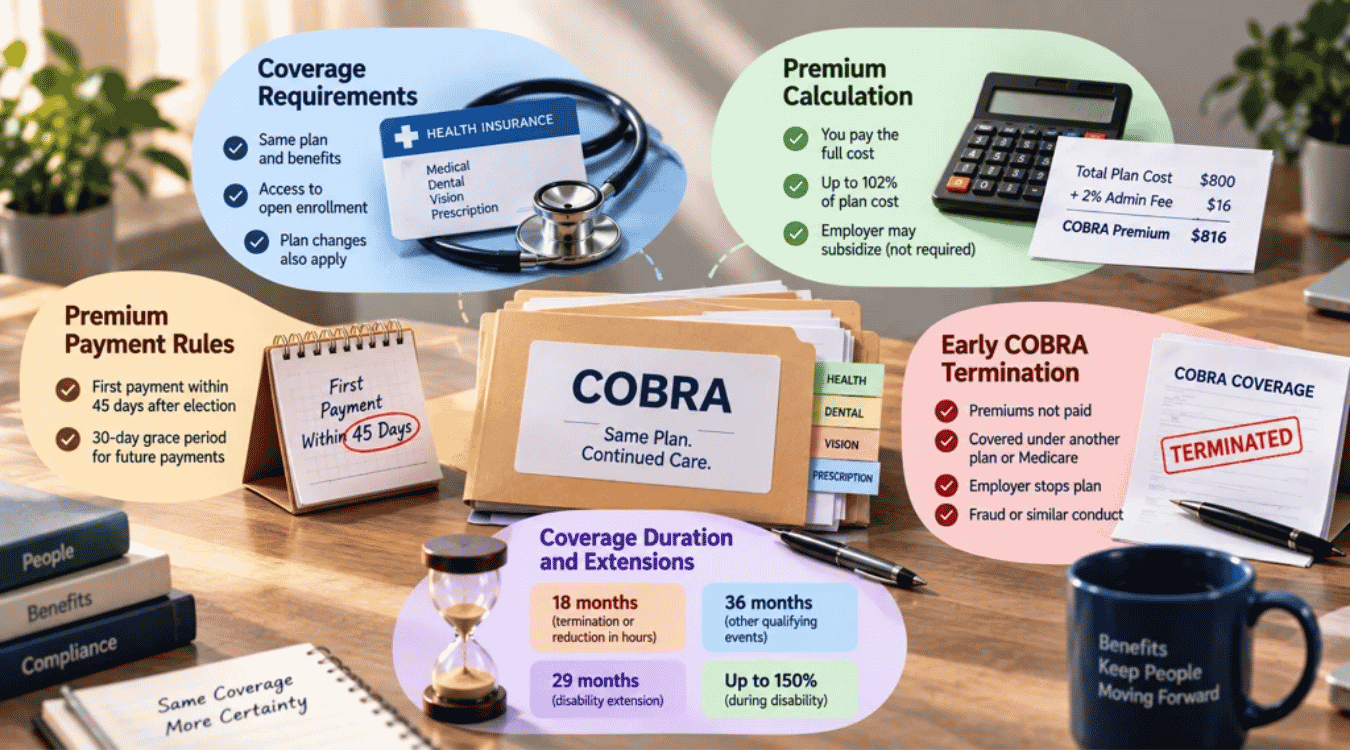
COBRA participants generally receive the same health plan coverage available to similarly situated active employees and their families. That includes the same benefits, deductibles, copays, coverage limits, claims procedures, and access to open enrollment, so employers should coordinate COBRA timelines with their open enrollment checklist and deadlines. Plan changes that apply to comparable active employees also apply to COBRA participants.
A qualified beneficiary can also change coverage during open enrollment under the same rules that apply to similarly situated employees. A child born to or placed for adoption with a covered employee during COBRA coverage can also be added under applicable plan rules.
COBRA Premium Calculation
Under COBRA, qualified beneficiaries usually pay the full cost of coverage. That means the employee's former share plus the amount the employer previously contributed. A plan can generally charge up to 102% of its total cost, which allows an additional 2% for administrative costs.
For example, if the total monthly health plan cost is $800, the COBRA premium could reach $816. Employers can choose to subsidize some or all of that cost, such as through a severance agreement, but federal COBRA generally does not require them to do so.
COBRA subsidies have also existed under temporary federal programs in the past. Employers should not assume that a historical subsidy applies to a current COBRA case.
Premium Payment Rules
A qualified beneficiary does not have to pay the premium on the day COBRA is elected. The plan must generally provide at least 45 days after the election for the initial payment. Because coverage can apply retroactively to the date prior coverage ended, that first payment may cover more than one month.
After that, plans must allow monthly payments and provide at least a 30-day grace period for subsequent premiums. Plans do not have to send a monthly bill. If a payment is slightly short, special rules can require notice and a reasonable period to correct the deficiency rather than immediate cancellation.
Coverage Duration And Extensions
COBRA coverage generally lasts up to 18 months after termination of employment, other than for gross misconduct or a reduction in hours. Other qualifying events, such as divorce or legal separation, death of the covered employee, or loss of dependent-child status, can provide qualified beneficiaries with up to 36 months of continuation coverage.
An 18-month period can extend to 29 months when the requirements for a disability extension are met. A second qualifying event can extend coverage to a maximum of 36 months in applicable circumstances. During an 11-month disability extension, the plan may charge up to 150% of the coverage cost when the disabled qualified beneficiary remains covered.
Early COBRA Termination
COBRA does not always continue for the maximum period. Coverage may end early if premiums are not paid on time, the employer stops maintaining any group health plan, or a qualified beneficiary becomes covered under another group health plan after electing COBRA. Medicare entitlement after the COBRA election can also end coverage in certain circumstances. Fraud or similar conduct that would justify terminating coverage for a comparable participant can be another reason.
The plan must provide an early termination notice when COBRA ends before the maximum coverage period. Qualified beneficiaries may then need to review alternative coverage options rather than assume their COBRA benefits will continue automatically.
How Can Employers Maintain COBRA Compliance?

COBRA compliance becomes easier when employers treat it as a repeatable process rather than a task that starts after someone leaves. Clear ownership, accurate employee data, reliable deadline tracking, and good records can help prevent small administrative errors from becoming larger COBRA violations.
Assign Clear Responsibility
Start by deciding who owns each part of COBRA administration. HR may record employment changes, payroll may provide hours and termination data, and the plan administrator may handle notices and elections.
Many employers also use COBRA administration services or third-party administrators to manage administrative tasks. That can save valuable time, especially for companies with many COBRA cases and those shifting from manual to smart HR processes. However, outsourcing does not make accurate employer data less important. DOL notes that employers may hire third-party benefits administrators while covered plans still need to meet COBRA and ERISA requirements.
Connect Employee Data
COBRA administration depends on accurate information moving between HR, payroll, benefits systems, and the COBRA administrator. A late termination date or missed reduction in hours can delay the qualifying event process and put required notices at risk.
Set up a consistent data flow for employment status, hours, coverage dates, dependent details, and contact information. Automated notifications or system integrations, supported by robust employee record-keeping software, can help, but they still need accurate source data. Online portals can also provide a central place to manage COBRA records, depending on the provider.
Track Every COBRA Deadline
Do not rely on someone remembering when a notice is due. Build deadlines directly into the COBRA workflow.
For example, employers generally have 30 days to notify the plan administrator of termination, reduction in hours, death, and certain other employer-reported qualifying events. The plan administrator generally has another 14 days after receiving proper notice to provide the election notice. Different timing can apply when the employer is also the plan administrator.
A comprehensive solution should track the event date, coverage-loss date, notification date, election deadline, payment dates, extensions, and coverage end date, ideally tying into broader employee compliance tracking processes.
Maintain An Audit Trail
Keep enough information to reconstruct each COBRA case later. Records should show what happened, when it happened, who handled it, and what communication was sent, including how COBRA decisions align with your broader payroll tax compliance and benefits reporting obligations.
Keep qualifying event data, eligibility decisions, copies of notices, mailing or delivery records, elections, premium payments, extensions, participant communications, and termination details. DOL guidance also stresses accurate contact information and clear notice procedures.
A strong audit trail can help the employer respond to questions from employees, clients, administrators, or regulators without searching through disconnected emails and spreadsheets.
Audit COBRA Cases
Periodic audits can catch problems before they affect more participants. An internal HR compliance audit checklist can help you compare termination and payroll records with COBRA cases and check whether every qualifying event was identified, notices went out on time, premiums were calculated correctly, and coverage dates match the health plan.
Incorrect premium calculations and missed notices deserve particular attention because COBRA failures can create financial and legal exposure. Regular payroll audit strategies can help validate that premiums and deductions align with plan rules. Internal Revenue Code Section 4980B provides an excise tax framework for failures to satisfy COBRA continuation requirements, and applicable employers or plans use Form 8928 to report tax due. The amount depends on the circumstances, so employers should not treat a single daily figure as the automatic penalty for every COBRA failure.
Regular reviews help employers find gaps early, correct them where possible, and maintain a more defensible compliance process.
What Happens When COBRA Administration Goes Wrong?
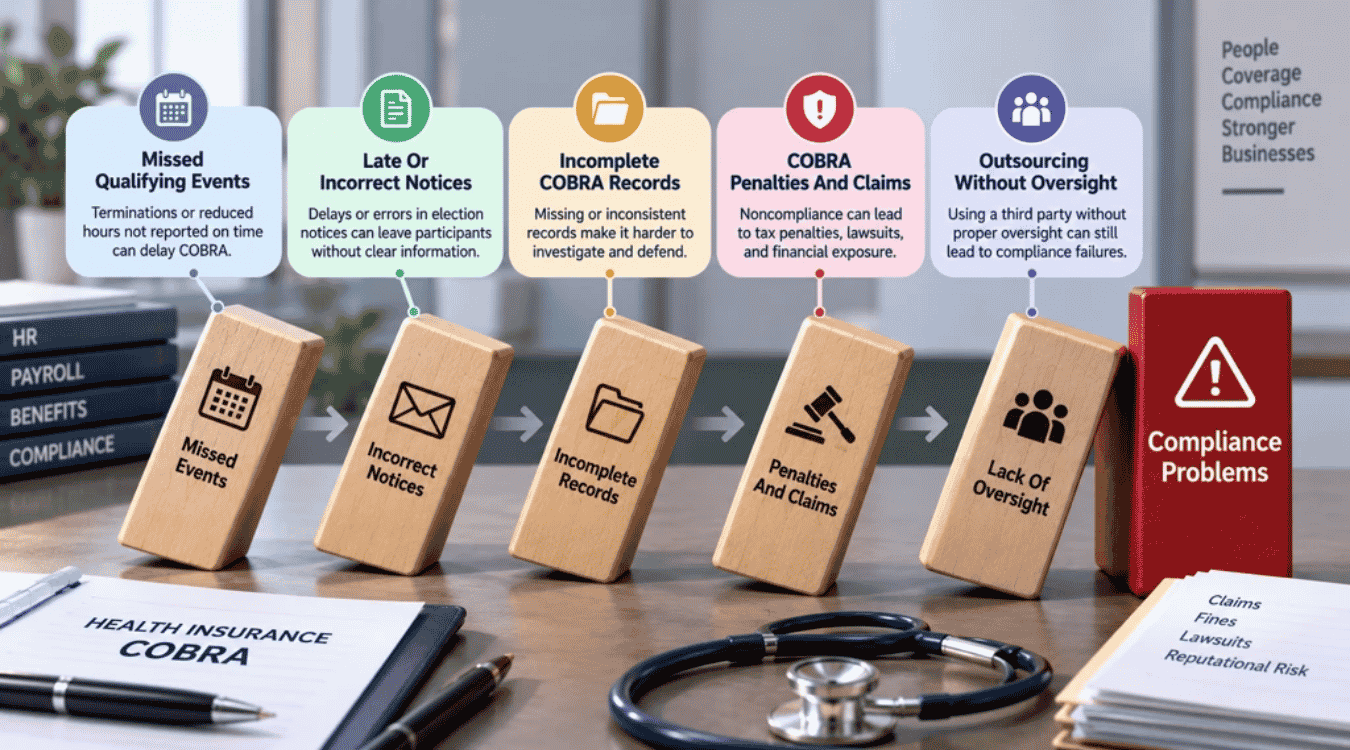
Small COBRA administration errors can become expensive problems. A missed event, late notice, or poor record can affect a participant's health coverage and expose the employer or plan to tax, claims, or other liability. Automating payroll with modern payroll software for businesses can help reduce some of the data and timing errors that feed into COBRA mistakes. Strong controls matter because several parties may depend on the same employment and benefits data.
Missed Qualifying Events
A COBRA case cannot move forward if the qualifying event never reaches the right person. Terminations and reductions in work hours are common examples. Employers generally must notify the plan administrator within 30 days after specified employer-known events.
Problems often start with a simple data gap. HR may record a termination late, payroll may have outdated hours, or benefits data may not reach the COBRA administrator. Integrated payroll processing services and regular reconciliation between payroll, HR, and benefits records can help catch missing events before notice deadlines pass.
Late Or Incorrect Notices
A late election notice can leave qualified beneficiaries unsure about their right to continue health insurance. Incorrect names, addresses, coverage dates, premiums, or election instructions can create problems too.
Employers should treat every notice as a compliance task, not routine paperwork. Federal rules generally give the plan administrator 14 days after receiving proper employer notification to issue the election notice. When the employer is also the plan administrator, a 44-day framework generally applies for relevant employer-reported events.
Incomplete COBRA Records
Good records matter when an employee questions what happened months later. A centralized payroll management system can support this by tying payroll changes to benefits and notice history. Employers should be able to show the qualifying event date, eligibility decision, notice date, delivery information, election, payments, coverage changes, and termination date.
Incomplete records make COBRA violations harder to investigate and defend. A reliable system or online portal can make records easier to access, but technology alone is not a comprehensive solution. The underlying data and administrative process still need to be accurate.
COBRA Penalties And Claims
COBRA noncompliance can create several types of financial exposure, so employers should avoid treating one penalty figure as universal.
Internal Revenue Code Section 4980B can impose an excise tax for failures to satisfy COBRA continuation requirements. IRS Form 8928 instructions calculate applicable tax based on the period of noncompliance and distinguish failures due to reasonable cause from those involving willful neglect. Accurate deductions, benefits contributions, and timelines in your employee self-service payroll system can lower the risk of COBRA-related tax exposure.
ERISA can also create separate litigation and penalty exposure in applicable circumstances. Figures such as $110 per day are often cited for certain ERISA disclosure failures, but that amount should not be described as an automatic penalty for every late COBRA notice or multiplied mechanically for a family of four. The exact consequences depend on the violation and applicable law.
Outsourcing Without Oversight
COBRA administration services can save valuable time, which is why many employers use third-party administrators. A provider may handle notices, elections, payments, online portals, and participant support for multiple clients.
Outsourcing, however, should not mean ignoring the process. Employers should confirm responsibilities, send accurate event data on time, review reports, check service performance, and understand who has legal responsibility under the plan. An HR shared services model can also centralize ownership for these vendor relationships. DOL guidance specifically recommends periodic monitoring of service providers and their recordkeeping and performance.
A COBRA administrator can handle much of the day-to-day work, but strong employer oversight remains an important part of a reliable compliance process, especially when paired with a centralized HR management system that keeps employee and benefits data aligned.
Final Thoughts
COBRA administration is easier to manage when every step has a clear owner. Employers need accurate employee data, reliable notice procedures, deadline tracking, and complete records to keep the process on track. Small errors can matter because federal COBRA sets specific responsibilities for employers, plan administrators, and qualified beneficiaries.
A strong process should connect HR, payroll, benefits, and the COBRA administrator rather than treat continuation coverage as a separate task. Employers should also review their plan rules regularly and stay current with federal and applicable state requirements.
The goal is not simply to send COBRA notices on time. Good administration protects employees’ access to health coverage while helping employers reduce compliance risk, avoid preventable disputes, and manage each qualifying event with confidence.
.jpg)