Employee Compliance Tracking To Reduce Compliance Risks
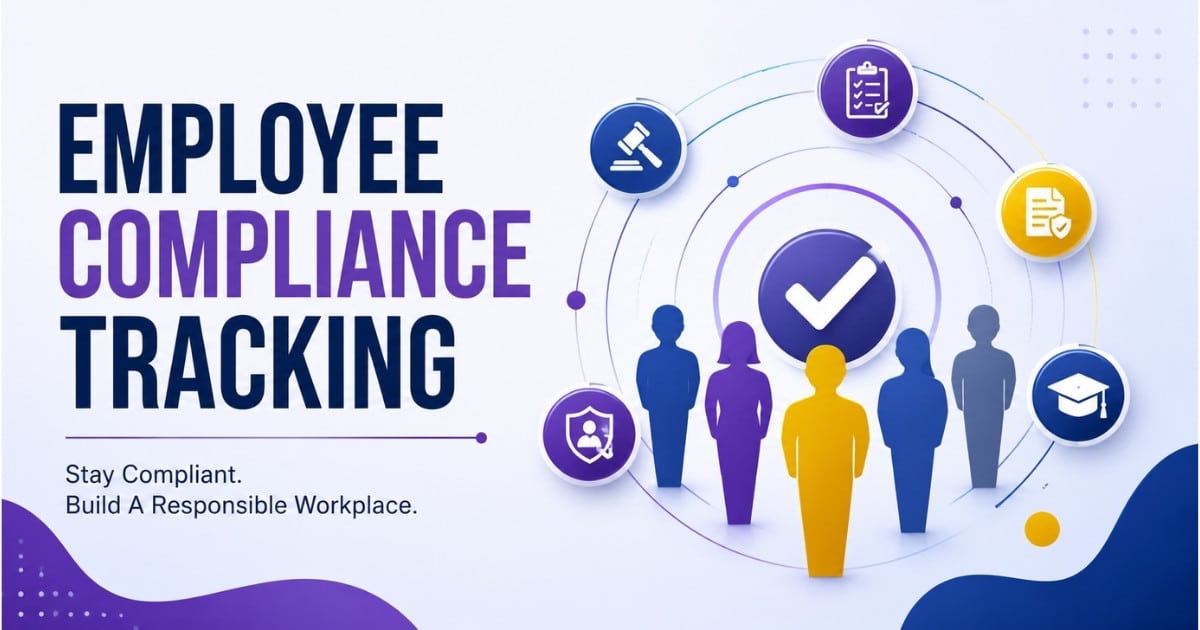
Table of Contents
Every organisation carries a set of legal, regulatory, and contractual obligations that apply directly to its people. When those obligations are not tracked at the individual employee level, the consequences can be severe. A 2025 Ponemon Institute study found that a single non-compliance event costs an average of US$14.8 million, including fines, disruptions, and remedial costs. Compare that with US$5.47 million to maintain regulatory compliance, and the economic argument for structured tracking becomes difficult to ignore.
The UK paints a particularly stark picture. Research by BPD Zenith revealed that seven in ten organisations in major industries lack reliable data tied to compliance, raising failure risk during inspections under the Health and Safety at Work Act 1974. Meanwhile, a survey of 920 UK workers found that 50 percent say health and safety training is skipped, with 31 per cent citing insufficient training budgets.
Employee compliance tracking helps organisations avoid reputational damage, reduce legal penalties, and keep business operations running without interruption. This article walks through what employee compliance tracking involves, why it matters, the features to look for, and how to implement it successfully.

What Is Employee Compliance Tracking
Employee compliance tracking is the systematic process of monitoring employee adherence to legal requirements, regulatory obligations, contractual terms, and internal policies. It covers verifying legal eligibility to work, confirming that mandatory training is completed, checking that professional licences remain current, and ensuring that every policy acknowledgement is documented. Employee compliance tracking typically involves monitoring mandatory training completion rates, tracking the expiration dates of certifications, and maintaining time-stamped records that stand up to scrutiny from regulators or tribunals.
Traditional approaches relied on shared spreadsheets, paper files, and email reminders. These methods create version confusion, lack centralised visibility, and produce weak audit trails. Automated compliance tracking combines technology with structured training programs by centralising each employee's profile, automating expiry alerts, and maintaining searchable records. Compliance management software replaces guesswork with verifiable evidence.
Employee Compliance Tracking Versus General Compliance Monitoring
It is common to confuse employee compliance tracking with broader compliance monitoring, but they serve different purposes. Compliance monitoring at the organisational level focuses on whether the right policies exist, whether controls are designed and operating effectively, and whether risk registers reflect the current threat landscape. Tools built for governance, risk and compliance, such as LogicGate Risk Cloud and similar platforms, sit at the board and enterprise level. They handle risk scoring, vendor due diligence, IT security controls, and control testing across the business.
Employee compliance tracking goes deeper. It asks whether each person has a valid certification, has signed the latest policy, has completed the required training for their specific role, and holds a current licence for the work they perform. Regulatory compliance monitoring at the enterprise level and internal monitoring at the individual level are both necessary, but they answer different questions.
Mature organisations connect both layers. For example, combining phishing simulation results with security awareness training completion rates gives a far more accurate picture of cyber risk than either metric alone. If 40 percent of staff fail a phishing test and 25 percent have overdue security training, the risk assessment becomes much more urgent than a generic policy review would suggest.
The table below summarises the core differences:
Aspect | Employee Compliance Tracking | General Compliance Monitoring |
|---|---|---|
Focus | Individual person-level evidence | Organisational controls and policies |
Data | Training records, licences, attestations | Risk registers, control tests, audit results |
Users | HR, payroll, line managers | Board, compliance committees, GRC teams |
Examples | DBS check valid, GDPR training completed | IT firewall configured, vendor contract reviewed |
Tools | Compliance monitoring software for employees | Enterprise GRC platforms, compliance monitoring tools |
Typical Stakeholders In Employee Compliance Tracking
Employee compliance tracking is not the responsibility of a single team. It works best when ownership is clear across several roles, because compliance tasks touch nearly every function in an organisation.
HR teams typically own the policies that define what compliance items apply to each role. They set the training requirements, manage onboarding documentation, and maintain employee records. Payroll teams ensure that hours, pay, overtime, and deductions are accurate and lawful, which is itself a compliance obligation. Line managers are closest to the day-to-day reality: they need to know which team members have expiring certifications or overdue training, and they are the ones who act on alerts. Health and Safety officers own safety training records, PPE fit-testing, incident reports, and medical clearances. Data Protection Officers and legal teams oversee GDPR training, confidentiality agreements, and records retention. Internal audit teams assess gaps, request evidence, and perform compliance tests.
It improves collaboration across departments for compliance tasks when responsibilities are explicitly assigned. Consider a practical scenario: HR defines that all new starters in a warehouse role must complete manual handling training within seven days. Payrun tracks completion automatically. If a team member has not finished by day five, the line manager receives an alert. If day seven passes without completion, the alert escalates to HR and the compliance officer. Without this clarity, everyone assumes someone else is handling it, and the gap remains invisible until an incident or audit surfaces it.
Why Employee Compliance Tracking Reduces Compliance Risks
The financial case for employee compliance tracking is straightforward. Non-compliance costs roughly 2.7 times more than maintaining an effective compliance program. When individual employee obligations are not monitored, the organisation accumulates risk across every untracked person, every expired licence, and every unsigned policy.
Reducing Regulatory And Legal Exposure
UK regulators expect documented, person-level evidence of compliance. The ICO looks for proof of data protection training during investigations. The HSE expects competence records linked to job roles. The FCA's Training and Competence sourcebook requires firms to maintain records of recruitment, training, supervision, and continuing professional development for every employee performing regulated activities.
Employee compliance tracking helps organisations avoid costly legal penalties by ensuring that these records exist and are current. Recent ICO enforcement actions between 2024 and 2026 have repeatedly cited insufficient or non-role-specific staff training, with fines ranging from £7,500 to £750,000 depending on severity. Compliance tracking reduces exposure to legal risks significantly, especially in employment tribunals where the absence of clear records for policies, acknowledgements, or timesheets can shift the burden of proof to the employer. Continuous monitoring involves ongoing verification of employee qualifications and licences, which means gaps are identified before they become enforcement triggers.
Preventing Operational Disruption And Safety Incidents
Employee compliance tracking helps organisations avoid operational disruptions by ensuring that only qualified, trained, and certified personnel are assigned to roles. Operational continuity prevents project delays by ensuring qualified personnel are assigned to roles, and compliance tracking creates a safer workplace by enforcing safety protocols.
In sectors such as construction, manufacturing, transport, and healthcare, an expired certification or a missed safety briefing can lead directly to an accident, a site closure, or a lost contract. UK Health and Safety Executive statistics for 2024/25 document thousands of non-fatal accidents and ill-health cases annually, many occurring where required training or supervision was missing. If a forklift operator's licence expires and the organisation relies on a spreadsheet that nobody checks, the operator may continue working until an incident forces everyone to look at the records.
Mitigating Data Privacy And Cybersecurity Risks
UK GDPR and the UK Data Protection Act require organisations to ensure that employees handling personal data are appropriately trained. Over numerous ICO enforcement actions, inadequate training has been cited as a contributing factor to breaches. Employee compliance tracking connects data protection obligations with tangible proof: completion records for security awareness courses, signed confidentiality agreements, and documented role-based access reviews.
Tracking completion of security awareness and data protection training reduces the likelihood of phishing and data loss incidents. Maintaining evidence of acceptable use policy acknowledgements and remote-working security guidance is equally important, particularly as hybrid working has become the norm. Compliance efforts in this area protect not just the organisation but also the individuals whose data it holds.
Improving Audit Readiness And Response
Audit readiness ensures organisations are prepared for regulatory audits at any time, not just during scheduled review periods. The difference between scrambling to collect evidence during an FCA, ISO 27001, or customer audit and producing reports instantly from a tracking system is measured in weeks of effort.
Auditors typically request training matrices by role and date, licence and certification status reports, policy acknowledgement logs, and exception reports with remediation timelines. Compliance tools can streamline evidence collection for regulatory frameworks, turning what used to be a three-week manual exercise into a near-instant dashboard export. St Mary's University raised compliance from approximately 40 percent to 97 percent and cut reporting cycles from three weeks to near-instant dashboards after adopting centralised tracking. Comprehensive audit trails support not just compliance audits but also incident investigations and root-cause analysis, giving audit processes the depth they need.
Supporting Culture, Ethics, And Whistleblowing
Tracking employee compliance is vital for maintaining a secure, legal, and ethical workplace, but tracking alone is not enough without an underlying culture of openness. Robust data helps identify where culture may be weak. Trends in late training, repeat policy breaches, or persistent non compliance at team level can signal leadership issues, overwork, or morale problems that deserve attention.
Employee compliance tracking can prevent workplace misconduct and exposes organisations to less risk when it is paired with speak-up channels, investigations, and follow-up training. When employees see that compliance efforts lead to genuine resolution rather than box-ticking, trust grows. Compliance tracking fosters trust with stakeholders and regulators by demonstrating that the organisation takes its obligations seriously. Regulators increasingly expect organisations to monitor non-financial misconduct: the FCA's recent PS25/23 guidance brings bullying and harassment explicitly within scope of conduct rules from September 2026, making enterprise risk management at the people level more relevant than ever.
Key Employee Compliance Areas For UK And Global Businesses
The core principles of employee compliance are consistent across jurisdictions: keep people safe, protect data, uphold professional standards, and pay fairly. However, the specific regulatory requirements differ by country, sector, and role. Organisations operating across multiple compliance frameworks must configure their tracking systems to reflect these differences, especially as remote and hybrid work has spread employees across regulatory environments that may have different rules.
Employment Law, Working Time, And Payroll Accuracy
UK employers must enforce minimum wage, working time limits under the Working Time Regulations, rest breaks, holiday accrual, sick leave entitlements, and parental leave provisions. Right-to-work checks must be documented to avoid civil penalties. Accurate time and attendance data, combined with payroll systems, is central to proving compliance in wage and hour disputes, making automated employee attendance tracking a critical capability. Hr compliance in this area is not optional: it is the foundation of the employment relationship.
Mandatory training includes tracking completion rates for safety and data protection courses, but it also extends to ensuring that employees understand their contractual obligations around working hours and overtime. In multinational contexts, systems must handle different working time, holiday, and pay rules by country or state, making it essential to manage regulatory requirements through configurable software rather than static spreadsheets.
Health, Safety, And High-Risk Work Activities
Mandatory safety training covers manual handling, working at height, use of machinery, first aid, and PPE usage. Risk assessments, toolbox talks, safety briefings, and incident investigations all need to be tracked at the employee level to meet HSE expectations. Expired permits, medical clearances, or PPE fit-tests must be flagged automatically to prevent unsafe deployment of staff.
Documentation management requires maintaining centralised repositories for safety records so that evidence is accessible during inspections. In the Aviagen case, a competency tracking mobile app replaced paper records and allowed managers to see when staff needed support, while also tracking Poultry Passport documentation across multiple sites. Maintaining regulatory compliance in safety-critical environments depends on this kind of structured, real-time visibility.
Data Protection, Information Security, And Confidentiality
Common requirements include mandatory GDPR training, secure handling procedures, and periodic policy attestations. UK GDPR requires staff to be aware of data protection principles, and regulators expect proof via completion records. Other industry standards such as PCI DSS mandate training for anyone handling payment card data, and NHS data security standards impose their own requirements.
Tracking must cover access approvals, remote-working security guidance, use of personal devices, and policy management for acceptable use agreements. When tracking tools show which employees with access to sensitive systems have not completed mandatory security training, the organisation can act before a breach occurs rather than after.
Financial Crime, Ethics, And Conduct Requirements
Anti-money laundering, counter-terrorist financing, anti-bribery under the UK Bribery Act 2010, sanctions screening, and market abuse regulations all require role-specific training, periodic attestations, and clear senior manager accountability. The FCA's Training and Competence sourcebook sets explicit requirements for employees in regulated activities, including appropriate qualifications, ongoing competence, supervision, and detailed record-keeping.
These tools help organisations align with regulations like HIPAA and GDPR, and in financial services, they extend to managing gifts and hospitality registers, conflict of interest disclosures, and outside business interests. Compliance activities in this domain are not limited to financial services: any organisation handling public funds, working with vulnerable customers, or operating internationally benefits from structured ethics and fraud awareness programmes.
Sector-Specific Licences, Registrations, And Professional Standards
Regulated professions in the UK include doctors and nurses (NMC, GMC registration), solicitors (SRA), teachers (DfE), chartered accountants (ACCA, ICAS), pilots (CAA), and security officers (SIA). Employee compliance tracking involves monitoring the expiration dates of professional licences because a lapsed registration can invalidate insurance, breach service contracts, and create regulatory exposure.
Multi-site organisations often struggle to keep local licence records accurate. Centralised compliance tracking software solves this by recording licence numbers, issuing bodies, renewal cycles, and supporting documents against each employee record. In the SK:N Group case, safety software improved oversight across more than 100 clinics, enabling head-office visibility that helped meet CQC standards and reduced internal clinic visit time. Tracking these relevant laws and obligations at scale requires a system, not a spreadsheet.
Features To Look For In Employee Compliance Tracking Software
The demands on compliance tracking tool capabilities have grown significantly by 2026. Remote work, multi-jurisdiction rules, more frequent audits, and emerging requirements around AI governance all raise the bar. Specialized software is often used to track compliance parameters across these dimensions, particularly HR software for small and medium-sized businesses that combines HR, payroll, and compliance support.
Centralised Employee Compliance Profiles And Dashboards
Each employee should have a single compliance profile that aggregates training history, licences, certifications, policy acknowledgements, compliance incidents, and actions, ideally within a modern employee record management system. Real-time dashboards provide insights into compliance status and risk levels, filtered by team, site, role, or country. Visual indicators such as completion percentages, expiry timelines, and red-amber-green status markers guide daily decisions.
It boosts transparency by centralising compliance data for stakeholders, so managers and HR can move from summary views to individual detail without switching systems. Document management is streamlined when all supporting files sit within the employee profile. Compliance dashboards replace weekly manual reports with live data that compliance officers, HR, and line managers can access whenever they need it.
Automation, Alerts, And Workflow Management
Configurable automated compliance workflows trigger tasks when employees join, change roles, or move locations, removing the need for manual checklists. HR workflow automation principles apply here: automated alerts help notify compliance officers of violations quickly, with reminders sent at 90, 60, and 30 days before expiry via email or in-app notification. Automated alerts notify compliance officers about violations and upcoming audits, while escalation rules route overdue items to HR or compliance teams when deadlines pass.
Automated compliance monitoring can reduce manual effort by up to 90 percent. In the Insynctive case, automating credential reminders improved driver document compliance by 45 percent within 60 days. Compliance tracking reduces manual work by automating repetitive tasks, and compliance automation frees up hours that HR and managers would otherwise spend chasing signatures and certificates.
Robust Reporting, Analytics, And Audit Trails
Standard reports should include completion rates by department, training effectiveness metrics, incident trends, and licence status breakdowns. Audit trails must include time-stamped records of changes, acknowledgements, and access for evidential purposes. Automated reporting allows compliance teams to export data for external auditors or feed it into analytics platforms, and well-managed employee payroll records are a crucial part of this evidential dataset.
Trending analysis over months and years shows regulators a trajectory of improvement. Automated evidence collection reduces the effort of compiling evidence packs before audits. Reporting tools that support both summary and granular views help reconstruct who knew what and when during incidents, strengthening the organisation's position in investigations.
Integrations With HR, Payroll, And Learning Systems
Compliance tracking software should integrate with existing business applications to avoid duplicate data and missed updates. Employee data from HRIS, payroll from systems like Payrun, training completions from LMS platforms, and identity records from access management tools should all flow into the compliance system. Comprehensive HR platforms with innovative features integrate with HRMS, ERP, and CRM systems for unified data, and open APIs with pre-built connectors reduce implementation overhead.
Payrun's strength in payroll and HR data provides a reliable source of truth for compliance status and eligibility. When someone changes role, location, or contract type, the compliance system should update their requirements automatically. Without these integrations, compliance processes rely on manual updates that inevitably fall behind.
Security, Privacy, And Role-Based Access Controls
Compliance data includes sensitive personal and sometimes medical information. Encryption in transit and at rest is mandatory, and data residency options matter for organisations with staff in multiple jurisdictions. Role-based access models ensure that HR sees all records, managers see only their team, and auditors access only the fields they need.
Common certifications such as ISO 27001 and SOC 2 indicate that a vendor takes security seriously. Detailed access logs and permissions support internal investigations when data is misused. Compliance solutions must protect the data they are designed to track, or they become a risk in themselves.
Steps To Implement Employee Compliance Tracking Successfully
Implementing employee compliance tracking is a practical project, not just a software installation. Whether starting from spreadsheets or replacing legacy tools, success depends on clear objectives, phased rollout, clean data, and a commitment to continuous compliance.
Defining Scope, Objectives, And Risk Priorities
Start by mapping every applicable regulation, policy, and certification by role, site, and jurisdiction. Separate legally required items from voluntary best practices. Set measurable objectives: for example, reduce overdue training from the current baseline by 50 percent within 12 months, or achieve 100 percent valid licences for safety-critical roles. Involve HR, legal, operations, and compliance leaders in agreeing priorities and success metrics, especially around payroll compliance for small businesses. Capture baseline data such as current completion rates and incident frequency to demonstrate improvement after implementation.
Cleaning, Consolidating, And Migrating Compliance Data
Audit existing data sources before migration. Spreadsheets, LMS exports, and paper files often contain duplicate records, missing expiry dates, and inconsistent naming conventions. Decide which historical data must be migrated based on legal, contractual, and business value, and use validation rules and mapping templates to ensure consistency. When payroll information is involved, mapping it into a modern payroll software platform ensures accurate, compliant calculations. Staged imports by department reduce errors and allow teams to verify accuracy before going live.
Designing Workflows, Alerts, And Governance
Translate each regulatory and policy requirement into a concrete workflow with defined owners, frequencies, evidence types, and escalation paths. Compliance workflows should start simple: a new starter receives mandatory training assignments automatically, and a missed deadline triggers an alert to the manager, then escalates to HR. Document governance clearly: who can change rules in the system, who approves new templates, and how changes are communicated. This governance structure is what sustains the compliance lifecycle over time.
Rolling Out To Managers And Employees
Pilot the system with a few departments or locations first, refining workflows based on real-world feedback before full deployment. Communication plans should explain why compliance matters, what is expected, and how the system supports managers rather than adding administrative burden. Short, practical training sessions and simple guides work better than long manuals. User-friendly interfaces reduce the learning curve for employees, and role-based views help managers see immediate value, particularly when rolling out an automated attendance management system alongside broader compliance workflows.
Monitoring, Reviewing, And Continually Improving
Establish regular review cycles where HR and compliance teams analyse data and adjust workflows. Continuous monitoring ensures compliance is maintained over time, not just once. Use analytics to identify training that is not effective, controls that generate excessive exceptions, or areas with persistent gaps. Organisations should revisit their compliance inventory annually or when significant regulatory changes occur, ensuring the system reflects current ongoing compliance requirements. Continuous monitoring ensures compliance is maintained over time by turning tracking into a living process rather than a static project.
Challenges In Employee Compliance Tracking
Even with the right tools, organisations can struggle if they underestimate change management, data quality, or the pace of regulatory change. Understanding these challenges helps set realistic expectations and build stronger programmes.
Overreliance On Manual Processes And Spreadsheets
Spreadsheets create version confusion, human error, inconsistent fields, and weak audit trails. Scaling to hundreds or thousands of employees across sites quickly overwhelms manual methods. A missed licence renewal due to fragmented tracking can lead to regulatory findings, operational shutdowns, or worse. Compliance management tools that centralise records and automate reminders replace these fragile manual processes with structured, reliable data, especially when they replace disconnected HR tools with a unified platform.
Keeping Pace With Regulatory Change And Complexity
Employment, safety, and data laws change frequently, and they will continue to evolve. Evolving regulations demand that tracking requirements are updated promptly. Scattered responsibility for monitoring law changes leads to inconsistent updates and compliance gaps. Regulatory changes should be captured centrally and rolled out to affected roles and locations through the system, rather than relying on ad hoc email updates that may never reach the right people.
Resistance From Managers And Employees
Common concerns include extra administrative burden, surveillance worries, and fears about punitive use of compliance data. Framing compliance tracking as support for managers (fewer surprises, better staffing decisions, clearer expectations) and for employees (safer workplaces, fair treatment) helps overcome resistance. Involving frontline leaders early in design and pilot phases ensures that workflows fit reality and earn trust.
Fragmented Systems And Data Silos
Data spread across HR, learning, safety, and local systems makes it difficult to form a single, accurate view of compliance status. Employees who leave may still appear compliant in one system, or role changes may not be reflected in training requirements. Without integrations, many deadlines and requirements are missed. Mapping data flows and ownership before implementation ensures that compliance management software can stitch these sources into a reliable whole.
Inadequate Measurement And Governance
Launching a system without active management leads to decay. Without KPIs such as completion rates, overdue items, incident frequency, and audit findings, there is no way to know whether the programme is working. A governance group with representation from HR, compliance, and operations should oversee rules, changes, and exceptions. Aligning governance with board-level risk reporting keeps employee compliance tracking visible and supported, avoiding the common trap of a "set and forget" implementation.
How To Choose The Right Employee Compliance Tracking Software
Selecting the right employee compliance software in 2026 requires matching capabilities to organisational size, sector, risk profile, and growth plans. This is not about chasing features; it is about proper compliance management that fits the way your teams actually work, particularly for small businesses choosing HR software with limited time and resources.
Aligning Software Capabilities With Compliance Objectives
Translate risk reduction, audit readiness, and time-saving objectives into practical software requirements. Create user stories: "As a line manager, I need to see all expiring certifications for my team in the next 30 days." Test how well each vendor supports these scenarios. Avoid overspecifying niche features while neglecting usability and reporting, which drive most day-to-day value. Look for software that supports regulatory frameworks like HIPAA and GDPR, and ensure it can accommodate your compliance frameworks and industry regulations, especially if you need HR and payroll software for SaaS businesses.
Assessing Usability, Adoption, And Support
Clunky interfaces and complex navigation lead to poor adoption and reversion to spreadsheets. Involve real users in demos and trials, asking them to complete typical tasks and provide feedback. Responsive vendor support, onboarding resources, and training materials matter for long-term success, so understanding Payrun as a strategic HR partner can be as important as the feature list. Hr compliance software is only useful if people actually use it.
Evaluating Integration, Scalability, And Performance
Reliable integrations with HR, payroll, learning, and identity systems are non-negotiable. Assess scalability by reviewing response times, peak usage handling, and support for growing user bases. Cloud-based architecture with regional hosting options is now standard, and compatibility with major cloud services helps with both performance and data residency. The platform should maintain compliance even as the organisation grows, for example by including smart attendance tracking with real-time timelines as the workforce scales.
Considering Total Cost Of Ownership And Return On Investment
Costs include licences, implementation, integrations, change management, and ongoing administration. Quantify savings from reduced manual admin, fewer incidents, lower audit costs, and improved legal outcomes. In the Insynctive case, a thrift retailer with 1,700 employees across 33 locations reduced processing time by 60 percent for status-change workflows and improved driver document compliance by 45 percent in 60 days. Understanding the end-to-end payroll processing cycle also helps quantify time saved when payroll and compliance are automated together. Compliance tracking software can reduce manual work by up to 90 percent when fully adopted.
Reviewing Security, Compliance, And Vendor Reliability
Ask about encryption standards, access controls, incident response processes, and vulnerability management. Vendor certifications such as ISO 27001 and SOC 2 indicate maturity. Review data processing agreements, sub-processors, and cross-border data transfer mechanisms. Detailed access logs and permissions support investigations, and robust payroll compliance software should demonstrate live monitoring of regulatory changes. Understanding the vendor's roadmap, financial stability, and support structures ensures a reliable long-term partnership.
How Payrun Supports Employee Compliance Tracking
Payrun is built as a payroll-centric HR and compliance management platform that already holds the data most critical to employee compliance: employee identities, roles, contracts, payment records, and hours worked. This foundation makes it a natural home for tracking training and certifications, managing policy acknowledgements, simplifying leave management for HR teams, and linking compliance status to payroll and scheduling decisions. When a licence expires or training lapses, the system can flag the issue before it affects eligibility, pay events, or task assignments.
Key capabilities include configurable certification and licence renewal workflows with automated reminders, centralised document storage for supporting evidence, and audit-ready reports that cover training matrices, compliance status summaries, and exception logs.
Organisations using Payrun have reported improved training completion rates, faster audit responses through compliance dashboards rather than manual report compilation, and fewer manual follow-ups. The result is greater operational efficiency, less administrative burden, and stronger compliance solutions that scale as the business grows, including for organisations managing remote and hybrid workforces with HRM software. Payrun's approach treats compliance not as a separate project but as an embedded part of how organisations manage people, payroll, and growth with confidence.
Frequently Asked Questions
How To Track Employee Compliance Without A Compliance Team?
Small organisations can begin by listing the legal must-haves that apply to their sector: right-to-work checks, basic health and safety training, and data protection awareness. Assign compliance oversight to a senior HR or finance person, supported by line managers who take responsibility for their teams. A compliance tracking tool like Payrun automates reminders and centralises evidence, removing the need for a dedicated compliance function.
How Often Should Employee Compliance Data And Requirements Be Reviewed?
Compliance data should be reviewed at least quarterly, with higher-risk sectors such as healthcare, construction, and financial services reviewing monthly. Policy and training requirements should be reassessed annually or whenever significant legislative changes occur, such as new data protection rules, FCA guidance updates, or revised HSE standards. Role changes and new regulatory requirements trigger immediate review.
How Can Organisations Balance Employee Privacy With Detailed Compliance Monitoring?
Privacy-respectful tracking relies on collecting only the data necessary for legal and contractual obligations. Provide clear privacy notices explaining what data is collected, why, and how it is used. Role-based access controls ensure that only authorised staff can view sensitive records, with audit logs recording who accessed what and when. Retention schedules must comply with GDPR principles, ensuring that background checks, medical data, and disciplinary records are not kept longer than needed.
What Metrics Best Show Whether Employee Compliance Tracking Is Working?
Core metrics include percentage of mandatory training completed on time, number of overdue items per department, incident and near-miss rates, audit findings over time, and average time to close non-compliance items. Trend direction matters as much as absolute numbers: a declining overdue rate over six months shows that interventions are working. Linking compliance metrics to business outcomes such as reduced absences, fewer fines, or improved customer audit scores strengthens the case for continued investment.
How Does Employee Compliance Tracking Work For Contractors, Temporary Staff, And Gig Workers?
Organisations remain responsible for ensuring that contractors and temporary staff performing regulated or safety-critical tasks meet the same training and licensing standards as permanent employees. A system like Payrun can maintain separate but consistent records for non-employees, tracking their certifications, policy acknowledgements, and access approvals. Contracts should specify who is responsible for providing and updating compliance evidence.