The Ultimate HR Compliance Audit Checklist For Employers
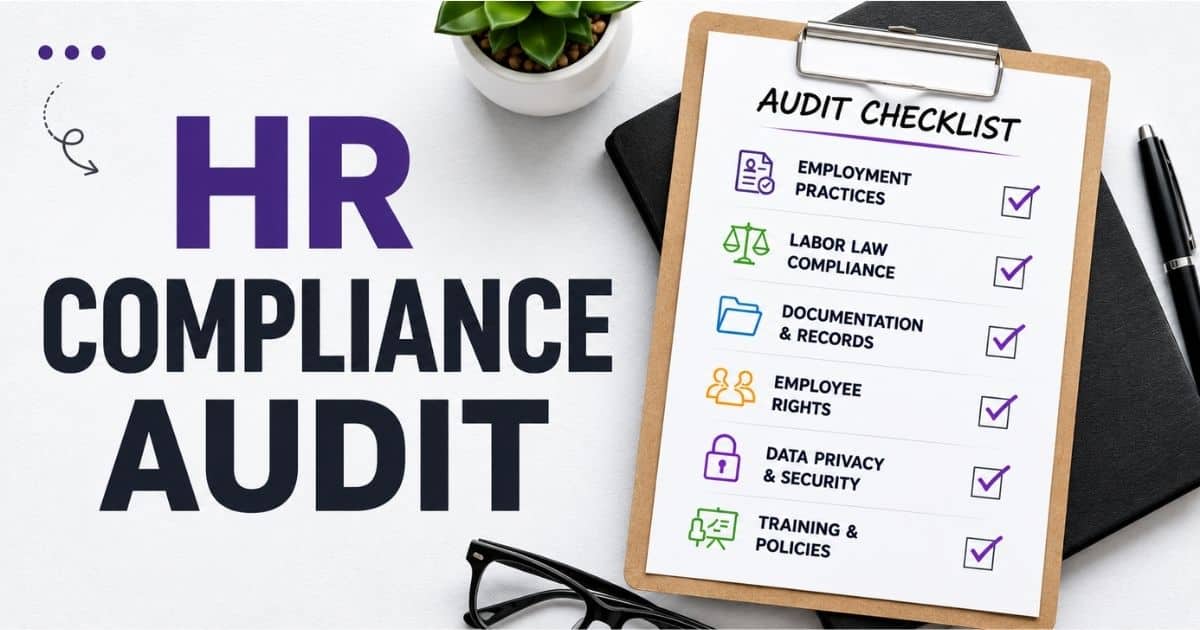
Table of Contents
An HR compliance audit is one of the most practical ways to find issues before they become expensive disputes, agency investigations, or employee trust problems. For growing employers, the challenge is not only knowing the rules, but proving that HR operations follow them consistently.
The U.S. Department of Labor’s Wage and Hour Division recovered more than $259 million in back wages in FY 2025, showing how quickly wage and hour compliance issues can become costly. At the same time, regulators such as the DOL, EEOC, OSHA, and state agencies continue to focus on classification, leave administration, discrimination, safety, and recordkeeping.
This guide gives employers a clear HR audit process, a detailed HR audit checklist, and practical steps for building a repeatable compliance audit program.

What Is An HR Compliance Audit
An HR compliance audit is a systematic review of an organization's HR policies, HR practices, HR records, and related documentation to confirm that they align with federal, state, and local employment laws. The primary goal of an HR compliance audit is to ensure legal compliance with employment laws and identify areas of non-compliance and risk before those issues lead to lawsuits, penalties, or employee relations problems.
A compliance audit typically reviews wage and hour rules under the Fair Labor Standards Act, equal employment opportunity standards under Title VII, the ADA, and the ADEA, workplace safety under OSHA, leave requirements such as the Family and Medical Leave Act, and employment eligibility rules such as Form I-9 documentation. An HR compliance audit evaluates HR policies for legal alignment, but it also looks at whether managers and employees follow those policies in real work situations.
Not every human resources audit has the same purpose. Comparative audits measure HR practices against peer organizations. Objectives-based audits assess HR performance against organizational goals and business objectives. Statistical audits analyze workforce data for performance patterns. Operational audits evaluate the efficiency of HR processes. Technology audits assess the effectiveness of HR systems and tools. Compliance audits ensure HR practices align with legal requirements.
Reasons Employers Need An HR Compliance Audit
Preventable HR issues often cause the largest problems. Misclassified workers, incomplete personnel files, outdated leave policies, weak disciplinary documentation, or missing training records can expose an employer to back wages, penalties, employee complaints, and reputational damage.
Detect Compliance Gaps
Many employers have written HR policies but inconsistent HR practices. An HR compliance audit compares the employee handbook, employment contracts, payroll records, training records, employee files, and manager actions against actual compliance obligations.
HR audits identify compliance gaps before they escalate into issues. Common high-risk areas in audits include I-9 errors and worker misclassification. A review may also uncover non-exempt employees who were treated as exempt, overtime that was not calculated correctly, or job descriptions that do not match actual duties.
Meet Legal Requirements
Employers must satisfy legal requirements across hiring, pay, safety, leave, benefits administration, and recordkeeping. Covered employers must also follow laws such as FMLA, ACA, COBRA, OSHA standards, and state or local employment laws when those rules apply.
Audits ensure compliance with the Fair Labor Standards Act regarding wage and hour regulations, including minimum wage, overtime, timekeeping, and hour compliance. Compliance with the Family and Medical Leave Act is checked during audits, including notices, eligibility, leave tracking, reinstatement, and benefits continuation.
Protect Employee Rights
A compliant workplace is not only about avoiding penalties. HR audits minimize legal liabilities and foster workplace fairness by confirming that employees receive fair pay, proper leave, safe working conditions, and consistent treatment.
Culture also affects retention. Research cited in workplace hiring studies shows that 47% of job seekers leave due to company culture issues. When employees aware of reporting channels see that employee complaints are handled consistently, trust improves and managers are more likely to follow fair employment practices.
Reduce Compliance Risks
Non-compliance can lead to significant legal risks and financial penalties. HR compliance audits help avoid lawsuits stemming from violations of employment laws, especially when employers use audit findings to correct problems quickly.
Conducting HR compliance audits can reduce legal liabilities significantly because the audit team can identify risks early, document corrective action, and show good-faith efforts if regulatory bodies later ask for relevant documentation.
Strengthen HR Policies
Audits help the HR department improve the organization's HR policies, update outdated rules, and align HR initiatives with compliance obligations. This includes leave policies, disciplinary procedures, workplace safety rules, pay practices, remote work expectations, and termination procedures.
HR audits streamline processes and improve operational efficiency, especially when paired with HR workflow automation for modern HR teams. They also support cost savings by reducing rework, payroll corrections, legal disputes, and manual document searches.
HR Compliance Audit Process For Employers
The HR audit process includes planning, data collection, and reporting. For midsize employers, especially those with 50 to 500 employees, the process should be structured enough to create consistency but practical enough for HR professionals to complete without disrupting daily HR functions.
Review HR Documentation
Start by defining the audit scope. Decide which locations, time periods, departments, and HR functions will be reviewed. Then collect audit materials such as the employee handbook, employment contracts, job descriptions, offer letters, payroll policies, leave policies, benefits documents, safety procedures, and prior audit findings, which can be easier for small businesses using Payrun HR software to maintain centrally.
The audit should also include personnel files, employee records, training records, payroll data, and policy acknowledgments. Proper employee record management systems for modern HR teams are essential for compliance, especially when a regulator requests proof of notices, signed forms, or disciplinary documentation.
Assess Policy Compliance
Next, compare written policies to daily practice. A policy may look compliant, but managers may still ask improper interview questions, approve leave inconsistently, or fail to document employee complaints.
Interviews with HR staff and employees are part of the audit process. These interviews help the audit team assess compliance, identify whether employees understand reporting procedures, and reveal whether local managers follow the same standards as the corporate HR department.
Verify Employee Records
Employee records should be complete, accurate, and stored securely. An HR compliance audit verifies proper Form I-9 documentation for employee eligibility, including completion timing, reverification, and retention.
The review should also check tax forms, benefit elections, emergency contacts, policy acknowledgments, training records, and medical records stored separately from general personnel files, with particular attention to employee data protection in HR systems. Incomplete or inconsistent employee files can create compliance issues even when the underlying HR decision was correct.
Evaluate Payroll Practices
Payroll review is one of the most important parts of a compliance audit. The audit team should test employee classification, pay rates, timekeeping, overtime, bonuses, deductions, final pay, and wage statements, all of which depend on accurate, compliant payroll processing for growing businesses.
Focus on root causes, not just symptoms, during audits. If overtime is wrong, ask whether the issue came from a system setup, manager approval behavior, unclear policy language, or lack of training. This approach helps prevent the same compliance gaps from returning in the next audit cycle.
Address Audit Findings
After analyzing audit findings, a comprehensive report is created. The report should identify compliance gaps, legal exposure, affected employees, recommended fixes, owners, deadlines, and follow-up dates.
Rank issues by severity. A missing handbook acknowledgment may be lower risk than systemic unpaid overtime. Non-compliance can lead to significant legal risks and financial penalties, so the highest-risk findings should move first into a corrective action plan reviewed by HR, finance, legal counsel, and leadership.
Top 7 HR Compliance Audit Checklist
Use an HR audit checklist to ensure thoroughness across the full employee lifecycle. This section organizes the core audit areas from the moment employers post job openings through termination and post-employment obligations.
Hiring And Onboarding Compliance Checklist
Hiring and onboarding reviews help confirm that recruitment practices follow equal employment opportunity rules and local employment laws.
Check the following:
- Job descriptions and job postings use nondiscriminatory language and reflect actual role requirements.
- Interview questions, selection criteria, and background screening steps are job-related and consistent.
- Background checks include required consent and follow Fair Credit Reporting Act and “ban the box” rules where applicable.
- Offer letters and employment agreements include pay details, at-will language where appropriate, probation terms, and mandatory notices.
- Onboarding includes tax forms, Form I-9 or right-to-work checks, employee handbook acknowledgments, safety notices, and required policy training.
Employee Classification And Payroll Compliance Checklist
Employee classification is one of the most common sources of back pay exposure. Review exempt and nonexempt status, independent contractor arrangements, job duties, salary basis, and state-specific classification tests.
Payroll checks should confirm minimum wage compliance, overtime calculations, meal and rest break rules, travel time, training time, on-call time, pay frequency, wage statements, deductions, and final paycheck timing. Using payroll automation software for faster and accurate processing can make these checks more reliable. Wage and hour compliance should also include any pay equity or salary transparency requirements that apply to the workforce.
Benefits, Leave, And Time Off Compliance Checklist
Benefits and leave audits should confirm that eligibility rules match plan documents and that employees receive required notices on time. Review health plans, retirement plans, COBRA, ACA requirements, ERISA documents, and summary plan descriptions, and consider modern leave management software options for 2026 that help keep these obligations on track.
Leave review should cover FMLA, state family leave, military leave, jury duty, sick leave, holiday policies, PTO accrual, carryover, and payout rules. Implementing robust employee leave tracking and management helps ensure these categories are handled consistently. Employee benefits administration should also confirm that leave approvals, denials, reinstatement, and benefits continuation are documented consistently.
Workplace Policies And Equal Employment Opportunity Checklist
Review policies covering anti-harassment, anti-discrimination, anti-retaliation, code of conduct, accommodation, privacy, monitoring, and complaint reporting. These policies should reflect current equal employment opportunity standards and protected classes under applicable laws.
The audit should also check whether managers completed required training, whether employee complaints were investigated promptly, and whether outcomes were documented. Regularly updating policies and training staff is crucial for compliance.
Health, Safety, And Working Conditions Checklist
Workplace safety audits should review OSHA obligations, safety training, incident reporting, emergency procedures, first-aid supplies, required postings, and hazard controls. Integrated tools such as smart attendance tracking software with real-time timeline views can also support safety by clarifying who was on site during incidents. Some OSHA programs have specific evaluation cycles, such as annual lockout/tagout reviews or three-year process safety management audits.
Remote and hybrid work should also be reviewed for ergonomic risks, work time expectations, availability norms, and burnout risks. Include workplace violence prevention, anti-bullying processes, and ways for employees to report unsafe conditions without retaliation.
HR Recordkeeping And Data Privacy Checklist
HR recordkeeping should confirm that personnel, payroll, medical, recruitment, and benefits files are retained and destroyed according to applicable laws, with special attention to accurate employee payroll records management. Proper access controls are critical for both paper files and digital HR system records.
Review permissions, encryption practices, audit logs, data subject request processes, and privacy notices. Modern payroll software with integrated HR features should support secure storage and easy retrieval of relevant documentation during an audit or agency inquiry.
Performance Management, Discipline, And Termination Checklist
Performance management audits should confirm that review cycles, rating scales, promotion criteria, and disciplinary procedures are applied consistently. Inconsistent performance management can create discrimination, retaliation, and wrongful termination risks.
Termination review should include final pay, notice requirements, benefits continuation, severance agreements, return of company property, and documented business reasons. Disciplinary documentation should clearly show what happened, what policy applied, and what corrective steps were taken.
Best Practices To Strengthen Your HR Compliance Audit Program
A single audit can fix immediate issues, but regular HR audits create a stronger compliance culture. Employers should treat each audit cycle as part of continuous improvement, not a one-time project.
Establish Regular Audit Schedules
An HR audit typically occurs every two to three years. Regular audits are recommended every two to three years, and employers should conduct HR audits every two to three years as a baseline for compliance, supported by an all-in-one HR platform that harnesses HR simplicity with Payrun.
Conducting HR audits every 2–3 years is recommended for compliance, but high-risk areas need more attention. Schedule regular mini-audits to catch issues early in wage and hour compliance, leave administration, I-9 files, harassment prevention, and workplace safety, especially if you are looking to simplify HR by replacing disconnected tools.
A structured audit calendar creates accountability across departments. Consistent review cycles help organizations identify compliance concerns before they escalate into costly legal, operational, or reputational problems.
Maintain Accurate HR Records
Accurate HR records make audits faster and more reliable. Keep job descriptions, time records, leave records, training records, employee files, and payroll documentation current and easy to retrieve with innovative HR management features in Payrun.
Clean records also support operational efficiency. When HR teams can quickly find audit materials, they spend less time searching and more time solving compliance issues.
Well-maintained documentation also demonstrates compliance during external reviews. Complete records provide evidence of policy enforcement, employee communications, and employment decisions when questions arise.
Update Policies Consistently
Employment laws change often, especially around paid leave, salary transparency, minimum wage, privacy, and worker classification. Policy updates should be version-controlled, communicated to employees, and stored with acknowledgment records.
Regular audits help ensure fair workplace practices and protect company finances by confirming that policies remain aligned with current legal requirements.
A formal policy review process reduces inconsistencies across the organization. Updated policies help managers make informed decisions while reinforcing compliance expectations throughout the workforce.
Train HR Teams Regularly
HR professionals and managers need practical training on classification, leave, accommodations, investigations, payroll approvals, workplace safety, and employee complaints. Training should explain what to do, when to escalate, and how to document decisions.
Training also reduces recurring compliance gaps. If several managers make the same mistake, the issue may be a training problem rather than a policy problem.
Continuous education helps teams stay prepared for regulatory changes. Regular training sessions strengthen decision-making, improve documentation quality, and promote consistent policy application across departments.
Monitor Regulatory Changes Continuously
Monitor updates from the DOL, EEOC, OSHA, state labor departments, and other regulatory bodies. HR teams should also involve legal counsel when expanding into new states, hiring remote employees in new locations, or changing compensation structures.
A strong monitoring process connects legal compliance to business outcomes. It helps employers avoid reactive fixes and plan HR initiatives with more confidence.
Proactive monitoring supports long-term compliance planning. Organizations that track regulatory developments early can adapt policies faster, reduce risk exposure, and maintain business continuity with fewer disruptions.
How To Build An Internal Audit Team And Governance Structure
A clear audit team and governance model help employers involve multiple perspectives in the audit process. HR, payroll, finance, legal, IT, operations, and safety leaders often see different risks, and those perspectives make the compliance audit more complete when supported by a trustworthy HR management partner like Payrun.
Define Audit Team Roles
Assign an audit lead to coordinate the review. Add HR process owners, payroll specialists, benefits administrators, safety leaders, IT or data privacy support, and legal counsel for higher-risk areas.
The team should understand the audit scope, timeline, confidentiality rules, and reporting expectations before reviewing records or interviewing employees.
Clearly defined roles improve accountability throughout the audit process. When every participant understands their responsibilities, employers can complete reviews more efficiently and reduce the risk of overlooked compliance issues.
Assign Clear Responsibilities
Each owner should know what to collect, what to review, and when findings are due. For example, payroll may test overtime and deductions, HR may review personnel files, and safety leaders may review incident logs and safety training.
Clear responsibility prevents missed tasks and helps the HR department complete the audit without confusion.
Documented responsibilities create a more organized audit workflow. Defined ownership also improves follow-through on corrective actions and ensures findings receive timely attention from the appropriate stakeholders.
Establish Governance Policies
Create a simple audit charter that defines purpose, frequency, documentation standards, escalation paths, and remediation rules. It should also explain how the employer protects confidential audit materials.
If legal exposure is likely, involve legal counsel early so the organization can manage privilege and remediation carefully.
Strong governance policies provide consistency across audit cycles. A structured framework helps employers apply the same standards, maintain compliance records, and manage risks more effectively.
Create Reporting Structures
Audit findings should be summarized for senior leaders in a practical format. Include risk ratings, affected employees, financial exposure, recommended actions, owners, and due dates.
Leadership reporting makes compliance visible and helps connect corrective action to cost savings, risk mitigation, and workforce planning.
A clear reporting structure supports informed decision-making. Executive visibility encourages accountability, prioritizes remediation efforts, and helps leadership allocate resources to address compliance concerns.
Strengthen Cross-Team Collaboration
HR compliance does not sit only inside HR. Payroll controls, hiring workflows, IT permissions, safety procedures, and manager behavior all affect compliance.
Cross-team collaboration helps employers assess compliance more accurately and fix root causes across systems, policies, and day-to-day employment practices.
Collaborative audits deliver a more complete view of organizational risk. Shared expertise improves problem-solving, strengthens compliance controls, and promotes continuous improvement across departments.
How Payrun Supports HR Compliance Audits
Payrun helps employers prepare for an HR compliance audit by centralizing key HR and payroll information in one platform, making it particularly valuable as HR and payroll software for SaaS and software businesses. Instead of searching across spreadsheets, email threads, and separate folders, HR teams can work from structured employee profiles, payroll data, timesheets, leave records, hiring pipelines, and administrative controls.
Payrun’s payroll management supports accurate salary disbursement, centralized payroll history, deductions, and employee access to payslips. This helps audit teams review pay history, wage changes, and payroll records with less manual effort and demonstrates the advantages of automated payroll software features and benefits. Payrun’s timeline and timesheet tracking also support informed decisions by giving managers visibility into work time, activity summaries, and attendance patterns.
Payrun’s leave management system for HR teams helps HR track requests, approvals, holidays, and team-level availability. During a compliance audit, this kind of leave management software to track, approve, and manage time off makes it easier to review whether leave was approved consistently and whether records match policy requirements, while avoiding common leave management mistakes companies must avoid. Payrun’s hiring and recruitment workflows help employers organize candidate stages, onboarding steps, and employee data, which supports review of hiring practices and onboarding documentation.
Frequently Asked Questions
How Often Should An Employer Conduct A Full HR Compliance Audit?
Most employers should conduct a full HR compliance audit every one to three years, depending on size, industry, locations, and risk level. High-risk areas such as wage and hour compliance, harassment prevention, employee classification, I-9 documentation, and health and safety may need quarterly or semi-annual mini-audits.
What Size Of Company Needs A Formal HR Compliance Audit Program?
Even small employers have compliance obligations around payroll taxes, minimum wage, workplace safety, I-9 documentation, and basic employment practices. As headcount grows, additional laws may apply, such as Title VII at 15 employees and FMLA for covered employers that meet the 50-employee threshold. A scaled HR audit checklist helps small teams stay organized, while growing companies benefit from a more formal program.
Should We Use External Experts For Our HR Compliance Audit?
Internal HR teams can handle many routine audit steps, but external experts are useful for complex wage and hour reviews, multi-state operations, worker classification, OSHA obligations, data privacy, and sensitive employee complaints. Employment lawyers or HR consultants can also provide an independent perspective and current legal insight.
How Do We Prioritize Issues Identified During The HR Audit?
Use a risk-based approach. Prioritize findings by legal exposure, number of affected employees, financial impact, likelihood of recurrence, employee harm, and reputational risk. Systemic unpaid wages, discrimination risks, unsafe working conditions, and missing employment eligibility records should usually be addressed before lower-risk documentation gaps.
What Is The Best Way To Prepare For Our Next HR Compliance Audit?
Start before the audit begins. Keep policies updated, centralize HR records, train managers regularly, document decisions, and maintain clean payroll, leave, and employee data in an HR system like Payrun. Assign audit responsibilities early, use a consistent HR audit checklist, and complete mini-reviews between formal audits so the next audit cycle is faster and more accurate.