Will AI Replace HR Jobs? What 2026 Data Says
Table of Contents
Will AI replace HR jobs? Every HR team seems to ask that question this year, and the honest answer sits between the two extremes people usually hear. AI tools already handle real tasks inside HR, from resume screening to payroll processing. Human resource management still leans on human judgment for decisions that matter most.
Most HR professionals are not losing jobs to one AI system overnight. Their daily tasks are changing fast. HR teams that once spent hours buried in paperwork now spend that time on strategy, culture building, and employee support. Here is what the newest 2026 data says about which HR jobs face real disruption, and how HR professionals stay essential as AI moves deeper into the HR function. The sections ahead cover which tasks are already automated, which roles carry the most risk, and the skills worth building now.

Will AI Replace HR Jobs?
AI will not replace HR jobs as a whole, but it is already replacing specific tasks inside them. Resume screening, payroll calculations, and routine questions are easy targets for automation. Conflict resolution, culture building, and career decisions are not.
Most HR teams will look smaller and more strategic within a few years. AI is not eliminating the HR function. AI is absorbing the busy work first. HR professionals who once spent their day on paperwork are shifting toward strategy and employee support. Job security now depends less on tenure and more on working alongside AI tools instead of competing with them.
What The Latest Data Shows About HR Job Risk
Numbers from older reports get repeated so often they start to feel outdated, and in this case, they are. SHRM published fresh 2026 data giving HR leaders a clearer picture of real displacement risk. AI replace HR debates finally have real evidence behind them.
SHRM 2026 Displacement Findings
SHRM's 2026 research puts real numbers behind a debate that used to run mostly on opinion. HR managers and HR business partners finally have a benchmark for how much AI in HR is genuinely changing job security.
Key figures from the report:
- 31.1 million U.S. jobs are now at least half automated, according to SHRM, 2026.
- Only 5.1 percent of employment, close to 7.9 million jobs, faces high displacement risk, according to SHRM, 2026.
- 60.4 percent of employment carries at least one nontechnical barrier that slows automation down.
Automation Versus Job Elimination
Task automation and full job elimination get treated as the same thing, but the SHRM data says otherwise. HR jobs tied to performance management and daily coordination are shifting in scope, not disappearing outright. HR managers overseeing this shift need to track the difference closely.
What the report found:
- 58 percent of organizations that tied restructuring to AI automated specific tasks, according to SHRM, 2026.
- Only 31 percent eliminated entire roles, according to SHRM, 2026.
- Losing one task rarely means losing the whole job. EY's 2025 US AI Pulse Survey found just 17 percent of employers are cutting headcount specifically because of AI, which lines up with SHRM's picture of redesign over replacement.
What AI Is Already Automating In HR
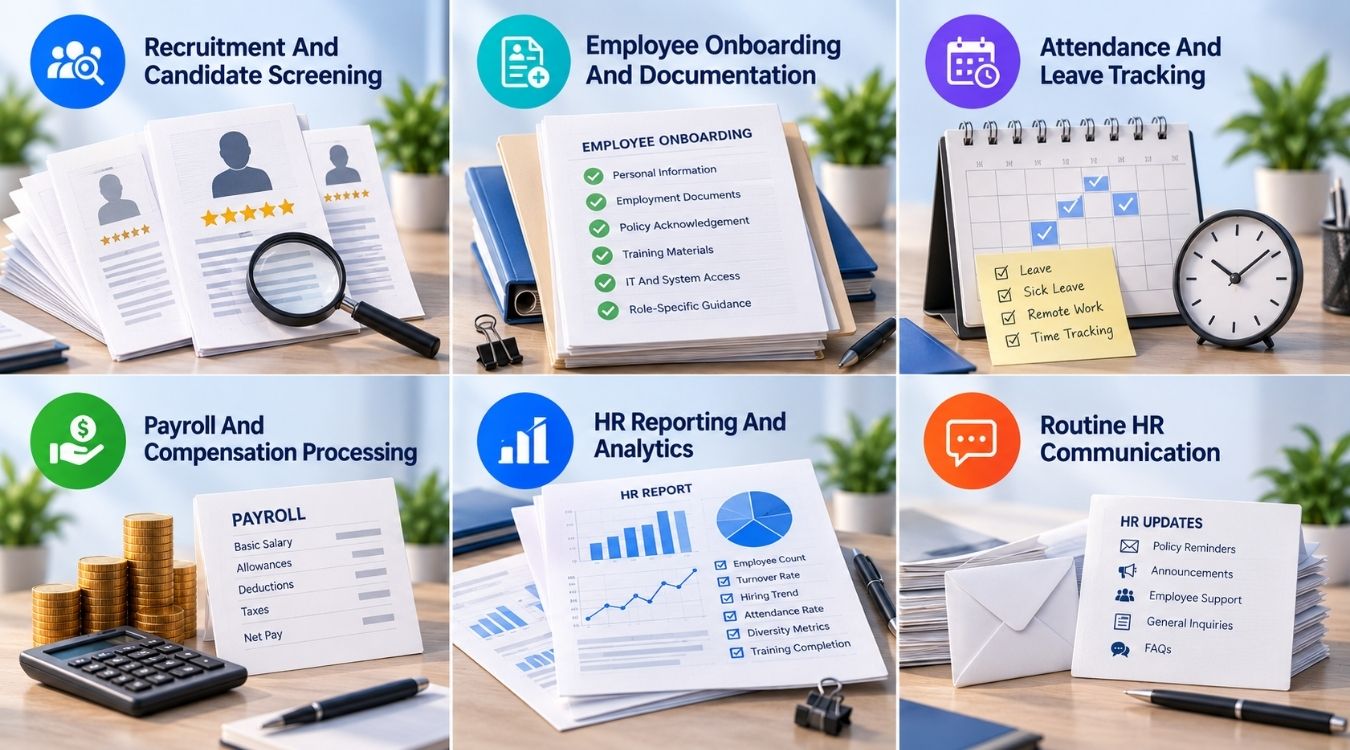
Artificial intelligence is not waiting for permission to take over repetitive HR tasks. Several parts of human resource management already run faster with AI tools handling the first pass, leaving human resource professionals to review and decide.
Recruitment And Candidate Screening
Resume screening used to eat entire days out of a recruiter's week. AI tools now scan hundreds of applications, match skills against job descriptions, and rank candidates before anyone opens a resume by hand.
Talent management teams still make the final call on culture fit and interview scheduling. Business leaders expect faster hiring cycles now, and this is the clearest place where AI-replacing HR conversations actually hold up in practice. The technology narrows the pool. A person still decides who gets hired.
Employee Onboarding And Documentation
New hire paperwork used to mean stacks of forms and slow manual entry across every department. AI tools now pre-fill documents, check for missing fields, and route forms to the right approver without anyone chasing signatures across departments.
Employee data moves faster once onboarding software handles the repetitive steps. HR tasks like explaining policies and building early trust still need a person, since no system replaces that first impression for a new hire. A smooth first week sets the tone for everything that follows.
Attendance And Leave Tracking
Manually tracking hours and leave balances used to eat up hours every single week for HR staff. AI tools now calculate balances automatically, flag policy violations, and send reminders before conflicts happen between managers and their teams.
Human resource professionals still step in for exceptions, like a leave request tied to a family emergency or a medical need. Automation handles the math so people can focus on judgment calls a system cannot make on its own. Trust in the process grows once employees stop chasing their own numbers.
Payroll And Compensation Processing
Payroll is one of the clearest wins for artificial intelligence inside HR right now. AI tools catch calculation errors, flag anomalies before a paycheck goes out, and apply tax rules automatically across multiple states and jurisdictions without extra manual effort.
Human resource management still needs a person to sign off on final numbers and handle disputes. Small business owners without a payroll specialist lean on this exact setup, since one payroll mistake damages employee engagement fast and quietly across the whole team.
HR Reporting And Analytics
Pulling reports used to mean exporting spreadsheets and building charts by hand every single month for every department. AI tools now surface turnover trends, engagement patterns, and workforce gaps without anyone building the report from scratch first.
Business leaders expect this kind of speed from HR now, not next quarter. Human resource professionals who read employee data quickly and turn it into a clear recommendation stand out fastest in any hr career, since insight now matters more than raw effort alone.
Routine HR Communication
Answering the same benefits question fifty times a year is not a good use of anyone's time or patience anymore for busy HR staff. AI tools now handle routine HR tasks around policies, benefits, and time off around the clock without complaint.
Employee support still needs a person for anything emotional or unclear. A chatbot can explain a policy well enough on its own. Culture building and trust still depend on human resource professionals showing up for the harder conversations that actually matter most.
HR Jobs Facing The Greatest AI Disruption
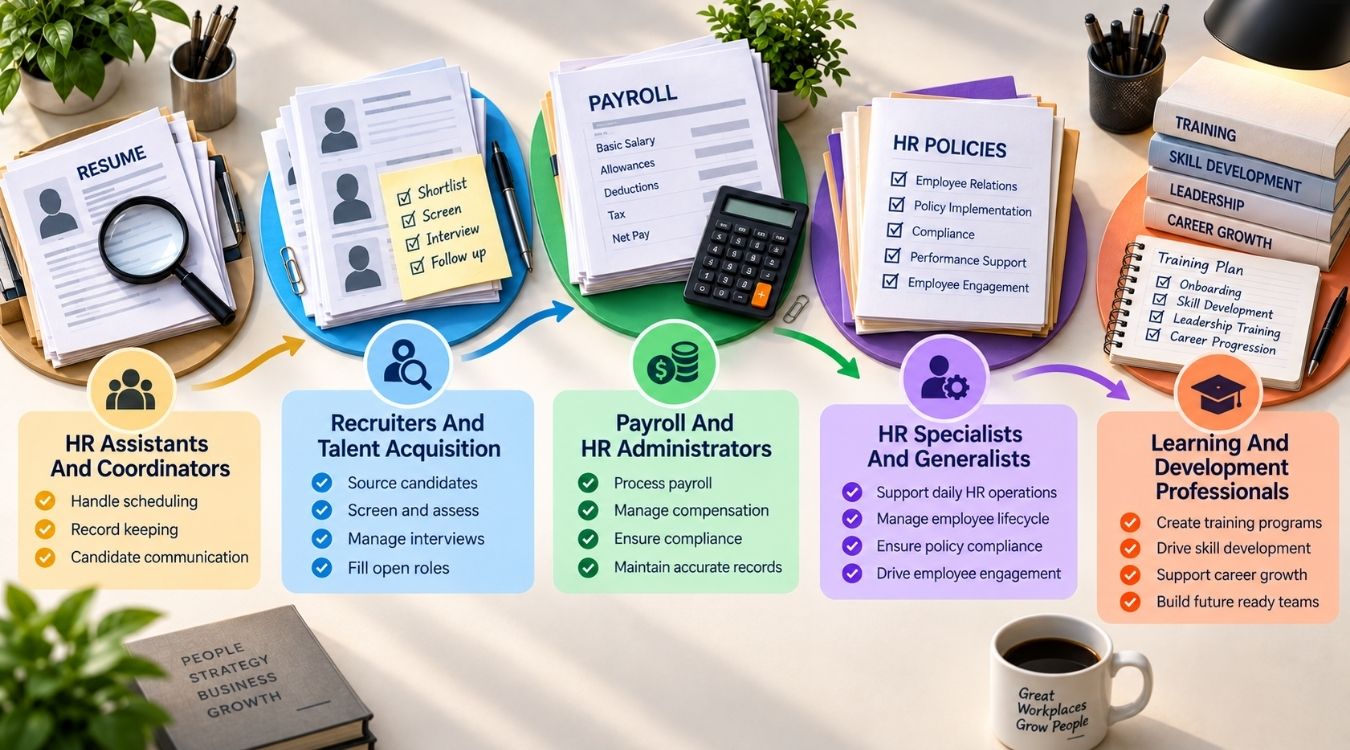
Not every HR role faces the same pressure from new AI systems. Jobs built mostly on repetitive tasks face the most disruption, while roles built on judgment and strategic thinking are holding steady across most HR organizations.
HR Assistants And Coordinators
HR assistants and coordinators often spend most of their day on scheduling, filing, and data entry across busy departments. AI powered tools handle exactly that kind of work now, which puts purely administrative roles at real risk of shrinking headcount.
Coordinators who move into culture work, onboarding experience, or internal communication tend to stay valuable over time. The title survives even as job descriptions shift underneath it. Job security here depends less on the role name and more on what the person actually does day to day.
Recruiters And Talent Acquisition
Recruiters used to measure success by how many resumes they could screen in a single day. Machine learning now handles that volume, which shifts the recruiter's real value toward interviewing, negotiation, and closing strong candidates faster.
Recruiters who lean into relationship building and employer branding are becoming harder to replace, not easier. Those stuck purely on resume review feel the most pressure as generative AI keeps entering the hiring stack. Talent acquisition is shifting from volume work toward real conversation and trust.
Payroll And HR Administrators
Administrators handling payroll processing and basic HR work face real disruption, since most of the job is calculation and rule application. AI systems handle both tasks faster and with fewer errors than manual work ever could manage.
Administrators who move into compliance oversight or vendor management tend to stay essential to the team. Pure data entry is shrinking fast across HR organizations of every size and budget. The people who replace HR managers on paperwork are software, not other humans.
HR Specialists And Generalists
Generalists cover a wide range of HR tasks, which makes some work automatable and other parts nearly impossible to replace entirely. Benefits enrollment and basic reporting face real pressure, while employee relations and policy interpretation do not. The Bureau of Labor Statistics projects HR specialist employment to grow 6 percent between 2025 and 2035, faster than the average for all occupations, which suggests demand for the role is holding up even as automation spreads.
Generalists who thrive treat AI as a tool instead of a threat, clearing administrative work off their plate first. That extra time usually goes toward employee experience and direct support, the parts of the job that built their reputation as a strategic business partner over time.
Learning And Development Professionals
Learning and development professionals used to build the same training deck for every new hire on the team. Generative AI now creates personalized content based on role, skill gaps, and even individual learning pace across departments.
Professionals who master these new tools produce more training material in far less time than before. The strategic thinking behind what people actually need to learn still requires a human who understands the business. Performance reviews still need a person reading between the lines.
HR Role | AI Disruption Risk | What Still Needs a Human |
|---|---|---|
HR Assistants and Coordinators | High | Culture work, onboarding experience, internal communication |
Recruiters and Talent Acquisition | Moderate to High | Interviewing, negotiation, employer branding |
Payroll and HR Administrators | High | Compliance oversight, vendor management, dispute handling |
HR Specialists and Generalists | Moderate | Employee relations, policy interpretation |
Learning and Development Professionals | Moderate | Deciding what people actually need to learn |
Employee Relations Management | Low | Conflict resolution, trust building |
Leadership Coaching and Mentoring | Low | Judgment built from experience, one-on-one mentoring |
What HR Work AI Cannot Replace
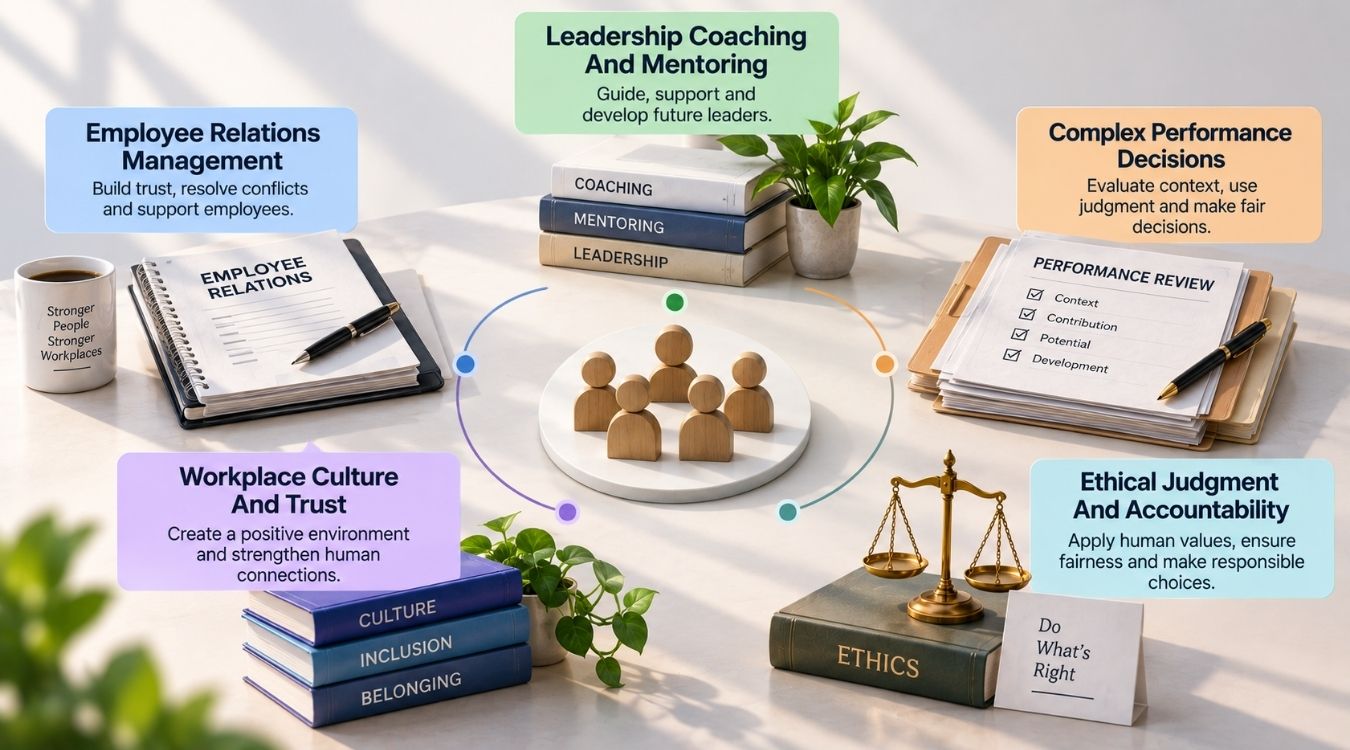
Some HR work resists automation because it depends on things machines cannot fully replicate. Trust, nuance, and accountability sit at the center of these job duties, and none of them shrink easily into a data set.
Employee Relations Management
A workplace conflict rarely follows a script that any tool can predict in advance. Two people with different memories of the same event need someone who can listen, ask the right questions, and find a fair resolution without leaning on a template.
Emotional intelligence drives this work more than any dataset ever could. AI enabled tools can flag a pattern of complaints across HR departments quickly and accurately. They cannot sit across from two frustrated employees and rebuild the trust between them, since that work still needs a real person.
Leadership Coaching And Mentoring
Coaching a manager through their first difficult termination takes real human insight built from years of hands on experience. Every manager and every situation calls for a slightly different approach that no script can cover in advance.
HR roles built around mentoring managers through tough calls become more valuable as AI takes over the surrounding paperwork. Mentorship depends on trust built over time, something no automated system has managed to replicate in the AI era, no matter how advanced the tools get.
Complex Performance Decisions
Performance reviews built purely on metrics miss context that actually matters to the person involved. A dip in output might reflect a personal crisis, a broken process, or a real performance problem, and only a manager close to the situation can tell which one it actually is.
AI can surface useful data and flag trends across performance reviews faster than any person could alone. Deciding whether someone gets a second chance, a warning, or a promotion still needs human oversight applied with real stakes in mind.
Workplace Culture And Trust
Shaping workplace culture takes consistency, modeling, and a hundred small decisions that never show up in a spreadsheet or a report. Culture spreads through how people are treated day to day, not through a policy document sitting in a folder somewhere unread.
HR leaders build trust by making values visible in everyday decisions, not just in a handbook nobody reads twice. Employee support follows leadership behavior, and no AI system carries the credibility a respected HR leader brings to that role.
Ethical Judgment And Accountability
Every AI system reflects the data and rules it was built on, which means someone still has to catch when those rules produce an unfair outcome. Ethical judgment means noticing when a policy technically applies but clearly should not in that specific moment. Bias risk here is not hypothetical. Amazon famously scrapped an internal hiring algorithm after it learned to downgrade resumes that included the word women, since the historical data it trained on skewed male.
Human oversight becomes more important as more payroll management and HR tasks move to automation, not less important. People who understand both the technology and its human impact are the ones organizations trust to keep AI systems accountable over time.
AI And Entry-Level HR Jobs
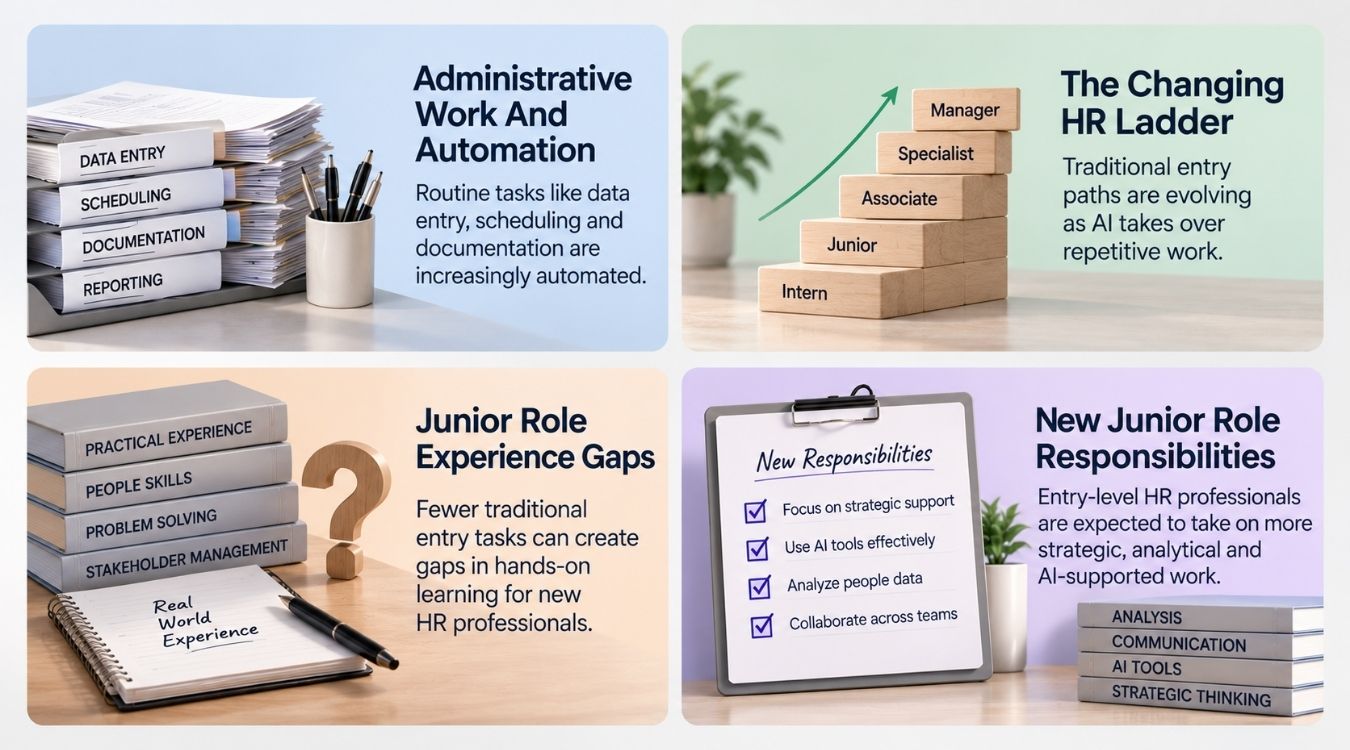
Entry level roles face a different kind of pressure than senior HR jobs, since much of what junior professionals traditionally did was administrative by design. That shift is changing what career development in HR actually looks like at the start.
Administrative Work And Automation
Filing, scheduling, and basic data entry made up a large share of entry level HR work for decades in most companies. New AI tools now handle most of that volume, which means fewer junior roles get created purely to manage paperwork all day.
Companies that once hired three coordinators for administrative support increasingly hire one person instead, backed by AI based tools that handle the rest of the load. That change reduces headcount at the bottom of the ladder faster than at any other level in HR.
The Changing HR Ladder
Career paths that once started with years of pure administration now move faster toward analysis and business strategy for junior staff. Junior professionals are expected to leverage AI within their first year rather than years into their career like before.
Companies increasingly reward people who can connect employee engagement surveys and workforce planning data to real business outcomes early on. The future of HR rewards fast learners over people who simply wait their turn on the ladder for a promotion.
Junior Role Experience Gaps
Fewer administrative tasks means fewer natural chances to learn HR fundamentals through repetition on the job. Junior professionals used to build pattern recognition by handling the same task hundreds of times before moving up into bigger responsibilities.
Skills gaps show up faster now, since new hires skip straight to overseeing an AI agent instead of doing the underlying task by hand first. Managers training junior staff need to be intentional about closing that gap instead of assuming it closes on its own over time.
New Junior Role Responsibilities
Entry level HR jobs increasingly include reviewing AI automate output, spotting errors, and escalating anything that looks wrong before it reaches a manager or director. That responsibility takes more judgment than the filing and data entry work it replaced across most teams.
Junior professionals who treat this oversight as real skill building move up faster than those who treat it as busy work. Strategic initiatives around shaping company culture increasingly include junior voices earlier than they used to just a few years ago.
Skills That Will Keep HR Professionals Relevant
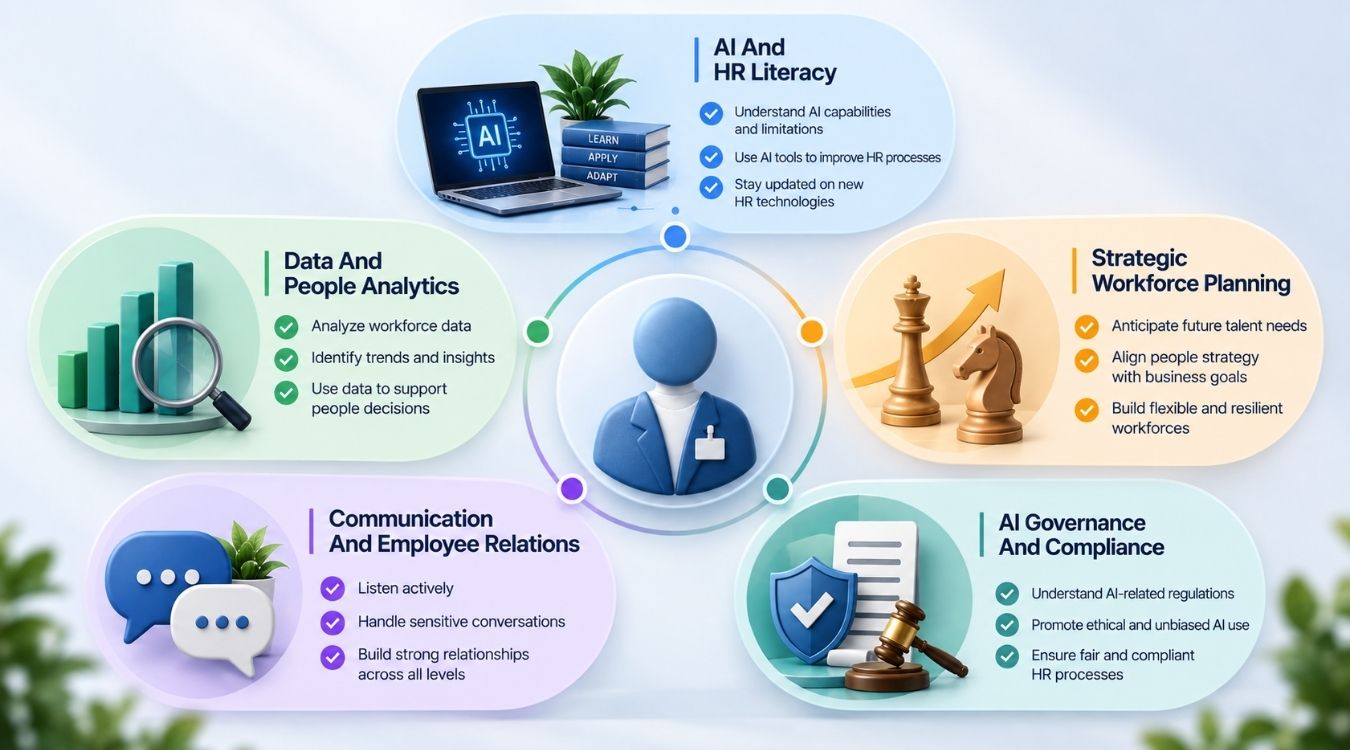
The HR professionals who stay valuable through this shift share a few things in common. None of it requires becoming a data scientist, but all of it requires treating new technology as part of the job in HR rather than a threat to it.
AI And HR Literacy
Understanding what AI tools can and cannot do matters more than knowing how to build one from scratch. HR professionals who can evaluate a new tool for bias, accuracy, and fit make better decisions than those who resist it or trust it blindly.
Basic fluency with the technology helps HR leaders ask sharper questions during vendor evaluations and contract talks. Nobody claiming AI will replace HR entirely has looked closely at how much of the hr field still runs on judgment, not just automation and speed.
Data And People Analytics
Reading a report and understanding what it actually means for the business are two very different skills entirely. HR professionals who can turn workforce numbers into a clear recommendation are becoming the most requested voice in leadership meetings across the entire company.
Data literacy helps HR identify patterns in turnover and engagement long before they become a real problem for the business. Business leaders trust HR more when its talent strategy is backed by AI driven insights rather than instinct alone every time.
Strategic Workforce Planning
Workforce planning used to mean reacting to headcount requests as they came in one at a time throughout the year. AI now lets HR anticipate skills gaps and hiring needs months ahead of when the actual need shows up on paper.
HR professionals who align workforce planning with real business strategy become strategic partners instead of support staff waiting for instructions. Some teams are even using personalized learning paths to close skills gaps before a hiring need becomes urgent.
Communication And Employee Relations
No AI tool can deliver difficult news with the right tone or read a tense room during a hard meeting between two people. Communication skills matter more, not less, as routine conversations get automated and human ones carry more weight than before.
HR professionals who invest in real listening and conflict resolution become the ones leadership calls first during a crisis. Employee development and employee relations work only grow more valuable as easy conversations get handled by simple tools instead.
AI Governance And Compliance
Someone has to make sure AI tools used in hiring, pay, and performance decisions do not create legal or ethical problems down the line. Governance is becoming a real specialty inside HR, not an afterthought handled by legal alone.
HR professionals who understand both compliance and the technology behind it are stepping into this gap early. Ethical judgment paired with technical fluency did not exist as a real job description five years ago, and now it is one of the fastest-growing niches in HR.
The HR Workforce In 2030
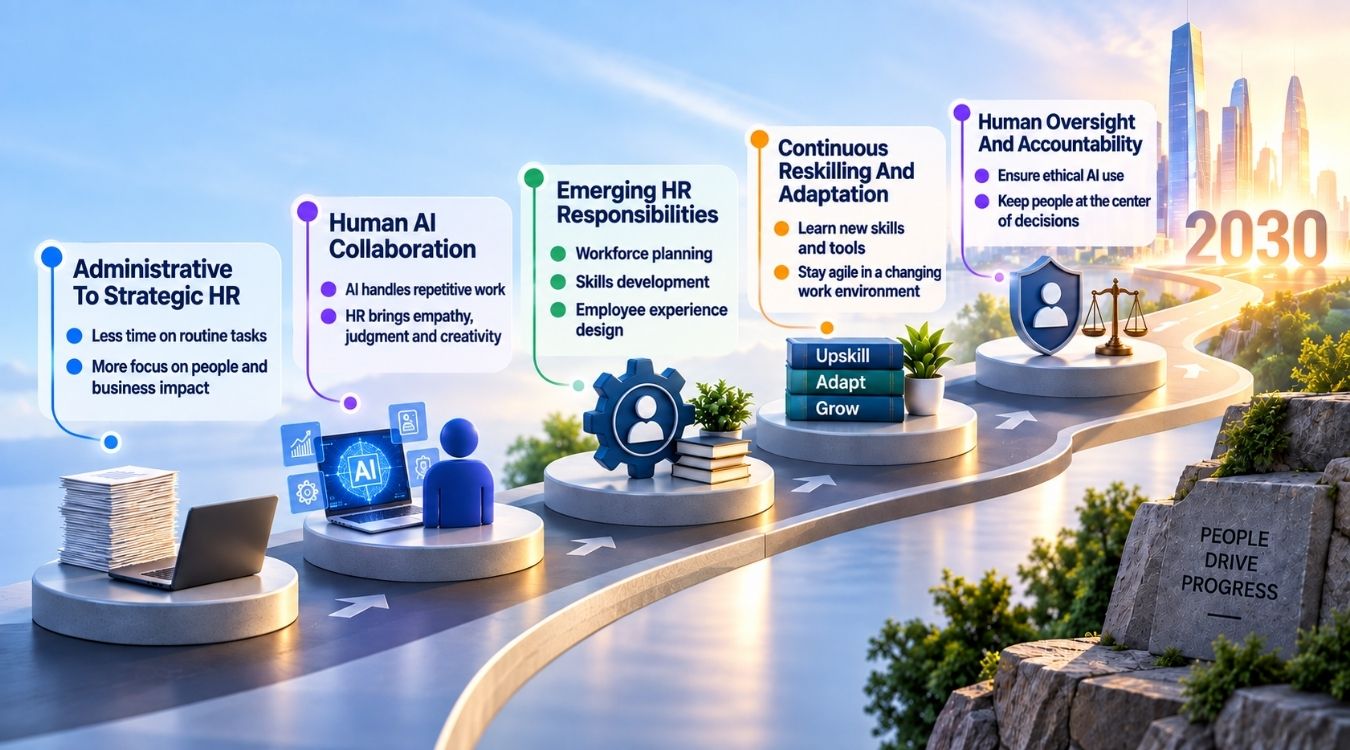
HR in 2030 will look noticeably different from HR today, though the shift will feel gradual rather than sudden. Most of the change already underway just needs a few more years to fully play out across every department. Fortune Business Insights projects the global HR technology market will grow from $40.45 billion in 2024 to $81.84 billion by 2032, a directional signal that organizations are investing in these tools rather than winding the function down.
Administrative To Strategic HR
HR departments are shifting away from being process managers and toward being strategic advisors to the business as a whole. Fewer people will spend their day on busy work, and more will spend it interpreting data and shaping real decisions.
Business outcomes increasingly get tied directly to HR strategy rather than treated as a separate concern off to the side. High value work like coaching managers and shaping company culture takes up more of the calendar than paperwork ever did in the past.
Human AI Collaboration
The most effective HR teams by 2030 will treat AI as a coworker rather than a background tool nobody thinks about twice. Reviewing recommendations before acting on them becomes a standard part of daily HR work across every single team.
More organizations are exploring systems that handle multi step processes on their own, from resume screening to routing approvals automatically. Human judgment stays essential even as these systems get more capable, since accountability still needs to sit with a real person in charge.
Emerging HR Responsibilities
New responsibilities are appearing that did not exist inside HR a decade ago, and most challenge the status quo directly and openly. HR departments are absorbing these duties rather than handing them entirely to IT or legal to sort out alone.
Roles built around oversight of automated systems are growing fastest inside larger organizations right now, and quickly. Smaller businesses tend to fold these responsibilities into existing generalist roles instead of hiring separately for something so new and specific.
Continuous Reskilling And Adaptation
The shelf life of any single HR skill keeps shrinking as new tools enter the market every single year without slowing down. Career growth in HR now means continuous learning rather than a credential earned once and relied on for decades.
Closing skills gaps quickly keeps professionals ahead of disruption instead of reacting to it after the fact each time. Teams that build real time feedback loops into training programs spot gaps faster than those relying on annual reviews alone every year.
Human Oversight And Accountability
Every automated decision still needs a person accountable for the outcome, and that will not change much by 2030 or beyond. Human judgment, not just AI handles, remains the deciding factor when a decision carries real consequences for an employee.
Leaders who build strong oversight habits now are setting the standard other departments will eventually follow across the company. Something as routine as benefits enrollment still needs a person checking that the system got it right for every single case that comes through.
Final Discussion
AI will keep automating HR tasks at a fast pace, but it is not on track to replace HR itself. Recruitment, payroll, and routine communication already lean on AI tools, while employee relations, culture building, and ethical judgment stay firmly human.
HR professionals who lean into this shift instead of resisting it are building real job security. Learning to work alongside AI, developing data literacy, and staying close to the human side of the job all point the same direction. Small businesses without a dedicated HR team can start with one honest use case, like resume screening, before expanding further.