Payroll Software Vs Services: A Complete Business Comparison
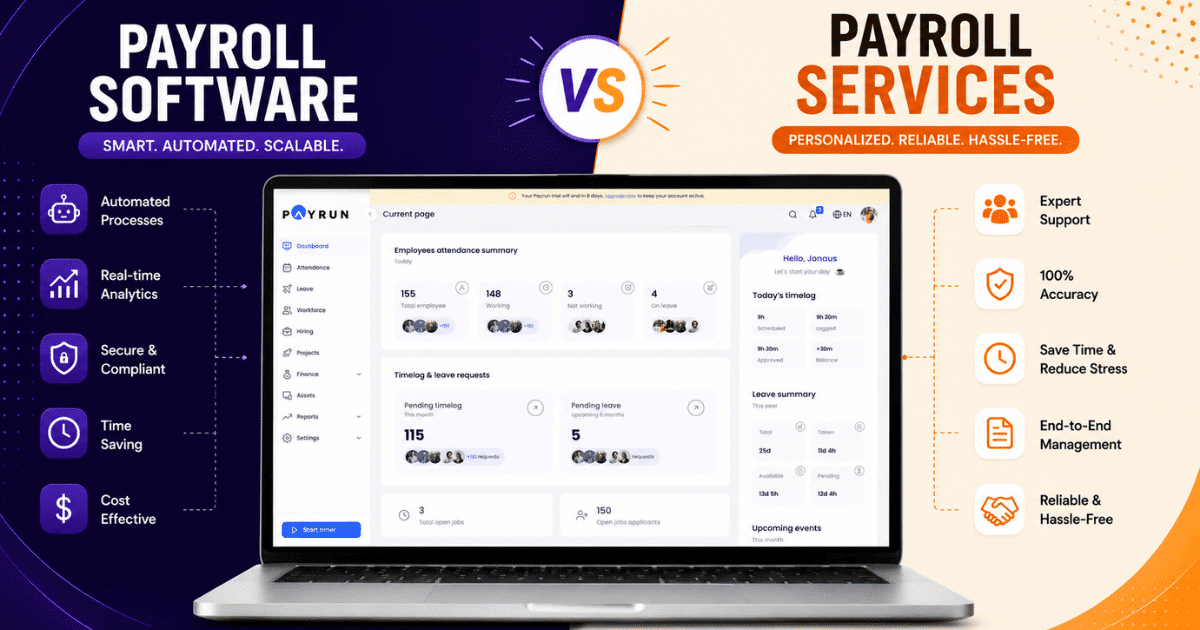
Table of Contents
Managing payroll has grown more complex in 2026 due to frequent tax code updates, hybrid work arrangements requiring multi-state withholding calculations, and expanding compliance obligations around paid leave and benefits administration. Payroll software refers to cloud-based platforms that let businesses run payroll internally with automated calculations, while payroll services involve third-party providers handling the entire payroll process on your behalf.
The choice you make directly affects how accurately you file taxes, how quickly employees receive payment, and how many hours small business owners spend on administrative work each pay period. Consider a 5-person startup still processing payroll in spreadsheets versus a 50-person company debating outsourcing payroll to specialists. This payroll software vs services comparison delivers a clear, side-by-side analysis showing the key differences and when each payroll option works best.

What Are Payroll Services
Payroll services are outsourced payroll solutions where a payroll service provider handles recurring payroll runs, tax payments, direct deposit processing, and regulatory reporting on behalf of your business. These providers manage the entire process from calculating gross-to-net pay to remitting employment taxes to federal, state, and local authorities.
In 2026, typical outsourced payroll services include new-hire onboarding and reporting, automated direct deposits, year-end tax forms like W-2s and 1099s, benefits administration support, and compliance alerts for changing regulations. Many payroll systems offered by these providers can handle complex tasks like wage garnishments, child support deductions, and managing employee benefits such as 401(k) contributions.
The core distinction is that while data still comes from the employer, the processing and filing responsibilities shift to an external team. This means your business submits hours and employee information, but the payroll service provider controls the workflow and timeline for execution.
What Is Payroll Software
Payroll software consists of cloud-based platforms that businesses use to run payroll internally, handling calculations, tax estimates, and payment processing through automated workflows. These payroll software solutions give owners direct control over the payroll process while reducing manual data entry through built-in automation.
Core features available in leading payroll software in 2026 include mobile apps for on-the-go access, employee self-service portals for viewing pay stubs and updating tax withholding information, time tracking integrations, and basic benefits administration tools. Payroll software automates many time consuming tasks, such as tax calculations, filing forms, and submitting payments to local, state, and federal agencies.
The typical workflow begins with importing time data from scheduling or time tracking tools, followed by automated gross-to-net calculations that factor in deductions and payroll taxes. The payroll system then prepares filings that businesses can submit electronically. Some platforms help you file taxes directly through IRS e-file partnerships, while others export data for accountants or human resources teams to finalize.
Payroll Software Vs Payroll Services Comparison
This section delivers the core comparison between payroll services and payroll software, examining six decision factors that matter most when handling payroll for your business. The table below summarizes the key differences, followed by detailed analysis of each factor.
Factor | Payroll Software | Payroll Services |
|---|---|---|
Control | Full direct access, real-time management, instant edits | Limited control, must submit payroll in advance |
Cost | $17-$45 base + $4-$12/employee monthly | $45-$100+ base + per-employee fees + additional charges |
Compliance | Tools provided, user bears filing responsibility | Expert handling with accuracy guarantees |
Time Investment | 4-8 hours per pay period for processing | 1-2 hours for data submission |
Scalability | Seamless growth to 100+ employees | Better for 30+ employees with complex needs |
Employee Experience | Custom portals, mobile access, self-service | Branded portals, may have slower updates |
Control And Ownership Of Payroll Process
Payroll software provides direct control over payroll processing, allowing for real-time management of every aspect of your payroll data. Business owners and HR teams can access live dashboards, create custom pay rules, and run off-cycle payments without waiting for external approval. Adding a shift premium or adjusting overtime calculations happens in minutes rather than days.
Payroll services reduce control over day-to-day operations, requiring submission of payroll in advance. Employers upload hours by cutoff deadlines, then providers process everything according to their internal schedules. Making last-minute changes typically requires raising support tickets with average resolution times of 24-48 hours.
Consider this contrast: an in-house team using payroll software can fix a bank detail error and reissue payment the same day. A company working with a payroll service provider may need to wait 2-3 business days for the same correction. For businesses with frequent bonus payments, commission adjustments, or seasonal staffing changes, this control difference significantly impacts operations.
Cost Structure And Long Term Value
Understanding the true cost of each approach requires looking beyond subscription fees. On average, payroll providers charge a base monthly fee ranging from $17 for do-it-yourself tax filing to $45 for full-service plans, with higher-priced packages exceeding $100 a month. In addition to the base fee, payroll providers typically charge a fee per employee or contractor, which can range from $4 to $12 per person monthly.
Many payroll vendors may impose additional costs for integrating accounting software or time-tracking software, paying employees in multiple states, or remitting garnished wages. These add-ons can push a 20-employee firm to $800 or more monthly with full-service providers.
Payroll software is generally more budget-friendly compared to payroll services. A typical software subscription runs $35-50 base plus $6-8 per employee, keeping that same 20-employee business under $200 monthly. However, managing payroll in-house can require a larger upfront investment in internal time, with owners or staff spending 4-6 hours per pay period on processing tasks.
Compliance Support And Tax Filing Responsibilities
Outsourced payroll services typically reduce the risk of payroll errors and compliance issues, as these providers specialize in handling tax withholding and reporting accurately. Many offer accuracy guarantees that indemnify businesses up to $25,000 for calculation errors made with correct data. Service providers maintain calendars for all filing deadlines and employ specialists familiar with 2026 changes to minimum wage laws, paid leave requirements, and multi-state payroll rules.
Businesses choosing software for payroll must invest more time and internal expertise for tax compliance, with a higher risk of user error. While payroll compliance software automates calculations and prepares forms, the responsibility to file taxes correctly still rests entirely with the business. In 2022, the IRS issued over 4.3 million penalties for employment tax issues, demonstrating the real stakes of tax filing mistakes.
The liability gap matters significantly here. When a payroll service provider makes a calculation error with correct data, their guarantee typically covers resulting penalties. When software is misused or data entered incorrectly, the business absorbs all consequences. Multi-state employers face amplified risks, as regulatory compliance across jurisdictions requires careful attention to varying overtime rules, withholding rates, and reporting requirements.
Time Investment And Internal Workload
Payroll software requires users to input hours and manage tax deposits, which can divert time from business growth. Routine tasks include reviewing timesheets, updating employee details, checking deduction calculations, and running preview reports before finalizing each pay period. A 20-employee business might spend 4-8 hours bi-weekly on these tasks.
Using payroll services can save time for business owners, allowing them to focus on other critical aspects of their business, as payroll services are designed to handle the entire payroll process efficiently. The employer’s role shifts to providing accurate data by cutoff times and approving draft runs, typically requiring just 1-2 hours per pay period.
Consider a founder currently staying late twice a month to process payroll for 15 employees. Understanding the full payroll processing lifecycle for growing businesses highlights how switching to outsourced payroll services could reclaim 10+ hours monthly, time that could generate revenue through sales, client work, or strategic planning. However, services do introduce coordination overhead through cutoff deadlines and occasional queries that require attention.
Scalability For Growing Businesses
Payroll software can scale smoothly from a small team to dozens of employees by adding users, locations, and pay rules through modular features. Most cloud-based payroll platforms handle growth to 100+ employees without requiring contract renegotiations or significant pricing jumps.
Payroll services may become more attractive at certain milestones. Once headcount approaches 30-50 employees, the complexity of benefits administration, multi-state compliance, and HR integration often justifies higher service fees. Businesses that are scaling rapidly or have complex compliance needs may prefer payroll services for the specialized expertise they provide.
Entering new states or regions, adding retirement plans, or integrating with more advanced human resources systems all increase complexity. Software handles this through configuration and integrations, while services assign specialists to manage these transitions. A company growing from 5 to 40 employees between 2023 and 2026 might start with software, then evaluate services as compliance requirements multiply.
Employee Experience And Technology Features
Modern payroll software offers employee self-service portals where staff can view payslips, update bank details, change tax forms, and access historical pay information. Most payroll software options today include mobile apps and employee self-service portals, allowing workers to view pay stubs and year-end tax forms from any device.
Many payroll services also provide employee portals and mobile access, though branding, responsiveness, and available features can vary between providers. Some services offer white-labeled apps that match company branding, while others use generic interfaces with less frequent updates.
Consistent, on-time payroll combined with clear pay information builds workforce trust. When employees can independently view their payroll details, update direct deposit information, or download year end tax forms without HR intervention, satisfaction improves. Both models support this goal, though software typically provides faster feature updates and more customization options.
Advantages Of Payroll Services For Certain Businesses
Payroll services are beneficial for companies that need to save time, reduce risk, and manage complex workforces. This section examines scenarios where outsourcing payroll genuinely provides the better fit, particularly for heavily regulated industries and employers with multi-location operations.
Expert Support For Complex Payroll Rules
A payroll service provider employs specialists familiar with federal laws, state regulations, pension requirements, and sector-specific rules. When your business lacks in-house payroll specialist expertise, these professionals interpret frequent law changes and ensure the correct treatment of varied compensation structures.
Consider a company transitioning from simple hourly wages to a mix of salaried, commissioned, and tipped employees. A payroll specialist at a service provider guides the setup, ensuring compliance with Fair Labor Standards Act overtime exemptions and proper handling of commission calculations. This advisory support prevents errors that pure software users might miss when configuring unfamiliar pay structures.
Reduced Risk Of Missed Deadlines
Payroll service providers maintain comprehensive calendars tracking every pay date, quarterly tax filing, and year-end submission deadline. They automatically file employment taxes, submit regulatory reports, and generate required forms without your team needing to monitor each obligation.
For businesses with seasonal peaks where management attention stretches thin, this deadline management proves invaluable. Missing a quarterly Form 941 or annual 940 can trigger tax penalties that compound quickly. Delegating these deadlines to specialists significantly lowers operational risk, though the legal obligations remain with the employer.
Hands Off Payroll Experience For Owners
Outsourcing payroll can save time for business owners, allowing them to focus on other critical aspects of their business, as these services handle payroll tasks more efficiently than most in-house solutions. Owners provide accurate data and approvals, and then the service manages calculations, payments, and filings end-to-end.
Some services bundle additional tasks like benefits administration, processing wage garnishments, and calculating statutory leave pay. A founder who previously dedicated 12 hours monthly to making payroll can redirect that time toward client relationships, product development, or strategic planning. This convenience typically costs more than software but delivers significant time savings for busy operators.
Support for Multi-Location or International Teams
Operating across multiple states or countries introduces substantial complexity in payroll management. Each jurisdiction has varying tax rates, withholding thresholds, overtime rules, and reporting formats that payroll processing software must track and calculate accurately.
Specialist payroll companies manage multi-jurisdiction payrolls and coordinate local compliance on behalf of employers. For businesses hiring remote workers across 10 or more states, or expanding internationally with employees in multiple countries, these providers handle complexity that typical small business payroll software cannot easily address.
When Outsourced Payroll Services May Not Fit
Not every business benefits from full outsourcing. Very small teams with simple pay structures often find service fees exceed the value received. Frequent last-minute pay changes, experimental compensation models, or tight budgets push some businesses toward more agile payroll software instead.
A startup testing weekly bonus structures might find service contracts too rigid when needing rapid adjustments. Understanding these limitations helps businesses enter conversations with payroll service providers with realistic expectations about flexibility and responsiveness.
Benefits Of Running Payroll With Software In-House
Small businesses with limited budgets and tech-savvy staff should consider using payroll software for its combination of control, cost savings, and flexibility. Simple payroll software for small businesses is suitable for smaller, tech-savvy teams seeking budget-friendly solutions that still provide professional-grade capabilities.
Greater Visibility Into Payroll Data
In-house payroll software provides real-time dashboards and reports on wages, taxes, overtime, and employer costs per period. Automated payroll software features and benefits give owners and finance teams the data access they need to forecast cash flow, plan hiring, and understand labor costs by department or project.
A manager spotting a sudden spike in overtime through software reporting can correct scheduling issues before costs escalate. Clear visibility also supports internal audits and smoother collaboration with accountants who can pull reports on demand rather than waiting for service provider exports.
Integration With Business Systems
Many payroll solutions must integrate with existing accounting software or HR tools to prevent manual double entries. Modern payroll software connects with top timesheet apps and time tracking solutions, point of sale systems, and workforce management tools through APIs and direct integrations.
When timesheets flow automatically from a scheduling app into your payroll platform before each run, error rates drop significantly. Payrun-style solutions act as a central point in the payroll process, syncing with both finance and human resources systems to eliminate data silos.
Flexibility For Changing Pay Structures
Using payroll software allows businesses to quickly add new earning types, adjust deductions, or create bonus structures without renegotiating contracts or waiting for provider approval. As outlined in this complete guide to payroll software features and automation, a business introducing performance bonuses can implement changes within minutes rather than submitting change requests and waiting days.
This flexibility serves startups, seasonal employers, and companies experimenting with incentive programs. Unlike traditional payroll service provider arrangements, software adapts immediately to evolving compensation needs.
Cost Predictability For Smaller Teams
Subscription-based payroll software helps small businesses plan predictable monthly costs even as headcount changes gradually. For startups and fast-growing teams, payroll software built for scaling businesses means a 12-employee firm might pay $100-150 monthly for comprehensive payroll software versus $400+ for equivalent outsourced services.
Managing payroll in-house can be less expensive than outsourcing, though it requires time investment from owners or staff. The financial savings in early growth stages can be substantial, offsetting the 4-6 hours spent per pay period on processing tasks.
Empowerment For Human Resources Teams
In-house payroll software enables your hr department to update employee records within a centralized management system, track leave balances, and manage benefits data within a single payroll system. This reduces back-and-forth communication with external providers and speeds responses to employee queries.
When HR corrects a bank detail mistake in software and reissues payment the same day, employee trust improves. Maintaining accurate employee payroll records is easier when good software includes support resources, guided workflows, and in-app validation checks, meaning empowerment does not require deep payroll expertise from day one.
Payroll Software Vs Services: Which One To Choose?
For most growing businesses in 2026, payroll software delivers the optimal balance of cost control, operational flexibility, and direct data access. Smaller teams with 1-10 employees typically find payroll software solutions sufficient for their needs, while maintaining the ability to scale as they grow.
Payrun exemplifies what an all-in-one payroll software platform can deliver: automated calculations for accurate pay runs within a comprehensive HR system, streamlined onboarding with digital forms, employee self-service for viewing pay stubs and updating details, and centralized payroll data accessible anytime. A 20-person marketing agency using such a payroll platform could reduce processing time from 8 hours to 2 hours per pay period, integrate timesheets directly, spot overtime patterns through dashboards, and stay compliant with multi-state requirements through built-in alerts.
When you want service-level reliability without sacrificing control or flexibility, modern payroll software makes managing payroll straightforward enough that outsourcing becomes optional rather than necessary.
Factors That Should Guide Your Payroll Decision
Deciding between payroll software and payroll services requires an honest evaluation of your specific situation. Payroll software allows businesses to manage payroll in-house, giving owners more control over the process, while payroll services outsource this responsibility to third-party providers. The following factors help clarify which approach fits your circumstances.
Business Size And Headcount Growth
Smaller teams with 1-10 employees may find simple payroll software sufficient, while larger teams should consider full-service payroll providers for complex needs. Very small businesses lean toward software due to cost efficiency and simplicity, while companies approaching 30 or more employees often find time savings from services outweigh higher direct fees.
A company growing from 5 to 40 employees over three years should plan to revisit their payroll setup at key milestones. Scalable software can remain viable throughout multiple growth stages, delaying the need for outsourcing until complexity truly demands it.
Complexity Of Pay And Benefits
Multiple pay rates, commission plans, shift differentials, and retirement plans all increase payroll complexity. Adding benefits like pension contributions, HSA management, or flexible spending accounts requires robust payroll support and careful configuration.
Complex setups can work with sophisticated payroll software but may require more internal expertise and thorough testing. When complexity exceeds your team’s capacity, payroll companies with specialized knowledge become attractive despite higher costs.
Internal Expertise And Available Time
Businesses with experienced finance professionals or dedicated HR staff are well-positioned to leverage payroll software’s control and features. Owner-managed firms without payroll knowledge may prefer services initially until they hire dedicated personnel.
Consider who will own payroll operations, how many hours they can dedicate each pay period, and what training they have received. A part-time bookkeeper can successfully run payroll with software when vendor support and clear documentation are available.
Risk Tolerance And Compliance Comfort
Some owners feel comfortable reviewing regulations, following government guidance, and relying on software prompts to stay compliant. Others prefer the reassurance of a third party provider taking day-to-day responsibility for tax filing and regulatory compliance.
If past penalties or audits have made your business cautious, additional external support may be justified. Risk tolerance should factor in not just potential fines but reputational harm from delayed or inaccurate pay that damages employee trust.
Future Technology And Integration Plans
Businesses planning to modernize their finance and HR technology stack benefit from flexible payroll software that integrates with other platforms. When you want to analyze labor data alongside sales figures or connect payroll to customer relationship management systems, replacing disconnected HR tools with an integrated platform enables these capabilities.
Traditional outsourced payroll services may offer limited integration points or slower update cycles. If your 2026-2028 plans include building a connected technology ecosystem, software flexibility becomes a significant advantage.
How Payrun Helps You Navigate Payroll Software Vs Services
Payrun delivers a modern payroll solution that combines the advantages of powerful payroll software with responsive support designed for growing businesses. Discover Payrun's innovative HR and payroll features as the platform handles payroll management from employee onboarding through accurate pay runs, with tools that simplify every step of the payroll process.
For businesses keeping payroll in house, Payrun provides automated calculations that ensure accurate salary disbursement, centralized payroll processing software with accessible payroll data for authorized team members, and employee self service features that let staff view pay stubs and update their information independently. The platform supports the hr department with clear workflows for leave management, expense tracking, and timesheet approvals.
Rather than choosing between full software control and outsourced convenience, Payrun positions itself as a strategic HR and payroll partner where businesses maintain direct access to their payroll operations while receiving guidance and support when needed. Integrations with accounting software and other workforce management tools eliminate manual double entries, while HR software built for small and medium businesses ensures responsive support helps navigate compliance questions.
Frequently Asked Questions
Can A Business Combine Payroll Software With Limited Payroll Services
Many payroll service providers work alongside software-using businesses to provide targeted support. A company might use payroll software for regular processing while engaging accountants or specialists for year end tax forms and complex payroll processing situations, audits, or complex filing situations. This hybrid approach balances hands-on control with occasional expert guidance.
How Difficult Is It To Switch From Payroll Services To Payroll Software
Switching involves exporting historical employee data, configuring pay schedules and tax settings in the new system, and testing calculations before your first live run. Following a complete guide to payroll software implementation and features, timing the transition at the start of a tax quarter generally simplifies reconciliation and year end reporting. The process takes planning but is manageable for most small and mid-sized businesses.
What Happens If Payroll Is Processed Incorrectly In Software
When mistakes occur in payroll software, the employer must correct the error, rerun payroll if necessary, and adjust any tax filings. Modern systems provide clear audit trails, reversal options, and support documentation that guides correction procedures. Notifying affected employees quickly and documenting all changes maintains trust and demonstrates compliance efforts.
How Secure Is Payroll Data With Software Compared To Services
Reputable payroll software uses encryption, access controls, and regular backups to protect sensitive information. Service providers also implement security measures, though businesses have less direct visibility into their internal systems and data handling policies. Evaluating security involves checking certifications, understanding data center practices, and reviewing user permission features.
How Often Should A Business Review Its Payroll Setup
Companies should review their payroll approach at least annually or sooner after major changes like rapid hiring, entering new regions, or adding significant benefits. These reviews assess whether current tools or providers still fit the organization’s size, complexity, and budget. A review might confirm that existing software continues serving well, prompt renegotiation with a payroll service, or indicate that changing models would improve efficiency.