Annual leave management: how to plan, approve and track staff holiday
Table of Contents
Three people want the week before Christmas. One of them booked it in a chat thread back in August, and nobody is sure who has days left.
You don't need an HR department to sort this out. You need a few written rules and one place where requests, approvals and balances live.
Quick overview
Annual leave management is how a business sets holiday entitlement, approves requests, avoids clashes and tracks balances through the leave year. For a small team it comes down to four things: a one-page leave policy, a shared holiday calendar, one approval rule and a live balance each employee can check. UK workers are entitled to at least 5.6 weeks of paid holiday a year; US federal law sets no minimum. Payrun HR software (payrun.app) includes leave requests, approvals and the leave calendar on every plan, including Free.
Last checked against GOV.UK, Acas and the US Department of Labor on 3 November 2026.
Key takeaways
- Check the legal minimum first: 5.6 weeks (28 days on a 5-day week) in the UK, none at US federal level.
- Write the policy on one page. Eight decisions cover almost every leave dispute before it starts.
- Set the leave year and public holidays before the first request. Every balance depends on them.
- Agree who approves, how fast and how peak-week clashes are settled.
- Track six numbers per person: allowance, earned, taken, approved, pending and available.
- UK employers must keep annual leave and holiday pay records for 6 years from 6 April 2026.
- Pick one carry-over rule in January and remind staff 3 months before the reset.
This guide walks through each step in the order you'd set it up: the legal minimum, the policy, the calendar, approvals, balances and year-end.

What is annual leave management?
Annual leave management is the system a business uses to give staff paid time off fairly, keep enough people at work and know every employee's balance at any point in the year. It has six parts:
- Entitlement: how many days each person gets, including the pro rata share for part-timers.
- Leave year: the 12 months the entitlement covers, and the date it resets.
- Requests: one route for asking, with the notice your policy sets.
- Approvals: who says yes, how quickly, and on what grounds they can say no.
- Calendar: one view of who's off, with public holidays and blackout dates.
- Balances and year-end: what's been taken, what's left and what happens to unused days.
Most leave problems start when these parts live in different places. The request is in chat, the approval was said out loud and the balance sits in someone's spreadsheet. Put all six in one place and most of the arguments go away.
How much annual leave are employees entitled to?
In the UK, almost all workers are entitled to 5.6 weeks of paid holiday a year, which is 28 days on a 5-day week. In the US, federal law doesn't require any paid vacation. Your policy can give more than the law requires, never less, so check the minimum for each country your staff work in.
Rule | United Kingdom | United States (federal) |
|---|---|---|
Minimum paid leave | 5.6 weeks a year (28 days on a 5-day week) | None. Paid time off is agreed between employer and employee |
Part-time staff | 5.6 weeks of their working pattern (3 days a week = 16.8 days) | Set by your policy |
Bank or public holidays | Can count towards the 28 days if the contract says so | No federal requirement to give them paid |
Unused leave | Carry-over only by agreement, with statutory exceptions | Set by policy and state law |
Records | Keep leave and holiday pay records for 6 years (from 6 April 2026) | Check state rules |
United Kingdom
- Almost all workers get 5.6 weeks of paid holiday a year. On a 5-day week that's at least 28 days, which is also the statutory cap.
- Part-timers get 5.6 weeks of their own working pattern. Someone working 3 days a week gets at least 16.8 days.
- Bank holidays don't have to be given as paid leave on top. You can count them towards the 28 days if the contract says so.
- Tell staff their leave year dates when they start. If the contract doesn't set a leave year, it starts on their first day.
United States
Federal law sets no paid vacation minimum. The Fair Labor Standards Act doesn't require payment for time not worked, including vacations and holidays, so paid time off is an agreement between employer and employee. State law can still decide what happens to unused leave when someone leaves, so check the rules for each state you hire in.
Sources: GOV.UK, Holiday entitlement, Acas and US Department of Labor, Vacation Leave, checked 3 November 2026. This is a summary, not legal advice. Contracts vary and rules change, so check the source or speak to an employment adviser before you change a policy.
What should an annual leave policy include?
An annual leave policy should cover eight decisions: entitlement, leave year start, upfront or earned leave, notice, the maximum number of people off, blackout dates, carry-over and year-end. It doesn't need legal prose. Write it on one page before anyone asks for December off. If you're writing other policies at the same time, our HR policy templates use the same one-page format.
Decision | A sensible small-team default | Why it matters |
|---|---|---|
Entitlement | The legal minimum or more, in days. Say whether public holidays are included. | Stops "is that on top?" arguments |
Leave year start | 1 January for everyone, so the whole team resets on one date. | One year-end instead of 30 |
Upfront or earned | Full allowance on day one, or earned month by month in a new starter's first year. | Avoids negative balances when people leave |
Notice period | Twice the length of the leave requested, plus 1 day. That's the UK default (GOV.UK) unless the contract sets a different rule. | Gives managers time to plan cover |
Max people off | A cap per team, for example 1 in 4 people on any day. | Clashes follow a rule, not favours |
Blackout dates | Named in advance: launches, year-end close, peak season. | Nobody books a week they can't have |
Carry-over | A clear cap and a deadline (covered below). | Stops balances piling up |
Year-end | A mid-year balance check and a reminder 3 months before the reset. | Avoids a December rush |
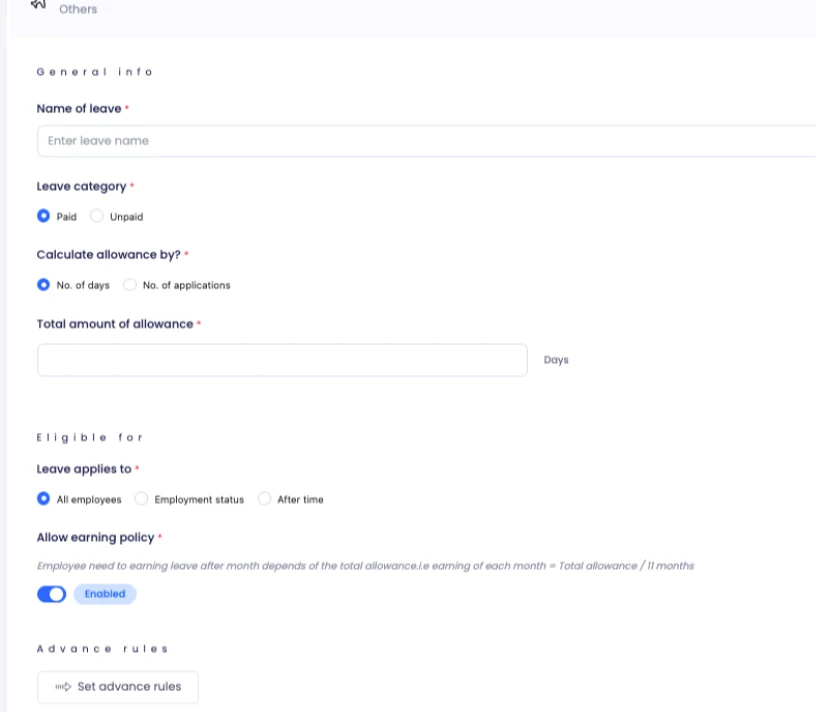
Once the policy is written, set it up in your leave tool so the rules apply to every request instead of living in a PDF. Every Payrun plan includes leave policies with default leave types, and on every plan you can edit those defaults, including the allowance in days and the earning toggle. With earning on, employees build up leave month by month instead of getting the full allowance upfront. Creating a new custom leave policy needs the Ultimate plan. A custom policy has its own name, paid or unpaid category, allowance in days and eligibility: everyone, an employment status, or staff past a set length of service.
How to plan the leave year and holiday calendar
Every balance depends on two things: when the leave year starts and which days the office is closed. Set both before the first request comes in.
Step 1: Fix the leave year
Pick one start month for the whole team and put it in the contract. GOV.UK says employers should tell staff their leave year dates as soon as they start work.
Step 2: Add public holidays and office closures
Add bank or public holidays, plus any days the office closes, such as the week between Christmas and New Year. In the UK you can tell staff to take leave on set dates, but you have to give notice at least twice as long as the leave itself.
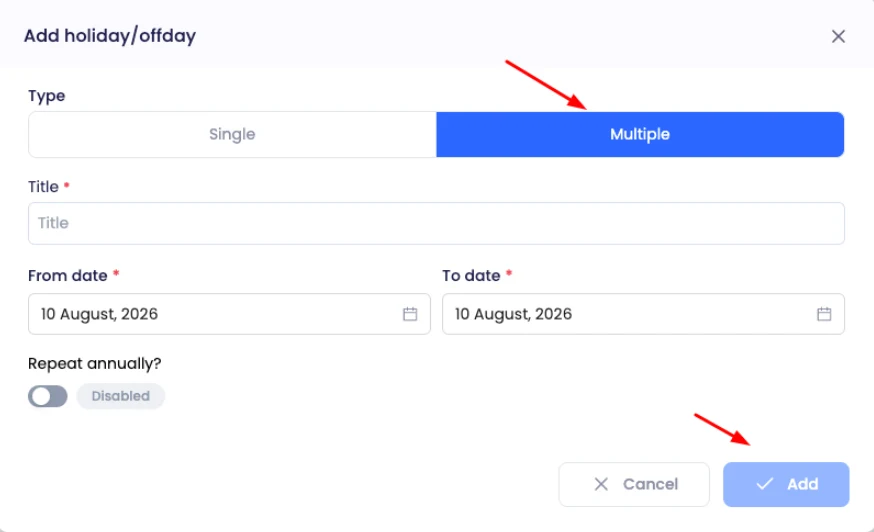
In Payrun this lives under Holiday & Offday settings. You can add a single day or a date range, set it to repeat every year, and add a selected year's holidays automatically. The leave calendar and holidays come with every plan, and Google Calendar holiday import is on Pro and Ultimate.
Step 3: Mark peak weeks and open December early
List your busy periods and blackout dates. Then open December requests in October or November, while there's still time to move people around. If part of the team works remotely or in another country, add their public holidays too. Our guide to leave management for remote teams covers those cases, and holiday management software compares the calendar options.
How should managers approve annual leave?
Managers should approve leave against written rules: a named approver, a reply within 2 working days, a clash rule for peak weeks and a business reason for any refusal. Without clear rules, the same person gets Christmas three years running because they always ask first, and someone else waits a week for an answer and books flights anyway. Four decisions prevent both:
- Who approves: the line manager, with a named backup when they're away.
- How fast: a reply within 2 working days. That's our recommendation, not a legal rule.
- How clashes are settled: first come, first served for normal weeks, and a rotation for peak weeks like Christmas.
- When a refusal is reasonable: only for a real business reason, such as nobody left to cover.
The UK notice rules behind refusals
Under GOV.UK's default rules, a worker gives notice at least twice as long as the leave they want, plus 1 day. An employer who refuses or cancels leave must give notice as long as the leave requested, plus 1 day. So a 10-day request needs 11 days' notice to refuse. Contracts can set different notice periods. Acas adds that employers should have a good business reason to refuse, and can't stop someone taking their leave entitlement altogether.
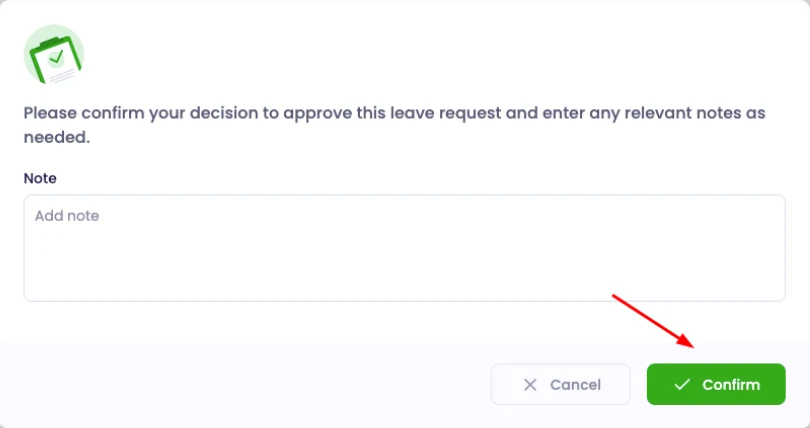
In Payrun, managers approve pending requests from Leave Records and can add a note before confirming. The leave status and the calendar update as soon as they confirm. For approval design beyond leave, see HR approval workflows.
How to track annual leave balances
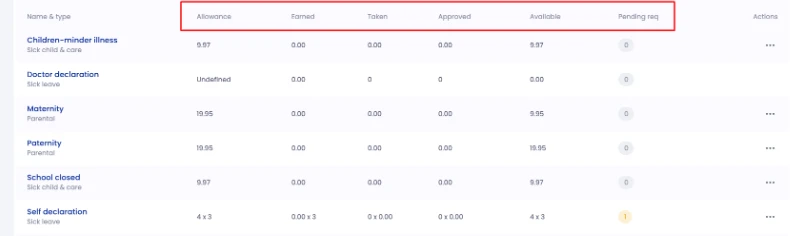
Track leave balances in a system that updates when leave is approved, not in a sheet someone retypes. A spreadsheet balance is right on the day someone updates it. After one missed half-day and one late approval, it no longer matches what people remember. For each employee and leave type, you need six numbers:
- Allowance for this leave year
- Earned so far, if leave builds up monthly
- Taken
- Approved but not yet taken
- Pending a decision
- Available to book
Payrun's Leave Summary shows all six for every leave type, per employee. Managers can also assign leave on someone's behalf, and employees request leave from the web app or the iOS and Android app.
UK employers now have a second reason to move off spreadsheets. From 6 April 2026, they must keep detailed records of annual leave and holiday pay for at least 6 years, and can be fined if they can't show them. Acas lists what to record: holiday taken, holiday carried over from previous years, holiday pay and any payments in lieu of holiday. Sources: GOV.UK, Holiday pay and Acas, Keeping records, checked 3 November 2026.
A system that logs every request, approval and balance change keeps that record for you. If you'd rather stay on a spreadsheet for now, our guide to employee leave tracking includes a free template and the balance formulas.
What happens to unused annual leave?
Unused leave is lost, carried over or extended, depending on your policy and the law where staff work. Decide the rule in January, not in the last week of December. Most small teams pick one of three options:
Option | Works well when | Watch out for |
|---|---|---|
Use it or lose it | You want everyone rested each year and balances kept simple. | A December rush. In the UK, statutory exceptions still apply. |
Capped carry-over | You want some flexibility without balances growing every year. | Without a deadline, carried days pile up. |
Extension window | Your peak season falls at year-end, as it does for retail or accounting firms. | You need to track which days are "old" and expire them on time. |
UK carry-over rules to build in
Staff can carry over part of their statutory 5.6 weeks only if a relevant agreement, such as the employment contract, allows it. Without one, they take it within the leave year. Leave above 5.6 weeks carries over only as the contract says. There are three exceptions where carry-over is required:
- Long-term sickness: up to 4 weeks can carry over, to be used within 18 months of the end of the leave year it was earned in.
- Maternity and other statutory leave: holiday the person couldn't use must be allowed to carry over.
- Leave you didn't let them take: if you didn't let someone take their holiday, didn't encourage them to or didn't tell them they'd lose it, they can carry over up to 4 weeks.
Source: Acas, Carrying over holiday, checked 3 November 2026. In the US, carry-over is set by your policy and state law, and some states restrict use-it-or-lose-it rules.
Payrun tracks allowances, leave years and balances, but this guide doesn't assume an automatic carry-over feature. Apply your rule at year-end and record the carried days. Leave records also don't change pay or tax on their own; your payroll process and accountant handle that.
One habit makes year-end much calmer: a mid-year balance check. Six months in, nudge anyone with more than half their allowance left.
5 annual leave mistakes small teams make
- Approving leave in chat. The approval scrolls away and the balance never updates.
- No written leave year. Everyone resets on a different date and year-end never ends.
- No clash rule for peak weeks. The person who asks first wins every year.
- Forgetting part-timers and new starters. Applying full-time numbers to everyone overpays some people and underpays others.
- Leaving carry-over until December. By then the only options are a rush or an argument.
Our guide to leave management mistakes covers more, including what each one costs.
Spreadsheet or leave management software: when to switch
A spreadsheet costs nothing and works fine for a team of four with one manager. It stops working when two managers approve the same week, or when you need 6 years of UK holiday records.
Need | Spreadsheet | Leave software |
|---|---|---|
Cost | Free | Free tiers exist; paid plans are usually per user |
Clash checks | Manual, by whoever looks | One shared calendar before approval |
Balance accuracy | As good as the last edit | Updates when leave is approved |
Employee self-service | Ask the person who owns the sheet | Staff check their own balance |
Records | Version history, if anyone kept it | Every request and approval logged |
Switch when any of these is true: you have more than one approver, someone has asked "how many days do I have left?" twice this month, or you employ UK staff and need the new records. For a side-by-side of tools, see our comparison of the best leave management software.
How to set up annual leave management in 5 steps
- Check the legal minimum for each country your staff work in.
- Write the eight policy decisions on one page and share it.
- Set the leave year and add public holidays and office closures to a shared calendar.
- Name the approver and backup, and agree the reply time and clash rule.
- Track balances in one system, and run a mid-year check before the year-end reset.
Payrun's Free plan covers up to 5 employees, with leave requests, approvals, the leave calendar, holidays and leave policies included. Paid plans start at $4.95 per user per month billed annually ($8.25 billed monthly). The 14-day free trial is separate: it covers up to 10 users with no card and no contract, and when it ends the account can switch to the Free plan. You can also see how leave management works first.