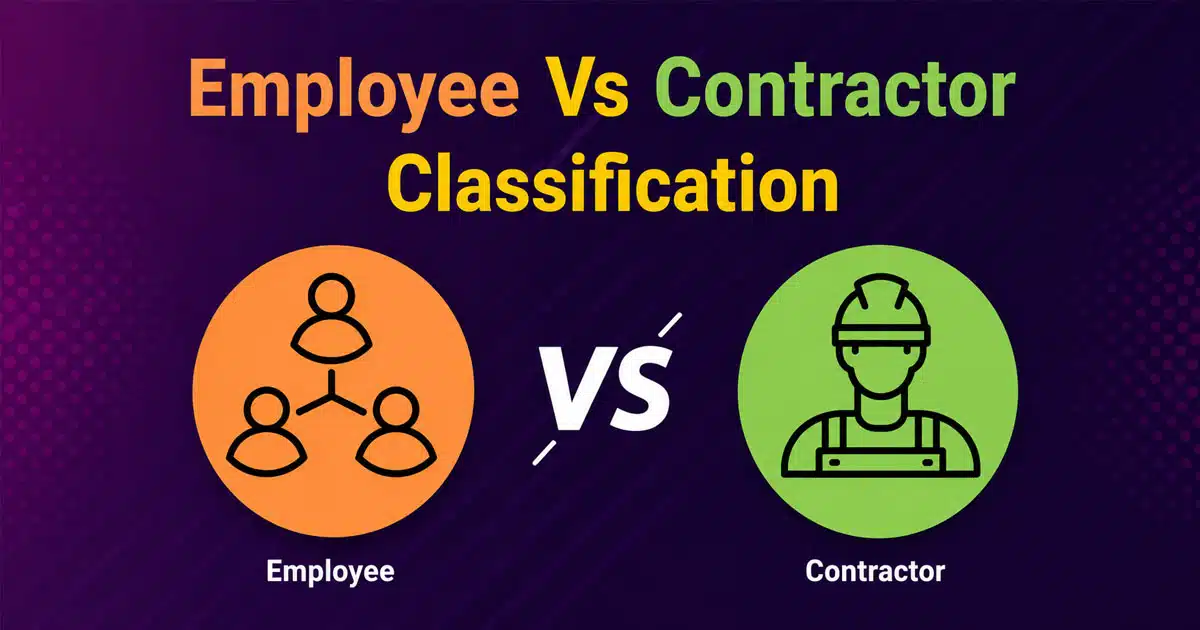
The employee vs contractor decision can affect your bottom line by a lot. Hiring an employee can cost up to 30% more than hiring an independent contractor. Employee benefits add 25% to 40% of base salary. Yet misclassification carries serious risks. Between 10% and 30% of employers have classified workers wrong.
The difference between independent contractor and employee status is vital for your business. In this article, We'll break down worker classification, tax obligations and legal requirements. You'll also see cost comparisons that help you make the right choice when hiring contractors vs employees.
What Is An Employee
An employee is a worker who performs services under company control. The employer-employee relationship exists when the worker’s job controlled by the business owner. Under common law rules and the Fair Labor Standards Act, the key aspect is control over work performed and services rendered. A written contract or tax forms do not decide worker classification. In employee vs contractor cases, employee status depends on the full employment relationship, not labels or a written agreement.
A worker is an employee when paid wages, works set hours, and does not operate as self employed individuals. Employees receive minimum wage, overtime pay, and employee benefits such as health insurance, vacation pay, and pension plan access. Employers handle tax withholding, social security, medicare taxes, and unemployment insurance taxes. Wrong worker classification leads to tax implications, back taxes, payroll taxes issues, and risks with workers compensation insurance and unemployment benefits.
What Is Independent Contractor
An independent contractor is a self employed individual who runs their own business and provides services to other businesses. In employee vs contractor situations, the main difference is control. An independent contractor relationship exists when the business owner controls only the result, not how work performed. The worker uses own tools, sets own hours, and handles own expenses. Independent contractor status depends on common law rules and the economic reality of the employment relationship, not a written contract or tax forms.
Independent contractors pay their own employment taxes, including social security and medicare taxes, for federal tax purposes. Businesses do not handle tax withholding, unemployment insurance taxes, or payroll taxes for them. Contractors do not receive minimum wage, overtime pay, or employee benefits like health insurance or workers compensation insurance. Wrong worker classification can create tax implications, back taxes, and issues with unemployment tax and unemployment benefits.
Key Differences Between Independent Contractor nd Employee
Classification between employee vs contractor hinges on several concrete factors that affect daily operations and legal obligations. The IRS uses behavioral, financial, and relational tests to determine worker classification. These distinctions shape everything from tax withholding to workers compensation insurance requirements.
Control Over Work Methods And Schedule
Behavioral control separates employees from independent contractors. Employees work under the business's instructions about when, where, and how to perform work. You set specific hours for employees and determine their work priorities. The degree of instruction matters a lot. More detailed instructions indicate employee status, while less detailed instructions reflect independent contractor status.
Employees cannot hire assistants to perform their work. Independent contractors maintain authority to hire their own employees. Training serves as strong evidence of an employer employee relationship. When you provide training on job procedures and methods, you demonstrate the desire for work to be done in a particular way. Independent contractors use their own methods without requiring training from clients.
Financial Aspects: Payment Structure and Own Tools
Financial control distinguishes contractors from employees through payment methods and resource ownership. Employees receive regular salary or hourly wage payments on fixed schedules. Independent contractors set their own pay rates and submit invoices after project completion. Payment timing varies for contractors based on milestones or deliverables rather than consistent paydays.
Tool and equipment ownership provides another difference. Independent contractors supply their own tools, a classic sign of contractor status. Employees use employer-provided equipment and systems to perform their jobs. Contractors have opportunities to earn profit or experience loss based on business performance, while employees do not face such financial risk.
Type of Relationship And Contract Terms
Written contracts shape the employment relationship. Independent contractors work under contract agreements that specify scope of work, pay rates, payment terms, confidentiality, start and end dates, and contractor status declarations. Employees complete W-4 forms for tax withholding, whereas contractors submit Form W-9 documenting their name, address, and taxpayer identification number.
Employee benefits separate the two classifications. You provide health insurance and pension plan options to employees. Independent contractors receive no such employee type benefits. The permanence of the relationship matters.
Work Location and Use Of Own Employees
Work location flexibility distinguishes independent contractors from employees. Employees often work on company premises at locations you determine. Contractors maintain freedom to work offsite and choose their work locations.
Knowing how to work for other businesses separates contractors from employees. Independent contractors work with multiple clients at once. Employees work for a single employer. Contractors can refuse work offers and select which projects to accept. The authority to hire assistants demonstrates independent business ownership.
Employee Vs Contractor Comparison Table
| Attribute | Employee | Independent Contractor |
|---|---|---|
| Definition | Works under employer control when performing services | Runs own business and provides services to clients |
| Control Over Work | Employer controls what and how work is done | Business controls only the result, not the method |
| Work Schedule | Employer sets hours and priorities | Sets own hours and chooses projects |
| Tools & Equipment | Uses company tools and systems | Uses own tools and equipment |
| Payment Structure | Paid salary or hourly wages on fixed schedule | Sets own rates and invoices for services rendered |
| Taxes | Employer handles tax withholding, payroll taxes, Social Security, and Medicare taxes | Pays own employment taxes as self employed individuals |
| Benefits | Gets employee benefits like health insurance, pension plan, vacation pay, overtime pay | No employee type benefits |
| Unemployment & Workers Comp | Covered by unemployment insurance and workers compensation insurance | Not covered by unemployment insurance or workers compensation |
| Relationship Duration | Ongoing employment relationship | Project-based or temporary independent contractor relationship |
| Legal Protection | Protected by minimum wage and hour laws under Fair Labor Standards Act | Not protected by minimum wage or overtime laws |
How To Determine Worker Classification
The IRS reviews worker classification through a structured framework based on common law rules. You must think over all information that provides evidence of control and independence when you determine whether someone qualifies as an employee or an independent contractor. Three main categories guide this assessment: behavioral control, financial control, and relationship type.
Behavioral Control: Company Control Over The Worker's Job
Behavioral control gets into whether you have the right to direct and control how the worker performs tasks. You don't have to exercise control actually. The right to control matters more than actual supervision.
Several factors reveal behavioral control. The type of instructions given shows your level of oversight. Instructions about when and where to work, what tools to use, what workers to hire for assistance, where to purchase supplies, and what order to follow all indicate employee status. The degree of instruction matters by a lot. More detailed instructions mean more control and point to an employee relationship. Less detailed instructions suggest independent contractor status.
Business Aspects And Own Expenses
Financial control focuses on whether you direct or control the economic aspects of the worker's job. Five factors fall under this category.
Significant investment separates contractors from employees. Independent contractors often invest heavily in equipment to perform services. Workers who make unreimbursed expenses, especially fixed ongoing costs, lean toward independent contractor status. The chance for profit or loss distinguishes business owners from workers. Someone with significant investment and unreimbursed expenses faces a greater HR risk.
Relationship Type: Written Contract And Employee Benefits
The relationship category gets into how you and the worker notice your arrangement. Written contracts describe the intended relationship. Employee-type benefits such as pension plan, insurance, vacation pay, and sick pay indicate employee status. The permanency of the relationship matters. Continuing relationships suggest employment, while project-based work indicates independent contractor status. Whether services performed are central to your regular business operations also factors into classification.
Common Law Rules And Providing Evidence
Anyone who performs services qualifies as your employee if you control what will be done and how it will be done under common law rules. The substance of the relationship governs worker status, not labels or how you characterize the arrangement. Employment status applies whatever the hours are full-time or part-time.
No single factor determines worker classification. You must weigh all factors together. Some factors may indicate employee status while other factors point to independent contractor status. The keys are getting into the entire relationship and thinking over the extent of your right to direct and control the worker. Document each factor used in your determination.
Employment Taxes and Payroll Tax Obligations
Tax obligations differ dramatically between employees and independent contractors. You need to understand these differences to protect your business from penalties and comply with federal requirements.
Tax Withholding Requirements For Employees
Federal income tax operates as a pay-as-you-go system. You withhold income tax from employee paychecks and pay it to the IRS in their name. The withholding amount depends on employee earnings and information provided on Form W-4, Employee's Withholding Certificate. The law requires employers to withhold employment taxes from their employees. These include federal income tax withholding and Social Security and Medicare taxes.
You must withhold from regular pay, commissions, vacation pay, reimbursements under non-accountable plans, pensions, bonuses, and gambling winnings. Wages paid and amounts withheld appear on Form W-2, Wage and Tax Statement at year end.
Social Security And Medicare Taxes Breakdown
Social Security taxes both employee and employer at 6.2% each. This creates a combined 12.4% rate. The wage base limit caps Social Security tax at $176,100 for 2025. Medicare taxes each party at 1.45%, totaling 2.9%[273]. Medicare has no wage base limit, unlike Social Security. All covered wages face Medicare tax.
Employees earning over $200,000 annually face an additional 0.9% Medicare tax. You must begin withholding this additional amount when wages exceed $200,000 and continue through year end. No employer match exists for the additional Medicare tax. Self-employed individuals pay both portions and face 12.4% for Social Security and 2.9% for Medicare.
Unemployment Tax And Unemployment Insurance Responsibilities
The Federal Unemployment Tax Act sets the FUTA tax rate at 6.0%. This tax applies to the first $7,000 paid to each employee annually. You pay FUTA tax from your own funds. Employees do not pay this tax or have it withheld.
State unemployment tax credits reduce your FUTA obligation. You may receive credit up to 5.4% when paying state unemployment taxes in full and on time. This credit brings the effective FUTA rate to 0.6%, or $42 maximum per employee yearly.
Tax Forms: W-2 Vs 1099 For Services Rendered
You must file Form W-2 for each employee from whom income, Social Security, or Medicare tax was withheld. The $600 threshold applies generally. You must issue W-2 forms when any taxes were withheld, whatever the amount. Forms W-2 require e-filing when you file 10 or more in a calendar year.
Use Form 1099-NEC to report payments totaling $600 or more during the tax year for independent contractors. You must request Form W-9 from contractors to get their taxpayer identification number. Businesses filing 10 or more information returns must e-file through the IRIS taxpayer portal or FIRE system.
Cost Comparison Between Hiring Contractors Vs Employees
Comparing costs between hiring contractors vs employees reveals complexities beyond simple hourly rates. The employee vs contractor decision has direct wages, employment taxes, benefits and expenses that accumulate quickly.
Direct Wage Costs And Hourly Rate Considerations
A common misconception assumes 1099 contractors always cost less than W-2 employees. Think about an employee earning $100,000 base salary. With benefits ranging from 15% to 30% of income, this employee costs around $115,000 annually. This works out to approximately $60 per hour for full-time work.
An independent contractor wanting equivalent compensation needs to charge at least $86 per hour to match the same take-home pay. That's $16 per hour higher than the employee rate. Market rates for contractors often reach $125 to $150 per hour for similar positions. Contractors charge 50% to 70% more than what you would pay a permanent employee typically.
Employment Taxes And Workers' Compensation Insurance
Workers' compensation insurance adds cost variation. Clerical work costs approximately $0.11 per hour. Construction or remodeling positions cost substantially more at roughly $2.45 per hour. These rates vary based on job type, claims history and industry risk factors.
Health Insurance And Pension Plan
Health insurance is a substantial expense in the employer-employee relationship. Employers contributed an average of $16,357 annually for family coverage and $6,584 for single coverage in 2022. Pension plan costs differ between defined benefit and defined contribution structures. A defined benefit plan requires contributions of 16.5% of total payroll management to replace 54% of income after retirement. A defined contribution plan needs 32.3% of payroll audit to reach the same endpoint.
Overtime Pay And Vacation Pay
Overtime pay at time and a half applies when employees work over 40 hours weekly. Paid leave benefits cost employers an average of $2.94 per hour, representing 7.4% of total compensation costs. This has vacation, holiday, sick and personal leave. Independent contractors receive no such employee-type benefits and handle their own time off without pay.
Cost Comparison Table
| Cost Factor | Employee | Independent Contractor |
|---|---|---|
| Base Pay Structure | Fixed salary (e.g., $100,000 ≈ $60/hour) | Higher hourly rate (often $86–$150/hour) |
| Employment Taxes | Employer pays part of Social Security, Medicare, and unemployment tax | Pays full self-employment taxes; no employer payroll tax burden |
| Benefits Expense | Employer covers health insurance, paid leave, pension plan (adds 15%–30%+) | No benefits cost to employer |
| Workers Compensation | Employer pays workers compensation insurance premiums | No workers compensation cost for employer |
| Overtime & Leave | Overtime pay and paid vacation increase total compensation | No overtime pay or paid leave required |
Advantages And Disadvantages Of Each Worker Status
Practical implications of the employee vs contractor decision extend beyond numbers and classifications. Each worker status carries distinct advantages and limitations that affect your operations.
Advantages Of An Employee
Full-time employees bring stability and commitment to your business. They remain more dedicated and invested in the company's success compared to temporary workers or contractors. This stability helps maintain consistency in operations. It makes sure projects reach completion with minimal disruptions.
The employer employee relationship provides greater control over work quality, schedules and policy adherence. You decide how, when and where work gets done. If your business suddenly needs to change course, you can adjust employee tasks or assignments without renegotiating contracts. Employees understand internal workings of your company. They become brand ambassadors. They promote your business because growth benefits their career prospects.
Disadvantages Of An Employee
Employment taxes and employee benefits create financial burdens. You must pay Social Security and Medicare tax on wages paid to employees. Companies must provide statutory benefits including annual leave and overtime pay. Employers who fail to offer required benefits face legal and financial penalties.
Strict labor laws govern the employer-employee relationship. You must comply with payroll regulations including the Fair Labor Standards Act and the Americans with Disabilities Act. Managing employees requires attention to growth opportunities, as lack of professional development causes employees to quit.
Advantages Of Contractor
Businesses save 20 to 30 percent by hiring independent contractors over full-time employees. Contractors handle their own employment taxes, health insurance and other benefits. This eliminates potential legal penalties you might face if you don't offer employees statutory benefits according to employment law.
Independent contractors bring specialized skills without requiring training. The HR process remains simple. It requires less administrative effort. Contractors complete work faster because they focus on targeted projects unlike employees who handle broader responsibilities. You gain staffing flexibility to meet short-term needs. When projects finish, the commitment ends without legal steps required for employee termination.
Disadvantages Of Contractor
Companies have less control over contractors. Independent contractors decide how best to accomplish tasks, with what tools and in what timeframe. If you interfere too much in contractor work, you risk worker misclassification. Contractors may lack passion for company long-term goals that employees demonstrate.
Contractors come and go frequently. This constant employee turnover causes disrupt workflow and company culture. Independent contractors bring inconsistent availability because they work for multiple clients. Misclassified workers create risks. When employers should have classified someone as an employee, they pay back taxes, interest on wages and fines. It
Legal Risks Of Misclassified Workers And Fair Labor Standards Act
Misclassification creates serious legal exposure that extends way beyond simple administrative errors. The Fair Labor Standards Act defines misclassification as treating a worker who qualifies as an employee under the law as an independent contractor.
Consequences of Worker Misclassification
When workers get misclassified, employees suffer because the employer's share of taxes goes unpaid and the employee's share remains unwitheld. Workers lose access to minimum wage protections and overtime pay. They also lose unemployment insurance, workers compensation coverage and employee benefits. Because of these violations, businesses face liability to cover unpaid payroll taxes, penalties, interest and back wages.
Back Taxes and Penalties from Federal Government
Unintentional misclassification results in liability for 1.5% of wages paid to cover income tax withholding and 40% of the employee's FICA share. The employer must pay 100% of the employer's FICA portion. Intentional misclassification carries much harsher penalties: 20% of all wages paid and 100% of both employee and employer FICA taxes. Criminal penalties include fines up to $1,000 per misclassified worker and imprisonment up to one year. California imposes civil penalties from $5,000 to $25,000 per violation for willful misclassification.
Minimum Wage and Hour Laws Violations
Employers face liability for failure to pay overtime and minimum wage under the Fair Labor Standards Act. The statute of limitations extends two years for non-willful violations and three years for willful violations. Companies incur massive penalties that include unpaid overtime costs, minimum wage deficits, liquidated damages equal to unpaid wages and attorney's fees.
Workers Compensation and Unemployment Benefits Issues
Misclassification results in penalties for unpaid workers compensation premiums. Claims from misclassified workers become the employer's sole responsibility without insurance coverage. Employers face penalties for failing to pay state unemployment insurance taxes. Workers may not qualify for unemployment benefits or workers compensation because of incorrect classification.
How to Choose An Employee or Contractor For Your Business
Your worker classification decision requires careful analysis of three critical factors before hiring contractors vs employees. The IRS emphasizes thinking about all information that provides evidence of control and independence.
Assess Your Need For Control Over Work Performed
Get into the level of control you need over work methods and schedules. The company's control over the worker's job determines classification under common law rules. Employee status applies if you require detailed instructions on when, where, and how work gets done. Independent contractor status fits better when you control only results without dictating methods. Behavioral control is the main differentiator between employees and independent contractors.
Duration Of Single Employer Vs Project Based
The appropriate classification depends on project duration. Work that continues indefinitely without a fixed ending date indicates the employer-employee relationship exists. Independent contractor status is suggested by sporadic or project-based work with fixed deadlines. Short-term jobs with multiple employers may still indicate employee status unless the worker's business decision drives this rather than industry norms.
Review Budget For Payroll Taxes And Employee Benefits
Calculate total costs beyond base wages. Employment taxes, workers compensation insurance, health insurance, and pension plan contributions add to employee costs significantly. Independent contractors handle their own tax obligations and employee type benefits, which reduces your financial burden.
Industry Requirements And Other Factors
Document all factors used in your determination. Submit Form SS-8 to request an IRS decision on worker classification if uncertainty persists. Misclassified workers create liability for back taxes and penalties.
How Payrun Helps Manage Employees And Contractors
Payrun helps business owners manage employee vs contractor classification with clarity and control. Payrun has several key features. Clear records help prove when an employer-employee relationship exists and when an independent contractor relationship applies. Proper worker classification reduces the risk of misclassified workers, back taxes, and tax implications.
For employees, Payrun handles payroll taxes, tax withholding, Social Security, Medicare taxes, unemployment insurance taxes, and unemployment tax reporting. The system also tracks minimum wage, overtime pay, wages paid, employee benefits, health insurance, pension plan contributions, and workers' compensation insurance. Accurate payroll processing protects your employment relationship under common law rules and federal tax purposes.
For independent contractor status, Payrun tracks payments without applying employee-type benefits or unemployment benefits. Contractors who use own tools, set own hours, and pay own expenses stay separated from employees or independent contractors in your system. Clean documentation supports compliance and protects your business from costly worker classification errors. You can enjoy Payrun at a suitable price.
FAQs
Can A Worker Be An Employee For Federal Tax Purposes But An Independent Contractor Under A Written Contract?
Yes, worker classification depends on the actual employment relationship, not a written agreement. Under common law rules, the level of company control and economic reality determines employee status. A contract alone does not override federal tax purposes or Fair Labor Standards Act standards.
Do Independent Contractors Qualify For Social Security And Medicare Benefits?
Yes, independent contractors qualify, but they pay full employment taxes themselves. Self-employed individuals cover both Social Security and Medicare taxes through the self-employment tax. No employer tax withholding or payroll taxes contribution applies.
Can A Business Owner Change Worker Classification Mid-Tax Year?
Yes, a business owner can adjust worker classification if facts support the change. Proper documentation must provide evidence of behavioral control, financial control, and relationship type. Incorrect changes without support can trigger back taxes and tax implications.
Are Remote Workers Automatically Considered Independent Contractors?
No, work location alone does not determine worker status. An employer-employee relationship exists if the worker’s job controlled by the company, even when services are performed remotely. Control over work performed remains the key aspect.
What Happens If A Company Fails To Pay Unemployment Insurance Taxes For Misclassified Workers?
Failure to pay unemployment tax and unemployment insurance taxes can result in penalties, interest, and liability for unpaid benefits. Misclassified workers may claim unemployment benefits, workers' compensation insurance, and unpaid wages paid under minimum wage and hour laws.