Distributed work environments require reliable systems to monitor work hours and employee availability. Remote attendance tracking helps organizations manage attendance records, monitor employee activity, and maintain accurate payroll processes. Businesses that rely on structured attendance software can track work patterns across distributed teams while maintaining clear visibility into employee schedules.
A well designed time and attendance system helps HR teams manage employee hours, track check ins through a time clock, and record daily attendance without relying on manual spreadsheets. These systems also allow employees to request time off, update schedules, and maintain accurate work records from remote locations.
Remote attendance tracking also helps organizations ensure compliance with work hour regulations and payroll requirements. With reliable attendance data, businesses improve workforce management, maintain accurate payroll processing, and support consistent productivity across remote teams.
What Is Remote Attendance Tracking In Distributed Workforces
Remote attendance tracking refers to the digital process of recording work hours and presence for employees working outside a traditional office environment. It uses digital tools such as mobile apps, GPS validation, and cloud platforms to capture clock in and clock out data as it happens.
The purpose extends beyond simple time recording. Organizations need to understand work patterns, productivity levels, and engagement for teams spanning multiple locations. Since 2020, distributed teams have become standard rather than exceptional. Cloud based systems now integrate with payroll, HR, and project management software through APIs that automate data flow and eliminate manual exports.
Modern attendance platforms include leave management, shift scheduling, and analytics dashboards. Advanced systems use AI to detect attendance anomalies and forecast staffing gaps. When remote employees know their attendance is monitored transparently, it promotes accountability and encourages consistent performance across the entire team.
Key Features Of An Effective Remote Attendance System

A reliable remote attendance system helps organizations manage attendance accurately across distributed teams. The right platform supports visibility, compliance, productivity, and workforce management while simplifying daily operations for employees and administrators.
Real-Time Time And Attendance Tracking
Accurate time and attendance tracking is the core function of any attendance management system. Organizations need accurate attendance records for remote workers, office workers, and employees operating under hybrid work arrangements. Real-time tracking helps eliminate delays in the attendance process, supports accurate monitoring, and reduces inaccurate reporting across distributed teams.
Mobile Attendance App With Remote Tracking
A modern attendance app allows employees to record remote employee time from any location. Mobile-based remote tracking enables staff to automatically clock in and out while giving managers visibility into attendance activities. This feature is particularly valuable for field employees, remote workers, and teams that operate across multiple locations and time zones.
Flexible Scheduling And Shift Management
Flexible scheduling is one of the most essential features of modern attendance solutions. Businesses can create rotating schedules, remote work policies, and shift assignments that support changing workforce demands. Flexible attendance controls help organizations manage hybrid work arrangements while maintaining accountability and workforce coverage.
Payroll And Workforce System Integration
Effective time and attendance software should connect seamlessly with a payroll platform and other workforce systems. Integration improves payroll accuracy, reduces administrative effort, and helps organizations manage overtime costs. A unified platform also ensures consistent data flows between attendance, payroll, scheduling, and workforce management functions.
Attendance Analytics And Reporting Tools
Advanced reporting tools transform attendance data into actionable insights. Businesses can analyze attendance trends, absenteeism patterns, scheduling efficiency, and labor utilization. Access to workforce analytics supports data-driven decision-making, helps operations teams identify inefficiencies, and enables managers to enhance productivity across the organization.
Compliance Controls And Productivity Features
Strong compliance and productivity capabilities help organizations maintain accurate attendance records while improving operational efficiency. Features such as audit trails, approval workflows, location verification, and automated alerts reduce compliance risks. Integration with project tools supports team productivity, delivers cost savings, and provides visibility without requiring employees to be physically present in a central workplace.
Remote Attendance Tracking Strategies For Distributed Teams

Managing employee attendance for distributed teams requires a practical approach combining clear policies, the right technology, and regular communication. These strategies help organizations balance transparency with trust while accommodating different work hours and arrangements.
1. Clear Remote Work Hour Policies
The foundation of any attendance system is clearly communicated work hour expectations. Organizations must define core working hours, break times, and leave requests procedures. For remote teams, this becomes more nuanced because schedules may not follow rigid patterns.
Policies should specify whether the organization requires synchronous overlap time across time zones, or if asynchronous work is acceptable. A company with team members in different cities might establish that 10 AM UTC is the only required synchronous meeting time, with flexibility outside that window. This prevents expecting availability that conflicts with local working norms.
Clear policies eliminate confusion and align employees with organizational expectations. They should also address what constitutes working in a remote context and when an employee is considered offline.
2. Structured Clock In And Clock Out Rules
Automation reduces errors associated with manual entry and provides accurate records. Employees should log hours digitally through centralized systems, making the process seamless and transparent. However, structure matters as much as automation itself.
The system should require consistent procedures rather than allowing retroactive time entry that undermines accuracy. Some organizations use geofencing for field workers, while remote and hybrid teams might use simple timestamp based systems. Mobile apps that push notifications reminding employees to clock out reduce forgotten logout problems. Research shows that buddy punching and time inflation decrease significantly when structured rules are enforced consistently.
3. Real Time Work Hour Visibility
Managers need real time visibility that allows them to identify patterns and address discrepancies before they affect business operations. This means dashboards showing who is logged in, who is offline, and trends over time.
If an employee typically logs in at 9 AM but has not by 10 AM, a manager can check in rather than discovering absence at end of month payroll processing. Cross environment dashboards present attendance metrics in consolidated views, allowing leaders to compare productivity patterns and adjust strategies accordingly. Instant access to attendance data improves forecasting for peak periods and project deadlines.
4. Transparent Attendance Reporting
Transparency builds trust and reduces disputes about employee hours worked. Systems should allow employees to view their own attendance records, clearly showing when they clocked in and out and total hours logged. When employees can verify their own data, they feel more confident in payroll accuracy.
Regular check ins maintain accountability and improve productivity. Short, structured virtual meetings allow employees to report progress, discuss challenges, and receive feedback. Managers who share attendance insights with their teams create transparency that invites problem solving rather than finger pointing.
5. Payroll Aligned Attendance Cycles
Attendance tracking systems must synchronize with payroll cycles to prevent errors and delays. Organizations should establish clear cutoff times for attendance data before payroll processing begins. If the payroll cycle ends on the 23rd at 11:59 PM UTC, all attendances must be finalized by that point, and payroll automation software for faster and accurate payroll processing can help enforce these cutoffs reliably.
For distributed teams across multiple time zones, this requires specifying a single reference time zone for payroll. Integration between attendance and payroll systems should be automated rather than manual. When humans transfer data manually between systems, errors multiply and payroll compliance becomes difficult to maintain.
6. Work Patterns Across Time Zones
Distributed teams present complexity when managing employees across regions where standard business hours vary. A developer in Singapore and a manager in Dublin operate 13 hours apart. Expecting identical working hours creates burnout and resentment.
Organizations should track work patterns by time zone rather than imposing universal schedules. Analytics dashboards should visualize when different team members typically work, revealing whether sufficient overlap exists for collaboration. Understanding these patterns also informs meeting scheduling. If meetings always occur at times convenient for one region but inconvenient for another, that pattern requires adjustment.
7. Team Accountability Through Communication
Regular structured communication transforms attendance tracking from punitive to supportive. Activity logs show not just when employees are logged in but which tasks they are working on. This information should inform conversations about workload rather than accusations about remote productivity.
Managers who use attendance data conversationally build trust. Saying that you noticed someone logged 52 hours this week and asking whether the project is especially demanding opens dialogue. Team accountability means shared responsibility for meeting deadlines with attendance data as supporting context rather than the primary measure.
Attendance Tracking Methods Used By Remote Teams

Remote teams employ diverse attendance management systems for flexible, hybrid, and remote teams ranging from manual spreadsheets to AI powered platforms. The choice depends on team size, budget, compliance requirements, and organizational culture.
Manual Attendance Records And Spreadsheets
Despite technological advancement, some organizations still rely on spreadsheets or email based attendance logs. Employees send daily or weekly reports to managers, who manually compile employee time worked. This process is labor intensive and error prone due to human error in data entry and forgotten entries, especially when compared with HR software versus spreadsheets for payroll and HR management.
However, manual systems exist because they require minimal infrastructure investment and no employee training. For very small businesses or those where exact hours matter less than output, spreadsheets remain functional. The critical limitation emerges at scale. Once a team exceeds 15 to 20 people, spreadsheet management becomes unwieldy and payroll processing delays multiply.
Browser Based Time Tracking Systems
Web based platforms allow businesses to centralize attendance management through a web platform. Employees log in through a browser to record their hours from any device with internet connectivity. Features often include simple clock in and clock out buttons, daily time summaries, and basic reporting.
The advantage is accessibility without requiring native mobile application development. The limitation is that browser systems require active connectivity and conscious user action to track time consistently.
Mobile Clock In Applications
Mobile app solutions address connectivity and usability limitations of browser systems. Employees download an app to their smartphone, receiving push notifications reminding them to track hours. Many apps include GPS tracking for field workers, automatic geofencing that logs time when entering specific job sites, and offline functionality that syncs data when connectivity returns.
Mobile apps also enable biometric authentication where employees clock using fingerprint or facial recognition. This prevents buddy punching and provides tamper proof records for diverse workforces.
Automated Attendance Monitoring Platforms
Advanced platforms combine GPS validation, biometric confirmation, and AI driven trend analysis for comprehensive attendance visibility. These transform raw clock in records into actionable workforce intelligence. Integrated workforce management systems merge attendance tracking with time management, project tracking, and HR systems in a single system.
Such platforms use AI dashboards to predict absence trends and highlight attendance irregularities proactively. The investment requires upfront cost and organizational change management, but operational efficiency gains justify the investment for organizations managing 50 or more distributed employees.
Integrated HR And Attendance Systems
The most mature approach combines attendance with broader HR functions including payroll, leave management, benefits administration, and compliance reporting. When an employee submits time off requests, leave management software to track, approve, and manage time off automatically updates absence tracking and feeds into automated calculations for payroll.
Seamless integration through APIs eliminates manual exports and data imports that introduce errors. Leave accrual calculations happen automatically based on company policy, reducing administrative tasks significantly.
Remote Team Time Tracking And Attendance Tools
Specialized tracking software combines functionality with analytics, detailed reports, and integrations. Modern tools balance employee privacy with organizational visibility and workforce management needs.
Cloud Based Time Tracking Platforms
Cloud infrastructure enables accessibility, scalability, and real time data synchronization across teams working remotely. Cloud based HR tools for remote teams allow employees in any location to log hours instantly, with data aggregating in centralized repositories accessible to managers.
Organizations avoid server infrastructure investment and management with cloud solutions. Updates deploy automatically to all users simultaneously. Teams can scale from 10 to 10,000 employees without infrastructure changes. Security should include encryption for data in transit and at rest, compliance certifications, and role based access controls.
Workforce Attendance Monitoring Systems
These systems focus specifically on attendance management rather than general time tracking. They include features like geofencing, shift scheduling to ensure proper coverage, and leave management capabilities.
Advanced workforce systems include analytics dashboards showing attendance patterns, absence trends, and planning insights. They can identify which employees frequently take certain days off, suggesting possible disengagement or personal scheduling preferences requiring attention, especially when supported by detailed employee time log reports for smarter attendance and productivity tracking.
Mobile Workforce Tracking Apps
Purpose built applications serve teams where employees work remotely, in the field, or split time between locations. These apps use device capabilities including GPS, camera for biometric authentication, and local storage for offline functionality, similar to leading timesheet apps for employees that boost productivity.
Mobile apps excel at solving the employee location question for field based teams. Geofencing automatically logs employees into projects when they arrive at client sites. The best apps use offline first architecture, allowing employees to check balances and clock in even without internet connectivity.
Attendance Analytics And Reporting Tools
These tools extract meaning from raw attendance data through visualization and statistical analysis. Employee timeline tracking for modern teams transforms logs into valuable insights like productivity patterns, team workload distribution, and absence trend forecasting.
Custom reporting allows managers to generate reports for specific purposes including payroll verification, compliance documentation, and performance reviews. Export functionality enables integration with other business systems for comprehensive solution approaches.
Payroll Integrated Attendance Platforms
The most integrated approach combines time tracking with payroll processing, eliminating error prone manual transfer of hours. When employees clock out, the system calculates pay automatically based on rates, overtime rules, and deductions.
Payroll integrated platforms handle complexity like different pay rates for projects, overtime calculations varying by country, and tax withholding based on hours worked. This automation prevents common payroll errors and ensures accurate payroll every pay period.
Operational Challenges In Remote Attendance Management

Managing attendance for distributed teams presents distinct operational challenges absent in traditional office settings. HR teams must address visibility limitations, time zone complexity, and employee experience concerns simultaneously.
Limited Visibility Into Daily Work Hours
In traditional offices, managers observe when employees start work and leave. Remote teams lack this visual confirmation. Managers cannot tell whether an employee clocked in on time, took extended breaks, or clocked out early without explicit tracking systems.
This visibility gap enables dishonest practices and prevents managers from identifying overworked employees before burnout occurs. Without real time visibility, problems remain hidden until payroll processing when corrections become expensive. Solving this requires technological solutions providing dashboards rather than retrospective reports to track employee attendance effectively.
Time Zone Coordination Across Teams
Distributed teams spanning multiple time zones create scheduling complexity for HR managers. When does a work day start and end for payroll purposes? Organizations often struggle conceptually with requiring synchronous presence during headquarters hours, creating impossible schedules for distant time zones.
Different time zones also complicate attendance data consolidation. Managing this requires explicit policies defining work hour expectations by zone. Some organizations establish that core hours occupy a narrow band with flexibility outside those hours to manage time effectively.
Inconsistent Attendance Reporting
Different teams often use different tracking methods, creating reconciliation challenges. The marketing team might use one platform while engineering uses another. When payroll time arrives, someone must manually reconcile data from multiple sources, introducing errors.
Inconsistency also means different data quality across the organization. This creates perception of unfairness and complicates analytics when comparing attendance across departments. Solving this requires standardization so all teams follow the same procedures using shared calendars and systems.
Attendance Data Accuracy Issues
Multiple factors compromise attendance data accuracy even when using modern platforms. Employees might forget to clock in. System bugs might occasionally fail to record timestamps. Time zone conversion errors introduce inaccuracy when the system does not handle conversion properly.
Organizations should implement verification procedures where data is reviewed before payroll processes. Automated anomaly detection flags unusual patterns prompting manual investigation before affecting employee experience negatively.
Compliance With Work Hour Regulations
Different countries enforce different work hour regulations to ensure legal compliance. The EU restricts weekly work hours to 48 and mandates rest periods. California has specific overtime thresholds. Australia has different leave entitlement calculations.
Organizations with distributed teams must track attendance in ways satisfying all applicable regulations. Failing to track accurately creates legal liability and potential fines. Regulatory reporting requires demonstrating compliance with formatted records for government audits.
Remote Attendance Data And Workforce Analytics
Raw attendance data provides value when transformed into actionable insights. Analytics dashboards, trend analysis, and reporting convert clock in times into workforce intelligence informing scheduling and strategic decisions.
Attendance Metrics For Workforce Productivity
Attendance data connects to productivity through multiple metrics. Completed requests measure how many tasks an employee brought to completion, providing objective data without subjective assessment.
Mean Deadline Deviation Percentage shows whether tasks were completed earlier or later than deadlines. This reveals who consistently meets deadlines and who chronically misses them. Response time metrics measure how quickly employees respond to requests, indicating engagement and availability. Organizations should track these metrics in aggregate, using them for insight rather than individual surveillance to improve productivity.
Work Hour Trends Across Distributed Teams
Analyzing when employees work reveals important truths about team dynamics. Does the team have sufficient synchronous overlap for collaboration, or does asynchronous communication dominate?
Work pattern analytics might reveal that some employees consistently work before core hours, suggesting timezone misalignment or personal preference. Comparing work hours across the team highlights inequality. Some organizations discover one employee consistently works 45 hours weekly while peers work 35, indicating workload distribution problems requiring attention.
Absence Patterns And Workforce Planning
Absence data reveals significant information about employee engagement and wellbeing. Organizations can identify concerning patterns like recurring absence on specific days suggesting possible disengagement or personal scheduling conflicts.
Absence analytics inform workforce planning. If predictable absences occur during specific times, organizations can easily request additional staffing accordingly. Absence trends signal early disengagement, with increasing frequency possibly indicating employee dissatisfaction preceding resignation.
Attendance Reports For Team Managers
Managers need customized reporting enabling them to understand their specific team patterns. Reports should show individual employee hours alongside team averages, highlighting outliers requiring conversation.
Effective manager reports distinguish between absence reasons because vacation, sick leave, and personal days have different implications. Alerts and exceptions reports flag unusual patterns requiring management attention, transforming attendance from compliance requirement into management tool.
Performance Insights From Attendance Data
Attendance data provides context for performance evaluation but should not be the primary measure. An employee logging 40 hours weekly does not guarantee productivity. Combined with output metrics like tasks completed and quality delivered, attendance data reveals important patterns.
Organizations should use attendance data conversationally in performance reviews. Asking about overtime patterns opens dialogue about efficiency or process improvements rather than creating confrontation.
Compliance And Security In Remote Attendance Tracking
Attendance tracking systems handle sensitive employee data and legal compliance obligations. Organizations must balance transparent tracking with employee privacy rights while maintaining data security across jurisdictions.
Work Hour Compliance Requirements
Different jurisdictions enforce specific work hour regulations that organizations must maintain evidence of meeting. The European Union Working Time Directive limits work to 48 hours weekly averaged over reference periods with minimum rest periods between shifts.
California wage and hour laws require break periods and overtime pay after 8 hours daily or 40 hours weekly. Organizations with international distributed teams must track hours satisfying all applicable regulations. Failure to comply creates legal liability including employee lawsuits for unpaid wages and regulatory fines.
Data Privacy In Attendance Tracking Systems
Attendance tracking systems collect sensitive personal information. Employees should have clear notice regarding what data is collected, how it is used, who can access it, and retention periods.
The General Data Protection Regulation in Europe requires explicit consent before collecting personal data. Employees must voluntarily agree to tracking, understanding what they are agreeing to. Data minimization principles suggest collecting only information necessary for legitimate purposes without excessive surveillance.
Secure Employee Attendance Records
Employee attendance records contain personal information requiring protection. Systems should encrypt data in transit and at rest. Access should be restricted to authorized personnel only using role based access controls.
Audit trails should record who accessed attendance records and when, enabling detection of unauthorized access. Multi factor authentication should protect system access beyond username and password alone. Regular security audits should test whether attendance systems can withstand attacks.
Regulatory Reporting For Work Hours
Organizations in regulated industries must produce work hour reports demonstrating compliance. Financial services firms must show employees comply with maximum work hour restrictions. Healthcare organizations must document that staff scheduling meets shift limits.
Attendance systems should enable generating these reports automatically rather than manually compiling data. Automated reporting reduces errors and compliance risk while saving administrative time.
Transparent Attendance Monitoring Policies
Organizations should clearly communicate how attendance is tracked and what it is used for. Transparent policies build employee trust and reduce perception of surveillance. Employees should understand attendance tracking exists for payroll accuracy and workload management purposes.
Policies should specify whether activity monitoring occurs beyond attendance itself. When tracking becomes transparent, it becomes less intrusive. Employees who understand why they are monitored and see policy enforced consistently feel the system is fair.
Best Practices For Managing Remote Attendance Systems

Implementing attendance systems is only effective when accompanied by organizational practices supporting accuracy, fairness, and integration with broader workforce management. Success depends on combining technology with communication and continuous improvement.
Centralized Workforce Attendance Records
Organizations managing multiple teams should centralize attendance data rather than allowing separate systems. Centralized repositories with structured approval workflows in HR and payroll provide leadership with company wide visibility while reducing reconciliation burden during payroll processing.
Centralization enables consistent policies. When all attendance flows through the same system, uniform procedures are easier to enforce across the organization. Central systems prevent data silos where important patterns visible organization wide are hidden within individual team records.
Automated Time Tracking Workflows
Automation reduces human error and frees managers from manual data entry through automated time tracking workflows. When employees clock in and out through consistent procedures, the system records timestamps accurately. Payroll automation software for faster and accurate payroll processing ensures overtime calculations, leave accrual, and compliance checking can be automated based on organizational policies.
Automated workflows create visible evidence of the process. Unlike manual tracking where decisions are implicit, automated systems document policies explicitly. However, some judgment still requires human input for unusual patterns.
Regular Attendance Data Reviews
Organizations should implement regular reviews of attendance data before payroll processes. Weekly or biweekly reviews catch errors early when corrections remain inexpensive and straightforward.
Reviews should focus on exceptions and anomalies. An employee logging unusual hours should be questioned. Managers should review data for their teams, discussing any patterns that seem incorrect. This transforms attendance review from audit function into collaborative process.
Payroll Integration With Attendance Data
Attendance systems should integrate with payroll to prevent manual transcription errors affecting accurate records. When employees clock out, the system should calculate gross pay based on hours worked, applicable rates, and deductions, leveraging robust payroll software with automation and integrations.
Integration requires careful configuration of payroll rules. The system must understand salaried versus hourly distinctions, jurisdiction specific rates, and mandatory versus voluntary deductions. Integration also enables payroll efficiency with faster processing and fewer errors.
Clear Attendance Policies For Teams
Policy clarity prevents disputes and sets expectations. Policies should specify work hours, break procedures, leave request procedures, overtime approval processes, and consequences for violations.
For hybrid teams, policies should explicitly address time zone expectations. Are employees required to work specific hours, or just deliver expected outputs? Clear policies should be documented and communicated with acknowledgment that employees have read and understood them. Consistent enforcement builds trust across the organization.
How Payrun Supports Remote Attendance Tracking
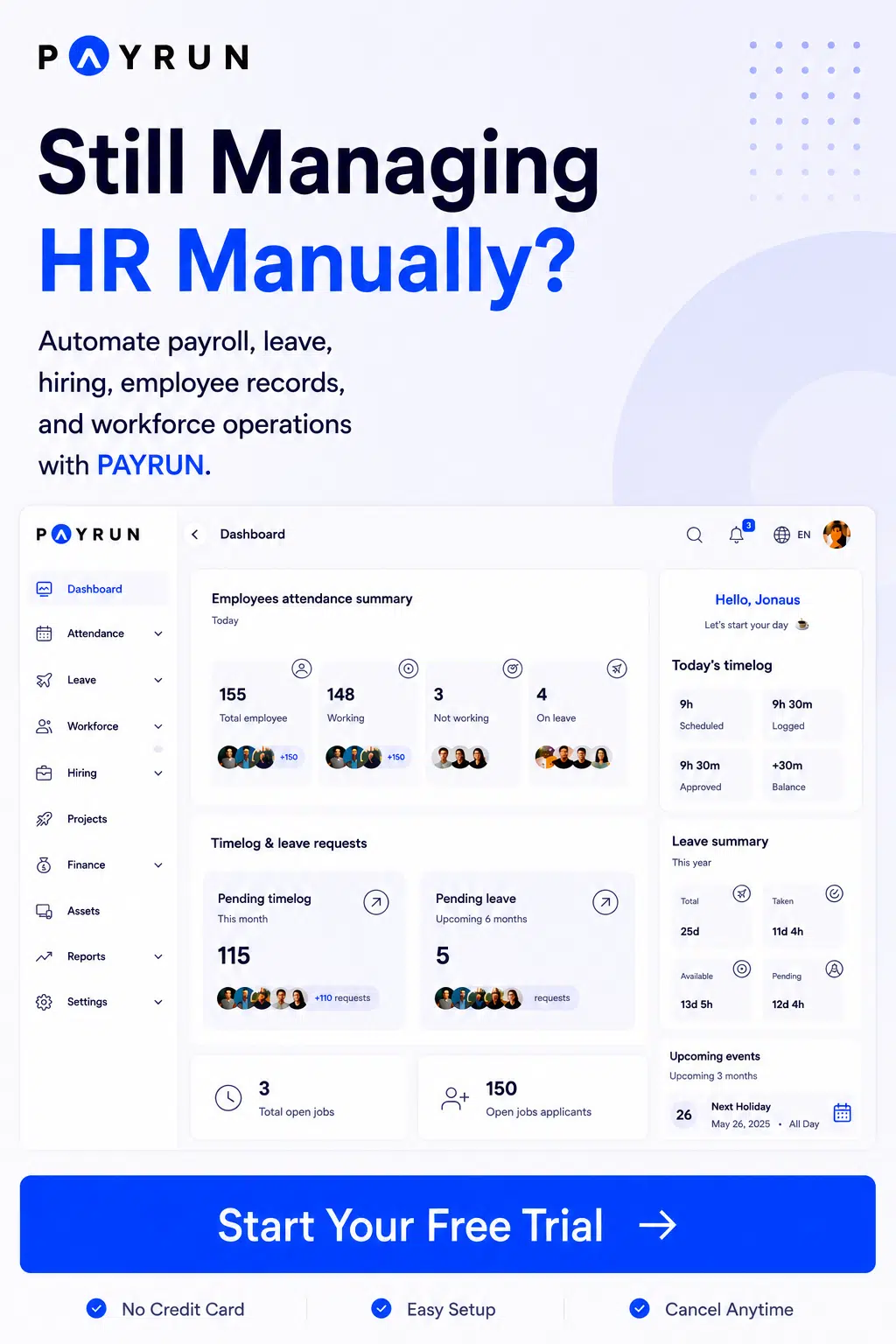
Payrun brings attendance and payroll together in one platform built for growing businesses managing remote teams. Employees can record hours from laptop or mobile while managers review and approve entries in a centralized location. This eliminates scattered spreadsheets and email chains that create confusion, thanks to Payrun's innovative HR features for end to end management.
Approved hours flow directly into Payrun payroll, reducing manual work and end of month surprises. The platform supports different pay periods, overtime rules, and allowances common across various business types. Smart attendance tracking software with real time timeline view provides calendar views and activity summaries that help managers make informed decisions about workload distribution.
Payrun keeps attendance records securely with audit trails that satisfy compliance requirements. Both finance teams and founders gain clear visibility of labour costs without chasing down data from multiple sources. The result is fewer emails, fewer spreadsheet errors, and more confidence on payday for everyone involved, especially when following best practices on implementing an attendance management system in your business.
Frequently Asked Questions
How Remote Attendance Tracking Improves Payroll Accuracy
Remote attendance tracking eliminates many common payroll errors by recording data automatically through consistent systems. When employees clock in and out digitally, it removes calculation mistakes from manual time entry. Integration between attendance and payroll means hours flow directly without human retyping, eliminating transcription errors. Employees who can review their own attendance records catch mistakes before they become payroll disputes.
What Data Remote Attendance Systems Track
Basic systems track clock in and clock out times, calculating total hours worked. More advanced systems track leave type when employees take time off, distinguishing between vacation, sick leave, and personal days. Some systems record which projects employees worked on for billing purposes. Biometric systems record authentication method while GPS enabled systems track location for field workers.
How Attendance Tracking Works Across Time Zones
Attendance systems automatically convert local times to organization reference time zones for payroll processing. When an employee clocks in at 9 AM in their location, the system records both local time and the equivalent UTC time. Organizations should establish clear cutoff times in a single time zone so employees everywhere understand deadlines for timecard submission.
How Time Tracking Software Prevents Attendance Errors
Timestamp based systems eliminate mistakes from employees trying to remember hours worked weeks later. Clock in at the moment of work starting ensures accuracy. Automation prevents calculation errors in overtime and deductions. Validation procedures catch unusual patterns automatically, flagging anomalies for investigation before they affect payroll.
What Metrics Evaluate Remote Workforce Attendance
Attendance rate measures the percentage of scheduled days employees work. Absenteeism rates distinguish between authorized and unauthorized absence. Punctuality metrics track whether employees clock in at scheduled times. Task completion metrics directly measure productivity when combined with attendance data. These metrics should be tracked in aggregate by team for insight rather than individual surveillance purposes.