Many companies ask the same question too late: “How many people do we really need next quarter, and how many will we need next year?” When that question is answered by pressure, complaints, or last year’s headcount, the result is often over-hiring during growth and rushed cuts when demand slows.
Workforce capacity planning is a more disciplined way to staff. It connects workforce availability to business goals by looking at employee hours, available hours, job titles, right skills, leave, productivity, and demand forecasting. Effective workforce capacity planning involves balancing employee availability with business demand, which helps leaders meet demand without carrying idle resources or creating unnecessary costs.
Workforce Capacity Planning Basics
Workforce capacity planning ensures organizations have the right number of employees with the right skills at the right time. Unlike simple headcount planning, workforce capacity planning focuses on capabilities and available hours rather than just headcount, and many smaller teams use workforce management software to keep that data visible.
Capacity Planning Defined
At its simplest, planning is the process of aligning workforce supply with business demand over several weeks, quarters, or years. Capacity planning focuses on human capital over several weeks to years, while resource planning allocates specific resources to tasks or projects. Resource planning covers all types of resources, not just workforce, and capacity planning is strategic; resource planning is tactical. Capacity planning outputs include skills gap analyses and hiring plans.
Effective capacity planning helps organizations make informed staffing decisions before workforce shortages or surpluses occur. By evaluating future demand against available talent and skills, businesses can improve workforce utilization, reduce hiring risks, and support sustainable growth.
Demand Forecasting
Demand forecasting estimates the amount of work the business will need to complete. It can be based on orders, tickets, calls, signed contracts, upcoming projects, new projects, or a project portfolio. In contact centers, for example, leaders calculate required FTEs by forecasting call volume and AHT, then converting that workload into hours per week.
Accurate forecasting enables leaders to anticipate workforce needs before demand changes affect operations. Historical trends, seasonal fluctuations, business goals, and market conditions all contribute to building forecasts that support effective staffing and resource allocation decisions.
Resource Assessment
Current capacity starts with the existing workforce. Baseline capacity is calculated as 40 hours times number of FTEs, then adjusted for real availability. A team of 30 employees has 1,200 baseline hours per week, but if only 80% is available after leave, admin, breaks, meetings, and training, weekly capacity falls to 960 productive work hours.
Resource assessment provides a realistic view of available workforce capacity. Organizations that regularly evaluate employee availability, productivity levels, and workload distribution using real-time attendance and time tracking software can identify constraints early and take proactive steps to improve operational efficiency.
Capacity Drivers
Capacity depends on more than people count. Leaders must account for shrinkage factors like breaks and training in capacity calculations, and they should adjust baseline by subtracting unavailable time for project work. A team member assigned to specific projects for 10 hours per week cannot also complete tasks in normal operations for those same hours.
Additional factors such as employee skills, process efficiency, technology adoption, and organizational structure also influence workforce capacity. Understanding these drivers helps leaders create more accurate plans and avoid unexpected gaps in workforce availability.
Planning Challenges
Many hr leaders still plan mainly around headcount, even though skill sets and real capabilities are often the constraint. A skills inventory helps understand actual team capabilities in workforce capacity planning. Mapping skills inventories and forecasting labor demands are core strategies in workforce capacity planning because they reveal skill gaps, critical roles, and roles where professional development can add capacity without hiring new employees.
Workforce planning becomes more complex when organizations face rapid growth, changing market conditions, or evolving skill requirements. Maintaining accurate workforce data and regularly reviewing assumptions helps businesses respond more effectively to changing workforce demands.
Business Impact Of Getting Capacity Wrong
A common 2023 and 2024 pattern was clear: companies hired for growth that did not arrive, then corrected quickly. TechCrunch reported about 262,735 tech layoffs in 2023, with many companies cutting after pandemic-era expansion failed to match current demand.
Over-Hiring Costs
Over-hiring creates labor costs before there is enough demand to justify them. Payroll, benefits, equipment, onboarding, and management time all rise while utilization falls. Low utilization below 65% to 70% can indicate idle resources and weak cost efficiency.
Excess staffing can also reduce organizational agility and increase pressure on profit margins. Businesses that consistently carry unused capacity often struggle to allocate resources efficiently, making it harder to invest in strategic initiatives and growth opportunities.
Understaffing Risks
Understaffing looks cheaper at first, but it usually shifts cost into overtime, missed service levels, and employee burnout. If overtime stays above 10% to 15% of payroll, the organization may be hiding a capacity shortfall that should be solved through redeployment, contingent workers, automation, or selective hiring.
Persistent understaffing can also increase employee turnover and reduce workforce morale. Teams that operate under constant pressure often experience lower engagement levels, creating additional recruitment and training costs that affect long-term business performance, especially in remote teams where HRM software supports workload visibility and engagement.
Productivity Loss
Poor workforce capacity creates uneven workloads. One business units may run at 95% utilization while another sits near 55%. Effective planning improves operational efficiency and employee retention by balancing workloads and giving managers better visibility before productivity drops.
Balanced workloads allow employees to focus on high-value work without unnecessary stress or idle time. Better workforce distribution improves collaboration, supports consistent performance, and helps organizations maintain productivity levels during changing business conditions, and personnel management software can centralize the data needed to make those adjustments.
Budget Impact
Workforce capacity planning minimizes costly overstaffing and last-minute hiring. It also helps finance teams see whether labor costs support business priorities. Effective workforce capacity planning offers operational and financial benefits because leaders can shift budget from reactive hiring to growth opportunities, internal mobility, or automation.
Better visibility into workforce costs enables more accurate forecasting and resource allocation. Organizations can make strategic investments with greater confidence while reducing the financial uncertainty associated with unexpected staffing shortages or excess capacity.
Customer Impact
When staffing levels do not match business demand, customer satisfaction suffers. Customers wait longer, projects slip, and service teams miss commitments. Capacity planning helps protect both service quality and margin by keeping the organization close to demand without building unnecessary fixed cost.
Reliable staffing levels help organizations maintain service consistency across customer touchpoints. Faster response times, stronger service delivery, and improved project execution contribute directly to customer retention, loyalty, and long-term business growth.
Key Capacity Planning Strategies For Staffing Decisions
Capacity planning strategies give leaders a structured way to decide when to hire, wait, redeploy, or borrow capacity. Most organizations blend strategies across business units because predictable demand, volatile demand, and scarce skills require different responses.
Lead Strategy
Lead strategy builds capacity ahead of demand to reduce skill shortages. It works for critical roles where hiring takes time or where delay would damage business goals. The trade-off is cost: if demand does not arrive, the business carries excess capacity.
Organizations often use this approach when entering new markets, launching products, or preparing for anticipated growth. Although it increases short-term labor costs, it can help secure talent and avoid future staffing bottlenecks.
Lag Strategy
Lag strategy delays investments until demand is clear to minimize waste. It suits roles that are easy to hire for or seasonal work where demand is uncertain. The risk is slower response, higher overtime, and possible service pressure while managers wait to add capacity.
This strategy prioritizes cost control and workforce efficiency when market conditions are unpredictable. Businesses using a lag approach must closely monitor demand indicators to avoid staffing shortages that affect operations and customer service.
Match Strategy
Match strategy scales capacity in near-real time using agile models. It uses small hiring increments, shift changes, cross-training, part-time support, and contingent workers. For teams with variable demand, match strategy often balances cost efficiency with service reliability.
A match strategy helps organizations remain flexible without committing to significant workforce expansion. Continuous monitoring and workforce adjustments allow leaders to respond quickly to changing workloads while maintaining productivity and service standards.
Flexible Staffing
Flexible staffing reduces fixed payroll exposure. Seasonal employees, contractors, shared services, and part-time schedules can support peaks without committing to permanent hires. This is especially useful when historical data shows a spike will last one quarter, not a full year.
Flexible workforce models help businesses adapt to fluctuations in demand while controlling labor expenses. They also provide access to specialized skills when needed without increasing long-term headcount commitments across the organization, particularly when supported by HR and payroll software for SaaS and software teams that simplifies managing mixed worker types.
Skills-Based Planning
Skills-based planning connects existing skills to future demands. The World Economic Forum estimates that 22% of jobs will be reshaped between 2025 and 2030, which makes skill visibility a serious workforce strategy issue on its own. McKinsey research shows that top performers in complex roles can be up to 800% more productive than average performers, so identifying and developing those skills through skills-based planning has a direct capacity payoff.
Organizations that understand workforce skills can identify gaps early and develop employees before shortages occur. This approach improves workforce agility, supports internal mobility, and reduces dependence on external hiring for critical roles, which becomes easier with a centralized employee record management system.
How To Staff For Demand Without Over-Hiring
Many leaders still staff from last year’s headcount or from the loudest operational pain point. A better approach is to compare current capacity, forecast demand, and the resources required before approving new roles.
Map Current Capacity In Hours And Skills
Start by calculating capacity at team and role level. For example: 30 service reps × 40 hours × 0.8 availability = 960 productive hours per week, not the theoretical 1,200. Pull data from payroll, hr systems, leave records, and timesheets so workforce planners can see real availability and existing employees’ skills.
Accurate capacity mapping provides a clear picture of workforce availability and capability. Leaders can identify resource constraints, uncover underutilized skills, and make staffing decisions based on actual workforce capacity rather than assumptions or outdated headcount figures, especially when data comes from a modern employee time tracking app.
Forecast Demand With Real Drivers
Forecast demand from business drivers such as ticket volume, order volume, store traffic, project requirements, or signed contracts. A support team expecting 12,000 tickets next quarter at 10 minutes each needs 2,000 hours before shrinkage. For contact centers, required FTEs should come from call volume and AHT, not a flat headcount ratio.
Demand forecasts become more reliable when tied directly to measurable business activities. Using operational data instead of assumptions helps organizations allocate resources accurately and avoid unnecessary hiring while maintaining service quality and productivity, and implementing an automated attendance management system is one practical way to improve that data.
Identify Gaps Between Capacity And Demand
Performing a gap analysis helps identify surpluses or shortages in workforce requirements. If a team needs 1,500 hours per month and available capacity is 1,250 hours, the gap is 250 hours, or roughly 1.5 FTEs. The gap may be a volume gap, timing gap, or capability gap where the team has people but not the right skills.
Gap analysis allows leaders to understand the exact nature of workforce challenges before taking action. Identifying whether shortages stem from workload, scheduling, or skills helps determine the most effective staffing solution, and distinguishing time tracking vs attendance tracking data is key to diagnosing the real issue.
Select The Right Capacity Planning Strategy
Choose the strategy by function. Use lead strategy for scarce engineering or compliance roles, lag strategy for easily sourced seasonal roles, and match strategy for variable support or delivery work. An adjust strategy focuses on internal reconfiguration to manage capacity, such as moving work across teams, changing shifts, or reallocating people before hiring.
Different workforce situations require different planning approaches. Selecting the appropriate strategy helps organizations balance labor costs, workforce flexibility, and operational performance while reducing the risk of unnecessary staffing decisions, particularly when paired with robust timesheet apps for employees that surface real utilization patterns.
Design Staffing Actions Beyond New Hires
Not every capacity gap needs new employees. Leaders can use overtime caps, shift redesign, cross-training, automation, internal mobility, and contingent workers. One practical example: a company facing a 400-hour monthly gap may avoid 10 new hires by cross-training current employees, reducing low-value admin, and borrowing capacity from a quieter team.
Alternative staffing actions often provide faster and more cost-effective solutions than recruitment. Organizations that optimize existing resources can improve workforce efficiency while preserving budget flexibility and reducing long-term labor commitments, especially when they track employee attendance accurately to see where hours can be rebalanced.
Set Guardrails To Prevent Headcount Creep
Require capacity data and forecast demand justification before any new role is approved. Review utilization, overtime, contractor spend, vacancies, and revenue per FTE monthly. If utilization stays below 70% for three months, review redeployment before approving more hiring or considering hiring freezes.
Clear approval criteria help organizations maintain workforce discipline and avoid unnecessary expansion. Regular workforce reviews ensure staffing decisions remain aligned with business demand, financial goals, and long-term operational requirements.
Demand Forecasting Methods That Support Smarter Staffing
Accurate forecasting is what keeps workforce plans useful. Forecasts will never be perfect, but they should be specific enough to guide staffing decisions, budget planning, and operational scheduling, and they must align closely with payroll processing so labor cost forecasts match reality.
Use Historical Patterns As A Baseline
Use 18 to 24 months of historical data to identify recurring peaks and troughs. A retailer whose Q4 demand is usually 35% to 40% higher than Q1 can plan extra coverage early instead of relying on last-minute hiring. Historical data is a baseline, not the full answer.
Historical trends provide valuable context for workforce planning and help organizations recognize predictable demand cycles. While past performance cannot guarantee future outcomes, it offers a reliable starting point for estimating staffing requirements and operational needs.
Layer In Leading Indicators
Leading indicators include sales pipeline, bookings, signed contracts, website traffic, and pre-orders. A confirmed $2 million project over nine months may require 12,000 delivery hours, which project managers can translate into capacity by role. Operations managers should connect these indicators to workforce needs.
Leading indicators provide an early view of future demand before workloads materialize. Organizations that monitor these signals can make proactive staffing decisions, reduce resource shortages, and prepare teams for upcoming business activity more effectively.
Incorporate Scenario Planning
Scenario planning compares low, base, and high demand. If demand may swing by plus or minus 15%, permanent hiring should cover the base case while flexible labor covers the high case. Capacity planning tools help balance supply and demand effectively by recalculating needs when assumptions change.
Scenario planning improves workforce resilience by preparing organizations for multiple demand outcomes. Instead of relying on a single forecast, leaders can evaluate staffing options and create contingency plans that reduce operational risk, supported by flexible payroll software that can model different headcount and cost scenarios.
Account For Attrition And Absence
Attrition assumptions matter. If voluntary turnover is 18% in a 100-person team, the organization may lose about 18 people in a year, or 1.5 people per month. Leave, long-term sickness, training, and absence should be included so future demands do not collide with missing capacity.
Workforce availability often changes due to factors beyond business demand. Including expected absences and turnover in forecasts creates more realistic staffing plans and helps organizations avoid unexpected workforce shortages throughout the year.
Use Technology For Continuous Forecast Refinement
AI-driven tools enhance accuracy in workforce capacity planning by comparing actuals with forecast demand. Predictive analytics, spreadsheet models, BI tools, and platforms such as Workday Adaptive Planning can improve accurate forecasting when data is clean. If forecast variance exceeds 10% to 15%, update assumptions rather than waiting for the annual plan.
Technology enables organizations to refine forecasts continuously as new data becomes available. Regular updates improve planning accuracy, support faster decision-making, and help leaders respond quickly to changing workforce and business conditions by pulling from tools like real-time attendance tracking timelines and time tracking apps.
Cost Efficiency Levers In Workforce Capacity Planning
Workforce capacity planning helps avoid costly overstaffing or understaffing. It gives finance, HR, and operations a shared view of where labor is productive, where capacity is constrained, and where the business can improve without harming employees.
Align Staffing Mix With Demand Volatility
Stable demand supports more permanent staff. Volatile demand often needs a mix of full-time, part-time, seasonal, and contingent workers. A business may move 15% to 20% of highly seasonal roles into flexible contracts to improve cost efficiency while still meeting peak demand.
A balanced staffing mix allows organizations to adjust workforce levels without excessive labor costs. Matching employment models to demand patterns helps improve flexibility, reduce unnecessary expenses, and maintain service quality during peak periods.
Improve Utilization Before Adding Headcount
Utilization measures the share of available hours spent on value-adding work. Many service teams target 75% to 85% utilization because 95% leaves little room for training, absence, or quality work. Before hiring, check whether another team has unused available capacity.
Improving workforce utilization often creates additional capacity without increasing payroll costs. Organizations that optimize schedules, workloads, and resource allocation can improve productivity while avoiding unnecessary recruitment and onboarding expenses with the help of innovative HR management features in Payrun.
Target Overtime And Backfill Spend
Overtime is an early warning signal. If overtime stays above 10% to 15%, leaders should check whether the cause is a true capacity gap, poor scheduling, absence, or skill shortages. Payrun’s payroll, timeline, timesheet, and leave management system data can help teams spot overtime and backfill patterns earlier.
Monitoring overtime and replacement staffing costs helps leaders identify workforce inefficiencies before they become larger financial issues. Early intervention can improve scheduling practices and reduce long-term labor expenses across departments.
Automate Repetitive Work To Expand Capacity
Automation is a capacity lever. Automating invoice matching, routine approvals, or repetitive helpdesk steps can free hundreds of hours per month. Capacity planning should include capacity added by automation, but the goal is often redeployment to higher-value work rather than automatic headcount reduction.
Automation enables teams to focus on strategic and customer-facing activities instead of repetitive administrative tasks. As routine work decreases, organizations can improve productivity and increase workforce capacity without adding employees, especially when they automate leave management to track, approve, and manage time off.
Design Simple Metrics To Track Cost Impact
Track a focused set of metrics: labor cost as a percentage of revenue, revenue per FTE, utilization, overtime percentage, vacancy rate, and contractor share of labor. Review these metrics quarterly across HR, finance, and operations so data driven decisions support organizational goals.
Consistent measurement helps organizations evaluate whether workforce investments deliver expected results. Simple performance metrics improve visibility, strengthen accountability, and support better workforce planning decisions across the business.
Capacity Planning Tools And Data You Actually Need
Good planning does not always require enterprise software. It does require consistent data, clear ownership, and practical tools that connect supply, demand, and cost.
Choose The Right Level Of Tooling For Your Size
A 100-person company may start with spreadsheets, Payrun data, and basic workload exports. A 2,000-person company may need advanced capacity planning software, BI reporting, or enterprise capacity planning tools. The priority is reliable data before complex tooling.
Organizations should select tools that match their workforce complexity and planning requirements. Investing in sophisticated software too early can create unnecessary costs, while simple and reliable systems often provide enough visibility for effective decision-making, such as an all-in-one HR platform like Payrun.
Integrate Payroll And Time Data For Real Capacity Views
Payroll shows cost and headcount. Time tracking shows employee hours, available hours, and utilization. Together, they reveal whether current employees are overloaded, underused, or assigned to work that does not match their skill sets.
Combining payroll and workforce activity data creates a more accurate picture of organizational capacity. Leaders can identify workforce imbalances, improve resource allocation, and make staffing decisions based on actual workforce performance and availability, which is especially valuable for small teams using HR software for small businesses.
Use Project And Workload Tools To Quantify Demand
Ticketing tools, CRM systems, and project platforms provide demand-side data. If a project plan contains 2,000 hours across three months, leaders can convert that into FTE needs by role. Effective capacity planning tools improve project delivery on time and budget because project execution is tied to real workforce supply.
Demand data from operational systems helps organizations connect business activity with staffing requirements. This visibility enables more accurate workforce forecasts and reduces the risk of capacity shortages during critical projects or peak periods.
Build Dashboards For Capacity And Utilization
A useful dashboard shows headcount, available hours, forecast demand, utilization, overtime, and gaps by department, role, and location. Tools like Runn provide real-time visibility into resource utilization, while capacity planning software automates adjustments to resource allocations in larger environments. Payrun can supply important payroll, leave, employee, and timesheet data for these reporting workflows.
Well-designed dashboards simplify workforce planning by presenting critical metrics in one place. Decision-makers can quickly identify trends, monitor workforce performance, and respond to capacity issues before they affect operations.
Set Up Simple Governance Around Capacity Data
Assign clear owners. HR maintains people data and skill records, finance validates costs, and operations validates demand. Monthly operational reviews and quarterly strategic reviews help prevent conflicting models, outdated assumptions, and poorly justified hiring requests.
Strong governance ensures workforce planning data remains accurate, consistent, and actionable. Defined responsibilities and regular reviews improve collaboration across departments and support more reliable staffing and capacity planning decisions.
Key Workforce Capacity Planning Formulas And Metrics
The strategies above work best when paired with a small set of formulas that turn workforce data into a clear go or no go signal for hiring. These calculations do not require expensive software, just consistent inputs from payroll, time tracking, and scheduling data.
Baseline Capacity Formula
Baseline capacity equals number of employees multiplied by weekly contracted hours, then adjusted for real availability. A team of 30 employees working 40 hours per week has 1,200 baseline hours, but if only 80% of that time is available after leave, training, and admin, productive capacity falls to 960 hours per week.
This number is the starting point for every other calculation in this section, so it should be recalculated whenever headcount, contracted hours, or shrinkage assumptions change.
Capacity Gap Formula
Capacity gap equals forecast demand in hours minus available capacity in hours. If a team needs 1,500 hours a month and only has 1,250 hours available, the gap is 250 hours, or roughly 1.5 FTEs at 160 hours per month.
A positive gap points to understaffing, while a negative number signals spare capacity that could support other teams before any new hire is approved.
Utilization Rate Formula
Utilization rate equals total hours worked divided by total hours available, multiplied by 100. Most service teams target a range of 75% to 85%, since a rate near 95% leaves little room for training, absence, or quality checks.
Tracking utilization by team or role highlights where workload is unevenly distributed, which is often cheaper to fix through redeployment than through new hiring.
Overtime Percentage Formula
Overtime percentage equals overtime hours divided by total regular payroll hours, multiplied by 100. If overtime consistently runs above 10% to 15% of payroll, the organization is likely masking a real capacity shortfall rather than absorbing a short-term spike.
Reviewing this figure alongside vacancy rates and contractor spend helps leaders decide whether the fix is hiring, redeployment, or better scheduling.
Forecast Accuracy Formula
Forecast accuracy equals one minus the absolute difference between forecast and actual demand, divided by actual demand, multiplied by 100. Comparing this figure every planning cycle shows whether assumptions are improving or drifting.
If forecast variance stays above 10% to 15% for more than one cycle, it is a sign to update the underlying assumptions rather than wait for the next annual planning round.
Payrun Role In Workforce Capacity Planning
Payrun supports workforce capacity planning by giving businesses a clearer foundation for people, time, payroll, leave, hiring, and employee management data. That matters because effective capacity planning links workforce availability to business goals, and leaders cannot make confident staffing decisions when information is scattered, which is why understanding Payrun as a strategic HR partner is important.
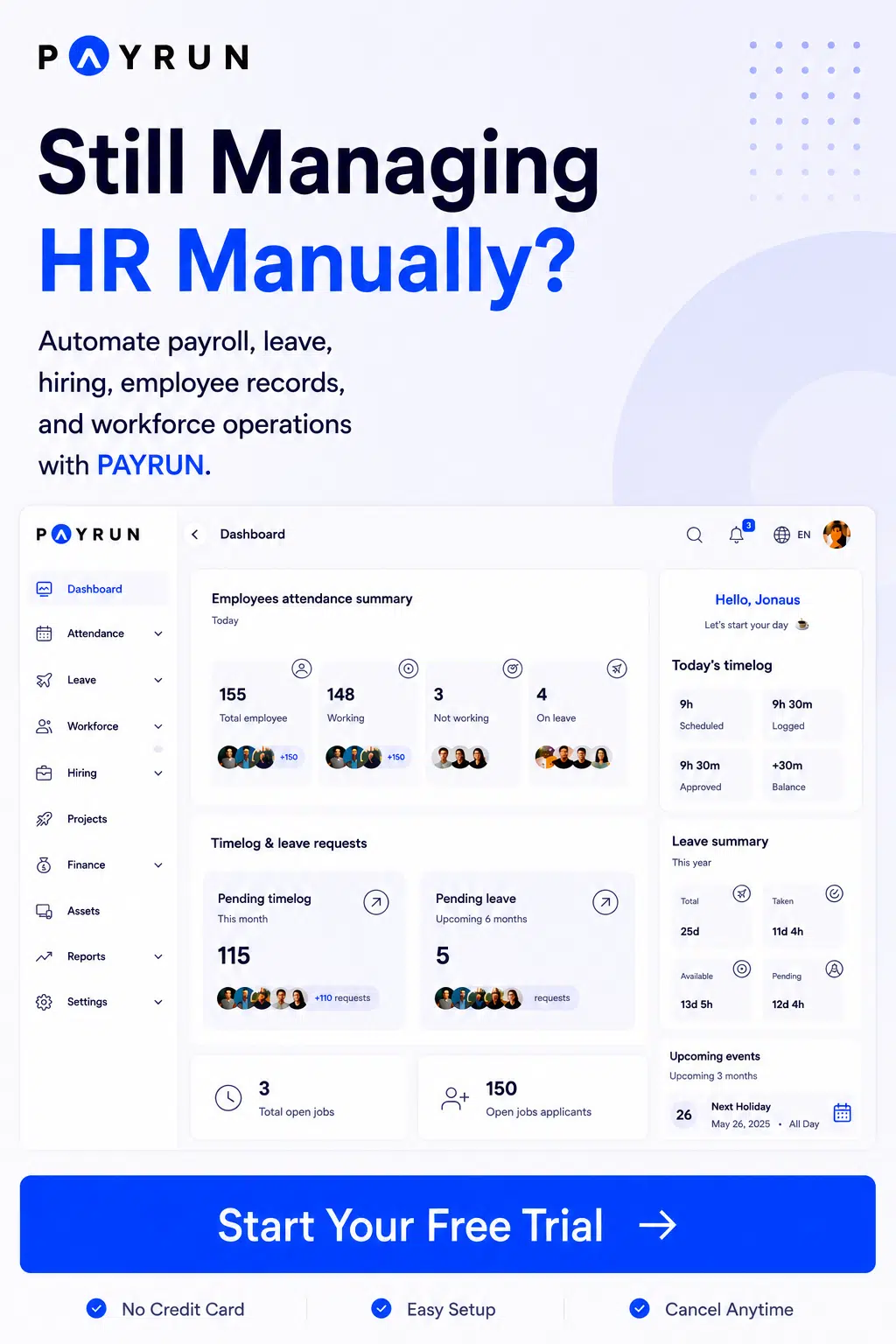
With Payrun, teams can manage payroll, track employee hours through timeline and timesheet features, review leave visibility, organize hiring workflows, and maintain centralized employee records. These inputs help leaders compare current capacity with business demand, monitor labor costs, and see where staffing levels may be misaligned.
Payrun also supports practical workforce planning conversations between HR, finance, and managers. Instead of relying on assumptions, leaders can review payroll data, time records, leave information, and employee profiles to understand where the organization may need professional development, internal mobility, contingent support, or selective hiring.
FAQs
How Often Should We Review Workforce Capacity Plans?
Most organizations should review workforce plans at least quarterly. Fast-changing environments such as ecommerce, startups, and contact centers should review capacity monthly. Major contracts, regulatory changes, market downturns, or sudden demand shifts should trigger an extra review.
How Do We Handle Uncertain Or Highly Volatile Demand?
Use scenario planning and match strategy. Keep a stable core team, then add flexible capacity through cross-training, contingent workers, part-time schedules, or short-term support. In volatile periods, use 30, 60, and 90-day forecasts instead of relying only on annual plans.
What Metrics Show That We Are Over-Hiring Or Under-Hiring?
Low utilization below 65% to 70%, rising labor cost as a percentage of revenue, and growing idle resources may signal over-hiring. Persistent overtime above 10% to 15%, missed deadlines, customer complaints, and rising employee burnout may signal under-hiring.
How Does Capacity Planning Connect To Performance And Engagement?
Balanced workloads help employees complete tasks without constant pressure. Good capacity planning reduces burnout, improves operational efficiency, and gives employees better growth opportunities because managers can see where work, skills, and capacity are misaligned.
Can Smaller Businesses Benefit From Capacity Planning Without Dedicated Analysts?
Yes. Smaller businesses can start with Payrun payroll data, leave records, timesheets, employee profiles, and a spreadsheet. Calculate capacity monthly, compare it with recent workload, identify gaps, and adjust schedules or hiring before small problems become expensive staffing mistakes.