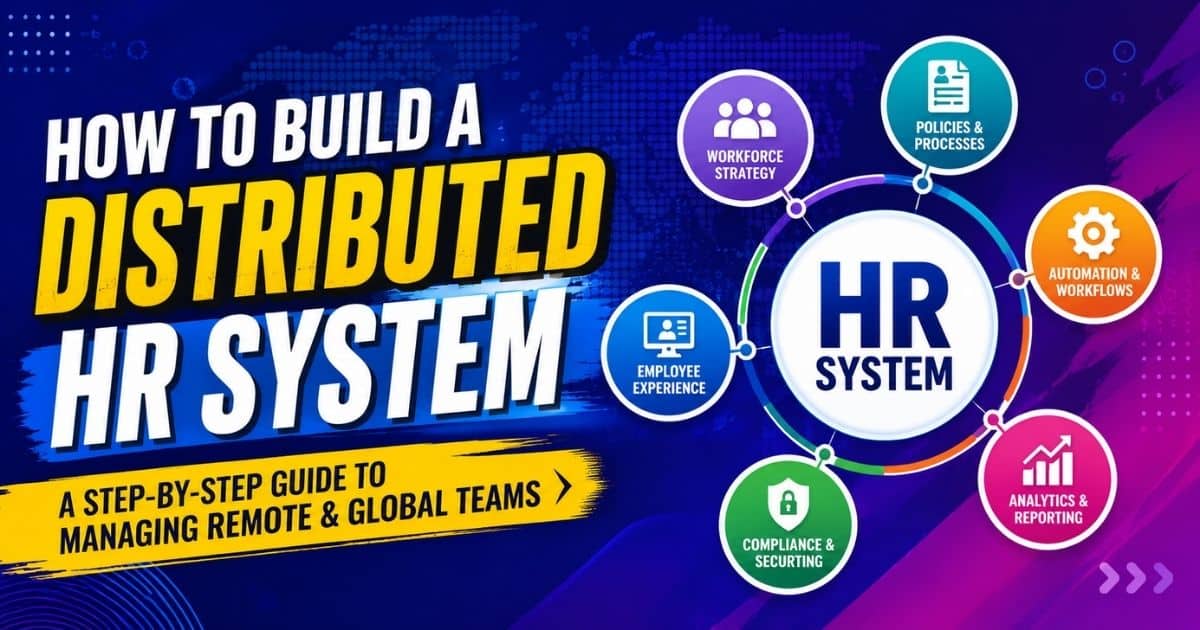
Remote work has changed how organizations manage people, processes, and performance. A distributed HR system helps HR teams support employees across different locations while maintaining consistency, compliance, and productivity. Building an effective system requires more than remote policies. Organizations need the right
distributed HR software, payroll software, communication processes, and workforce management strategies.
A centralized HR platform allows HR professionals to manage employee records, automate workflows, and streamline daily operations from a single location. Cloud HR software also improves accessibility, making it easier for employees and managers to access information whenever needed.
By combining technology, standardized processes, and performance management practices, organizations can create a scalable HR framework that supports remote teams, improves employee experiences, and enables long-term business growth.
What Is A Distributed HR System?
A distributed HR system is a framework that enables organizations to manage employees across multiple locations through centralized processes and technology. Unlike traditional HR models, it relies on cloud-based HR software and cloud HR systems to handle employee data, communication, compliance, and workforce management from a single platform.
HR leaders use scalable HR systems to support remote and hybrid teams while maintaining consistency across the organization. Modern HR tools automate routine tasks such as onboarding, leave management, payroll coordination, and performance tracking, allowing HR teams to operate more efficiently regardless of where employees work.
Why Companies Are Moving Toward Distributed HR Operations
Organizations are adopting distributed HR operations to support global teams, improve workforce flexibility, and manage employees more efficiently. Advances in cloud platforms and automation have made it easier to support remote and distributed teams at scale.
Access To Global Talent
Traditional hiring often limits companies to local candidates. Distributed HR operations allow organizations to recruit talent from different cities, countries, and time zones. This approach gives businesses access to specialized skills while creating more diverse teams. HR leaders can also improve talent management by hiring the best candidates regardless of location.
Support For Hybrid And Remote Workforces
Remote employees now expect flexible work arrangements. Distributed HR systems provide a unified system for managing communication, onboarding, performance reviews, and employee development across multiple locations. Cloud-based platforms help HR teams deliver a consistent experience to both office-based and remote employees while supporting new hires from day one.
Improved Business Scalability
As organizations grow, manual HR processes become difficult to manage. Cloud HR systems automate routine tasks such as payroll processing, leave management, time tracking, and employee record updates. A scalable HR framework allows businesses to expand into new markets without significantly increasing administrative workloads. Integration with existing systems, accounting tools, and financial systems further improves operational efficiency.
Better Compliance And Global Workforce Management
Managing employees across multiple regions creates challenges related to local labor laws, tax compliance, and payroll regulations. Distributed HR operations help organizations centralize compliance management while working with global payroll providers and payroll software. Standardized processes reduce compliance risk and address many modern HR challenges by ensuring critical data is managed consistently across all locations. Robust security measures also help protect sensitive employee information.
Better Employee Experience And Data-Driven Decisions
Modern HR platforms provide employees with self-service access to information, requests, and support resources. This improves employee engagement and reduces delays in everyday HR interactions. At the same time, workforce analytics deliver data-driven insights into performance, retention, productivity, and workforce trends. Organizations can use these insights to make informed decisions, improve employee experiences, and optimize long-term workforce strategies.
Key Features Of A Distributed HR System

A successful distributed HR system combines technology, processes, and communication practices to support employees across multiple locations. The following features help organizations improve efficiency, maintain compliance, and manage distributed workforces effectively.
Centralized Employee Data Management
A distributed HR system should maintain all employee records within a single platform. Centralized data management provides HR teams with easy access to employee information, payroll details, benefits records, and performance history. Having a unified source of information reduces duplicate data, improves accuracy, and helps organizations make data driven decisions. Mobile access further allows managers and employees to retrieve information from anywhere, and mobile employee self-service makes these capabilities accessible on the go.
Digital HR Workflows
Digital workflows replace manual processes that often slow down HR operations, making HR workflow automation a critical component of modern distributed HR systems. Tasks such as onboarding, leave approvals, expense requests, and employee updates can be automated through predefined approval workflows. Automation reduces administrative tasks, minimizes human errors, and allows HR professionals to focus on strategic initiatives rather than routine paperwork. For mid-market organizations, workflow automation can significantly improve operational efficiency without increasing headcount.
Remote Communication Infrastructure
Distributed teams rely heavily on communication tools to stay connected, and effective remote workforce management software plays a key role in enabling that connection. A strong communication infrastructure supports collaboration through messaging platforms, video meetings, knowledge bases, and employee portals. Effective communication systems help maintain transparency, strengthen team dynamics, and ensure employees remain aligned with company goals regardless of location. Consistent communication also helps reduce misunderstandings and improve engagement, especially when supported by an employee self-service portal that keeps information accessible and up to date.
Performance And Goal Management
Managing performance across distributed teams requires structured processes and clear visibility. Modern HR platforms help managers set goals, track progress, conduct performance reviews, and provide continuous feedback. Performance management tools allow leaders to monitor employee development and identify opportunities for improvement. Clear performance tracking ensures employees remain focused on objectives while supporting accountability across the organization.
Compliance And Documentation Processes
Compliance becomes more complex when employees work across different regions and jurisdictions. A distributed HR system helps organizations manage employment contracts, policy acknowledgments, tax documentation, and benefits administration such as health insurance. Centralized documentation processes improve record-keeping, reduce compliance risks, and ensure organizations can meet regulatory requirements. Secure document storage also helps protect sensitive employee information while maintaining audit readiness.
How To Build A Distributed HR System

Building a distributed HR system requires more than adopting remote work policies. Organizations need scalable processes, modern technology, and consistent employee experiences that support teams across locations, time zones, and employment structures.
Step 1: Develop Your Distributed Workforce Strategy
Every successful distributed HR system starts with a clear workforce strategy. Organizations must define where employees will work, how teams will collaborate, and what hiring model best supports business goals. This stage should address global hiring plans, workforce expansion goals, and potential skills gaps that could affect future growth.
A strong strategy also defines expectations around remote work, communication standards, management responsibilities, and employee support. Clear workforce planning helps HR teams create consistent experiences for employees regardless of location while ensuring business objectives remain aligned with workforce needs.
Step 2: Build Your HR Technology Foundation
Technology serves as the backbone of any distributed HR system. Organizations should implement a centralized platform that combines employee records, payroll, benefits administration, document management, and workforce reporting. The selected solution should provide the core functionality needed to support employees throughout their lifecycle.
Integration capabilities are equally important, especially for organizations that want to replace disconnected tools with a unified HR platform. HR systems should connect with collaboration platforms, payroll systems, recruitment software, and productivity tools. A connected technology ecosystem eliminates duplicate data entry, improves visibility, and reduces reliance on outdated systems that often create inefficiencies.
Step 3: Standardize Policies And Core HR Processes
Distributed teams require clear and documented HR processes. Organizations should establish standardized policies for attendance, performance expectations, employee conduct, expense management, and time off requests. Consistency reduces confusion and ensures employees receive equal treatment regardless of location.
Standardized onboarding workflows are particularly important. New employees should follow the same structured process whether they are hired locally or internationally. Clear documentation also helps organizations maintain compliance with evolving labor requirements and operational standards, and is a foundation for any structured HR process improvement initiative.
Step 4: Create A Remote-First Employee Experience
Employee experience plays a critical role in distributed workforce success. Remote employees often face challenges related to communication, visibility, and engagement. Organizations should create systems that help employees feel connected and supported throughout their employment journey.
Effective employee onboarding programs help new hires integrate quickly into company culture. Regular communication, virtual collaboration opportunities, mentorship programs, and professional development initiatives contribute to stronger employee experiences. A remote-first approach ensures processes are designed for distributed employees rather than adapted from office-based environments.
Step 5: Automate And Optimize HR Operations
As organizations grow, manual HR activities become increasingly difficult to manage. Automation helps streamline repetitive tasks such as onboarding workflows, approval requests, employee record updates, and leave management, supporting the broader shift from manual to smart HR. Automated processes reduce administrative workloads while improving accuracy and efficiency.
Automation also allows HR teams to focus on strategic initiatives such as talent development, workforce planning, and employee engagement. Optimized operations create a more scalable HR environment capable of supporting continued business growth.
Step 6: Measure Performance, Compliance, And Engagement
Continuous measurement helps organizations improve their distributed HR systems over time. HR leaders should track employee engagement, retention, productivity, hiring performance, and workforce satisfaction as part of a broader HR digital transformation strategy. Regular performance reviews provide valuable insights into employee progress and organizational effectiveness.
Compliance monitoring is equally important, particularly for companies operating across multiple regions. HR teams must stay aligned with tax regulations, local employment requirements, and data security standards. Measuring key workforce metrics enables leaders to make informed decisions, identify improvement opportunities, and strengthen long-term workforce performance.
Common Challenges When Building A Distributed HR System

Building a distributed HR system creates growth opportunities, but it also introduces operational and management challenges. Organizations must address these issues early to create a solid foundation for long-term success.
Communication Gaps
Communication becomes more difficult when employees work across different locations and time zones. Delayed responses, inconsistent information sharing, and reduced visibility can affect collaboration and productivity. Without clear communication frameworks and tools, remote teams may struggle to stay aligned on priorities, projects, and organizational goals.
Compliance Complexity
Managing employees across multiple countries introduces significant compliance challenges. HR teams must navigate local labor laws, tax regulations, employment classifications, and benefits requirements that vary by region. Failure to meet legal obligations can increase compliance risk and lead to financial penalties. Maintaining accurate documentation and staying updated on regulatory changes requires continuous effort.
Technology Fragmentation
Many organizations rely on multiple platforms for payroll, recruitment, communication, performance management, and workforce administration. When systems fail to integrate effectively, data becomes scattered across different applications. Technology fragmentation creates inefficiencies, increases manual work, and makes it difficult for HR teams to access reliable workforce information. A unified approach helps reduce dependence on disconnected tools and other tools that duplicate functionality.
Employee Isolation
Remote employees can sometimes feel disconnected from their colleagues and the organization. Limited social interaction may affect employee engagement, collaboration, and overall job satisfaction. Organizations often use virtual events, recognition programs, regular check-ins, and pulse surveys to understand employee sentiment and strengthen workplace connections. Addressing isolation is essential for maintaining motivation and supporting high performance across distributed teams.
Maintaining Consistent Culture
Creating a strong company culture becomes more challenging when employees rarely interact in person. New hires may find it difficult to understand company values, expectations, and team dynamics without structured support. Organizations must intentionally reinforce culture through onboarding programs, leadership communication, employee development initiatives, and consistent management practices. A strong culture helps improve retention, supports collaboration, and contributes to better workforce outcomes.
How To Evaluate Distributed HR Management Software
Choosing the right distributed HR management software requires more than comparing feature lists. Organizations should evaluate how well a platform supports remote teams, automates processes, maintains compliance, and scales with future workforce growth.
Assess Remote Workforce Management Capabilities
A distributed HR platform should be designed to support remote employees across different locations and time zones. Look for features that simplify employee onboarding, workforce management, collaboration, and employee record management. The software should provide a consistent experience for both managers and employees regardless of where they work.
Evaluate Employee Self-Service And User Experience
Employee adoption often depends on usability. Employees should be able to access personal information, submit time off requests, update records, review benefits information, and complete HR tasks without relying on HR staff. Mobile access is also important for distributed teams that require flexibility. A simple and intuitive user experience reduces administrative burdens and improves employee satisfaction.
Review Automation And Workflow Features
Strong automation capabilities help organizations eliminate repetitive administrative tasks. Evaluate whether the software supports onboarding workflows, approval processes, document management, leave requests, and employee lifecycle management. Effective automation reduces manual work, improves consistency, and allows HR teams to focus on strategic priorities instead of routine operations.
Check Compliance, Security, And Global Workforce Support
Organizations with distributed workforces often operate across multiple regions and countries. The software should support local labor requirements, tax regulations, and workforce compliance needs. Strong data security controls are equally important for protecting employee information. Look for role-based access controls, audit trails, encryption, and compliance certifications that demonstrate a commitment to security and regulatory compliance.
Analyze Reporting, Analytics, And Integration Capabilities
Modern HR software should provide actionable insights through workforce reporting and analytics. Metrics such as employee turnover, hiring performance, engagement levels, and workforce productivity help leaders make informed decisions. Integration capabilities are also critical. The platform should connect seamlessly with payroll systems, collaboration platforms, accounting software, and other business applications. A well-integrated system creates a centralized source of workforce data and improves overall operational efficiency.
How HR Software Supports Distributed Teams

HR software plays a critical role in helping organizations manage distributed teams efficiently. By centralizing workforce information, automating processes, and improving visibility, modern HR platforms enable organizations to support employees across multiple locations while maintaining consistency and productivity.
Centralized Workforce Management
Distributed teams generate large amounts of employee data, documents, and workforce records. HR software provides a centralized platform where organizations can manage employee profiles, payroll information, benefits, attendance records, and employment documents, with cloud HRMS solutions offering particular advantages for distributed teams. A centralized system reduces data silos and gives HR teams, managers, and employees access to accurate information from a single source. This improves decision-making and helps maintain consistency across the workforce.
Workflow Automation
Many HR activities involve repetitive administrative work. HR software automates tasks such as onboarding, employee record updates, leave approvals, payroll coordination, and policy acknowledgments. Automation reduces manual workloads, improves process consistency, and minimizes human errors. As organizations grow, automated workflows allow HR teams to manage larger workforces without significantly increasing administrative overhead.
Employee Self-Service
Self-service functionality empowers employees to manage routine HR activities independently. Employees can update personal information, submit leave requests, access company policies, review benefits information, and complete HR-related tasks through a centralized portal. Self-service capabilities reduce dependency on HR staff, improve response times, and create a more convenient experience for distributed employees working across different locations and schedules.
Analytics And Reporting
Modern HR software provides valuable workforce insights through reporting and analytics tools. Organizations can track metrics such as employee turnover, hiring performance, workforce productivity, engagement levels, and retention trends. HR leaders can use this information to make data-driven decisions, identify potential workforce challenges, and improve organizational performance. Analytics also help measure the effectiveness of HR initiatives and support long-term workforce planning.
Together, these capabilities help organizations create more efficient HR operations while supporting distributed employees effectively. By combining centralized workforce management, automation, self-service functionality, and workforce analytics, HR software provides the foundation needed to manage remote and distributed teams at scale.
Final Thoughts
Building a distributed HR system is no longer optional for organizations that rely on remote, hybrid, or globally distributed teams. As workforces become more decentralized, HR operations must evolve beyond traditional office-based processes and adopt systems designed for flexibility, scalability, and consistency.
A successful distributed HR system combines clear workforce strategies, standardized processes, modern technology, automation, and strong compliance management. Equally important is creating an employee experience that supports collaboration, engagement, and professional growth regardless of location.
Organizations that invest in the right foundation can reduce administrative complexity, improve workforce visibility, and make better business decisions through data and analytics. By continuously refining processes and adapting to changing workforce needs, companies can build an HR function that not only supports distributed teams effectively but also drives long-term organizational success.
Frequently Asked Questions
What Is The Difference Between Remote HR And Distributed HR?
Remote HR focuses on supporting employees who work outside a traditional office. Distributed HR is broader and includes managing employees, processes, compliance, and operations across multiple locations, regions, or countries. A distributed HR system is designed to support long-term workforce scalability, global hiring, and location-independent operations while maintaining consistency across the organization.
What Tools Are Required For A Distributed HR System?
Most organizations need an HRIS, payroll software, communication platform, performance management tools, document management systems, and employee self-service portals. Additional tools may include workforce analytics, time tracking software, recruitment platforms, and compliance management solutions. The best approach is to build an integrated ecosystem where information flows seamlessly across systems.
How Do You Manage Compliance In A Distributed Workforce?
Compliance management requires organizations to monitor local labor laws, tax obligations, employment regulations, and data privacy requirements across different regions. HR teams often use centralized documentation, automated compliance workflows, and specialized payroll providers to reduce risk. Regular audits and policy reviews also help organizations maintain compliance as regulations evolve.
How Can HR Maintain Company Culture In Remote Teams?
Strong company culture requires intentional effort in distributed environments. Organizations can strengthen culture through structured onboarding, transparent communication, employee recognition programs, leadership visibility, professional development opportunities, and regular feedback initiatives. Virtual team activities and consistent company values also help employees feel connected regardless of location.
What Are The Biggest Challenges Of Distributed HR Management?
Common challenges include communication gaps, compliance complexity, technology fragmentation, employee isolation, and maintaining consistent employee experiences. Managing teams across different time zones and jurisdictions can also create operational difficulties. Organizations that invest in standardized processes, automation, and effective communication systems are better positioned to overcome these challenges and support long-term growth.