How to calculate pro rata holiday for part-time staff (UK)
Table of Contents
A part-time bookkeeper works Tuesday to Thursday. Her manager gives her 16 days' holiday, "because that's three-fifths of 28, rounded down". The rounding takes her below the legal minimum, nobody has thought about bank holidays on days she never works, and she joined in July, so the full-year figure was wrong to begin with.
Pro rata holiday is one multiplication. What catches small employers out is everything around it: hours instead of days, bank holidays, starters and leavers, and the separate rule for staff whose hours change every week.
Quick overview
Pro rata holiday is a part-time worker's share of the 5.6 weeks' paid holiday every UK worker is entitled to. Multiply the days (or hours) they work each week by 5.6, cap it at 28 days, and pro-rate again if they join or leave part way through the leave year. Irregular-hours and part-year workers accrue 12.07% of the hours they work instead. Payrun HR software (payrun.app) sets leave allowances in days and can accrue them monthly.
Rules last checked against GOV.UK and Acas on 23 November 2026.
Key takeaways
- Every UK worker gets 5.6 weeks' paid holiday a year. For part-timers that's days worked a week × 5.6, so 3 days a week is 16.8 days.
- Statutory paid holiday is capped at 28 days, even for someone working 6 days a week.
- Bank holidays can count towards the 5.6 weeks, but a part-timer can't be made to use leave for a bank holiday on a day they don't work.
- Starters and leavers get a share of the year's leave for the part of the leave year they work: one-twelfth for each month under an accrual system.
- For leave years starting on or after 1 April 2024, irregular-hours and part-year workers accrue 12.07% of the hours they work in each pay period.
- From 6 April 2026, employers must keep annual leave and holiday pay records for at least 6 years.
This guide covers what pro rata holiday means, how to calculate it in days and in hours (with lookup tables), how bank holidays work for part-time staff, how to handle starters and leavers, how the 12.07% rule works, and how to set it up in a spreadsheet or in leave software. There's a free printable worksheet you can download, too.

What is pro rata holiday?
Pro rata holiday is holiday worked out in proportion to how much someone works. "Pro rata" means "in proportion". A full-time worker on 5 days a week gets at least 28 days a year; someone working 3 days a week gets the same 5.6 weeks, which comes to 16.8 days.
It applies to anyone who doesn't work a standard full-time week: part-time staff, people on compressed or reduced hours, term-time staff and anyone who joins or leaves part way through the leave year. Part-time workers can't be treated less favourably than full-time workers, so if your full-time staff get more than the legal minimum, your part-timers get a pro-rated share of that extra too (Acas).
Holiday is only part of fair treatment for part-timers. Their pay, overtime and benefits follow the same logic; our guide to payroll for part-time employees covers the pay side, and our annual leave management guide covers planning and approving leave across a team. Holiday also sits inside wider absence management, alongside sickness and family leave.
How do you calculate pro rata holiday in days?
Multiply the number of days someone works each week by 5.6. That gives their statutory minimum in days, capped at 28. If your full-time staff get more than the minimum, divide your full-time allowance by 5 and multiply by the days worked.
Days worked a week | Statutory minimum (days a year) | If full-time staff get 33 days (25 + 8 bank holidays) |
|---|---|---|
1 | 5.6 | 6.6 |
2 | 11.2 | 13.2 |
3 | 16.8 | 19.8 |
4 | 22.4 | 26.4 |
5 | 28 | 33 |
6 | 28 (the statutory cap) | Your policy decides |
Never round a part day down below the statutory minimum. Most employers round up to the nearest half day (16.8 becomes 17) or give the exact figure and let staff take half days. Whatever you choose, record each person's allowance and balance; our guide to employee leave tracking shows how to keep balances accurate through the year.
How do you calculate pro rata holiday in hours?
Multiply the hours someone works each week by 5.6. Use hours when staff work regular weeks but uneven days, for example 8 hours on Monday and 4 on Friday, because a "day" of holiday means something different on each of their working days.
Hours worked a week | Statutory minimum (hours a year) |
|---|---|
7.5 | 42 |
15 | 84 |
20 | 112 |
22.5 | 126 |
30 | 168 |
37.5 | 210 |
When someone books leave, deduct the hours they would have worked that day. A person on 37.5 hours a week has 210 hours of statutory holiday; a day off on a 9-hour shift uses 9 of them. This only works if you know each person's contracted hours, so keep them on the employee record and match them to what they actually track as hours worked. For rota-based teams, see our guide to employee shift management; staff who still log hours on paper can use our free timesheet templates, and our guide to time tracking for small businesses covers the rest.
How do bank holidays work for part-time staff?
Bank holidays don't have to be given as paid leave on top of the 5.6 weeks; employers can include them in it. The rules are the same for full-time and part-time staff, but part-timers need one extra check: a bank holiday might fall on a day they don't work.
The fairest method is to include bank holidays in each person's pro-rated total, then deduct only the bank holidays that fall on their own working days. Acas gives the example of two people who both work 3 days a week and both get 16.8 days including bank holidays:
- Ali works Mondays. If the business closes on bank holidays and, say, 6 fall on Ali's working days, Ali uses 6 days of leave for them and has 10.8 days left to book.
- Jo doesn't work Mondays. Fewer bank holidays land on Jo's working days, and Jo can't be made to use leave for a bank holiday on a day Jo doesn't work. Jo books the rest as normal.
If you'd rather keep it simple, give bank holidays on top of the statutory minimum, pro-rated by days worked. England and Wales usually have 8 bank holidays a year, and Scotland and Northern Ireland have different ones, so check each person's location. Our guide to holiday management software covers how teams track who's off when, and the best leave management software comparison shows which tools import bank holidays.
How do you work out holiday for starters and leavers?
Someone who starts or leaves part way through the leave year gets a share of their annual entitlement for the part of the year they work. In the first year of a job you can use an accrual system: the worker builds up one-twelfth of their leave each month. GOV.UK's example is a 5-day worker on 28 days, who has 7 days after 3 months (28 ÷ 12 × 3).
If someone starts part way through a month, GOV.UK lets them accrue one-twelfth from their first day, rounded up to the nearest half day: 28 ÷ 12 = 2.33, so 2.5 days for that month. Tell new starters their leave year and allowance on day one; it belongs on your employee onboarding checklist.
When someone leaves, work out what they've accrued up to their last day. Pay for untaken statutory leave in the final pay is the only time holiday can be paid instead of taken, and it's owed even after a dismissal for gross misconduct. If they've taken more leave than they've built up, you can't deduct it from the final pay unless they agreed to that in writing beforehand. Add it to your offboarding steps, and record leave owed at month end the same way as a payroll accrual.
Worked example: a starter and a leaver
Both examples use a 3-day week (16.8 days a year) and a leave year running from 1 January to 31 December (sample data).
- Starter on 1 July: 16.8 × 6 ÷ 12 = 8.4 days for the rest of the leave year. Rounded up to the nearest half day, that's 8.5 days.
- Leaver on 30 September who has taken 10 days: accrued 16.8 × 9 ÷ 12 = 12.6 days. 12.6 − 10 = 2.6 days of untaken statutory leave, paid in the final pay.
Download the free pro rata holiday worksheet (PDF). Page 1 has the four formulas with spaces to fill in, plus the days and hours lookup tables. Page 2 has these examples filled in, along with a bank holiday example and a 12.07% hours log.
How does the 12.07% rule work for irregular hours?
For leave years starting on or after 1 April 2024, irregular-hours and part-year workers build up holiday at 12.07% of the hours they actually work in each pay period. Irregular hours means the number of hours in a pay period often or always changes; part-year means there are weeks in the leave year where they don't work and aren't paid.
Round up to the nearest hour when the result has 0.5 of an hour or more. GOV.UK's example: 30 hours worked in a weekly pay period × 12.07% = 3.621, so 4 hours of leave, which can be taken from the next pay period. 12.07% is 5.6 weeks divided by the 46.4 weeks left in the year after the holiday is taken. Regular-hours staff, full-time or part-time, don't use 12.07%: they get 5.6 weeks calculated as above.
Rule | What it says (UK) |
|---|---|
Statutory entitlement | 5.6 weeks' paid holiday a year for almost all workers, including agency, irregular-hours and part-year workers |
Cap | Statutory paid holiday is limited to 28 days |
Bank holidays | Can be included in the 5.6 weeks; no leave can be taken for a bank holiday on a non-working day |
Irregular-hours and part-year accrual | 12.07% of hours worked each pay period, for leave years from 1 April 2024 |
Rolled-up holiday pay | Allowed only for irregular-hours and part-year workers (leave years from 1 April 2024); not for regular-hours staff |
Carry-over | Up to 8 of 28 days, if the contract allows; up to 20 days (regular hours) or 28 days (irregular hours) for leave missed through sickness |
Leaving a job | Untaken statutory leave paid in lieu; no deduction for over-taken leave unless agreed in writing |
Records | From 6 April 2026, keep annual leave and holiday pay records for at least 6 years |
Sources: GOV.UK, holiday entitlement, GOV.UK, calculate leave entitlement, GOV.UK, holiday pay, Acas, holiday entitlement and Acas, bank holidays and Christmas, checked 23 November 2026. You can check individual cases with the GOV.UK holiday entitlement calculator. This is a summary, not legal advice.
Holiday pay has its own rules: a week's holiday pay depends on the hours and pay pattern, which the GOV.UK holiday pay guide explains. If staff work extra hours, see our glossary entry on mandatory overtime, and include holiday records in your next HR compliance audit.
Is a spreadsheet or leave software better for tracking pro rata holiday?
A spreadsheet is fine for a few part-timers on fixed days. Once you have starters during the year, different leave years, bank holidays by location and approvals, the sums multiply and so do the errors.
Need | Spreadsheet | Leave software |
|---|---|---|
Pro rata allowance | Formula per person, easy to break | Set per leave policy |
Starters and leavers | Worked out by hand each time | Monthly earning from the start date, where supported |
Balances | Updated manually after each request | Updated when leave is approved |
Approvals | Email or chat | Request and approve in one place |
Bank holidays | Typed in each year | Imported or added automatically, depending on the tool |
6-year records | Depends on your file keeping | Leave history kept with the employee |
Our comparison of HR software vs spreadsheets covers when to switch, and a simple HR approval workflow keeps leave requests moving either way. The most common errors are in our list of leave management mistakes, and distributed teams have their own issues, covered in leave management for remote teams.
How Payrun handles holiday allowances
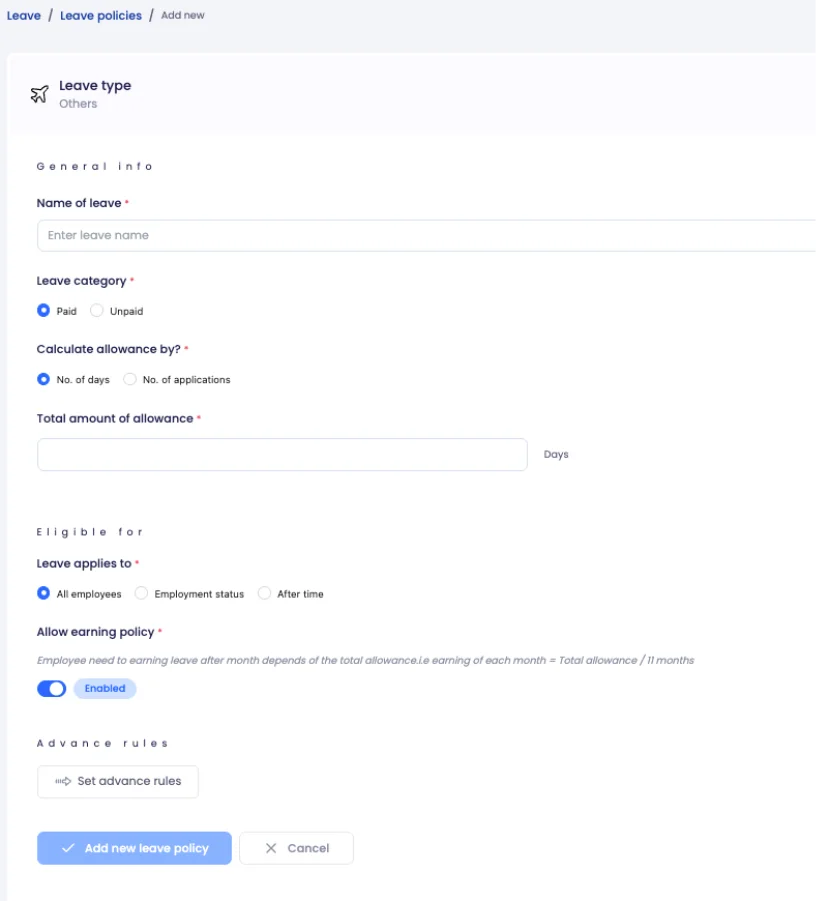
Payrun HR software manages leave through leave policies under Settings, then Timeline and Leave. Each policy has a name, a paid or unpaid category and an allowance, set as a number of days or a number of applications.
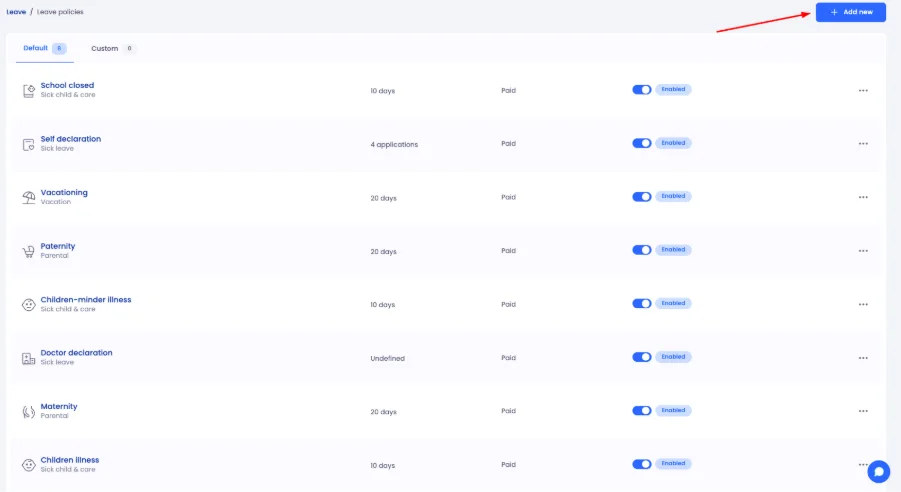
A leave policy can apply to all employees, to an employment status or to staff after a set time in the job. Turning on the earning policy makes staff earn their allowance month by month instead of getting it all at once (Payrun spreads the total allowance over 11 months), which suits new starters. Default leave policies can be edited on every plan; creating your own policy, such as a separate allowance for part-time staff, needs the Ultimate plan.
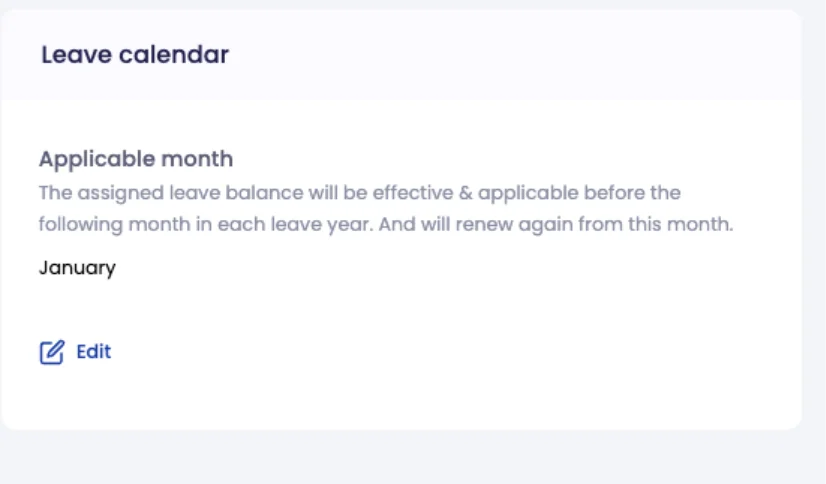
The leave calendar sets the month your leave year starts, which is when balances take effect and renew each year.
Payrun sets allowances in days, so it doesn't calculate the pro rata figure for you. Work it out with the tables above or the worksheet and enter it as the allowance. For hours-based or 12.07% accrual, keep the hours calculation outside Payrun. See the leave management feature page for requests, approvals and balances, and our paternity leave policy guide for family leave, which also builds up holiday while staff are away (maternity leave too).
5 pro rata holiday mistakes small employers make
- Rounding a part-timer's allowance down, which takes them below the 5.6-week minimum.
- Making part-timers use leave for bank holidays that fall on days they don't work.
- Counting holiday in days for staff with uneven shift lengths, so one "day" off costs 4 hours and another costs 9.
- Using 12.07% or rolled-up holiday pay for regular-hours staff. Both are only for irregular-hours and part-year workers.
- Not keeping leave and holiday pay records for 6 years, which has been required since 6 April 2026.
Holiday mistakes don't stay in the leave tracker: underpaid leave and wrong final-pay balances end up as payroll errors.
If you're weighing a looser approach to time off, read the pros and cons of unlimited PTO first; the statutory 5.6 weeks still applies. Write your rules into your employee handbook using our HR policy templates.
How to set up pro rata holiday in 5 steps
- Set one leave year for the business and tell every employee its dates.
- Decide whether bank holidays are inside or on top of the 5.6 weeks, and write it down.
- For each part-timer, choose days or hours, then calculate their allowance with the tables or the worksheet.
- Pro-rate again for anyone who joins or leaves during the leave year.
- Move irregular-hours and part-year staff to 12.07% accrual, and keep every record for 6 years.
Once allowances are set, let staff check their own balance through an employee self-service portal; it cuts the "how many days have I got left?" questions.
If you'd rather keep allowances, requests and balances in one place, Payrun's leave management lets you edit the default leave policies on every plan, including Free for up to 5 users. Creating custom leave policies, for example one for part-time staff, is on the Ultimate plan at $14.95 per user per month billed annually ($24.92 billed monthly). The 14-day free trial covers up to 10 users with no card and no contract, and afterwards the account can switch to the Free plan (up to 5 employees). See all plans on the pricing page.