We know that 80% of businesses in the US now use hr software for small teams. This contributes to a massive $14.8 billion market. This isn't just a trend. Human resource software for small business transforms how you manage employee data and handle payroll processing while streamlining core hr functions.
Manual HR processes eat up your time and slow your growth. The right small business hr software changes that. In this article, we will talk about what hr software for small companies does, which features matter most, and how to choose the best solution for your team's needs.
What Is HR Software For Small Teams?
HR software for small teams is a digital system that helps small businesses manage people, data, and daily HR tasks in one place. Many small business owners rely on HR software platforms to organize employee records, manage employee data, and handle basic HR functions. A modern HR management system often includes time tracking, payroll processing, and benefits administration. Cloud-based HR software also allows employees access through a self service portal and mobile access.
A good HR software solution supports the entire employee lifecycle. HR teams can manage employee onboarding, performance management, and performance reviews without using multiple systems. Many HR platforms also include applicant tracking systems for job postings and talent acquisition.
Human resource software often integrates payroll software, accounting software, and compliance tools. Automated payroll, tax filing, and compliance alerts reduce manual work and improve HR operations for small companies.
Why Your Small Team Needs Human Resource Software
Small teams often handle HR tasks manually. Spreadsheets, emails, and scattered tools slow down HR processes. Human resource software brings structure to daily work. A reliable HR software solution helps small businesses manage employee data, payroll, compliance, and performance management in one place.
Centralized Employee Data Management
Employee data often sits across emails, spreadsheets, and multiple systems in small companies. That creates confusion and errors. HR software for small teams solves that problem. A human resources information system stores employee records, tax forms, workforce data, and benefits enrollment in one secure platform.
A centralized HR management system helps the HR team manage employee data faster. HR platforms also allow employees access through a self service portal. Staff can update personal details or submit time off requests without HR support. Research from Deloitte shows that companies with centralized HR systems reduce administrative HR tasks by nearly 30 percent.
Efficient Payroll And Compliance Support
Payroll processing becomes complex even for small businesses. Manual payroll increases the risk of tax filing errors and compliance issues. Understanding what payroll processing is clarifies each step you need to manage. HR software platforms integrate payroll software, payroll tools, and automated payroll features that help small business owners run payroll accurately.
Many HR software solutions also include compliance tools and compliance alerts. Those features help businesses meet tax regulations and labor laws, and a dedicated payroll compliance guide for small businesses can help teams understand their obligations. According to the IRS, payroll errors affect about 33 percent of employers each year. A cloud based HR software platform reduces that risk with automated calculations and built-in compliance support.
Better Hiring And Talent Acquisition
Hiring becomes difficult without proper HR tools. Job postings, applicant tracking, and candidate communication require structured processes. HR software for small businesses includes applicant tracking systems that organize talent acquisition in one dashboard, and dedicated tools like Payrun's recruitment system can make your hiring process much faster.
HR management software stores candidate profiles, resumes, and interview notes. The HR team can review applicants faster and make better hiring decisions. LinkedIn reports that companies using applicant tracking systems fill positions 20 percent faster than companies that rely on manual hiring processes. A modern HR platform helps small teams compete for top talent.
Stronger Performance Management
Performance management helps small teams grow in a structured way. HR software includes performance management tools that track employee goals, feedback, and performance reviews. Managers gain clear visibility into employee engagement and workforce management.
Performance data also helps businesses analyze workforce data and improve productivity. A recent Gallup study found that companies with structured performance reviews achieve 14 percent higher productivity. HR management software makes performance management easier through dashboards, automated reminders, and employee lifecycle tracking.
Automated HR Operations And Daily Tasks
Daily HR operations involve many repetitive tasks. Time tracking software, benefits administration, employee onboarding, and time off requests require constant attention. HR automation simplifies those processes through one HR software platform.
Employees can submit time off requests, check employee benefits, and access HR data through a mobile access portal. HR teams gain more time for strategic HR work instead of administrative work. Software for small businesses also integrates accounting software and payroll software. Small business HR systems help small teams reduce manual work and manage HR tasks efficiently.
Essential Features In Small Business HR Software
Small businesses need practical HR tools that simplify daily HR tasks. The right HR software for small teams brings payroll, employee data, and HR processes into one platform. Exploring an HR software feature list for small businesses helps you prioritize what matters. Key features help HR teams manage people, improve compliance, and automate routine work.
Employee Data And HR Records
Employee records often become difficult to manage when stored across spreadsheets and emails. HR software platforms solve that problem with a modern employee record management system and centralized employee data storage. A human resources information system keeps HR data, tax forms, job roles, and workforce data in one place.
A modern HR management system also allows employees access through a self service portal. Staff can update contact details, view documents, and check employee benefits. According to PwC, companies that centralize employee data reduce administrative HR work by about 25 percent. Small business HR teams gain faster access to information and better HR operations.
Payroll Processing And Payroll Tools
Payroll processing remains one of the most important HR processes for small companies. HR software often includes payroll software that helps businesses run payroll with automated payroll calculations. Payroll tools also manage tax filing, tax forms, and international payroll.
Cloud based HR software reduces payroll errors and improves accuracy. The American Payroll Association reports that automated payroll systems reduce payroll mistakes by up to 80 percent. A comprehensive payroll software guide helps small teams understand which features matter most. Many HR software solutions also allow businesses to pay international contractors and manage payroll alongside accounting software. Small business owners gain more control over payroll operations.
Time Tracking And Workforce Management
Time tracking helps small businesses monitor attendance, working hours, and employee productivity. HR platforms usually include built-in time tracking tools that allow employees to submit time off requests and track hours worked.
Workforce management features also help HR teams analyze workforce data and plan schedules. Managers can review attendance patterns and approve time off requests through the HR platform, especially when they use dedicated tools to track employee attendance. Research from QuickBooks shows that businesses using digital time tracking tools save about 4 hours per week on administrative work. HR software for small teams brings more visibility into employee activity.
Employee Onboarding And Lifecycle Management
Employee onboarding shapes the early experience of new hires. Employee onboarding software and broader HR software solutions simplify employee onboarding with structured workflows and digital forms. New employees can upload documents, access company policies, and complete onboarding tasks through a self service portal.
A good HR management system also tracks the full employee lifecycle. HR teams manage promotions, benefits enrollment, performance reviews, and role changes in one platform. BambooHR research shows that structured onboarding improves employee retention by 82 percent. Small businesses gain better organization and stronger employee engagement.
Performance Management Tools
Performance management helps organizations track progress and support employee growth. HR management software often includes performance management tools that support goal setting, feedback, and performance reviews.
Managers can monitor employee engagement and evaluate results through dashboards. Workforce data also helps leaders analyze workforce performance and identify improvement areas. Gallup reports that companies with structured performance management processes experience 21 percent higher profitability. HR software platforms make performance management easier for small companies.
Benefits Administration And Enrollment
Benefits administration becomes difficult when HR teams rely on manual tracking. HR software streamlines benefits enrollment and helps employees review available employee benefits through the HR platform.
Employees can select benefits plans, update coverage, and access HR help desk support through the employee self-service portal. HR automation reduces paperwork and manual communication. According to the Society for Human Resource Management, digital benefits administration reduces HR workload by nearly 30 percent. Small businesses gain better control over benefits administration with cloud based HR software.
Compliance Tools And HR Automation
Compliance support remains essential for small businesses. HR software includes compliance tools that track tax regulations, labor policies, and reporting requirements. Compliance alerts notify HR teams about deadlines and required updates.
HR automation also helps manage HR processes such as employee onboarding, payroll processing, and document storage. Software provisioning allows businesses to manage employee access across tools and systems. A reliable HR vendor also updates compliance tools regularly. HR solutions help small companies reduce legal risk while improving HR efficiency.
Top 8 HR Software For Small Businesses In 2026
Choosing the right HR software for small teams starts with understanding what modern HR platforms offer. Small businesses need tools that manage employee data, payroll processing, hiring, and compliance in one system. The following HR software solutions stand out in 2026.
1. Rippling: All-In-One HR And IT Management
Rippling combines HR management software with IT administration in one platform. Companies manage employee onboarding, payroll processing, benefits administration, and device provisioning from the same dashboard. The system connects with more than 500 integrations, which helps businesses reduce multiple systems across departments.
Rippling works well for organizations that want advanced workforce management and automation. Pricing starts at about $8 per employee monthly, but additional modules raise the monthly fee. Growing businesses benefit the most because the system scales well as teams expand.
2. BambooHR: User-Friendly HR Platform
BambooHR focuses on simple and accessible HR tools for small businesses. The platform organizes employee records, onboarding workflows, time off requests, and performance management tools in a clean interface. Many HR teams choose BambooHR because employees access the platform easily through its self-service portal.
More than 34,000 companies use BambooHR worldwide. Businesses report saving hundreds of administrative hours and reducing HR costs by nearly 40 percent. Payroll processing is available as an add-on rather than part of the core HR system.
3. Payrun: Flexible HR Software For Small Teams
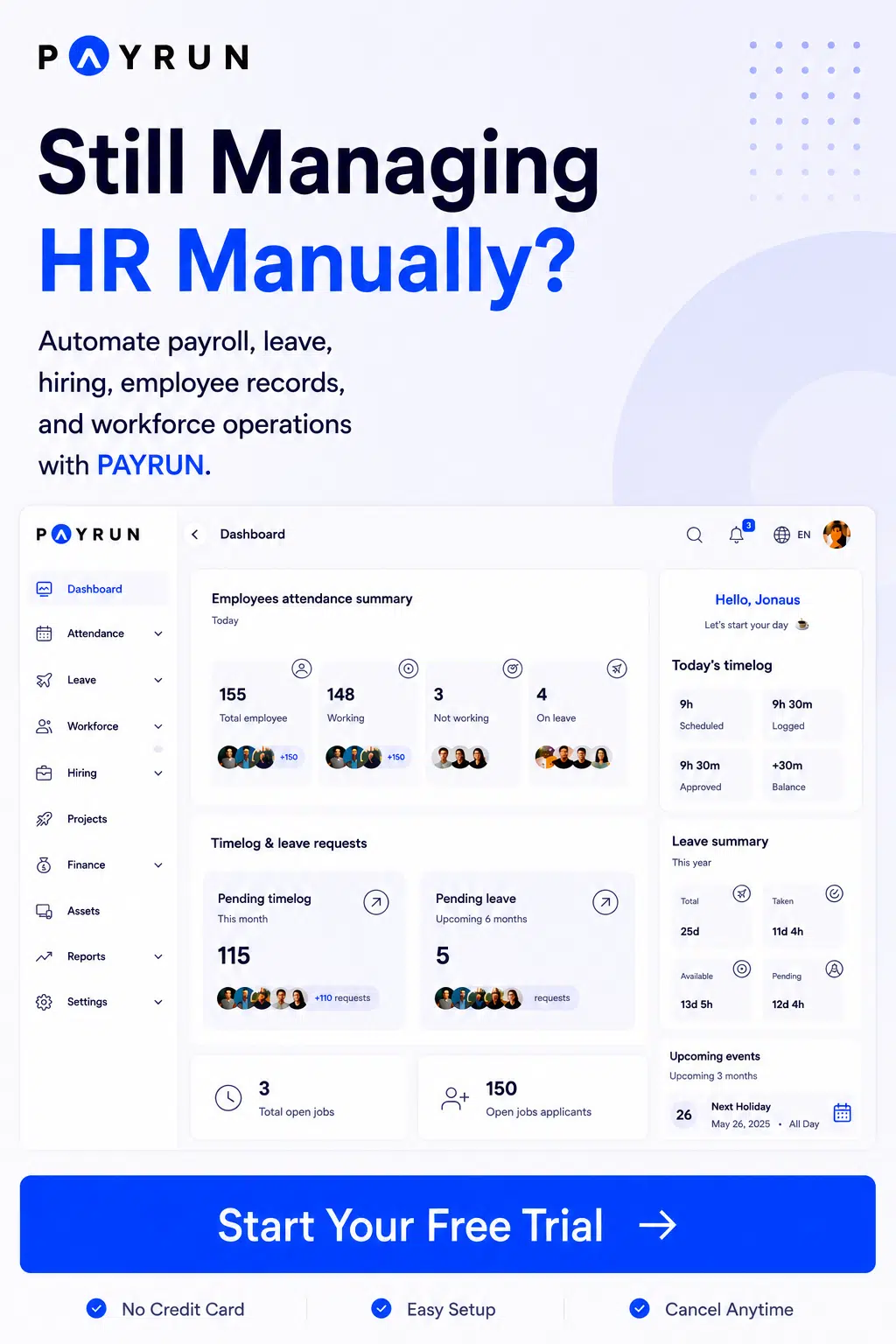
Payrun offers a modern HR software solution designed for startups and growing businesses. The platform centralizes employee records, attendance tracking, leave management, and recruitment tools inside one cloud based HR software system. Small teams manage HR tasks such as job postings, hiring, and employee onboarding without switching between different tools.
The platform also connects HR data with payroll processing and attendance records, which reduces manual updates and improves payroll accuracy. Employees access timesheets, leave requests, and work hours through a mobile-friendly interface. Businesses can also start with a free plan, while paid tiers scale from about $29 per month as teams grow.
4. Gusto: Payroll Focused Solution
Gusto serves more than 400,000 small businesses. The platform specializes in payroll software and tax filing automation. Businesses run payroll in minutes while the system calculates taxes and files with federal and state agencies automatically.
Plans start at $49 per month plus $6 per employee. Gusto also integrates with more than 300 HR software platforms and accounting software tools. Customers report saving around four hours each month on payroll management after switching to the platform.
5. Paychex: Comprehensive HR Suite
Paychex Flex provides a full HR management system designed for small companies with up to 49 employees. The platform includes employee onboarding, applicant tracking, performance management tools, and automated time tracking with geofencing.
Paychex also provides compliance support for regulations such as ACA and COBRA. The system includes a self service portal and 24/7 customer support. Small business owners often rely on Paychex when compliance management becomes a priority.
6. Zoho People: Budget-Friendly HR Platform
Zoho People gives small businesses an affordable HR platform with flexible pricing. Plans begin at about $1.50 per user monthly, which makes it one of the lowest cost HR solutions available.
The system includes employee database management, time tracking, attendance monitoring, and workflow automation. Companies can activate add-on modules for performance reviews and benefits administration. More than 45,000 businesses use Zoho People to manage HR processes.
7. ADP Run: Established Payroll Provider
ADP RUN focuses on payroll processing and tax compliance for small companies. The platform supports automated payroll, tax filing, and reporting with government agencies. ADP currently serves more than 900,000 small business clients worldwide.
Three out of four businesses report finishing payroll in under 15 minutes with ADP RUN. The platform also earned the number one ranking for small business payroll on G2 in 2026.
8. HiBob: Modern HR Platform For Growth
HiBob built its HR management system with employee experience in mind. The platform combines core HR features, performance management tools, and workforce analytics. Managers gain insights into workforce data and employee engagement through advanced reporting tools.
HiBob currently serves more than 4,200 companies and recorded 40 percent growth last year. The platform holds a 4.5 rating on G2 and customers report an average return on investment of 254 percent within nine months.
How To Choose The Right HR Software For Small Companies
Picking the best hr software for your small business feels overwhelming when dozens of hr platforms promise similar features. The decision becomes clearer when you follow a structured approach.
Assess Your Current HR Challenges
Identify what's actually broken first. Are you losing top candidates during hiring? Struggling with consistent employee onboarding experiences? Missing compliance deadlines that could cost you penalties?
Speak with department heads and employees about their experiences to gather suggestions. Review performance data and measure employee engagement to identify gaps an hr management system can fill. Define your business and HR goals with clarity. Focus on improving hiring, retention and productivity through better hr tools if your main goal is increasing revenue.
Assess your workforce needs too. Think about how many users need access and what each group requires the system to do. Managers need different capabilities than employees or admins.
Define Budget And ROI Expectations
Small business hr software costs $5 to $20 per employee monthly. Base fees range from $40 to $100 and one-time implementation costs apply. Factor in all expenses including subscription fees, setup costs, training and time spent by internal staff managing the system.
Calculate the value your hr software solution brings. Multiply hours saved by hourly wages of HR staff. Include avoided payroll errors and compliance penalties using past fees as examples. Organizations using hr automation can save up to 40% on administrative costs.
Review Must-Have Versus Nice-To-Have Features
Create a checklist separating core requirements from extras. Small businesses with one to 1,000 employees use five hr tools on average, and one-third of applications don't get regular use. This wastes money on features you'll never touch.
Prioritize software that increases efficiency through automation and AI capabilities for error detection. It should connect to your accounting software and existing systems while supporting growth with flexible pricing and reliable customer support.
Request Demos And Trial Access
Don't settle for vendor-driven demos. Lay out your most common use cases and put the system through those paces. Make it fit your unique processes so you can tell if it meets your needs.
Trial periods give you practical understanding by letting you explore features and test effectiveness in ground application scenarios like employee data management and performance management.
Think About Implementation Timeline And Support
Most hr systems take 6 to 12 weeks to implement. Ask vendors if they provide free data migration support or dedicated implementation services before finalizing your choice. Review the vendor's onboarding steps and confirm everything fits your budget rather than discovering later you need additional paid support.
Key Benefits Of HR Software For Small Teams
After selecting your hr software for small teams, you'll experience tangible improvements across daily hr operations. These benefits extend beyond simple convenience.
Simplified Processes And Workflow Automation
Automation transforms how you handle hr tasks. HR professionals save an average of seven hours per week by automating administrative tasks such as payroll automation software, time-off tracking, and resume screening. That's nearly a full workday returned to your schedule.
The efficiency gains compound quickly. Businesses can reduce costs related to manual HR operations by a lot, with AI-powered recruitment tools cutting hiring costs by up to 30%. Your hr team stops wrestling with repetitive document processing and starts focusing on strategic initiatives that grow your business.
Improved Compliance And Risk Management
HR compliance software integrates with payroll and HCM solutions to transform disconnected manual workflows into a unified compliance platform. It automates key compliance functions and helps reduce errors while improving risk management.
The system's tools and processes update with regulations, reducing your time spent researching, understanding, and implementing new requirements. This matters because staying compliant becomes nearly impossible as business operations grow in scale and complexity.
Improved Employee Experience Through Self-Service
Employees don't just want easy access to their HR data anymore. They just need it. Self service portal features let workers enter their data once, which then flows to every relevant tool in your system.
This autonomy increases trust, engagement, and retention by connecting talent with instant, accurate access to their information. Meanwhile, employees who update their own information through self-service portals reduce errors caused by manual data entry. The average estimated cost of a single HR data entry task sits at $4.86, so these savings accumulate fast.
Better Data Management And Real-Time Reporting
Real-time data gives you faster insights into your workforce and turns your HCM into a strategic, responsive force. Up-to-date data lets your management team make important decisions faster.
People analytics platforms transform your workplace with better access to insights and easy-to-use reporting, which help you make informed decisions to improve employee engagement, boosted productivity, and reduce employee turnover. Having real-time data on absenteeism, employee performance, turnover, and workload distribution allows managers to address issues as they arise.
HR automation enables analytical decision-making by simplifying the collection, processing, and analysis of vast amounts of workforce data. Automated systems provide real-time access to critical information such as employee performance, engagement levels, and compliance status.
Common Mistakes Small Teams Make When Choosing HR Software
Mistakes in the selection process create expensive problems that haunt you for years. You avoid regret when you understand these pitfalls.
Price-Based Decisions
Entry-level plans look tempting until you realize they lack the features you need. The price climbs fast once you make the tool useful. We've had to assign internal staff to clean and format employee data by hand, which we didn't budget for at first. Implementation costs, data migration, integrations and tiered support add up fast. Organizations that focus on low subscription fees miss the total cost of ownership picture.
Scalability And Growth Needs Get Ignored
Your hr software for small teams must grow with you. Customization can be complex and costly. It often means extensive coding, testing and ongoing maintenance. Heavy customization complicates future upgrades because standard software updates might not be compatible with modified systems. Cloud-based solutions offer inherent scalability without big infrastructure investments. Predicting future needs proves challenging, and systems that seem scalable now might struggle later.
Implementation Complexity Gets Underestimated
Survey respondents believed their implementation exceeded expectations in any facet only 13% of the time. Confusion around implementation is a recipe for disaster, with problems starting before going live. We underestimate the internal time and resources needed. Poor data preparation leads to errors and delays. Teams need to understand vendor implementation plans. These include project management, configuration, testing, integrations and change management support.
Employee Buy-In And Training Fall Short
Resistance stems from fear of the unknown, loss of control, concerns about job security or discomfort with learning new processes. Employees view new hr systems as low-priority or optional without enthusiastic support from leadership. Detailed training programs ensure employees feel equipped to handle transitions. We need to communicate how the system addresses specific pain points and benefits employees.
Vendor Research Stays Insufficient
Customer retention after 12 months is a great way to measure customer service. You don't keep most customers without doing something right. Customer support ranks as the top reason why employers switch vendors. Selection managers should speak with references before signing contracts. The vendor is as important as the software itself.
Best Practices Of HR Software For Small Teams
Small businesses gain the most value from HR software when teams follow the right processes. Clear structure improves HR operations and reduces manual work. A well-planned HR software solution helps small teams manage employee data, payroll processing, and HR tasks efficiently.
Choose The Right HR Platform
Small businesses should start by selecting the right HR platform. Not every HR software solution fits small teams. A good system should include core HR features such as employee records, payroll processing, time tracking, and benefits administration.
Cloud based HR software often works best for small companies. Teams gain mobile access, a self service portal, and simple software provisioning. Resources on how to simplify remote team management with cloud HR tools can be especially helpful if your workforce is distributed. Many HR software platforms also integrate accounting software and payroll software. Small business owners should also evaluate monthly fee, compliance support, and scalability before choosing an HR vendor.
Centralize Employee Data And HR Records
Employee data often sits across emails, spreadsheets, and documents. That creates confusion and slows HR processes. HR software for small teams solves that problem through a centralized human resources information system, allowing you to simplify HR by replacing disconnected tools.
A modern HR management system stores employee records, HR data, workforce data, and tax forms in one platform. HR teams manage employee data faster and avoid duplicate records. Employees also gain direct access to personal information through a self service portal. Centralized HR systems help small businesses improve workforce management and reduce administrative work.
Automate Payroll And HR Tasks
Payroll processing and repetitive HR tasks consume valuable time. HR automation helps small teams handle those processes faster. HR software platforms automate payroll calculations, tax filing, and compliance alerts.
Automated payroll tools also help businesses run payroll accurately each month. HR teams reduce manual errors and avoid compliance issues. Many HR platforms also automate employee onboarding, benefits enrollment, and time off requests. HR automation gives HR teams more time to focus on employee engagement and strategic HR operations.
Use Data For Workforce Insights
Workforce data provides valuable insights for small businesses. HR management software allows teams to analyze workforce data and track employee performance. Managers gain better visibility into employee lifecycle metrics such as retention, productivity, and engagement.
Performance management tools help managers conduct performance reviews and track employee development. HR platforms also generate reports that highlight trends across HR processes. Data-driven HR decisions help small companies improve talent acquisition and workforce planning.
Train Employees And HR Teams
HR software works best when employees and HR teams understand how to use the platform. Proper onboarding and internal training help teams adopt new HR systems quickly.
Employees should learn how to access HR tools, submit time off requests, and update employee records through the self service portal. HR teams should understand features such as compliance tools, payroll processing, and benefits administration. Training improves adoption and helps small businesses gain the full value of their HR software platforms.
Why Payrun Fits For Small Teams That Need HR Software
Payrun offers a practical HR software solution built for small businesses. Many small companies struggle with spreadsheets and scattered HR tools. Payrun's innovative HR features replace multiple systems with one cloud-based HR software platform. Small teams can manage employee data, employee records, and daily HR tasks in one place. The HR management system also supports time tracking, employee onboarding, and workforce management.
The platform also simplifies payroll processing and HR operations. Businesses can run payroll, manage employee benefits, and track attendance through integrated payroll tools. A self-service portal allows employees access to HR data, time off requests, and basic HR functions. Small business owners gain better visibility into workforce data and HR processes. Payrun works as a flexible HR software for small teams that need reliable HR systems without complexity.
FAQs
Can HR Software For Small Teams Work Without A Dedicated HR Department?
Yes. HR software for small teams is designed for small businesses without a full HR team. Small business owners can manage employee data, payroll processing, and basic HR functions through one HR platform. Automation reduces manual HR tasks.
Is Cloud-Based HR Software Secure For Managing Employee Records?
Yes. Most cloud-based HR software platforms use encryption and secure access controls to protect employee records and HR data. Many HR systems also include compliance tools and audit logs to help small companies maintain HR compliance.
Does HR Software For Small Businesses Integrate With Accounting And Payroll Software?
Yes. Many HR software solutions integrate with payroll software and accounting software. That connection allows businesses to run payroll, manage tax filing, and sync workforce data without switching between multiple systems.
How Does HR Software Help Small Businesses Track Employee Performance?
HR management software includes performance management tools that track goals, feedback, and performance reviews. Managers can analyze workforce data and monitor employee engagement through reporting dashboards.
What Factors Should Small Businesses Consider Before Selecting HR Software?
Small companies should evaluate core HR features, payroll tools, compliance support, and pricing structure. A dedicated guide on setting up HR tools for startups can clarify what to implement first. The right HR software platform should also support employee onboarding, time tracking, and workforce management as the business grows.